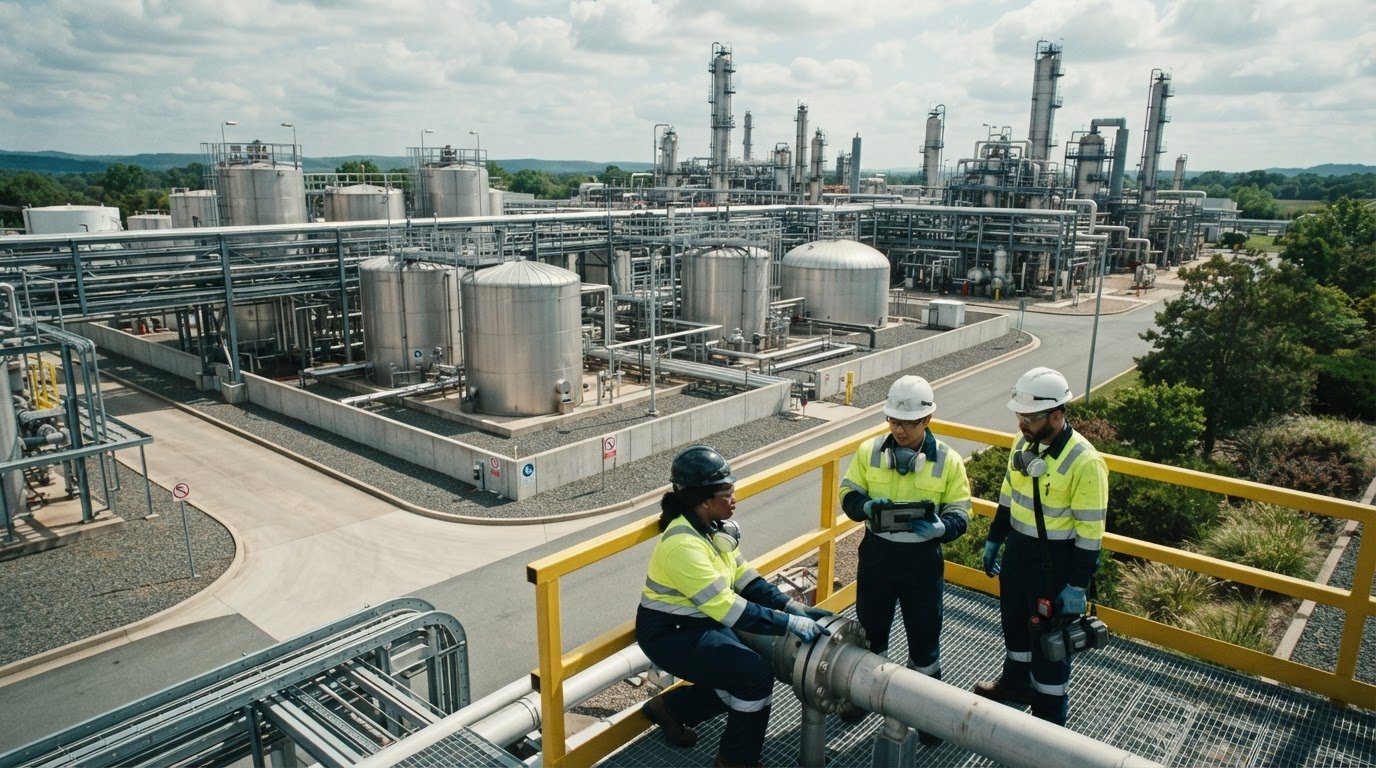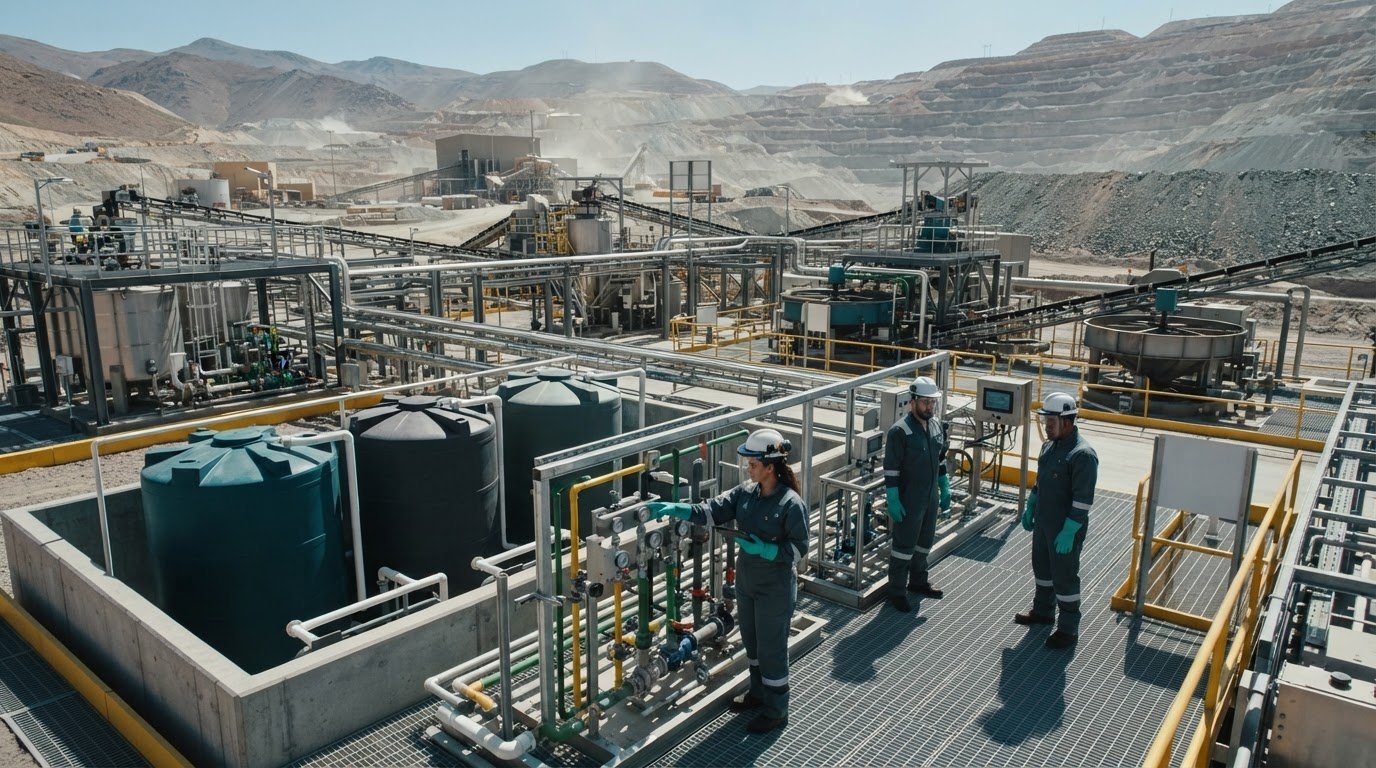

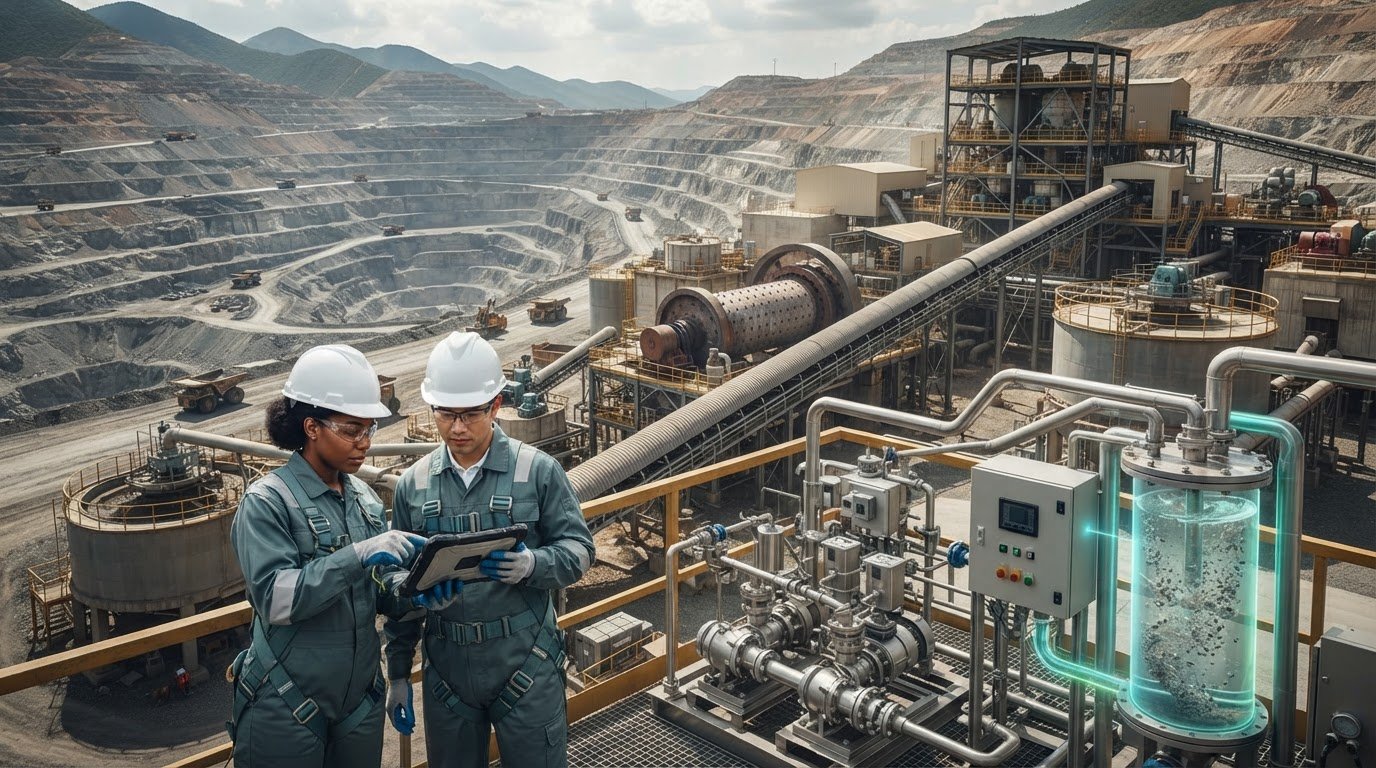
Energy efficiency in mineral processing starts at the mill. When grinding uses a large share of a plant’s power or limits throughput, mechanical adjustments alone may not deliver the performance the circuit needs. Mining Grinding Aids offer another option: chemical optimization that can support efficient breakage and help limit fine particles from agglomerating.
High energy use, mill bottlenecks, and uneven particle size distribution can all affect downstream flotation and final recovery. The challenge is to improve comminution without compromising the liberation and consistency that mineral processing depends on. That calls for a solution matched to the ore and circuit, not a one-size-fits-all approach.
This article explains how grinding aids may help lower energy consumption per ton, increase mill capacity, and support mineral recovery. It covers how these chemicals work, what to consider when choosing a formulation for wet or dry grinding, and why baseline audits and precise dosing matter. JAS Global Industries offers technical consulting and tailor-made formulations to help plants assess optimization opportunities for their specific ore and operating conditions.
Key Takeaways
- Mining Grinding Aids can support more efficient particle breakage by changing how mineral surfaces interact during comminution.
- Match the formulation to dry or wet circuit conditions, including moisture and slurry behavior.
- Establish baseline performance with a technical audit before selecting reagents or adjusting dosage.
- Ore-specific formulations can address distinct processing needs across phosphate, potash, and base metal ores.
- JAS Global Industries combines mining chemical expertise with tailored solutions to support mineral processing optimization.
The Economic Impact of Grinding Efficiency in Modern Mining
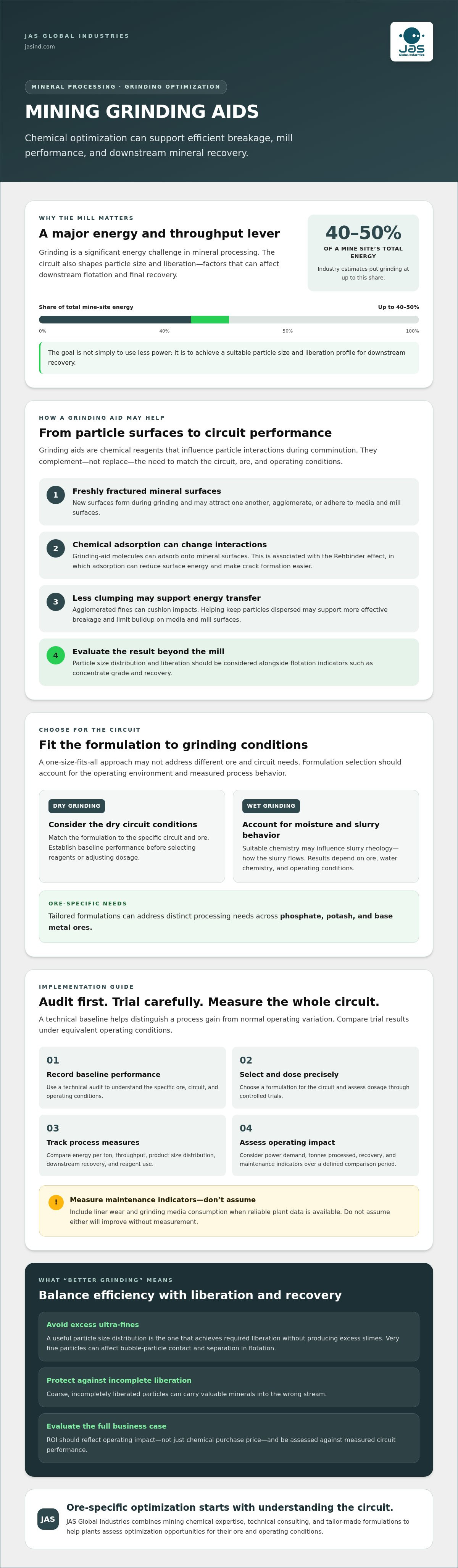
Comminution is a major cost and energy challenge in mineral processing. Industry estimates put grinding at up to 40–50% of a mine site’s total energy consumption. That share makes the grinding circuit a worthwhile optimization target, particularly when energy prices and operating costs put pressure on margins.
Mining Grinding Aids are chemical reagents added to support comminution. By influencing particle interactions during grinding, they can complement equipment and operating adjustments. The objective is not simply to use less power. It is to produce a suitable particle size and liberation profile for downstream recovery.
Comminution: The Mining Industry’s Largest Energy Consumer
Ball mills, SAG mills, and vertical mills use energy through different combinations of grinding media, ore movement, and material breakage. A ball mill, for example, reduces material through the movement and impact of the charge inside a rotating drum. The energy burden varies by circuit and ore, so plant measurements are more useful than assuming a standard split among mill types.
Mechanical improvements remain important, but equipment changes alone may not address particle agglomeration or the energy needed to reach the target grind. Chemical optimization provides another variable to test against measured circuit performance, rather than treating the mill as a purely mechanical system.
Mitigating Rising Operational Costs with Chemical Reagents
Grinding efficiency can be assessed by comparing the mineral liberation achieved with the energy input required. To evaluate the business case for a grinding aid, establish a baseline and compare trial results under equivalent operating conditions. Track energy per ton, throughput, product size distribution, and downstream recovery alongside reagent use. Include liner wear and grinding media consumption when reliable plant data is available. Do not assume either will improve without measurement.
ROI should reflect the full operating impact, not just the chemical purchase price. A useful assessment considers changes in power demand, tonnes processed, recovery, and maintenance indicators over a defined comparison period. Because ore characteristics and circuit conditions vary, technical audits and controlled trials can help distinguish a process gain from normal operating variation. This gives the plant a clearer basis for deciding whether chemical optimization supports lower operating costs while protecting mineral recovery.
The Science Behind Mining Grinding Aids: Mechanics and Performance
Grinding transfers mill energy into fractures that expose valuable mineral surfaces. However, freshly broken particles can attract one another, form agglomerates, or adhere to grinding media. These interactions can waste energy and affect the material sent to flotation. Mining Grinding Aids are formulated to influence particle surface interactions, helping the circuit grind more effectively and produce feed better suited to downstream separation.
Reducing Surface Energy and Preventing Agglomeration
When minerals fracture, new surfaces with high surface energy form. Molecules in a grinding aid can adsorb onto these surfaces and change how particles interact. This is associated with the Rehbinder effect, in which chemical adsorption can reduce surface energy and make crack formation easier. An aid may also limit fine particles from clumping together or building up as a coating on media and mill surfaces.
This matters in practical terms. Agglomerated fines can cushion impacts, absorbing energy that could otherwise contribute to breakage. By helping keep particles dispersed, an aid may support more effective energy transfer. In wet circuits, suitable chemistry can also influence slurry rheology, or how the slurry flows. More consistent flow may help stabilize material movement through the circuit, although the result depends on the ore, water chemistry, and operating conditions.
Impact on Particle Size Distribution and Downstream Flotation
A useful particle size distribution is not necessarily the narrowest one. It is the distribution that achieves the required mineral liberation without producing excess ultra-fines, often called slimes. Too many slimes can complicate flotation: very fine particles may behave differently from target-sized grains and affect bubble-particle contact and separation. Coarse, incompletely liberated particles can also carry valuable minerals into the wrong stream.
Assess grinding aid performance beyond the mill. Compare particle size distribution and liberation with flotation indicators, such as concentrate grade and recovery, under comparable operating conditions. A change that increases fine production without improving liberation may not benefit the overall circuit. More consistent grinding, on the other hand, may give operators better control over flotation feed quality. Evaluate the formulation and dosage against the specific ore and process.
For broader context on how specialty chemistry supports mineral processing and recovery, explore mining solutions. Plants assessing ore-specific options can also review JAS Global Industries’ mining chemical expertise as part of a technical evaluation.
Strategic Application: Dry vs. Wet Grinding Circuits
Grinding chemistry must suit the circuit. Dry grinding aids need to work with limited moisture and help reduce powder cohesion. Wet-circuit formulations must perform in a liquid environment without disrupting slurry flow or downstream separation. Moisture content is a key selection factor because it affects how a reagent disperses and interacts with mineral surfaces. The right option depends on ore properties and plant conditions, not just mill type.
Enhancing Throughput in Dry Ball Mill Operations
In dry grinding, fine particles can stick together or adhere to equipment, contributing to pack set and restricting material flow. This can be a concern with minerals such as feldspar. A suitable aid may improve powder dispersion and flow through the mill. Better-dispersed particles may also help an air separator classify material more consistently. Assess the result using operating data, including throughput, product size distribution, and energy use.
Optimizing Slurry Rheology in Wet Grinding Processes
Wet circuits bring different challenges. High-density slurry can become difficult to move, affecting mill discharge and classification. A compatible grinding aid may help manage particle interactions and slurry rheology, but its effect depends on water chemistry, pH, solids content, and ore mineralogy. Test under representative conditions before selecting a formulation or changing the dose.
Water quality matters because dissolved ions and pH can influence reagent adsorption and particle dispersion. A formulation that performs with one water source may behave differently with another. Wet-circuit trials should therefore track slurry flow and discharge alongside grind size and energy demand.
Compatibility with downstream flotation chemistry also deserves attention. Grinding aids enter a process that may later use collectors and frothers, so evaluate whether the chosen chemistry supports the required flotation response. Do not assume mill gains will carry through unchanged. Understanding broader surfactant chemistry can help frame interactions among reagents and mineral surfaces.
In either circuit, compare results against a baseline under consistent operating conditions. In dry systems, improved flow and dispersion may ease throughput constraints. In wet systems, manageable rheology may support steady discharge and downstream processing. For an overview of related mineral-processing chemistry, see mining solutions. JAS Global Industries develops tailor-made mining chemical solutions, and its mining grinding aid expertise may be relevant when evaluating circuit-specific requirements.
Implementation Guide: Testing, Dosing, and Process Audits
Select a grinding aid for the ore and circuit, rather than treating it as a universal fix. Mineralogy, ore hardness, water chemistry, mill configuration, and target product size all affect performance. A technical audit gives the plant a starting point: document operating conditions, identify bottlenecks, and establish baseline measurements before choosing a reagent.
Track performance across the circuit, not just at the mill. Core indicators include energy per ton, throughput in tonnes per hour, and particle size distribution (PSD). Where possible, include downstream recovery and flotation response. This helps ensure that a finer grind or higher throughput is not mistaken for an improvement if mineral recovery suffers.
Laboratory Testing and Pilot-Scale Evaluation
Laboratory work can help screen options before a plant trial. Compare untreated ore with samples treated using candidate Mining Grinding Aids. Keep test conditions consistent and record the ore’s mineralogical characteristics. Bond Ball Mill Work Index testing may be included in a comparative program, but document the test method and any modifications for chemical addition so the results can be interpreted appropriately.
Use the results to identify formulations worth evaluating at pilot scale or in a controlled plant trial. Laboratory tests can inform a baseline and help assess potential energy effects, but they do not guarantee plant-scale savings. Confirm performance under representative operating conditions and across relevant ore variability.
Precision Dosing Strategies for Maximum Yield
Establish dosing location and rate through testing. Depending on the circuit, trial addition at the feed belt or mill inlet, then compare distribution, mixing, and measured process response. Automated dosing can help maintain a set feed rate. Where real-time instrumentation is available, operating data such as ore hardness can inform adjustments. Verify any control changes against energy, throughput, and PSD trends.
Regular technical audits can check dosing accuracy, review process changes, and help keep reagent application aligned with current ore and circuit conditions.
- Record baseline operating data before dosing begins.
- Change one key variable at a time during trials where practical.
- Review mill and downstream performance before confirming an adjustment.
JAS Global Industries provides tailor-made mining chemical solutions and technical consulting for process optimization. Discuss a mining grinding aid assessment to explore a site-specific approach to testing and dosing.
JAS Global Industries: Advanced Formulations for Global Mineral Security
Reliable mineral processing helps protect the supply of resources that underpin industry and infrastructure. JAS Global Industries supports this work with tailor-made specialty chemicals for mining, including mining grinding aids, flotation collectors, and flocculants. Its approach combines technical consulting and process optimization with formulations developed around the ore and plant operating conditions, rather than a single standard recipe.
This focus is relevant across phosphate, potash, and base metal operations. Ore mineralogy can vary considerably, and factors such as clay content, hardness, and the desired grind can shape reagent requirements. A formulation selected for one ore body may not suit another. Technical evaluation helps identify the processing challenge and assess whether a tailored chemical approach is appropriate.
Tailor-Made Chemical Solutions for Complex Ores
For a high-clay or particularly hard ore, the key question is how its properties affect grinding, particle flow, and downstream recovery. The JAS Global Industries tailor-made formulation capability allows these site-specific conditions to inform solution development. Assess the potential value through baseline measurements and controlled trials, checking results against energy use, throughput, particle size distribution, and recovery.
Final product handling may call for a different chemical function from grinding. For example, anti-caking agents address flow and storage issues in applicable products. They are not interchangeable with grinding aids. Matching each chemical to its process stage helps maintain product quality without confusing separate operational needs.
Plant teams can evaluate a potential partnership by defining trial conditions, agreeing on relevant performance indicators, and documenting results against an established baseline. This makes it easier to assess the value of a chemical solution using site-specific evidence.
Global Reach, Local Process Understanding
Operating since 1998, JAS Global Industries is headquartered in Dubai, with sales and service offices across the Middle East, Africa, Asia, and Europe. Its research and innovation centers support work on specialty chemical solutions, while technical consulting connects formulation choices to processing needs. Teams should confirm the technical and supply arrangements available for their location rather than assume on-site support or a particular delivery model.
Whether mining chemistry supports sustainability objectives depends on its performance in the circuit, its compatibility with other process chemicals, and its contribution to operational goals. By pairing ore-specific formulation with measured process review, mining operators can assess whether a chemical solution supports resource productivity and dependable plant performance.
Make Grinding Performance a Lasting Advantage
Better comminution starts with understanding the ore, the circuit, and the results the plant needs. Mining Grinding Aids can support that effort, but their value depends on careful testing, appropriate dosing, and performance checks beyond the mill. Energy use, throughput, particle size, and downstream recovery all belong in the assessment.
A site-specific approach also helps teams avoid treating different ores and operating conditions as though they were the same. Technical review can turn process data into practical decisions about formulation and application. Ongoing evaluation helps keep those decisions aligned with changing conditions.
JAS Global Industries provides technical consulting for process optimization and tailor-made mining chemical solutions. Its research and innovation capabilities support the development of formulations for specific ore bodies and process goals.
Contact JAS Global Industries to discuss a technical assessment for your mining grinding process.
Frequently Asked Questions
What are mining grinding aids and how do they work?
Mining grinding aids are chemical reagents added to support mineral comminution. They can adsorb onto freshly fractured mineral surfaces, influencing surface energy and particle interactions. This may make breakage more efficient and reduce the tendency of fine particles to clump together or coat grinding media. Their effect depends on ore mineralogy, circuit conditions, and formulation. Plants assess performance by comparing energy use, throughput, particle size, and downstream recovery against a baseline.
How much energy can grinding aids save in a typical mining circuit?
There is no single reliable energy-saving figure for every mining circuit. Results depend on the ore, mill, operating conditions, reagent selection, and how performance is measured. Establish a baseline for energy per ton, then run a controlled trial and compare equivalent operating periods. Check throughput and product size as well as energy use, so a change in power consumption is not mistaken for an overall process improvement.
Do grinding aids affect downstream flotation or leaching processes?
They can influence downstream processing indirectly by changing particle size distribution, mineral liberation, and surface chemistry. Those changes may affect flotation behavior, while leaching performance can also depend on the resulting particle size and exposed mineral surfaces. The direction and scale of any effect are specific to the ore and chemistry. Include relevant recovery or extraction measures in trials, and check compatibility with collectors, frothers, or leaching conditions before adopting a formulation.
Can grinding aids be used in both wet and dry grinding mills?
Yes, grinding aids can be formulated for wet or dry circuits, but the same chemistry should not automatically be assumed suitable for both. In dry grinding, moisture and powder flow are important considerations. In wet grinding, slurry rheology, pH, and water quality can affect performance. Match the formulation to the environment, then test it under representative plant conditions and review mill performance alongside downstream processing indicators.
Are JAS Global grinding aids compatible with different types of grinding media?
Compatibility with a particular grinding medium should be confirmed through technical evaluation rather than assumed. Performance can depend on the aid’s formulation, ore properties, mill conditions, and interactions with the media and other process chemicals. JAS Global Industries provides tailor-made mining chemical solutions and technical consulting. Share the mill setup and operating data with the technical team, then assess candidate formulations through controlled testing before making operational changes.
How do I determine the correct dosage of a grinding aid for my ore type?
Determine dosage through a technical audit and controlled testing, not a universal rule of thumb. Establish baseline energy per ton, throughput, and particle size distribution, then evaluate dosage levels under comparable conditions. Consider ore mineralogy, hardness, moisture, and water chemistry where relevant. Confirm the selected rate in a plant trial, and review flotation or recovery results as well as mill indicators before treating it as an operating set point.
What is the impact of grinding aids on mill liner wear and maintenance?
The effect on liner wear and maintenance is not guaranteed and should be measured at the site. Changes in particle flow, mill operation, or throughput may influence wear patterns, but liner life also depends on factors such as ore abrasiveness, mill conditions, and media. Track maintenance records and liner observations alongside energy and production data during a trial. This helps determine whether any change is linked to the aid or to normal operating variation.
How do grinding aids improve the particle size distribution of the final product?
Grinding aids can help limit particle agglomeration and improve dispersion, which may support more consistent grinding. The goal is not simply to make every particle finer. It is to achieve the size range and liberation needed for the next processing stage while avoiding excess ultra-fines. Compare particle size distribution before and during trials, then check whether the change supports downstream flotation or other recovery objectives for the ore.