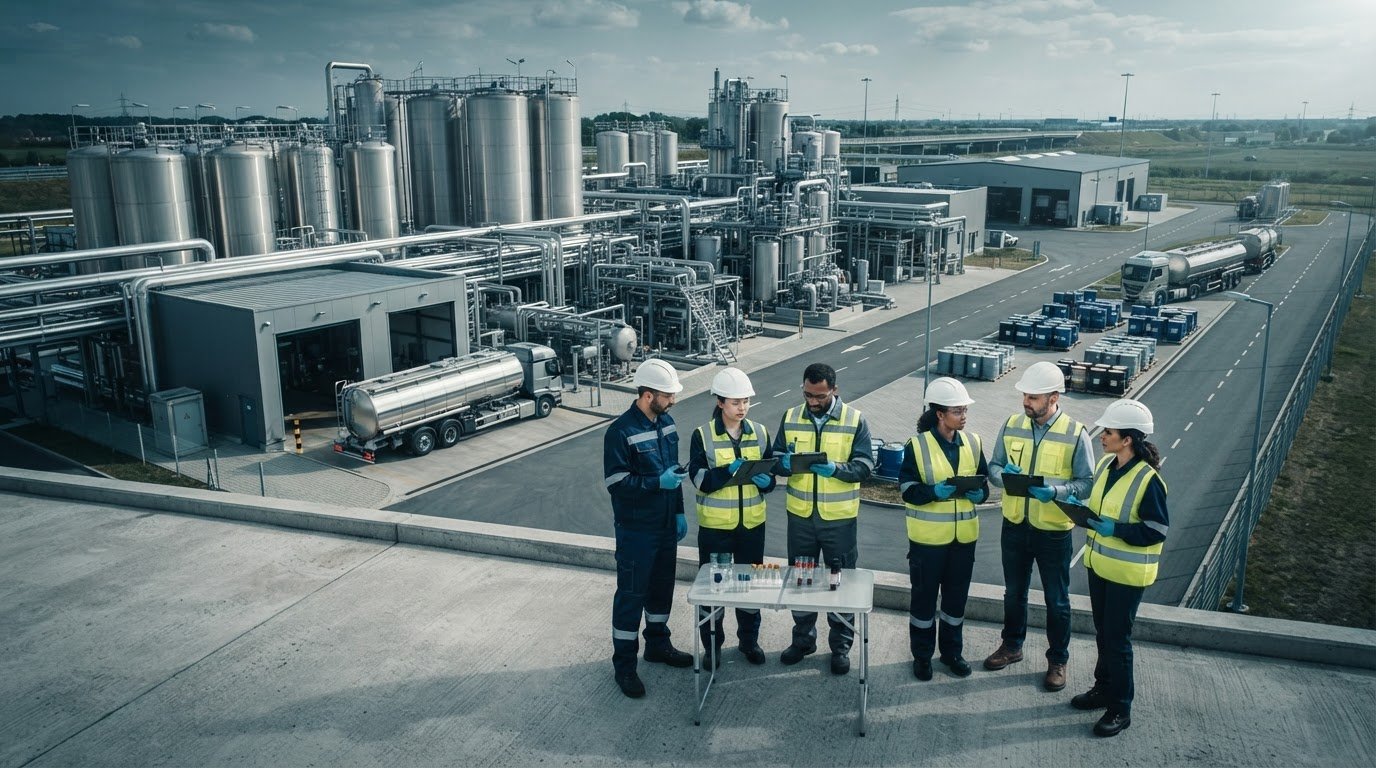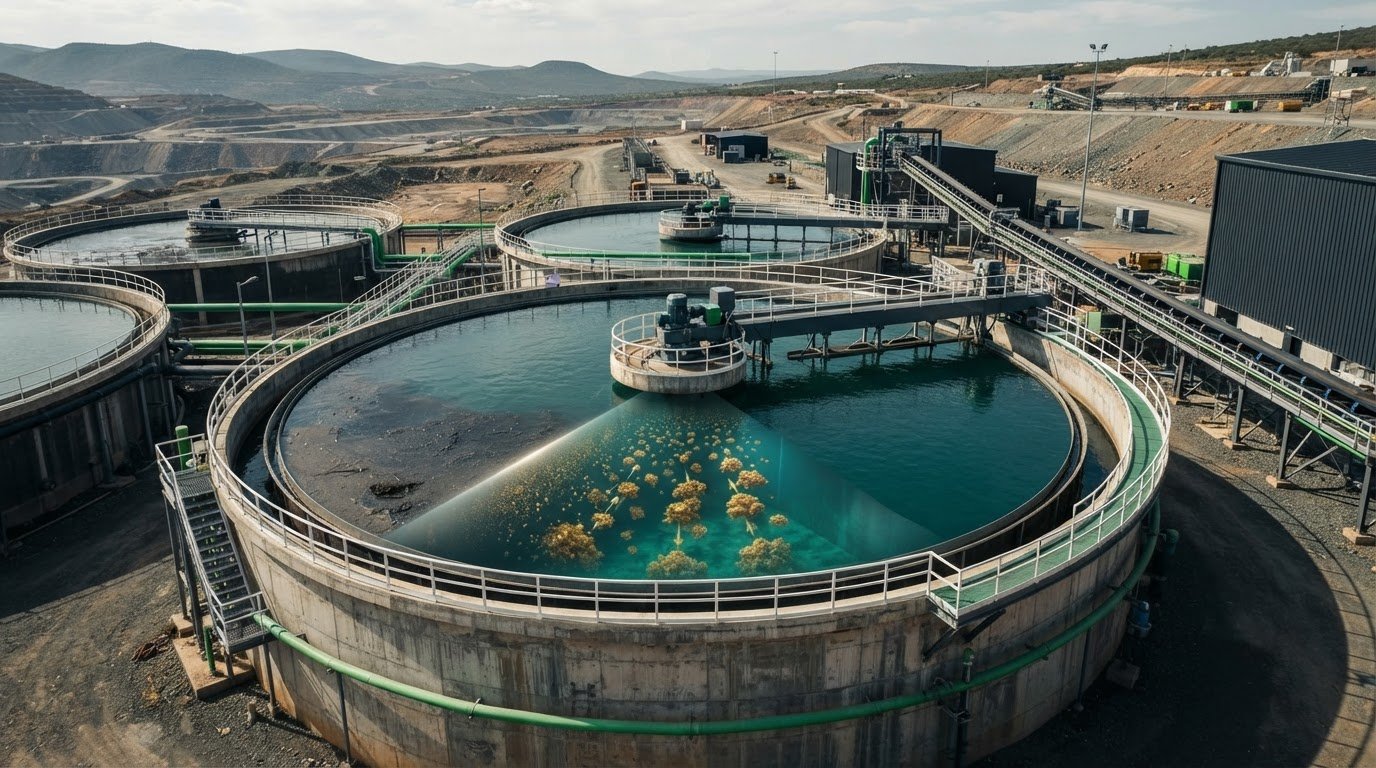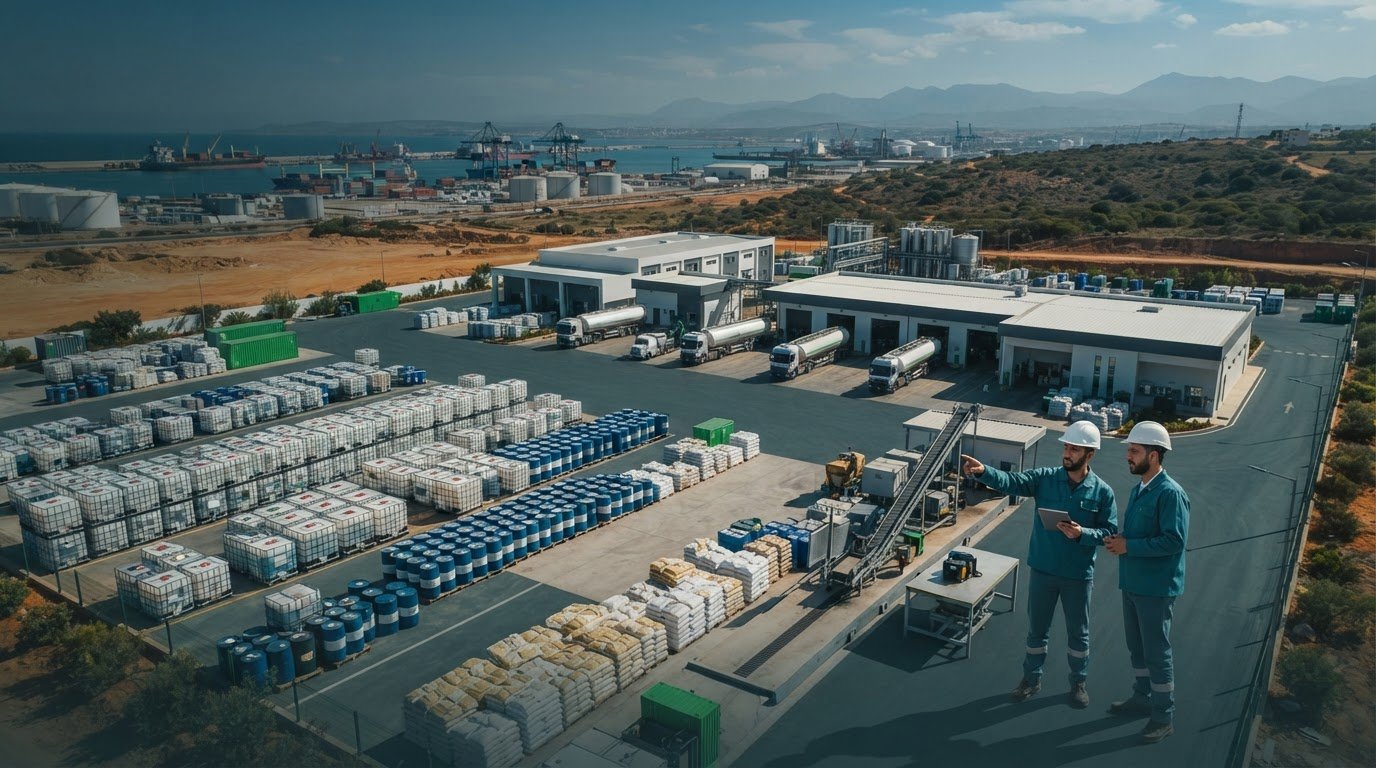



What if the key to your plant's profitability isn't found in higher throughput, but in the precision of a single drop? Many industrial leaders accept chemical overdosing as a necessary evil to maintain product quality or meet environmental standards. You've likely seen the rising operational expenditure from chemical waste and the quiet damage of equipment corrosion. Yet, the pressure to maintain mineral recovery or fertilizer stability never wavers. Effective chemical dosing optimization is the only way to resolve these conflicting demands while protecting your essential infrastructure.
Achieving this level of precision transforms industrial liabilities into strategic assets. By aligning custom-formulated reagents with real-time process data, you can significantly reduce costs while ensuring absolute regulatory compliance and maximizing yield. This is about more than simple logistics. It's about the security and protection of your global resources. We will examine the three pillars of dosing precision: advanced hardware, custom chemistry, and the technical consulting required to protect your industrial infrastructure and ensure long-term stability across the mining, fertilizer, and water treatment sectors.
Key Takeaways
- Learn how precision reagent application mitigates the hidden costs of overdosing, including excessive sludge production and accelerated equipment wear.
- Understand why chemical dosing optimization requires a shift from manual jar testing to real-time, automated feedback loops for consistent process stability.
- Discover the specialized techniques used to maximize mineral recovery in mining and enhance granule integrity in fertilizer production.
- Identify how to navigate fluctuating raw material quality by implementing a practical audit framework that prioritizes efficiency over volume.
- See why custom-engineered formulations provide the ultimate layer of protection for industrial assets compared to generic, off-the-shelf alternatives.
The Strategic Value of Chemical Dosing Optimization in Industrial Processes
Chemical dosing optimization is the precise application of reagents to achieve maximum reaction efficiency. It isn't merely a logistical task; it's a strategic necessity. Optimization represents the critical balance between chemical stoichiometry and mechanical delivery. In most industrial environments, dosing involves the metered introduction of specialty chemicals into a process stream to trigger a specific reaction. When this balance is lost, the industrial and economic fallout is significant. Precision ensures that every milliliter of a reagent performs exactly as intended. Reliability is built on this accuracy.
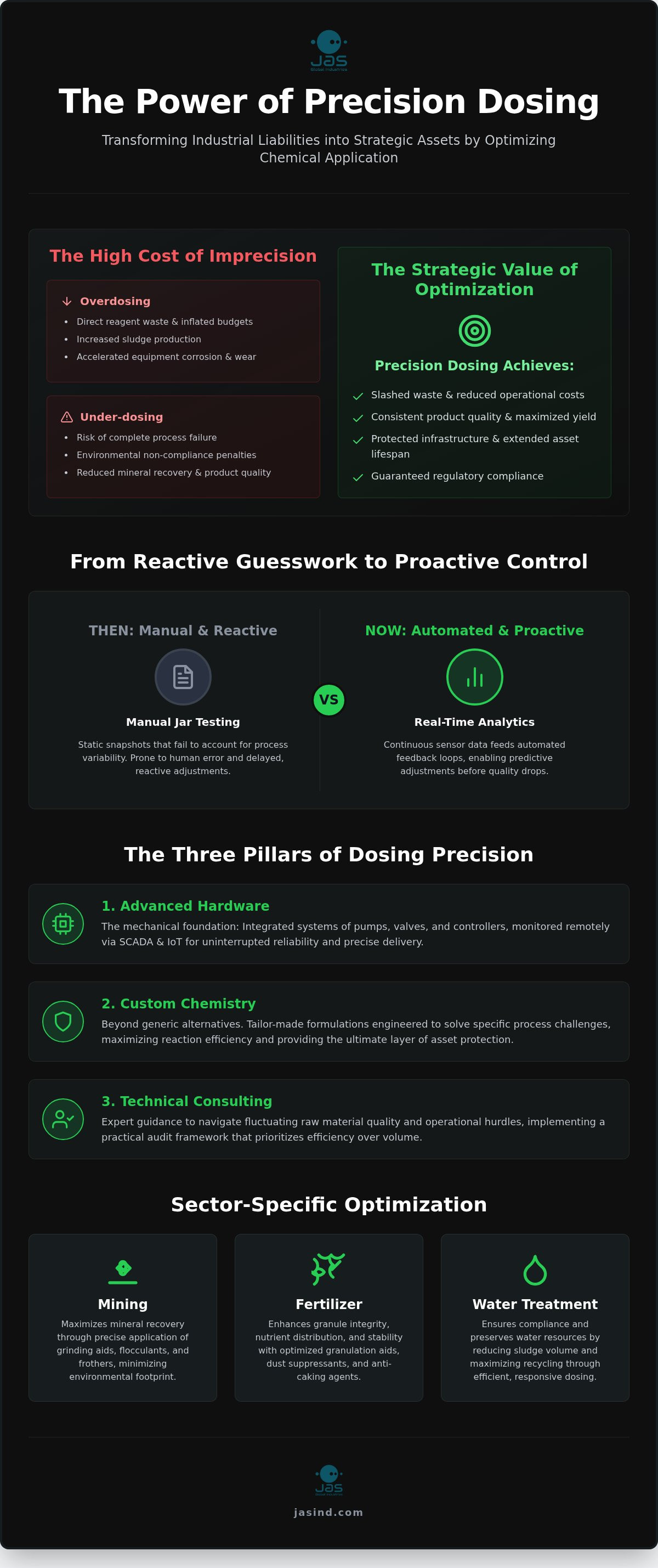
The impact of overdosing is often hidden but destructive. It results in direct reagent waste, which inflates budgets without adding value. It also leads to increased sludge volumes in water treatment and accelerated equipment wear across all sectors. On the other hand, under-dosing presents even greater risks. Process failure, environmental non-compliance, and reduced mineral recovery can halt production entirely. We view chemical dosing optimization as the primary defense against these operational failures.
Economic and Operational Drivers for Optimization
Reducing operational expenditure begins with reagent consumption management. By fine-tuning the delivery of mining grinding aids or fertilizer granulation aids, plants can slash waste. This precision directly improves product consistency. In fertilizer manufacturing, stable dosing leads to uniform nutrient distribution and granule strength. In mining, it ensures predictable recovery rates. Beyond immediate costs, optimization acts as a shield for industrial assets. Effective application of corrosion inhibitors and scale inhibitors prevents the slow degradation of pipes and tanks, while high-performance separation equipment from Sacor Engineering maintains its reliability when paired with correctly optimized chemical inputs. We protect the infrastructure that powers your business. Longer asset lifecycles mean lower capital reinvestment and higher long-term value.
The Role of Global Resource Security
Our commitment extends beyond the factory floor. We position ourselves as a global guardian of resources. Optimized water treatment preserves the world's fresh water supply by maximizing recycling and minimizing discharge. In the agricultural sector, the efficient use of fertilizer dust suppressants and anti-caking agents supports global food security by ensuring nutrients reach the soil effectively. Sustainable mining relies on the responsible application of flocculants and frothers to minimize the environmental footprint of extraction. We view every optimized process as a contribution to global stability. Resource protection is our mission. Industrial reliability is our method.
Mechanisms of Precision: How Modern Dosing Systems Function
Modern industrial environments demand more than estimation. They require absolute control. The shift from manual jar testing to real-time, automated feedback loops marks the evolution of industrial reliability. While jar testing provides a static snapshot, it fails to account for the dynamic nature of raw material inflow. True chemical dosing optimization relies on continuous data to maintain process integrity. This evolution transforms chemical application from a reactive task into a proactive strategy for asset protection.
Integration with SCADA and IoT platforms extends this control to a global scale. Leading automation experts like Ana-Digi Systems help plants implement these sophisticated frameworks to ensure remote monitoring of chemical levels so that protection is never interrupted by an empty tank or a mechanical failure. This connectivity provides a transparent view of reagent consumption. It allows operators to manage resources with categorical precision. When hardware and data align, the result is a stable, resilient industrial process.
From Jar Testing to Real-Time Analytics
Static lab tests belong to a different era. Inflow variability in mining or water treatment can change by the hour. Sensors for pH, turbidity, and conductivity now provide immediate feedback to dosing skids. This allows for predictive dosing. Instead of reacting to a process failure, the system adjusts setpoints before quality drops. We prioritize the security of your output through these automated loops. They eliminate the human error inherent in manual adjustments. This transition ensures that your process remains within strict environmental compliance hurdles without constant manual intervention.
Hardware Synergy: Pumps, Valves, and Controllers
Precision is only as good as the delivery mechanism. Choosing between peristaltic, diaphragm, or solenoid pumps depends on the specific chemical profile. High-viscosity reagents require different torque and pressure management than thin solutions. Pulse-free flow is essential for even chemical dispersion. Without it, you risk localized overdosing and wasted material. Every component must be chosen with a focus on long-term value.
Specific surfactant properties often dictate these hardware choices. These chemicals can interact with pump seals or tubing if material compatibility isn't verified. We focus on the synergy between the reagent and the machine. If your current infrastructure is underperforming, a professional technical audit can identify where hardware mismatches are draining your budget. Flow rate control and pressure management are the final pieces of the puzzle. Dosing skids must maintain consistent pressure to ensure the correct volume reaches the process stream. This mechanical reliability forms the foundation of modern industrial stability.
Sector-Specific Optimization: Mining, Fertilizer, and Water Treatment
Each industrial sector faces unique chemical challenges. A generic approach to reagent application fails to account for the specific mineralogy of an ore body or the humidity of a fertilizer warehouse. Precision chemical dosing optimization requires deep technical expertise tailored to the operational environment. By aligning chemical delivery with the specific needs of the process, industries protect their assets and ensure the stability of global resources. We provide the technical consulting necessary to bridge the gap between chemical potential and industrial reality.
Maximizing Yield in Mining Operations
Mining operations demand yield. Achieving this requires the optimization of frothers and collectors to match specific ore grades. When these reagents are applied with precision, mineral recovery increases while waste decreases. You can find more detail on these processes in our guide to mining solutions. Beyond flotation, the role of flocculants in tailings management is critical for water recycling and environmental protection. High-precision dosing of grinding aids also reduces energy consumption. This lowers costs and supports sustainable extraction practices.
Ensuring Flowability in Fertilizer Production
Fertilizer plants require flowability. The maritime transport of bulk fertilizers exposes granules to varying temperatures and moisture levels. Dosing anti-caking agents is the primary method for maintaining product quality during these long journeys. Precision is equally vital for applying dust suppressants to ensure worker safety and environmental compliance. We also focus on the following areas:
- Managing granulation aids to increase plant throughput and granule strength.
- Precision application of coloring agents for consistent brand identification.
- Optimizing defoamers to prevent process interruptions during phosphoric acid production.
Advanced Dosing for Industrial Water Treatment
Water facilities ensure purity. In high-efficiency reverse osmosis (RO) systems, antiscalant dosing strategies are the only way to prevent membrane fouling and maintain high recovery rates. Thermal desalination requires similar precision to manage scale in extreme environments. We protect these vital infrastructure assets through the careful application of biocides and corrosion inhibitors in cooling towers. When raw water turbidity fluctuates, optimizing the coagulant dose becomes a matter of security. Reliable water treatment preserves fresh water resources for the communities that depend on them. Every drop counts. Every dose matters.
Overcoming Common Dosing Challenges: A Practical Audit Framework
Industrial processes are rarely static. The primary challenge in maintaining stability is the constant fluctuation of raw material and feedwater quality. Whether it's a shift in ore grade or a change in raw water turbidity, these variables disrupt chemical balance. Many operators fall into the trap of believing that more chemical equals better results. This misconception leads to reagent waste and operational instability. True chemical dosing optimization requires a move away from volume-based thinking toward a precision-led methodology.
Operational hurdles like air binding and chemical crystallization often stem from poor system design or improper product selection. Air binding stops delivery entirely. Crystallization blocks lines and damages pumps. These issues aren't just maintenance nuisances; they're threats to your process security. Resolving them requires a structured approach that examines the interaction between the reagent and the hardware. Reliability is the result of this technical rigor.
The Technical Audit Process
A professional technical audit provides the roadmap for recovery. It moves from broad observations to specific technical corrections. We follow a rigorous three-step framework to restore efficiency and protect your assets:
- Step 1: Baseline Measurement. We quantify current reagent consumption against actual yield. This identifies the efficiency gap and sets a benchmark for improvement.
- Step 2: Analysis of Properties. We evaluate the chemical-physical properties of the reagents. This ensures compatibility with the process stream and the delivery hardware.
- Step 3: Hardware Calibration. We verify the accuracy of sensors and pumps. Even the best chemicals fail if the delivery system is miscalibrated.
Mitigating Operational Risks
Protection of industrial assets involves more than just the dosing point. Scale buildup in delivery lines can slowly choke a system, leading to unexpected downtime. Regular maintenance protocols must be integrated into the daily workflow. We also prioritize safety in storage environments. Managing h2s treatment and odor risks is essential for protecting personnel and local communities. Finally, training operators on precision dosing protocols ensures that the benefits of an audit are sustained long-term. If you're ready to identify the hidden inefficiencies in your plant, our team is available for a comprehensive technical audit and process optimization review. We provide the expertise needed to transform your chemical application into a pillar of stability.
Tailor-Made Formulations: The Final Frontier of Process Reliability
Precision hardware and real-time data provide the infrastructure for success. However, the chemistry itself remains the most critical variable. Off-the-shelf reagents often limit the potential of even the most advanced dosing skids. These generic solutions are designed for averages; they don't account for the specific mineralogy of your ore or the unique ion profile of your process water. True chemical dosing optimization is only realized when the reagent is engineered to match the environment. We move beyond simple supply. We provide the technical consulting and R&I expertise needed to protect your industrial assets through custom chemistry.
A partnership with a specialty chemical provider is a long-term strategic asset. It ensures that your process isn't just running, but is resilient against fluctuations. Our global R&I centers focus on developing high-performance reagents to solve specific site challenges. This scientific rigor creates a foundation of trust. It transforms a transactional vendor relationship into a vital global guardianship of your resources. Reliability is the result of this deep technical integration.
The Science of Custom Formulation
Molecular precision changes outcomes. For example, the molecular weight and charge density of mining flocculants must be tuned to specific tailings profiles to ensure rapid settling and clear overflow. A slight mismatch leads to reagent waste and poor water recovery. In water treatment, developing site-specific antiscalants for complex brackish water RO prevents membrane scaling that generic products miss. For the fertilizer sector, tailor-made granulation aids directly impact granule hardness and storage stability. These aren't minor adjustments. They're fundamental engineering corrections that drive yield and stability.
Sustainability and Future-Proofing
The future of industry is inseparable from environmental responsibility. We reduce the environmental footprint of your operations through biodegradable chemical options and high-efficiency formulations. Optimized dosing is a direct contributor to corporate ESG goals. It minimizes waste, protects local ecosystems, and preserves fresh water. By securing the future of industrial infrastructure through advanced chemical technology, we ensure that your operations remain viable in an increasingly regulated world. Reliability is built on foresight. Sustainability is built on science. We protect the resources that power the world.
Securing Your Industrial Future Through Precision
Industrial reliability is no longer just about maintaining throughput. It's about the intelligent protection of your assets and the responsible management of global resources. Through comprehensive chemical dosing optimization, your facility can move beyond the inefficiencies of overdosing and the risks of non-compliance. We've explored how the synergy of automated hardware and custom-engineered chemistry provides the only viable path to long-term stability in the mining, fertilizer, and water treatment sectors.
Since 1998, we've acted as a global guardian for critical infrastructure. Our global R&I centers and expert technical consulting ensure that your chemical application is a strategic asset rather than an operational burden. It's time to transform your process into a model of efficiency and sustainability. Take the first step toward total process reliability today. Request a Technical Audit for Your Dosing System and partner with a leader dedicated to your long-term success. Your infrastructure deserves the security of precision.
Frequently Asked Questions
What are the primary benefits of chemical dosing optimization?
Precision in reagent application reduces operational costs and ensures environmental compliance. It prevents the financial waste of overdosing while protecting critical infrastructure from corrosion and scale. By achieving the correct chemical balance, plants maximize product yield in mining and improve granule stability in fertilizer production. Effective chemical dosing optimization transforms chemical delivery into a pillar of process reliability and global resource security.
How does automated dosing compare to manual jar testing?
Automated dosing provides real-time adjustments based on continuous sensor feedback, whereas manual jar testing offers only a static snapshot of process conditions. In dynamic environments like water treatment or mining, raw material quality fluctuates hourly. Automated systems react instantly to these changes. This eliminates the human error and lag time inherent in manual methods, ensuring consistent protection for your industrial assets and higher operational efficiency.
Can chemical dosing optimization reduce my energy consumption?
Optimization of specific reagents like mining grinding aids directly lowers the energy required for comminution. By improving the efficiency of the grinding process, plants reduce the electrical load on large-scale mills. Similarly, preventing scale in heat exchangers through precise antiscalant dosing maintains optimal thermal transfer. This reduces the fuel or electricity needed to maintain process temperatures, supporting both profitability and corporate sustainability goals.
What sensors are most critical for real-time dosing control?
The most critical sensors depend on the specific application but typically include the following:
- pH and ORP sensors for chemical reaction control.
- Turbidity and suspended solids meters for water treatment and tailings.
- Conductivity sensors to monitor dissolved solids and scaling risk.
- Flow meters to ensure precise volumetric delivery of reagents.
These tools provide the data necessary for a responsive, automated feedback loop.
How often should a chemical dosing system be audited?
A comprehensive technical audit should be conducted at least annually, or whenever there is a significant change in raw material quality. Regular reviews identify mechanical wear in pumps and drift in sensor accuracy before they cause process failure. Periodic audits also allow for the integration of new chemical technologies or tailor-made formulations. This proactive maintenance schedule secures the long-term value of your industrial infrastructure and prevents costly chemical waste.
Is it possible to optimize dosing for multiple chemicals in a single process?
Modern SCADA systems manage complex multi-reagent environments by coordinating the interaction between different chemicals. For example, in mining flotation, the system must balance collectors, frothers, and depressants simultaneously. Optimization ensures that one chemical doesn't counteract another. This holistic approach prevents reagent interference and maximizes overall process efficiency. It requires a deep understanding of both chemical stoichiometry and mechanical delivery hardware.
What role does chemical viscosity play in dosing accuracy?
Viscosity dictates the selection of delivery hardware and the precision of flow rate control. High-viscosity reagents, such as certain flocculants or anti-caking agents, require specialized pumps to maintain consistent pressure. If the pump isn't matched to the chemical's thickness, dosing becomes irregular. This leads to localized overdosing or system blockages. Accuracy depends on the synergy between the physical properties of the reagent and the mechanical capabilities of the dosing skid.
How do custom formulations improve dosing efficiency?
Custom formulations are engineered to match the specific mineralogy or water chemistry of a particular site. Off-the-shelf chemicals often contain unnecessary components or incorrect concentrations for complex industrial profiles. By using a tailor-made reagent, you ensure that every molecule contributes to the desired reaction. This level of chemical dosing optimization reduces the total volume of chemicals required and provides a higher level of protection for your industrial assets.