

Can a microscopic failure in the green state compromise the integrity of an entire industrial supply chain? For manufacturers handling unfired components, high breakage rates and carbon residue are more than just technical hiccups. They're expensive threats to operational stability. You likely agree that achieving the perfect balance between mechanical strength and thermal efficiency feels like a constant battle. Selecting high-performance Ceramic Binders is no longer a simple procurement task. It's a strategic decision that protects your process and secures your output.
Discover how advanced formulations enhance structural integrity and process reliability across modern manufacturing. We'll show you how to optimize burnout cycles and resolve common incompatibilities between binders and deflocculants. This guide covers the shift toward sustainable solutions and the latest ASTM standards, such as the August 2026 guide for 3D printed ceramics, that are shaping the future of the industry. You'll gain the technical insights needed to increase mechanical strength and secure higher plant yields through specialized chemical precision.
Key Takeaways
- Master the principles of green strength to reduce breakage during the handling and machining of unfired ceramic components.
- Evaluate the performance trade-offs between natural and synthetic polymers to find the ideal chemical origin for your specific industrial application.
- Optimize your sintering efficiency by selecting Ceramic Binders that ensure complete burnout and minimal residual carbon.
- Balance slurry viscosity and mechanical stability through a deeper understanding of the synergy between binders and deflocculants.
- Leverage custom formulations and global technical consulting to secure higher plant yields and long-term process reliability.
What are Ceramic Binders and Why are They Critical for Green Strength?
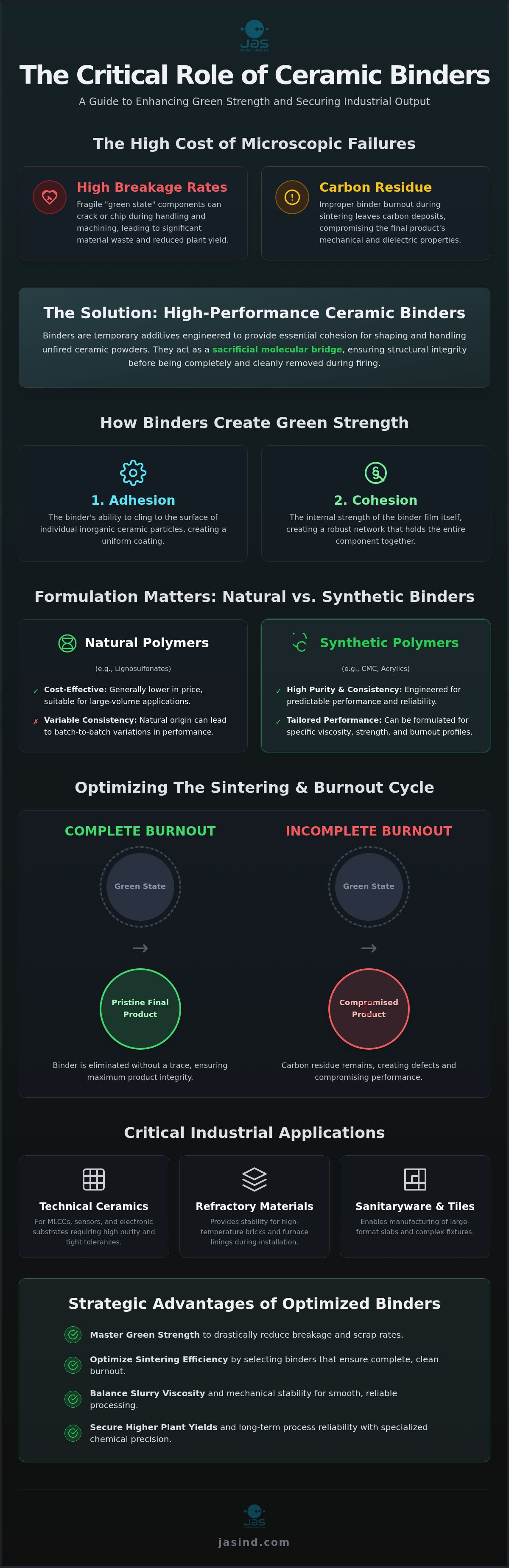
Industrial ceramics begin as fragile powders. Without a unifying force, these particles cannot withstand the rigors of modern manufacturing. Ceramic Binders serve as this essential bridge. They're temporary additives engineered to provide the necessary cohesion for shaping and handling before the final firing. To understand the broader context of What are Binders?, one must look at their role as sacrificial agents. They exist to serve a purpose during the "green" state, only to be completely removed during the sintering process. This temporary nature is critical. If a binder leaves behind carbon residue, it compromises the final product's dielectric properties or mechanical durability. Precision in formulation ensures that the binder performs its duty and then exits the system without a trace.
Reliability in the pre-fired state is the foundation of industrial throughput. Manufacturers face constant pressure to reduce scrap rates and prevent pre-kiln defects. When a component fails in the green state, it represents lost energy, wasted raw materials, and diminished plant yield. High-performance Ceramic Binders safeguard these investments. They provide the structural security needed to move components through automated production lines, ensuring that every piece reaches the kiln in pristine condition. By preventing edge chipping and internal laminations, these chemicals act as the first line of defense in quality control.
The Mechanical Function of Binders in Ceramics
Binders operate through two primary mechanisms: adhesion and cohesion. Adhesion allows the binder to cling to the surface of inorganic particles, while cohesion provides the internal strength of the binder film itself. This dual action creates a robust network that enhances plasticity. For complex shapes, such as automotive honeycomb filters or intricate electronic substrates, this formability is non-negotiable. It allows for tighter tolerances and more ambitious designs without risking structural failure during the drying phase. Green strength is the mechanical integrity of an unfired ceramic body.
Common Industrial Applications
The demand for specialized chemical binding spans across several critical sectors. Each application requires a specific balance of strength and burnout efficiency to ensure process stability.
- Technical Ceramics: Supporting the production of multilayer ceramic capacitors (MLCCs) and sensors for the electronics and automotive industries.
- Refractory Materials: Providing the necessary stability for high-temperature bricks and furnace linings during installation and initial heating.
- Sanitaryware and Tiles: Enabling the manufacturing of large-format slabs and complex fixtures that must remain stable under their own weight.
Choosing the right system isn't just about chemistry; it's about protecting the stability of the entire production cycle. A well-chosen binder secures the transition from a loose powder to a high-performance industrial asset.
The Chemistry of Binding: Selecting the Right Formulation
The selection of Ceramic Binders begins at the molecular level. It's a precise calculation of polymer chain length and surface interaction. Natural polymers like lignosulfonates offer cost-effective stability, while synthetic alternatives provide unparalleled consistency for high-performance applications. Molecular weight is the primary driver here. Longer polymer chains typically increase green strength, yet they also raise the viscosity of the slurry. Finding the balance ensures that the binder coats every particle surface without clogging the delivery system. Understanding the chemistry of binder burnout is equally vital. If the molecular structure doesn't decompose cleanly, the resulting carbon residue can ruin the final component's integrity.
Solubility determines the process flow. Most modern plants favor water-soluble systems for their safety and environmental profile. However, solvent-based systems remain essential for specialized ores that react poorly to moisture. Uniform distribution is the goal. A binder that clumps or migrates during drying creates internal stresses. These stresses lead to the very cracks we aim to prevent. Achieving a homogenous mix requires a deep understanding of how the binder's functional groups bond with specific ceramic oxides.
Organic Binders: Cellulose and Acrylic Systems
Carboxymethyl Cellulose (CMC) remains the industry standard for traditional ceramic bodies. It's reliable, effective, and burns out predictably. For technical ceramics requiring extreme precision, acrylic emulsions offer a superior alternative. These synthetic systems provide the flexibility needed for high-pressure pressing. They ensure the component retains its shape through every stage of transport. Organic systems are prized for their clean decomposition, leaving behind a pure ceramic matrix after sintering. This predictability is the cornerstone of industrial security.
Inorganic and Specialty Binders
Some processes require structural support that persists beyond the initial heating phase. This is where inorganic binders, such as specialized silicates or clays, become indispensable. They don't burn away; they become part of the final ceramic body. Hybrid systems combine the best of both worlds, using organic agents for initial handling and inorganic components for high-temperature stability. Choosing the right formulation requires a holistic view of ceramics chemicals and their interactions across the entire production line.
Process optimization starts with the right chemical partner. If you're looking to refine your formulation, exploring specialized binder solutions can secure your production yields and protect your operational efficiency.
Organic vs. Inorganic Binders: A Performance Comparison
Choosing between organic and inorganic systems is a strategic decision that defines the structural security of the final product. Organic Ceramic Binders are the primary choice for technical applications where chemical purity is non-negotiable. These polymers provide exceptional green strength for handling but are designed to vanish during firing. In contrast, inorganic binders remain within the ceramic matrix, providing permanent structural bonds. This is a vital distinction for large-scale refractory components where the binder's presence doesn't compromise the material's thermal resistance. Selecting the wrong system leads to more than just scrap. It causes long-term operational instability and higher costs in bulk chemical supply contracts.
Performance in automated manufacturing requires a binder that withstands rapid-fire kilns and high-speed pressing. Organic systems typically offer better compatibility with modern, fast-paced production lines. They provide the necessary lubricity for dry pressing and the flexibility for thin-film casting. However, the choice often comes down to residual carbon. In high-performance electronics, even trace amounts of carbon can ruin dielectric properties. Securing performance and protecting yields requires a binder that matches the specific thermal profile of your kiln.
Debinding and the Burnout Phase
The transition from a green body to a sintered ceramic occurs during the debinding phase. This critical window, usually between 200°C and 600°C, is when the organic matter decomposes. If the heating rate is too aggressive, gas pressure builds up within the pores. This leads to bloating or "black coring," where unburned carbon is trapped in the center of the component. Optimizing this cycle is essential for process efficiency. It ensures that emissions are managed responsibly while preventing internal defects that only appear after the final firing.
Process Compatibility Matrix
Binder selection must align with the specific forming method used in the plant. Each technique places different mechanical demands on the chemical system. Synthetic polymers often outperform natural alternatives in precision environments due to their consistent molecular weight and predictable drying rates.
- Dry Pressing: Requires binders with high lubricity and low spring-back to ensure uniform density.
- Slip Casting: Demands low-viscosity binders that don't interfere with the deflocculation of the slurry.
- Extrusion: Needs binders that provide high plasticity and "green" toughness to prevent sagging in large profiles.
While natural binders are cost-effective for traditional tile manufacturing, synthetic options offer the reliability needed for complex automotive and aerospace components. Balancing these factors is the key to achieving higher mechanical strength in pre-fired components without sacrificing sintering efficiency.
Optimizing the Slurry: Binders and Deflocculants Synergy
The stability of an industrial slurry depends on a delicate chemical equilibrium. When you introduce Ceramic Binders into a system already containing dispersants, you're initiating a competition for particle surface area. This interaction defines the success of the entire casting process. If the binder and the Ceramic Deflocculants aren't chemically compatible, the result is often a sharp rise in viscosity or, worse, complete flocculation. Managing this synergy is the only way to maintain low viscosity for easy pouring while securing the high green strength required for subsequent handling. This balance is not just a technical preference; it's an operational necessity.
Rheology control is the science of flow. It dictates process speed. It ensures product quality. In high-solids slurries, the goal is a thixotropic behavior that remains fluid under shear but stable at rest. When Ceramic Binders are poorly integrated, they can cause bridge-building between particles. This leads to sedimentation, where heavy particles settle out of suspension and create density gradients in the mold. It also risks air entrainment, which introduces microscopic pinholes that compromise the component's final structural integrity. Troubleshooting these failures requires a precise understanding of the molecular forces at play.
Surface Chemistry and Adsorption
Competitive adsorption is a primary challenge in slurry formulation. The binder must not displace the deflocculant, as this destroys the dispersion and leads to immediate thickening. Water quality and pH levels act as critical variables here; even minor shifts in ionic strength can neutralize the charge on a particle surface. Polyacrylate binders modify the electrical double layer of ceramic particles, providing steric stabilization that prevents premature thickening in high-solids slurries. This stabilization ensures the slurry remains workable even at high loading levels, protecting the consistency of the output.
Technical Audits and Process Optimization
Achieving the perfect formulation is rarely possible through off-the-shelf products. It requires on-site laboratory testing and custom dosing strategies tailored to specific mineralogy. This optimization does more than protect the product; it significantly reduces energy consumption during the drying phase. By allowing for higher solids loading, you reduce the volume of water that must be evaporated. This translates to shorter cycle times and lower carbon footprints for industrial kilns. For those seeking a deeper understanding of dispersant mechanics, referencing Surfactant Chemistry provides essential context for modern industrial additives.
Process reliability is the cornerstone of global manufacturing. If your slurry performance is inconsistent, you can request a technical process audit to identify and resolve chemical incompatibilities today.
Securing Industrial Efficiency with JAS Global Solutions
Complex mineralogy demands more than generic additives. One-size-fits-all Ceramic Binders often fail because they don't account for the unique ionic interactions of specific ore bodies. Since 1998, JAS Global Industries has specialized in tailor-made formulations that bridge this gap. We don't just provide chemicals; we provide operational security. Our Dubai-headquartered logistics network ensures that critical industrial resources reach the Middle East, Africa, and Asia without delay. This reliability protects the stability of your production line and the integrity of your final output. It's a commitment to performance that goes beyond the transactional.
Efficiency is a moral obligation. We develop binders that minimize environmental impact by enabling lower sintering temperatures and reduced energy use. These solutions help manufacturers meet global sustainability goals while maintaining high mechanical strength in pre-fired components. By optimizing the burnout cycle, we reduce emissions and protect the local environment. Our mission is to ensure that industrial progress and ecological responsibility move in parallel. This focus on long-term value helps our partners navigate the complexities of modern infrastructure with confidence.
A Partner in Global Resource Security
Innovation drives stability. Our multiple R&I centers focus on the next generation of Ceramic Binders, ensuring they meet evolving ASTM standards and market demands. Reliability in bulk chemical supply isn't just about logistics; it's about protecting industrial infrastructure. We act as a vital guardian for the sectors that build the modern world. By securing every step of the chemical process, we ensure that global resources are used with maximum efficiency and minimum waste. Our presence in major industrial hubs provides the steady hand needed for continuous, non-stop operations.
Engaging Specialized Technical Support
Continuous improvement requires expert insight. We offer technical consulting and on-site laboratory testing to identify bottlenecks in your current process. This technical audit determines the precise dosing required for your specific material composition. We work with you to develop a custom chemicals management plan that integrates specialized additives into your existing workflow. This partnership ensures long-term value and higher plant yields. Contact JAS Global Industries for tailor-made ceramic binder solutions to secure your operational future and protect your industrial output.
Advancing Industrial Stability Through Chemical Precision
Industrial ceramics are the backbone of modern infrastructure. Achieving the perfect balance between mechanical protection and thermal efficiency requires more than off-the-shelf additives. It demands a strategic understanding of how Ceramic Binders interact with complex mineralogy and slurry rheology. You've seen how the right formulation reduces breakage and ensures a clean sintering process. This precision is the foundation of high-yield manufacturing.
Since 1998, JAS Global Industries has acted as a technical partner for manufacturers across multiple continents. Our R&I centers drive innovation by developing tailor-made solutions that secure your plant yields. We move beyond simple logistics by offering on-site technical audits and laboratory testing to resolve your most persistent process failures. This commitment to technical excellence protects your output and your operational security. It's about building long-term reliability in an ever-changing global market.
Take the next step in securing your manufacturing future and protecting your resources. Optimize your ceramic process with JAS Global specialty chemicals. Your journey toward greater efficiency and process reliability starts with a partnership rooted in technical expertise and ethical responsibility.
Frequently Asked Questions
What is the primary role of a binder in ceramic manufacturing?
The primary role of a ceramic binder is to provide "green strength" to the unfired body. It acts as a temporary adhesive that holds particles together during shaping, drying, and machining. This mechanical stability ensures that components don't crack or collapse before they reach the kiln. Without these additives, complex industrial shapes wouldn't survive the transition from raw powder to sintered product. It's a fundamental requirement for maintaining high plant yields.
How do organic binders differ from inorganic binders in performance?
Organic binders are designed to decompose and exit the ceramic body during firing, ensuring high chemical purity. They're preferred for technical ceramics and electronics where residual matter can ruin performance. Inorganic binders, such as clays or silicates, remain as a permanent part of the final matrix. They provide structural support that persists at high temperatures. Choosing between them depends on whether you require a sacrificial agent or a permanent structural reinforcement.
What temperature is typically required for complete binder burnout?
Complete binder burnout typically occurs within the temperature range of 200°C to 600°C. This phase, known as debinding, requires a controlled heating rate to allow gases to escape the porous structure safely. If the temperature rises too quickly, the binder can trap carbon or cause physical bloating. Precise thermal management during this window is critical for securing the structural integrity and aesthetic quality of the finished industrial component.
Can binders affect the final color or translucency of a ceramic product?
Yes, Ceramic Binders can significantly affect the final appearance of a product if they leave behind impurities. Organic binders that don't burn out completely leave carbon residue, which causes graying or dark spots. Some lower-grade binders also contain trace metallic ions that react during sintering to alter translucency or color consistency. Selecting high-purity, tailor-made formulations is essential for applications where visual and optical properties are critical to the end-user.
What is 'black coring' and how can binder selection prevent it?
Black coring is a defect where unburned carbon remains trapped in the center of a ceramic component after firing. This happens when the outer surface vitrifies before the binder in the core has fully oxidized. It often results in internal stress and reduced mechanical strength. Selecting Ceramic Binders with a wider decomposition window and a cleaner burnout profile prevents this issue. It ensures the gases escape before the pores close and the body densifies.
How does molecular weight influence the effectiveness of a ceramic binder?
Molecular weight determines the balance between binding efficiency and slurry viscosity. Higher molecular weight polymers create stronger bridges between particles, which increases green strength. However, they also raise the viscosity of the slurry, making it harder to pour or cast. Manufacturers must select a molecular weight that provides enough toughness for handling without compromising the flow characteristics needed for efficient production. It's a precise calculation of chain length and surface interaction.
Why is compatibility between binders and deflocculants so important?
Compatibility is vital because binders and deflocculants often compete for the same adsorption sites on particle surfaces. If the binder displaces the deflocculant, the slurry will thicken or flocculate immediately. This leads to sedimentation and inconsistent density in the final product. A harmonious chemical system ensures that the deflocculant maintains low viscosity while the binder provides structural integrity. This synergy is the cornerstone of reliable industrial processing and high-quality output.
Are there sustainable or eco-friendly ceramic binder options available?
Sustainable options are increasingly available through natural polymers and high-efficiency synthetic formulations. Natural binders like lignosulfonates are biodegradable and cost-effective for large-scale operations. Modern synthetic binders focus on reducing environmental impact by allowing for higher solids loading, which cuts down on the energy required for drying. These eco-friendly solutions help industrial plants meet global sustainability goals while protecting their operational stability and long-term process reliability.