
Can a nearly invisible chemical additive decide the fate of a multi-million dollar production run? In an industry where the global market for Ceramic Binders is surging toward a projected $7.1 billion by 2034, the answer is a resounding yes. You likely know the frustration of high breakage rates during the handling of unfired pieces or the persistent headache of binder migration causing surface defects. These aren't just minor technical glitches. They're direct threats to your operational stability and global competitiveness.
This article reveals how advanced formulations optimize green strength and restore process reliability in large-scale manufacturing. We'll explore the engineering required to achieve superior mechanical strength in dry pieces while maintaining seamless integration with your existing deflocculants. From stabilizing slurry rheology to ensuring clean burnout, this guide provides the technical roadmap to secure your yields and protect your industrial infrastructure. Discover the path to zero-defect processing and long-term structural integrity.
Key Takeaways
- Understand how Ceramic Binders act as essential temporary scaffolds to maximize green strength and eliminate breakage during high-volume industrial handling.
- Learn to differentiate between organic and inorganic chemistries to ensure clean thermal decomposition and prevent surface defects in finished products.
- Discover the critical chemical synergies between binder systems and deflocculants to maintain stable slurry rheology and optimal particle distribution.
- Establish a rigorous evaluation framework that balances additive procurement costs against a significant reduction in plant scrap rates and wasted materials.
- Explore the advantages of tailor-made formulations designed to adapt to specific regional raw materials for consistent, reliable production yields.
The Critical Role of Ceramic Binders in Modern Manufacturing
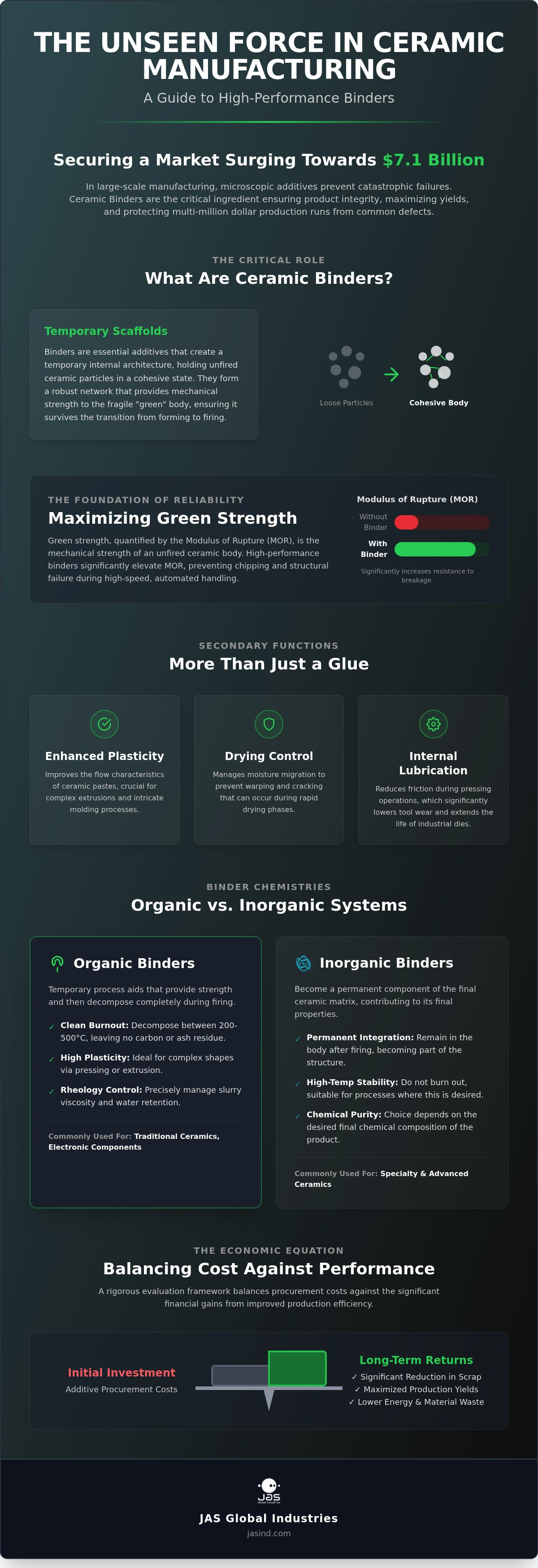
Industrial processing demands precision at every stage. In the Ceramic engineering process, structural integrity begins long before the material enters the kiln. Ceramic Binders function as temporary scaffolds, providing the necessary internal architecture to hold unfired particles in a cohesive state. These additives aren't merely process aids; they're essential guardians of product stability. By facilitating particle-to-particle adhesion, they ensure that the fragile "green" body survives the transition from forming to firing.
Mechanical strength serves as the primary metric for industrial success. In large-scale manufacturing, breakage rates represent more than just lost product. They signify wasted energy, misused raw materials, and compromised operational efficiency. Optimizing binder concentration is a technical necessity. It creates a robust network that withstands the rigors of industrial handling. High-performance binders contribute to global resource conservation by maximizing yields and reducing the environmental footprint of scrap material.
Green Strength: The Foundation of Process Reliability
Process reliability depends on the Modulus of Rupture (MOR). This measurement quantifies the mechanical strength of unfired ceramic bodies. Ceramic Binders elevate the MOR to prevent edge chipping and catastrophic structural failure. In modern, automated production lines, this strength is non-negotiable. Robotic grippers and high-speed conveyors lack the delicate touch of a human operator. Without sufficient green strength, automation becomes a liability rather than an asset. Reliable binders allow for faster cycle times and consistent output across the global manufacturing footprint.
Beyond Adhesion: Secondary Functions of Binders
The utility of a binder system extends beyond simple adhesion. These specialty chemicals provide a range of secondary benefits that stabilize the entire production cycle:
- Enhanced Plasticity: Binders improve the flow characteristics of ceramic pastes, which is vital for complex extrusion and intricate molding.
- Drying Control: By managing the migration of moisture, binders help prevent the warping and cracking that often occur during rapid drying phases.
- Lubrication: Many organic binders act as internal lubricants. This reduces friction during pressing operations, significantly lowering tool wear and extending the life of expensive industrial dies.
These functions ensure that the final product meets the rigorous standards required for modern infrastructure. By choosing the right binder system, manufacturers move from simple logistics to long-term value creation. It's about securing the yield and protecting the resource.
Classifying Binder Systems: Organic vs. Inorganic Chemistries
Selecting the correct chemistry is a strategic decision for any industrial manufacturer. The fundamental distinction between organic and inorganic binders lies in their thermal behavior. Organic systems act as temporary aids. They provide green strength but vanish during firing. Inorganic systems often become permanent components of the final ceramic matrix. This choice dictates the structural integrity and chemical purity of the finished piece. Efficiency in processing depends on matching the binder family to the thermal profile of the kiln.
Organic Binders: Clean Burnout and High Plasticity
Organic Ceramic Binders are the industry standard for traditional ceramics and electronic components. Polyvinyl Alcohol (PVA) and Carboxymethyl Cellulose (CMC) offer exceptional plasticity. This makes them ideal for complex pressing or extrusion. The primary advantage is clean burnout. These binders decompose into gases at relatively low temperatures, typically between 200°C and 500°C. This prevents carbon staining or residual ash that could compromise the electrical or aesthetic properties of the piece.
Strategic use of cellulose ethers and polyacrylates allows for precise control over slurry rheology. These agents manage water retention and prevent premature drying during the forming stage. Managing aqueous slurry rheology is simpler with organic agents. They allow for precise viscosity control without altering the fundamental chemistry of the raw materials. Maintaining this stability is essential for high-speed production lines where consistency is the benchmark of success. It's a balance of performance and purity.
Inorganic Binders: For Extreme Thermal Environments
Some applications demand structural bonds that survive the kiln. Inorganic binders, such as silicates and aluminas, are deployed for high-temperature refractories and technical coatings. Unlike organic counterparts, these materials fuse with the ceramic particles during sintering. They contribute to the final density and chemical profile of the body. This is crucial for components operating in extreme thermal or corrosive environments where organic material would fail prematurely.
While they offer superior permanent strength, manufacturers must account for how these additives affect the final melting point or thermal expansion of the ceramic. In technical ceramics, the binder often acts as a sintering aid. It promotes densification at lower temperatures. This saves energy and protects equipment. Selecting a binder system requires balancing these environmental goals with technical performance. For those seeking specialized guidance, exploring tailor-made ceramic formulations can bridge the gap between process efficiency and global responsibility. This proactive approach ensures that industrial solutions remain sustainable and reliable for the long term.
Evaluating Performance: Key Selection Criteria for Industrial Scale
Procurement for large-scale facilities requires a rigorous evaluation framework. It's not just about the cost per kilogram. It's about the total cost of quality. High-quality Ceramic Binders justify their cost by slashing plant scrap rates and reducing energy waste from re-processing. Every broken green piece represents lost time and lost profit. Compatibility testing ensures that these additives don't react negatively with glazes or slips. Ash content remains a critical metric for high-purity applications. For non-oxide ceramic powders, the choice of chemistry is highly specialized, as highlighted in this technical report on non-polymeric binders. Thermal expansion coefficients must also match the ceramic body to avoid micro-cracking during the heating phase. A mismatched binder can induce internal stresses that only appear after the final firing.
Processing Methods and Binder Compatibility
Industrial forming methods dictate binder selection. In dry pressing, the binder must facilitate granulation and provide internal lubrication for uniform density. This ensures the powder flows easily into the die. Slip casting requires agents that maintain low viscosity to ensure proper mold filling without hindering the deflocculation process. Extrusion processes demand additives that maximize plasticity and green strength. These binders act as structural stabilizers while the material is under high shear. Even in the emerging field of 3D ceramic printing, specific binder requirements focus on rapid solidification to preserve layer-by-layer integrity. Matching the additive to the method is the only way to achieve process stability across global production sites.
Mitigating Binder Migration and Surface Defects
Binder migration is a common industrial challenge that compromises surface quality. During the drying phase, the evaporating liquid carries dissolved binder to the surface of the part. This creates a hard "skin" that often causes glaze peeling or uneven sintering. Achieving uniform distribution in thick-walled parts requires precise control over drying rates and binder gelation points. If the concentration is too high at the surface, it effectively blocks moisture escape, leading to internal pressure and cracks. Troubleshooting these issues involves analyzing the interplay between temperature, airflow, and chemical concentration. Solving these surface defects protects the finished product and secures the manufacturing yield. It's about ensuring the integrity of the piece from the core to the surface.
Optimizing the Slurry: Synergies Between Binders and Deflocculants
Industrial success depends on an integrated approach to chemical management. While Ceramic Binders provide essential structural stability, they don't function in a vacuum. They must coexist with Ceramic Deflocculants. This chemical interplay is a delicate dance of ionic competition. Both additives compete for the same surface sites on clay and mineral particles. If a binder is too aggressive, it can displace the deflocculant. This leads to a sudden, unwanted rise in viscosity. Such a conflict can render a slurry impossible to pump or cast. Maintaining low viscosity while increasing green strength is the ultimate goal. It requires a deep understanding of how these molecules interact at the particle interface. pH levels and water quality add another layer of complexity. Hard water ions like calcium can bridge binder molecules, causing them to coil and lose their binding efficiency.
Rheology Management in High-Solids Slurries
Achieving the ideal thixotropic profile is necessary for stable suspensions. In high-solids slurries, the right Ceramic Binders influence the sedimentation rate. They help keep heavy minerals from settling at the bottom of storage tanks. This ensures that every piece produced has the same mineral composition from the start of the shift to the end. Precise dosing is the hallmark of a mature process. There is a fine line between a stable suspension and unwanted flocculation. Small errors in chemical measurement can trigger agglomeration. This leads to surface lumps, internal voids, and compromised structural integrity.
Advanced Formulations for Technical Ceramics
Technical ceramics like high-purity alumina demand even more specialized care. Customizing the binder-deflocculant ratio is the only way to achieve the high green density required for advanced aerospace or electronic applications. Dispersing agents play a protective role here. They prevent binder molecules from clumping together before they can properly coat the ceramic particles. In industrial tile production, this synergy directly impacts the bottom line. Optimized slurries reduce internal stresses during the drying phase, which significantly lowers the rate of warping and cracking. To secure your manufacturing yield and enhance process reliability, explore our integrated ceramic chemical solutions. This proactive management protects your resources and ensures long-term industrial stability.
Advanced Ceramic Solutions: The JAS Global Industries Advantage
Industrial excellence requires more than off-the-shelf additives. It demands a partnership rooted in stability and technical foresight. Since 1998, JAS Global Industries has provided specialty chemical formulations that secure the foundation of modern infrastructure. We understand that raw materials vary significantly by geography. Our Ceramic Binders are tailor-made to adapt to specific regional mineralogies. This ensures that your production yields remain consistent regardless of local raw material fluctuations. Our global manufacturing footprint provides the supply chain security necessary for continuous, high-volume production. We don't just sell chemicals; we provide the structural certainty your process requires.
Research and Innovation in Ceramic Chemistry
Innovation is the engine of industrial progress. Our global R&I centers focus on developing the next generation of sustainable chemistry. We specialize in low-emission binders that support the shift toward green ceramics without compromising mechanical performance. When complex process failures occur, our technical teams provide collaborative troubleshooting. We move beyond simple supply to offer deep-tissue diagnostics. Our support extends from on-site laboratory testing to comprehensive plant audits. This ensures that every stage of your manufacturing cycle is optimized for maximum resource protection. We believe that technical expertise is a tool for global guardianship, ensuring that every ton of raw material is used to its full potential.
A Strategic Partner for Global Resource Security
Our mission is clear: we protect global resources through optimized industrial efficiency. This commitment extends across our entire portfolio, including fertilizers, mining, and Ceramics Chemicals. By integrating these solutions, we help our partners achieve a state of operational security. Our global manufacturing footprint ensures that your supply chain remains resilient against local disruptions. We act as a foundational pillar for the industries that build the world. We offer more than products; we offer reliability rooted in decades of experience. For a customized process audit that identifies efficiency gaps in your production line, contact our Dubai headquarters. Let's secure your industrial future together. We're ready to help you optimize your yields and protect your long-term value.
Securing the Future of Industrial Ceramic Production
The transition from raw material to finished product requires more than just heat. It demands a sophisticated chemical strategy that prioritizes structural integrity at every stage. You've seen how the right additives eliminate breakage, manage slurry rheology, and ensure clean thermal decomposition. By integrating Ceramic Binders with precision-engineered deflocculants, manufacturers move from simple production to optimized global resource protection and long-term stability.
Reliability is the hallmark of a mature process. We support this mission through our global presence with sales offices in Europe, Asia, and Africa. Our specialized R&I centers conduct advanced chemical testing to solve your most complex process failures. Consult with our technical experts for custom Ceramic Binder formulations to identify efficiency gaps and protect your industrial yield. Expert technical audits are the first step toward a more resilient manufacturing footprint. Let's build a stable foundation for your global infrastructure today.
Frequently Asked Questions
What is the primary difference between organic and inorganic ceramic binders?
Organic binders are temporary scaffolds that decompose during firing, while inorganic binders remain as permanent structural components in the sintered body. Organic types like PVA or CMC are designed for clean burnout, leaving no trace in the final product. Inorganic binders, such as silicates or aluminas, are essential for extreme thermal environments where the binder must fuse into the ceramic matrix to provide lasting structural integrity and corrosion resistance.
How do ceramic binders improve the green strength of a body?
Ceramic Binders improve green strength by forming a polymeric film that bridges individual ceramic particles. This adhesive network creates a mechanical bond that resists tension and shear during handling. By increasing the Modulus of Rupture, these additives prevent edge chipping and structural failure in unfired pieces. This enhanced strength is vital for modern automated production lines where robotic systems require high mechanical stability to move pieces safely.
Will adding a binder to my ceramic slurry affect the final firing temperature?
Organic binders typically don't affect the final firing temperature because they decompose before the sintering phase begins. However, inorganic binders often act as sintering aids or fluxes, which can significantly lower the temperature required for densification. It's essential to analyze the chemical composition of inorganic additives to ensure they don't lower the melting point of your refractory materials or negatively alter the thermal expansion of the finished ceramic body.
How can I prevent binder migration during the drying process?
Controlling the drying rate and the gelation point of the binder system is the most effective way to prevent binder migration. If drying occurs too rapidly, the liquid carries dissolved binder to the surface, forming a hard skin that causes glaze defects. Maintaining high humidity during the initial drying stages and selecting binders with specific thermal gelation properties ensures a more uniform distribution throughout the cross-section of thick-walled industrial parts.
Can binders be used in combination with other dispersant agents?
Yes, binders are frequently used alongside dispersants, but you must carefully manage the ionic competition between these additives. Both chemicals compete for surface sites on the ceramic particles. If the binder concentration is too high, it can interfere with the deflocculant's ability to lower viscosity. Successful formulations rely on a balanced ratio that achieves the necessary green strength without compromising the rheological stability or the thixotropic profile of the ceramic slurry.
What are the environmental considerations for using synthetic ceramic binders?
Synthetic Ceramic Binders require careful management of emissions and wastewater discharge. Many modern synthetic options are formulated to be low-VOC and biodegradable, reducing the environmental footprint of the burnout phase. Manufacturers should prioritize binders that decompose into harmless gases like carbon dioxide and water vapor. This approach aligns with global sustainability goals and ensures compliance with strict industrial regulations regarding air quality and chemical waste management.
How much binder is typically added to a standard ceramic body formulation?
Typical addition rates for organic binders range from 1% to 5% of the total dry weight of the ceramic body. The exact percentage depends on the forming method; dry pressing often requires lower concentrations than extrusion or 3D printing. Inorganic binders vary more widely based on their role as permanent structural agents. It's a technical balance where adding too much can cause warping during drying, while too little leads to catastrophic green-state breakage.
Why is ash content a critical metric for selecting an organic binder?
Ash content represents the residual inorganic impurities left behind after an organic binder has burned out. In high-purity technical ceramics or electronic components, even a tiny fraction of residual ash can cause carbon staining or electrical failure. Selecting a binder with an ash content below 0.1% ensures that the final product maintains its intended chemical purity and aesthetic quality. This metric is the benchmark for securing high-value yields in precision industrial manufacturing.