


With the global market for anti-redeposition agents projected to reach $2.35 billion by 2026, the stakes for industrial detergent formulation have never been higher. You've likely seen the frustration of "greying" fabrics, where inefficient soil suspension turns a premium wash into a subpar result. It's a persistent challenge. Traditional components like Carboxymethyl Cellulose often fail to integrate with modern liquid formulations, leaving manufacturers caught between performance gaps and rising consumer expectations. Choosing the right anti-redeposition agent is no longer just a chemical choice. It's a strategic commitment to fabric integrity and resource security. Protect fabrics. Secure performance.
We understand that your goal is to maintain high whiteness retention across multiple cycles while navigating a tightening regulatory landscape. This 2026 buyer's guide provides the technical roadmap you need to optimize detergent efficiency and ensure compliance with global environmental standards. You'll discover how to transition toward bio-based polymers and implement custom dosing strategies that reduce overall chemical consumption. By the end of this article, you'll have a clear framework for selecting high-performance additives that protect both your brand reputation and the planet's resources. Let's explore how to turn technical challenges into sustainable industrial advantages.
Key Takeaways
- Eliminate the "grey veil" by mastering advanced soil suspension to protect fabric longevity and aesthetic value.
- Compare the technical advantages of traditional CMC against high-performance copolymers to solve solubility challenges in modern liquid detergents.
- Select the ideal anti-redeposition agent by matching chemical properties to specific formulation formats, including concentrated liquids and unit-dose pods.
- Ensure compliance with 2026 sustainability standards by adopting biodegradable polymers that maintain efficiency in energy-saving, low-temperature wash cycles.
- Optimize operational yields through technical audits and custom dosing strategies designed for industrial reliability and resource security.
The Critical Role of Anti-Redeposition Agents in Modern Detergent Systems
In the complex chemistry of industrial cleaning, the most critical battle isn't just removing dirt; it's keeping it away. An anti-redeposition agent serves as a molecular barrier that prevents dislodged soil from migrating back onto clean fibers during the wash cycle. Without these specialized polymers, dirt remains trapped in the wash liquor, eventually settling back onto the fabric surface. This failure creates the "grey veil," a progressive dulling of colors and whites that suggests a lack of cleanliness even after a full cycle. It isn't just an aesthetic issue. It's a failure of chemical security that compromises the perceived value of the detergent and the life of the textile.
Extending the lifecycle of textiles is a fundamental pillar of global resource stability. When fabrics retain their original brightness and structural integrity, they remain in use longer. This longevity reduces the immediate demand for raw materials and energy intensive manufacturing, directly contributing to a more sustainable circular economy. High-performance anti-redeposition agent technology transforms detergents from simple cleaning solutions into essential tools for textile preservation and resource protection. By ensuring that soil stays suspended until it's rinsed away, these agents protect the long-term investment consumers and industries make in their fabrics.
Understanding the Soil Redeposition Mechanism
Effective cleaning requires a dual-action approach: detachment and suspension. While surfactants excel at loosening soil from fibers, they don't always possess the strength to keep that soil from re-attaching. Anti-redeposition agents solve this by adsorbing onto the fabric surface, creating a hydrophilic shield that resists hydrophobic oily soils. This chemical repulsion is driven by electrical charges. Zeta potential is the electrokinetic potential in colloidal systems that dictates the strength of repulsion between similarly charged particles and prevents them from clumping or re-settling on the fabric surface. By managing these microscopic forces, the formulation ensures that the "wash" stays in the water and out of the weave.
Why Whiteness Retention is a Strategic KPI
Whiteness retention is a primary metric for consumer trust and brand authority. If a detergent fails to maintain fabric brightness over ten or twenty wash cycles, the formulation is viewed as inferior. Manufacturers use whiteness indices to quantify this performance, measuring how effectively a formula prevents the slow accumulation of microscopic soil particles. Relying on an advanced anti-redeposition agent allows for superior results without the need for aggressive bleaching agents or high-temperature cycles. This shift protects the delicate fibers of modern apparel and reduces the chemical burden on global water treatment systems. It's a strategy where performance reliability meets environmental responsibility.
Advanced Chemistry: Comparing CMC, Polyacrylic Acid, and High-Performance Copolymers
The efficacy of a modern detergent rests on the precision of its polymer backbone. Choosing the right anti-redeposition agent requires a deep understanding of how different chemical structures interact with both the fabric and the wash liquor. As formulation formats evolve from traditional powders to concentrated liquids and unit-dose pods, the chemistry must adapt to meet new solubility and stability demands. Optimize formulations. Protect resources.
CMC: Strengths and Limitations in the Modern Market
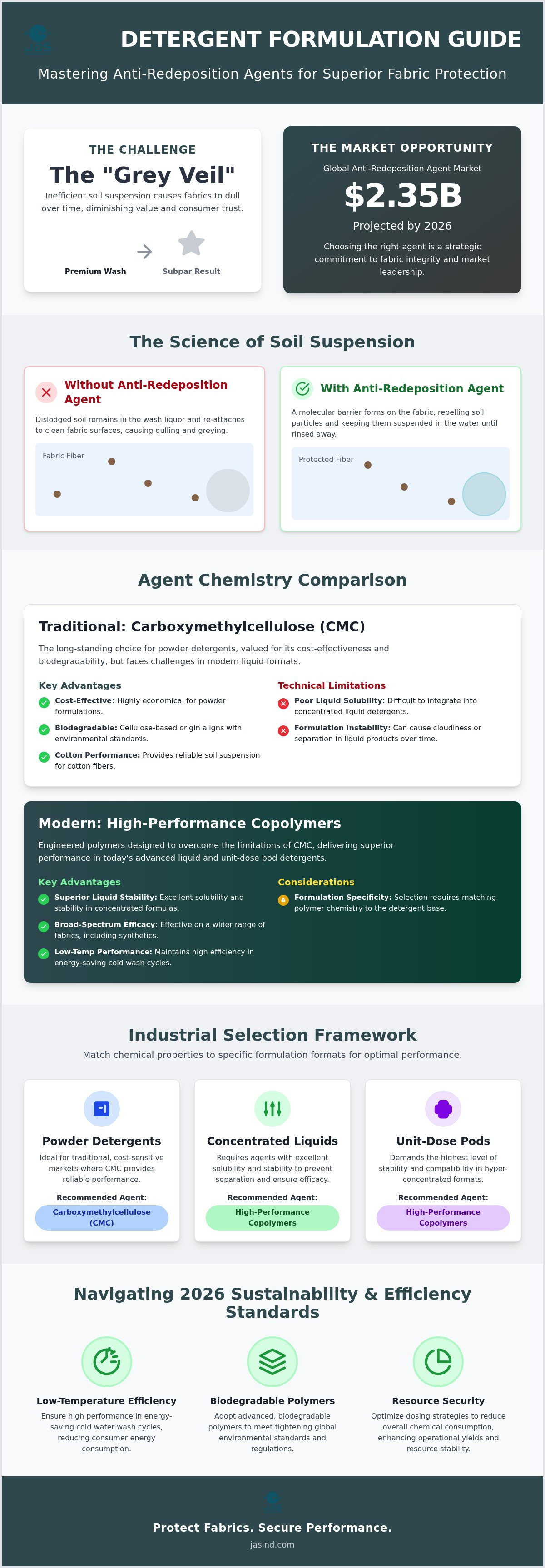
Carboxymethylcellulose (CMC) has long served as the foundational choice for powder detergent formulations. Its primary appeal lies in its cellulose-based origin, offering a favorable biodegradability profile that aligns with long-standing environmental expectations. In powder systems, CMC is highly cost-effective and provides reliable soil suspension for cotton fibers. However, CMC faces significant technical hurdles in the modern liquid market. It often suffers from poor solubility in concentrated formulas and can lead to instability or phase separation in pod formats. While it remains a staple for value-tier powders, it lacks the versatility required for high-density, multi-component systems.
The Rise of Synthetic Homo-polymers and Co-polymers
Synthetic alternatives like Polyacrylic Acid (PAA) and specialized Home Care Homo-polymers have redefined the standards for soil suspension. These polymers operate primarily through electrostatic repulsion, ensuring that soil particles carry a similar negative charge to the fabric, which keeps them apart. Recent academic reviews of advanced detergent chemistry emphasize how tailoring the molecular weight of these chains allows for the targeted dispersion of specific soil types, such as clay or particulate matter. These synthetic agents are particularly effective at inhibiting calcium carbonate scale, making them indispensable in hard water conditions.
For 2026, the industry has moved toward Home Care Co-polymers as the high-performance standard. These agents provide a dual-action mechanism: electrostatic repulsion combined with steric hindrance. By creating a physical, "bushy" barrier around soil particles, they prevent re-attachment even when electrical charges are neutralized by high mineral content in the water. This multi-functional approach ensures that a high-performance anti-redeposition agent remains reliable across diverse global wash conditions. If you're looking to refine these chemical synergies, a technical consultation on custom dosing can help identify the ideal polymer-surfactant balance for your specific needs.
The relationship between surfactants and polymers is one of mutual reinforcement. While surfactants lower surface tension to dislodge oily sebum and dirt, the polymer secures that soil in the wash liquor. This synergy allows manufacturers to reduce overall surfactant dosages without compromising on whiteness retention. It's a strategic shift that lowers formulation costs while meeting the rising demand for more sustainable, concentrated products.
Industrial Selection Framework: Matching Agents to Formulation Requirements
Selecting the right anti-redeposition agent is a strategic decision that bridges chemical potential with operational reality. It's about matching molecular architecture to the specific stresses of the wash environment. While the American Cleaning Institute's definition of anti-redeposition agents highlights their essential role in preventing soil re-attachment, the practical application varies wildly between high-volume powder plants and specialized liquid pod facilities. Formulators must evaluate the target soil profile, prioritizing particulate dispersion for clay-heavy regions or oily sebum suspension for apparel-focused markets. Performance reliability depends on this alignment.
Global water hardness remains a primary variable in selection. In regions with high mineral content, such as parts of Europe and Asia, an agent must provide robust calcium carbonate inhibition to remain effective. Cost-in-use analysis is equally vital. While some raw materials might appear cheaper per ton, their required dosage may be significantly higher to achieve the same whiteness retention. Choosing a high-efficiency polymer often reduces overall chemical consumption, securing both economic margins and environmental goals. Analyze the lifecycle. Protect the margin.
Optimizing for Concentrated Liquid Detergents
The shift toward ultra-concentrated formulas creates unique stability challenges. Clear liquid detergents require agents that remain soluble even in high-surfactant environments. If the polymer precipitates, it doesn't just fail to protect the fabric; it destroys the product's shelf appeal. Success requires a precise integration of surfactant chemistry with specialized co-polymers that resist "salting out." This synergy ensures that the anti-redeposition agent remains active and clear, maintaining performance in the smallest unit doses.
Specialized Agents for Institutional and Industrial (I&I) Cleaning
Commercial laundry operations demand a different level of chemical security. These systems handle massive soil loads and require agents that remain stable across a wide temperature spectrum, from energy-saving cold washes to high-temp industrial cycles. In these environments, compatibility with industrial water treatment chemicals is mandatory. The goal is to ensure that anti-scaling and anti-redeposition functions work in tandem, protecting both the expensive commercial machinery and the heavy-duty textiles they process. Reliability is the foundation of industrial trust.
Operational Efficiency and Sustainability: Navigating 2026 Regulatory Landscapes
Sustainability in 2026 isn't a choice; it's a regulatory mandate. The shift toward biodegradable and bio-based polymers reflects a global move toward chemical security and ethical manufacturing. High-potency additives allow for a reduced chemical footprint without sacrificing whiteness retention or soil suspension. This efficiency is critical for meeting EU Ecolabel requirements and North American TSCA standards. Detergent manufacturers are increasingly focusing on concentrated formulas to reduce water usage, packaging, and transportation costs. By enabling high performance in energy-saving, low-temperature wash cycles, a modern anti-redeposition agent directly supports global resource protection goals. Efficiency secures the future. Performance protects the brand.
Technical Audits and Process Optimization
Industrial reliability starts in the laboratory before moving to the production line. We've seen how on-site technical audits can transform plant yields by identifying precise polymer-surfactant interactions. Troubleshooting these synergies at the production level prevents batch waste and ensures consistent product quality across global supply chains. Our R&I centers, operating since 1998, focus on tailor-made formulations that ensure industrial reliability. Implementing precise chemical dosing strategies reduces over-consumption and lowers operational costs. It's about moving from broad estimation to categorical precision. If you're ready to optimize your plant's performance, book a technical audit with our specialists to refine your chemical consumption.
The Future of Sustainable Home Care Chemistry
Innovation now focuses on carbon-neutral polymer production and long-term stability. We are seeing a cross-pollination of industrial techniques, where stability methods used in Ceramics Chemicals are being adapted to enhance the shelf-life of home care additives. These advanced manufacturing processes ensure that bio-based agents maintain their structural integrity even in concentrated liquid environments. Following the launch of 100% bio-based agents in February 2026, industry analysts predict that sustainable alternatives will represent an increasingly dominant share of the $2.35 billion anti-redeposition agent market. This evolution represents a foundational shift in how we approach the stability of critical global resources.
Optimizing Your Formulation with JAS Global Industries’ Specialist Solutions
Since 1998, JAS Global Industries has served as a foundational presence in the specialty chemical industry. We don't just supply raw materials; we deliver technical security for the world's most prominent home care brands. Our role as a global guardian of resource stability is rooted in a deep history of corporate reliability and industrial expertise. By offering tailor-made formulations and custom dosing strategies, we ensure that every anti-redeposition agent we provide meets the specific needs of your production environment. Secure performance. Protect resources.
Our commitment extends beyond the laboratory. With R&I centers strategically located to support our global presence, we bridge the gap between chemical theory and on-site implementation. We understand the pressures of 2026 sustainability standards and the rising costs of raw materials. This is why we position ourselves as a technical partner rather than a mere supplier. Our goal is to help you maintain high whiteness retention while reducing overall chemical consumption through precise process optimization. Reliability is our legacy. Performance is our promise.
Our Portfolio of Home Care Polymers
We offer a sophisticated range of polymers designed to solve the most complex soil suspension challenges. Our high-efficiency Home Care Homo-polymer series provides exceptional whiteness retention, preventing the "grey veil" in traditional and modern detergent formats. For multi-action performance, our Home Care Co-polymer solutions utilize both electrostatic repulsion and steric hindrance to secure soil particles in the wash liquor. We also provide sustainable, bio-based anti-redeposition agent options that comply with the strictest global environmental regulations, ensuring your product line remains future-proof and ethically responsible.
Partnering for Operational Reliability
Supply security is the backbone of industrial success. JAS Global Industries maintains a robust logistics network across the Middle East, Asia, and Europe, ensuring that bulk contracts are fulfilled with categorical precision. We provide the stability your infrastructure requires. Our technical consulting services include comprehensive audits designed to identify inefficiencies and reduce operational costs. By optimizing your polymer-surfactant synergies, we help you achieve superior performance with lower dosages. It's a strategic shift toward long-term value and human impact. Contact JAS Global Industries for a technical audit of your formulation.
Securing the Future of Industrial Fabric Protection
The 2026 industrial landscape demands more than simple soil removal; it requires a strategic commitment to textile security and global resource protection. Transitioning to an advanced anti-redeposition agent ensures your products maintain peak whiteness retention while meeting the year's stringent sustainability standards. By aligning specific polymer architectures with your unique formulation requirements, you secure both fabric longevity and operational efficiency. It's about moving beyond transactional supply toward a model of long-term industrial reliability.
Since 1998, JAS Global Industries has served as a reliable pillar of specialty chemical innovation. Our global R&I presence and manufacturing centers provide the stability your supply chain needs to thrive in a shifting market. We offer expert technical consulting and on-site laboratory testing to help you refine chemical dosing and protect your margins. Our specialized formulations for whiteness retention and fabric protection are designed to meet the highest industrial benchmarks. Don't leave your formulation's performance to chance in an increasingly regulated world.
Optimize Your Formulations with JAS Global Industries and partner with a global leader dedicated to your industrial success. We look forward to securing your next technical breakthrough and building a stable, sustainable future together.
Frequently Asked Questions
What is the difference between a dispersant and an anti-redeposition agent?
Dispersants focus on the stability of particles within the wash liquor, keeping them evenly distributed to prevent clumping. An anti-redeposition agent specifically targets the fabric-soil interface to ensure dislodged dirt doesn't re-settle on the fibers. While all anti-redeposition agents act as dispersants, not all dispersants provide the surface-shielding properties required to prevent the "grey veil" in textiles. Categorical precision in selection ensures both liquid stability and fabric protection.
Is Carboxymethylcellulose (CMC) still effective in modern liquid detergents?
CMC remains a cost-effective standard for traditional powder detergents where solubility is less of a constraint. However, it often fails in modern concentrated liquids and unit-dose pods due to poor stability and potential phase separation. High-performance synthetic polymers or bio-based copolymers are now the preferred choice for liquid formats. These alternatives provide superior clarity and performance reliability in high-surfactant environments where traditional cellulose-based agents struggle.
How do anti-redeposition agents contribute to sustainability?
Sustainability is achieved through textile preservation and energy efficiency. By preventing soil re-attachment, these agents extend the usable life of fabrics, reducing the need for new textile production. They also enable high cleaning performance in low-temperature wash cycles, which significantly lowers household and industrial energy consumption. Using a high-potency anti-redeposition agent allows for ultra-concentrated formulas, which minimizes water usage and reduces the carbon footprint of global logistics.
Can anti-redeposition agents reduce the amount of surfactant needed in a formula?
Optimizing the polymer-surfactant synergy allows formulators to achieve high whiteness retention with lower surfactant concentrations. While surfactants are essential for soil detachment, the polymer handles the critical task of soil suspension. This strategic balance reduces raw material costs and minimizes the chemical burden on local water treatment systems. It's an efficient way to maintain performance while adhering to tightening environmental regulations regarding chemical discharge.
What are the regulatory requirements for laundry polymers in 2026?
The 2026 regulatory landscape focuses heavily on biodegradability and chemical safety. In Europe, compliance with EU Ecolabel standards requires polymers to meet strict aerobic and anaerobic degradation benchmarks. In the United States, the EPA continues to issue risk management rules under the Toxic Substances Control Act (TSCA) for specific chemical components. Manufacturers must verify that their chosen additives align with these evolving global standards to ensure long-term market access and supply security.
How do I determine the optimal dosage of an anti-redeposition agent?
Optimal dosage is determined through rigorous laboratory testing and technical audits that simulate real-world conditions. Formulators measure performance using whiteness retention indices across multiple wash cycles to find the point where performance peaks without over-consumption. Factors such as target soil profile, water hardness, and surfactant levels all influence the required concentration. Precise chemical dosing ensures industrial reliability while protecting the economic margins of the final product.
Are synthetic polymers biodegradable for use in eco-friendly detergents?
Traditional synthetic homo-polymers often lack high biodegradability, but the industry has seen a major shift toward sustainable alternatives. Since early 2026, 100% bio-based and biodegradable agents have become more widely available to meet eco-certification requirements. These modern copolymers provide the high-action performance of synthetics with the environmental profile required for green product lines. Choosing these advanced materials allows brands to demonstrate social concern without compromising on technical excellence.
How does water hardness affect the performance of anti-redeposition agents?
Water hardness can severely compromise performance by allowing calcium and magnesium ions to neutralize the negative charges on both soil and fabric. This neutralization reduces the electrostatic repulsion that keeps soil suspended. High-performance agents are specifically designed to inhibit calcium carbonate scale, ensuring they remain active even in mineral-rich water. Selecting a polymer with robust hard-water compatibility is essential for maintaining consistent cleaning results across diverse global regions.