
Did you know that a mineral layer just 0.8 millimeters thick can spike your facility's energy consumption by 10% or more? For industrial operators, this isn't just a technical nuisance; it's a direct threat to the infrastructure that supports global water security. You've likely felt the impact of frequent plant shutdowns or the high costs of replacing membranes years before their expected expiration. It's a common struggle to balance high-volume output with the delicate chemistry required to prevent scale-induced pressure drops.
This reference guide provides the technical expertise you need to master the selection and application of Water Treatment Antiscalants. We'll show you how to optimize dosing to reduce chemical consumption by 15% while extending the life of your critical assets. We'll explore the chemistry behind scale inhibition and the precise strategies required to meet 2024 environmental discharge regulations without sacrificing operational reliability. By the end of this article, you'll have a clear roadmap for enhancing your water treatment processes and protecting your bottom line.
Key Takeaways
- Explore the essential role of scale inhibitors in maintaining industrial heat transfer and safeguarding global water security.
- Uncover the dual mechanisms of threshold inhibition and crystal modification to prevent mineral precipitation at the molecular level.
- Identify the technical criteria for matching Water Treatment Antiscalants to specific feedwater characteristics, from brackish sources to seawater desalination.
- Master precision dosing strategies to enhance membrane flux and eliminate the operational risks of chemical waste and biofouling.
- Leverage 25 years of industrial expertise and global logistics to ensure consistent quality and reliability in your chemical supply chain.
Understanding Antiscalants in the Context of Global Water Security
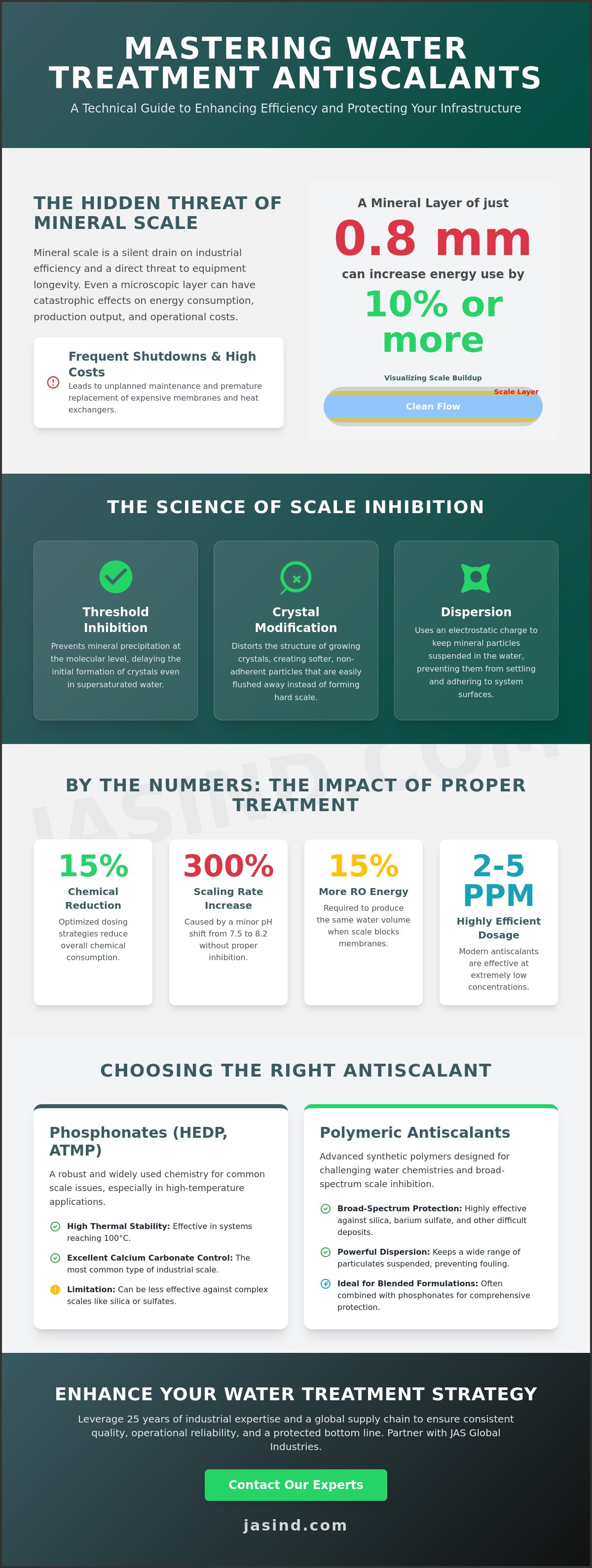
Water Treatment Antiscalants are essential tools in the fight for global water security. They serve as the primary defense against mineral salt crystallization in critical infrastructure. Scale isn't just a cosmetic issue. It's a direct threat to industrial productivity and resource conservation. For instance, a thin layer of calcium carbonate on a heat exchanger can slash thermal efficiency by 12%. This forces systems to consume more fuel, increasing carbon footprints and operational costs. In reverse osmosis plants, scale blocks membrane pores, reducing flux and requiring 15% more energy to produce the same volume of potable water.
Reliable water access depends on shifting from reactive maintenance to proactive inhibition. Relying on acid washes to remove scale is inefficient. It damages equipment and creates hazardous waste streams. Modern industrial strategy prioritizes prevention to ensure asset longevity. This Antiscalant overview highlights how these chemicals maintain system integrity through advanced molecular mechanisms. By preventing deposits before they form, industries protect the foundational infrastructure of society.
The Chemistry of Scale Formation
Mineral precipitation happens when water reaches supersaturation. This is the tipping point where the liquid can no longer hold dissolved solids in a stable state. Calcium Carbonate is the most frequent offender, but Barium Sulfate and Silica pose more difficult challenges due to their low solubility. pH levels and temperature fluctuations act as catalysts for these deposits. In a typical cooling system, a slight pH shift from 7.5 to 8.2 can increase the precipitation rate of calcium salts by 300%. These deposits create an insulating barrier that chokes industrial processes and reduces the lifespan of expensive membranes.
The Evolution of Industrial Scale Inhibitors
The industry has transitioned from crude phosphates to sophisticated synthetic polymers. Early treatments required high dosages that often led to secondary fouling. Today's high-performance formulations are effective at extremely low concentrations, often as low as 2 parts per million. Water Treatment Antiscalants now utilize the threshold effect to manage mineral loads. The threshold effect is defined as the process where sub-stoichiometric amounts of an inhibitor delay the growth of mineral crystals by adsorbing onto their surfaces. This breakthrough allows facilities to operate at higher concentration cycles. It reduces blowdown volumes and saves billions of liters of water globally each year.
The Science of Scale Inhibition: Mechanisms and Ingredients
Effective scale control relies on three primary chemical pathways. Threshold inhibition is the most efficient. It operates at sub-stoichiometric levels. This means 2 to 5 parts per million of Water Treatment Antiscalants can prevent the precipitation of hundreds of times their weight in mineral salts. This process delays the nucleation phase where minerals first begin to cluster. Crystal modification follows. The antiscalant molecules adsorb onto the mineral's growth sites. This distorts the lattice structure. Instead of forming hard, interlocking scales, the crystals remain blunt and non-adherent. Dispersion uses electrostatic charge. It keeps particulate matter suspended in the bulk water. This prevents surface adhesion on critical infrastructure.
Industrial reliability depends on the synergy of these mechanisms. A single formulation often combines threshold inhibitors with powerful dispersants. This multi-pronged approach ensures that even if one pathway is overwhelmed, the system remains protected. It's about maintaining the integrity of global infrastructure. These chemical solutions act as guardians for heat exchangers and membrane surfaces. They prevent the 15% to 20% loss in energy efficiency typically caused by a mere 1mm layer of calcium carbonate scale.
Phosphonates vs. Polymeric Antiscalants
Phosphonates like HEDP and ATMP provide high thermal stability. They're effective for calcium carbonate control in systems reaching 100 degrees Celsius. While phosphonates are staples, modern Water Treatment Antiscalants often rely on synthetic polymers. Polyacrylates and maleic acid copolymers handle complex scales. They manage silica and sulfate deposits where phosphonates might fail. Blended formulations combine these strengths. They provide broad-spectrum protection for diverse water chemistries. This approach ensures maximum system uptime and protects the longevity of expensive industrial assets.
Green Antiscalants and Environmental Sustainability
Modern industrial standards require higher biodegradability. The JAS Cares initiative reflects this shift toward phosphorus-free alternatives. Natural polymers derived from seaweed or starch are gaining traction. These green solutions must match the 95% efficiency of traditional chemicals to be viable. Industrial water security depends on balancing this efficacy with environmental compliance. Protecting our water resources is a global responsibility. We provide the tools for sustainable water management that don't compromise on performance. Transitioning to biodegradable options helps plants meet discharge regulations while maintaining high production rates. It's a commitment to both operational excellence and the health of our planet's ecosystems.
Selecting the Right Antiscalant for Your Industrial Process
Precision chemistry safeguards global water security. Choosing the right Water Treatment Antiscalants depends on a meticulous analysis of feedwater composition. Engineers must evaluate the Langelier Saturation Index (LSI) and the Stiff & Davis Stability Index (S&DSI) to predict scaling potential accurately. It's not a one-size-fits-all decision. The chemical selection must align with the specific mineral profile of the source water to ensure long-term system integrity.
Feedwater variability presents a significant challenge for industrial operators. Many sites experience a 20% shift in mineral concentration during seasonal transitions or heavy rainfall. This volatility demands a robust chemical profile. Brackish water sources often require high-performance phosphonates to manage diverse sulfate and carbonate scales. Seawater desalination faces different hurdles. High ionic strength and specific ions like strontium require specialized polymers to prevent crystalline growth on expensive equipment. Reliable performance across a wide pH range, typically from 5.0 to 9.5, is essential for maintaining operational stability.
- Chemical Matching: Aligning polymer molecular weight with specific scale types like Calcium Carbonate or Barium Sulfate.
- Temperature Resilience: Ensuring the additive remains effective in environments ranging from 10°C to over 100°C.
- Regulatory Compliance: Selecting products that meet international safety standards for discharge and potable water contact.
Membrane-Specific Applications: RO and Nanofiltration
Membrane blinding is a primary threat to high-recovery systems. When recovery rates exceed 75%, the risk of mineral precipitation increases exponentially. Proper antiscalant selection ensures compatibility with thin-film composite polyamide membranes. It prevents the irreversible fouling that destroys cellulose acetate structures. Effective Water Treatment Antiscalants reduce Clean-In-Place (CIP) frequency by as much as 60%. This extension of the service cycle preserves membrane flux and significantly lowers the total cost of ownership for the facility.
Thermal Desalination and Cooling Tower Systems
Thermal plants require chemicals that remain stable at temperatures reaching 110°C. Low-quality additives degrade in these harsh conditions, losing their sequestering power and leaving heat exchangers vulnerable. In open-recirculating cooling water systems, the antiscalant must work in synergy with corrosion inhibitors. Modern formulations provide a dual-action defense. They manage calcium phosphate scale while supporting the formation of a protective film on metallurgy. This integrated approach ensures the longevity of critical infrastructure and supports the brand's mission of industrial sustainability.
Optimizing Dosing Strategies and System Monitoring
Precision is the foundation of water security. Calculating the exact dosage of water treatment antiscalants requires a rigorous analysis of feed water chemistry, recovery rates, and temperature. Under-dosing leads to irreversible mineral scaling on membrane surfaces. This failure can reduce plant efficiency by 15% within just a few weeks of operation. However, the solution isn't simply to add more chemicals.
Over-dosing carries hidden costs that compromise sustainability. Excessive phosphorus-based additives often act as nutrients for microbial growth. This promotes biofouling, which increases cleaning frequency and shortens membrane life. Chemical waste alone can increase operational costs by 12% annually in large-scale desalination plants. Achieving the right balance ensures both mechanical integrity and fiscal responsibility.
Placement is critical for chemical dispersion. Injecting the antiscalant before the high-pressure pump ensures thorough mixing before the water reaches the membrane interface. When integrating these additives with biocides or flocculants, compatibility testing is vital. Anionic antiscalants can react with cationic flocculants. This creates a "sticky" precipitate that fouls membranes faster than the mineral scale it was designed to prevent.
Analytical Tools and Monitoring Protocols
Reliable operations depend on consistent data. Operators must track the Langelier Saturation Index (LSI) for brackish water or the Stiff & Davis Stability Index (S&DSI) for high-salinity seawater. Real-time monitoring of normalized flux and differential pressure provides the earliest warning of scale formation. A 10% increase in differential pressure or a 10% drop in normalized flux signals scale breakthrough. Identifying the root cause involves comparing these trends against water chemistry shifts or pump performance fluctuations. It's the only way to protect the system's long-term health.
Technical Audits and Process Optimization
A professional technical audit transforms plant yields. These audits identify hidden inefficiencies that standard maintenance routines often miss. Custom dosing strategies for water treatment antiscalants rely on site-specific data rather than generic manufacturer charts. Training operational staff ensures that chemical management remains a core priority. Proper handling and calibration of dosing pumps prevent the 5% to 8% drift in chemical delivery often seen in unmonitored systems. This level of oversight turns a standard facility into a model of industrial efficiency.
Looking for precision in your chemical management? Explore our technical audit services to secure your water infrastructure and optimize your yields.
Global Chemical Partnerships: The JAS Global Advantage
For 25 years, JAS Global Industries has operated on a foundational philosophy: Manufacturing Relationships. Distributing Quality. Our Dubai-centered global logistics network serves as a strategic hub, ensuring that critical industrial reagents reach MEA, Asia, and Europe with 24/7 efficiency. We don't just provide chemicals; we provide the stability required for modern infrastructure. This commitment is formalized through "JAS Cares," our dedicated initiative for sustainable industrial development. It's a promise to protect regional ecosystems while maximizing the output of the world's most vital sectors.
The role of Water Treatment Antiscalants extends far beyond simple maintenance. These formulations represent a shield against the mineral interference that threatens production capacity. By leveraging our quarter-century of manufacturing expertise, we bridge the gap between complex chemical engineering and practical field application. Our global presence allows us to monitor shifting industrial trends and respond with agility, positioning us as a quiet giant in the specialty chemical market.
Custom Formulations for Mining and Fertilizer Sectors
Ore processing and phosphoric acid production demand chemical precision that off-the-shelf products can't provide. We develop tailor-made reagents specifically designed to manage scale in these aggressive environments. Our advanced reagents for feldspar and fluorspar flotation have helped operators achieve higher recovery rates in 2024's competitive landscape. Specific regional water chemistries, particularly in arid hubs like Riyadh and Amman, present unique mineral profiles that require localized expertise.
- Engineering solutions for high-salinity feed water in the Middle East.
- Optimizing phosphoric acid evaporator efficiency through targeted scale inhibition.
- Reducing chemical waste by matching reagent dosage to specific ore mineralogy.
These customized Water Treatment Antiscalants ensure that mineral processing plants maintain peak uptime. When chemistry is calibrated to the specific water source, the risk of unexpected descaling shutdowns drops by nearly 40% based on recent field data.
A Strategic Partner in Water and Food Security
Chemical solutions are the bedrock of global food and water security. We view our role as a visionary partner, securing the resources that sustain growing populations. While technical consulting fees are a consideration, they're an investment that yields significant long-term operational savings. Industrial plants typically realize a 12% to 18% reduction in energy and maintenance costs when they move from generic programs to optimized chemical management. We focus on the foundational needs of society, ensuring that infrastructure remains resilient and efficient. To evaluate your current system's performance, contact our technical team for a process audit and discover how our expertise can secure your operational future.
Securing the Future of Industrial Water Infrastructure
Managing scale isn't just about protecting machinery; it's a critical pillar of global water security. High-performance Water Treatment Antiscalants prevent mineral deposition that otherwise compromises efficiency in desalination, mining, and power generation. By integrating advanced chemical mechanisms with precise dosing strategies, industrial operators significantly reduce maintenance costs and extend the lifespan of their infrastructure. It's a technical challenge that requires a partner committed to both innovation and reliability.
JAS Global offers over 25 years of specialty chemical expertise to address these complex requirements. Our dedicated Global R&I centers develop tailor-made formulations that solve unique site-specific issues. With a strategic presence across the Middle East, Africa, and Europe, we ensure that critical industries have the support they need to thrive. We believe in manufacturing relationships and distributing quality to protect the resources that sustain our world. Our team focuses on delivering measurable results that enhance both operational uptime and environmental stewardship.
Partner with JAS Global for Optimized Water Treatment Solutions and ensure your systems remain resilient in an evolving global landscape. Let's work together to build a more efficient and secure industrial future.
Frequently Asked Questions
What is the primary difference between an antiscalant and a dispersant?
Antiscalants prevent mineral precipitation by interfering with crystal growth, while dispersants keep existing particles from agglomerating. Antiscalants target dissolved ions like calcium and magnesium to stop them from forming hard scale. Dispersants use electrostatic repulsion to keep suspended solids moving through the system. Combining these technologies ensures 98% efficiency in membrane performance and prevents localized blockages.
Can antiscalants replace water softening in industrial RO systems?
Antiscalants can replace traditional ion exchange softening in many industrial RO systems, especially when feed water hardness is below 150 mg/L. This transition eliminates the need for salt regeneration and removes the burden of brine disposal. Using water treatment antiscalants instead of softeners reduces the physical footprint of the plant and lowers operational costs by approximately 25% in large-scale installations.
How do I know if my RO membrane is scaling or fouling?
Scaling is indicated by a 10% decrease in permeate flow or a 15% increase in salt passage, while fouling typically manifests as a 15% increase in differential pressure. Scaling results from mineral deposits like calcium sulfate. Fouling involves organic matter or biological growth. Monitoring these specific metrics helps operators implement the correct "JAS Cares" maintenance protocol to protect global water security.
Are water treatment antiscalants safe for potable water production?
Yes, antiscalants are safe for drinking water production if they carry the NSF/ANSI Standard 60 certification. This global safety benchmark ensures that chemical additives don't exceed strict health limits in the final product. Over 150 countries rely on these certified formulations to maintain high-quality standards in municipal desalination and potable water infrastructure.
What happens if I stop dosing antiscalant for a short period?
Stopping antiscalant dosing for as little as 30 minutes can cause irreversible mineral precipitation on membrane surfaces. These crystals serve as nucleation sites that accelerate further scale formation once the pump restarts. This brief lapse often leads to a 20% reduction in membrane life, necessitating immediate chemical cleaning to prevent permanent hardware damage.
How long can antiscalants be stored before they lose efficacy?
Liquid antiscalants typically maintain their full chemical integrity for 12 to 24 months when stored in sealed, original packaging. Operators should keep storage temperatures between 5°C and 35°C to prevent polymer degradation. After 730 days, the active ingredients may lose up to 30% of their inhibitory power, compromising the reliability of the industrial water treatment process.
Is there a "one-size-fits-all" antiscalant for all water types?
No single product works for every environment because feed water chemistry varies between brackish, sea, and recycled wastewater. A high-silica water source requires a different molecular formulation than one high in calcium carbonate. Customizing the chemical approach based on a 12-point water analysis is essential for maintaining the long-term health of global industrial infrastructure.
How does temperature affect the performance of scale inhibitors?
Higher temperatures generally accelerate mineral precipitation, which increases the demand for effective water treatment antiscalants. For every 10°C increase in feed water temperature, the solubility of certain minerals decreases, making scale formation more likely. Industrial-grade inhibitors must remain thermally stable up to 80°C to provide consistent protection in high-heat desalination and mining operations.