

Every year, industrial facilities lose between 2% and 5% of their bulk material volume to fugitive dust emissions during transit and storage. Implementing high-performance Anti-dusting Agents transforms this invisible loss into a tangible competitive advantage for your operations. You're already aware that uncontrolled dust isn't just a cleaning issue. It represents a direct risk to the respiratory health of 100% of your on-site team and can trigger regulatory fines that often exceed $15,000 per violation under modern environmental standards.
At JAS Global Industries, we believe that industrial efficiency and human safety are foundational to global stability. This guide provides the expertise needed to master the strategic selection and application of advanced chemical additives to protect product integrity and global supply chain efficiency. We'll examine technical application methods for the mining and fertilizer sectors, navigate the complexities of international regulatory compliance, and detail how to choose the right solution to secure your infrastructure. You'll gain a clear roadmap for reducing material degradation while upholding your commitment to being a responsible corporate citizen.
Key Takeaways
- Understand the science of particulate control and how specialized polymers create a protective film to maintain material integrity.
- Identify the most effective Anti-dusting Agents for your specific substrate while ensuring compliance with global safety and environmental standards.
- Execute a comprehensive site-wide dust audit to determine the precise application points that maximize coating efficiency and worker safety.
- Master strategies for managing high-heat and humidity to prevent clumping and preserve product quality in complex storage environments.
- Discover the long-term value of tailor-made chemical solutions in securing global supply chains and enhancing operational sustainability.
Understanding Anti-dusting Agents: The Science of Particulate Control
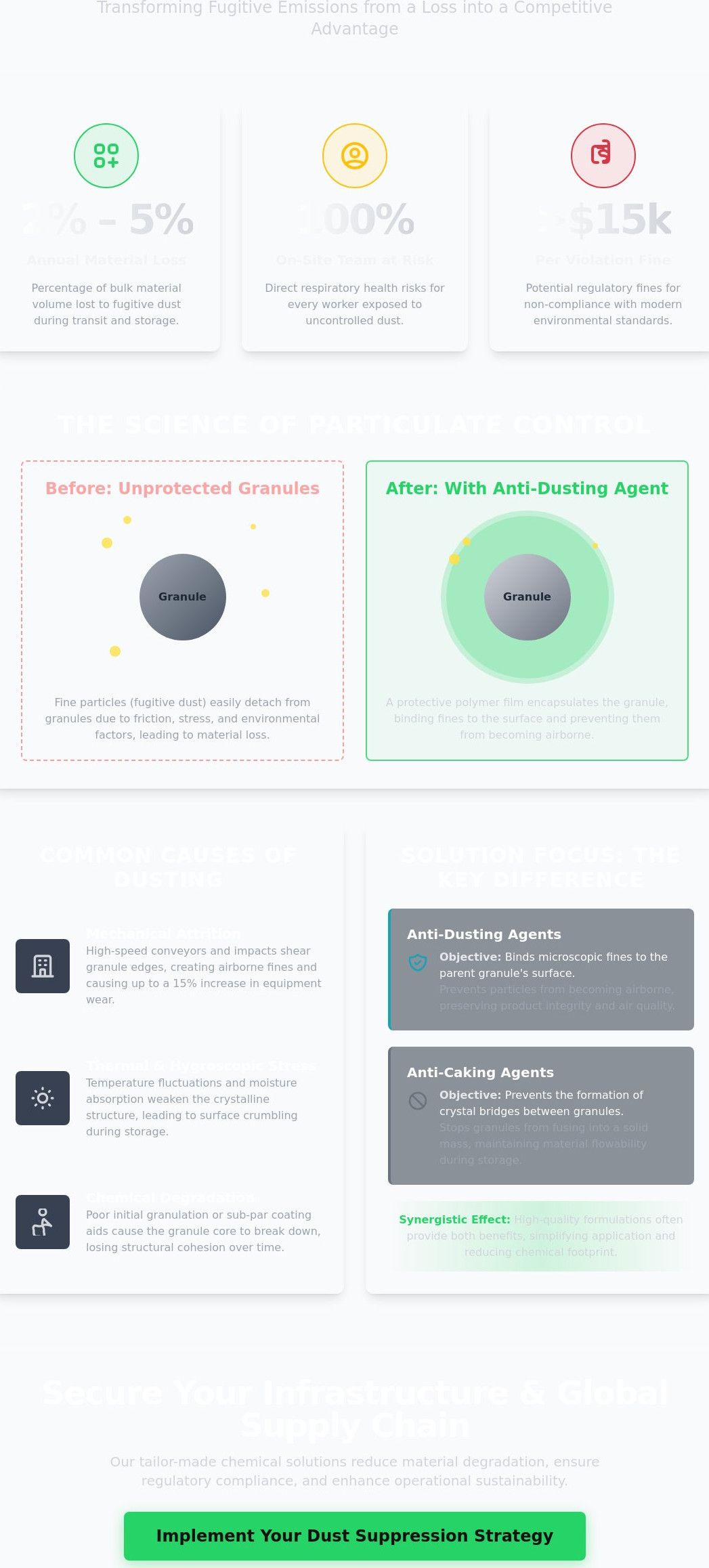
Anti-dusting Agents are specialty chemical formulations engineered to bind fine particles directly to the surface of granules or crystals. This process is not merely a surface-level treatment; it is a critical intervention in material integrity. These agents utilize a sophisticated blend of surfactants and polymers to reduce surface tension. By doing so, they create a uniform, protective film that encapsulates the material. This film acts as a microscopic anchor, ensuring that fines remain attached to the parent granule throughout the supply chain. It's a precise science that preserves the physical quality of bulk commodities.
Fugitive dust represents a silent drain on industrial profitability and global resources. Industry data indicates that material loss from dusting can reach between 0.5% and 2.0% of total volume during bulk handling and maritime transport. This translates to thousands of tons of lost product annually for large-scale producers. Beyond direct loss, dust accelerates equipment wear on conveyors, bearings, and filtration systems, increasing maintenance cycles by as much as 15%. We view this challenge through the lens of global responsibility. Preserving fertilizer quality via effective Dust abatement methods is essential for maintaining global food security. When nutrients stay on the granule, they reach the farm, ensuring crop yields remain stable and predictable.
Common Causes of Industrial Dusting
- Mechanical attrition: High-speed conveyor systems, often moving at speeds exceeding 4 meters per second, create significant friction and impact. This physical stress shears the edges of granules, creating a high volume of airborne fines.
- Thermal stress and hygroscopy: During 30-day storage cycles, granules often undergo temperature fluctuations and moisture absorption. This cycle of wetting and drying weakens the crystalline structure, leading to surface crumbling.
- Chemical degradation: Poor initial granulation or the use of sub-par coating aids can lead to a breakdown of the granule core. Without a resilient chemical barrier, the material loses its structural cohesion over time.
Anti-dusting vs. Anti-caking: Knowing the Difference
Distinguishing between these two processes is vital for effective material management. Anti-caking focuses on the prevention of crystal bridging, which stops granules from fusing into a solid mass during storage. Anti-dusting, conversely, focuses on particle binding to keep microscopic fines from becoming airborne. While their objectives differ, high-quality agents often provide synergistic effects. A well-formulated coating can serve a dual purpose, maintaining flowability while simultaneously suppressing dust. This dual-action approach simplifies application and reduces the total chemical footprint of the operation.
Anti-caking prevents the formation of solid bonds between granules, while anti-dusting binds microscopic fines to the surface of the parent material to maintain product integrity.
How to Select the Right Anti-dusting Formulation for Your Material
Selecting the correct Anti-dusting Agents requires a deep understanding of the substrate's chemical profile. For materials like Urea, NPK, or Potash, the additive must bond without compromising the nutrient integrity. A mismatched formulation leads to caking or reduced efficacy. We view these additives as vital tools for global food security. They ensure that fertilizers reach their destination intact and ready for application.
Compliance with OSHA and REACH standards is non-negotiable. Every industrial operation should maintain a rigorous dust control plan to protect personnel and the surrounding ecosystem. In regions like Dubai or Riyadh, humidity levels often exceed 60% while temperatures soar above 45°C. These extreme conditions demand formulations that remain stable and effective under thermal stress. Without the right chemical stability, the effectiveness of modern Anti-dusting Agents can degrade, leading to hazardous airborne particles.
A proper cost-benefit analysis looks beyond the price per ton. Reducing product shrinkage by even 2.5% can save thousands in lost inventory during bulk handling. Our focus is on distributing quality that pays for itself through operational efficiency and the preservation of material volume.
Key Selection Criteria for Fertilizer Additives
Hydrophobicity is essential for moisture-sensitive materials. The agent must create a barrier that prevents water absorption during storage. Aesthetic value matters too. The additive shouldn't alter the product’s color or produce a pungent odor that affects marketability. Modern chemical management plans now prioritize biodegradability. We're seeing a 15% increase in the adoption of bio-based polymers globally. These sustainable solutions protect the soil while maintaining high-performance standards.
Technical Audits and Laboratory Testing
R&I centers play a critical role in developing custom formulations. Every mineral composition is unique and requires specific dosing. Accelerated aging tests simulate months of maritime transport in just 72 hours. This ensures the product remains dust-free during long-distance shipping across varying climate zones.
Requesting a technical audit is the first step toward a precise dosing strategy. Our experts evaluate your specific equipment and material flow to optimize results. This precision minimizes waste and ensures every drop of chemical provides maximum protection. If you're looking to enhance your facility's output, consult with our specialists about custom additive solutions.
Step-by-Step: Implementing a Dust Suppression Strategy
Precision is the foundation of industrial safety. At JAS Global Industries, we view the application of Anti-dusting Agents as a critical step in protecting Global Food Security. A haphazard approach wastes resources; a structured strategy ensures long-term stability and environmental compliance. Implementation requires a logical progression from assessment to verification.
Step 1: Conduct a site-wide dust audit. Quantitative data drives results. Identify primary emission points such as conveyors, transfer chutes, and bagging stations. In typical fertilizer plants, 85% of fugitive dust originates from high-impact transfer points where granules undergo mechanical stress.
Step 2: Select the application point. Timing is everything. Apply the coating where the material is most receptive, typically immediately after the granulation and cooling phase. This allows the agent to bond effectively to the warm surface, creating a resilient barrier before the product enters storage silos.
Step 3: Calibrate dosing equipment. Uniform coverage is essential for performance. Over-saturation compromises the physical integrity of the granule, while under-application leaves it vulnerable to abrasion. Target a precise application rate, often measured in grams per ton, based on the specific surface area of your product.
Step 4: Integrate real-time monitoring. Modern infrastructure demands automation. Link dosing systems to flow meters to adjust flow rates based on production volume shifts. This ensures chemical efficiency even when plant throughput fluctuates during peak operational hours.
Step 5: Perform post-application quality checks. Verify the durability of the protective film. Use accelerated stress tests to simulate the friction of long-distance transport. This step ensures the product remains dust-free until it reaches the final consumer, upholding our commitment to quality.
Setting Up Dosing and Spraying Systems
The hardware dictates the outcome. Choosing between cone nozzles and flat fan nozzles depends on your conveyor width. Cone nozzles provide concentrated coverage for narrow chutes, while flat fan nozzles ensure an even curtain across wider belts. High-viscosity chemical reagents require specialized positive displacement pumps to maintain consistent pressure. By linking these systems to PLC controllers, we are Manufacturing Relationships through technical precision and reliability. Automation reduces human error and optimizes chemical consumption.
Monitoring and Maintenance Protocols
Maintenance preserves performance. Establish daily calibration routines to prevent nozzle clogging. A single blocked nozzle can reduce application efficiency by 15% in a single shift, leading to significant dust breakout. Track consumption rates against production yields to monitor ROI accurately. Safety is paramount when handling bulk chemical reagents in the plant. Ensure all staff follow established protocols for storage and handling to maintain a secure, sustainable working environment. Our focus remains on the foundational needs of global industry.
Optimizing Performance: Overcoming Practical Application Challenges
Implementing Anti-dusting Agents isn't a "set and forget" process. It requires technical precision. Industrial environments demand solutions that withstand the harshest conditions on Earth. High-heat zones like the Middle East often see surface temperatures exceed 60°C. At these levels, standard coatings lose viscosity. They fail to bond. Our approach ensures chemical stability remains intact, protecting the integrity of the material and the safety of the workforce. We don't just provide a product; we provide a shield for your infrastructure.
Advanced Coating Technologies for Extreme Climates
In regions like North Africa and the Arabian Peninsula, thermal degradation is a constant threat to dust suppression. We engineer our formulations to maintain a stable molecular structure even when exposed to 55°C ambient heat. Maritime transport adds another layer of complexity. Bulk fertilizer shipments often face 90% relative humidity during cross-ocean transit. This moisture leads to hygroscopic caking and product loss. Tailor-made formulations adapt to local environmental variables by balancing hydrophobic barriers with specific surfactant blends. This ensures your cargo arrives at its destination in a free-flowing, dust-free state, ready for distribution.
Troubleshooting Common Application Issues
If a product remains dusty after treatment, the issue is usually residence time. Most minerals require a specific window of contact to ensure total coverage. Over-wetting is another risk. Excessive application creates "mud" that later cures into hard cakes, ruining the product grade. Precision is vital. Operators must adjust formulas based on real-time data:
- Residence Time: Most minerals require 45 to 60 seconds of mixing for full encapsulation.
- Dosage Control: A 12% increase in fine particles usually requires a 5% increase in chemical application.
- Seasonal Calibration: Adjust surfactant ratios to account for humidity swings between 30% and 85%.
Efficiency drives profitability. The primary objection to high-quality Anti-dusting Agents is the upfront chemical cost. However, the data tells a different story. Facilities using advanced suppressants report a 35% reduction in industrial cleaning hours. They see a 20% decrease in conveyor belt maintenance costs. By reducing dust, you protect your machinery and your people. It's an investment in Global Food Security and operational longevity. We manufacture relationships by ensuring your facility runs at peak performance without the burden of airborne waste.
The JAS Global Advantage: Sustainable Chemistry for Global Security
JAS Global brings 25 years of specialized expertise in specialty chemical solutions to every industrial partnership. We don't believe in generic, one-size-fits-all products. Industrial environments are far too complex for a standard approach. Our Anti-dusting Agents are custom-formulated through rigorous research and innovation to meet the specific physical properties of your raw materials. We've established a presence across Europe, Asia, and Africa, ensuring that our clients receive seamless logistics and 24/7 technical support regardless of their location. This global reach is anchored by our JAS Cares initiative, a dedicated commitment to environmental stewardship and industrial safety that guides every formulation we develop.
We've built our reputation as a "quiet giant" in the chemical industry. We focus on reliability and established trust. Our team understands that chemical additives are more than just commodities; they're essential components of modern infrastructure. We've spent over two decades refining our R&I processes to ensure our chemistry remains at the cutting edge of sustainability and performance. Chemistry is our tool. Security is our mission.
Manufacturing Relationships through Quality
We integrate directly with your plant’s operational flow to improve total yields and reduce waste. Our process begins with professional technical consulting and on-site laboratory testing. This ensures the chemistry we provide matches your specific mineral profile and climatic conditions. In phosphate and potash mining operations, our tailored Anti-dusting Agents have helped facilities reduce material loss during handling by up to 15% in high-wind environments. We live by our signature philosophy: Manufacturing Relationships. Distributing Quality. We don't just sign contracts; we build long-term technical alliances that prioritize your bottom line and your workers' health.
- On-site calibration of chemical dosages for maximum cost-efficiency.
- Laboratory analysis of raw materials to prevent chemical incompatibility.
- Direct integration with existing spray and application systems.
Securing the Future of Food and Water
Efficient fertilizer additives are a cornerstone of global food security. When nutrients stay in the product instead of becoming airborne dust, global crop yields remain stable and predictable. We also leverage innovative water treatment synergies. These solutions protect local water resources from industrial runoff while simultaneously optimizing your production efficiency. It's a holistic approach to industrial chemistry. We frame our work through the lens of security because your production impacts the world’s most critical resources. By choosing a partner that cares about the broader human impact, you ensure your facility remains a responsible corporate citizen.
Ready to optimize your dust suppression strategy? Partner with JAS Global for a customized technical audit and secure your operational future today.
Securing Your Industrial Future Through Precision Dust Control
Effective dust suppression isn't just about regulatory compliance; it's a fundamental pillar of global food and water security. Implementing high-performance Anti-dusting Agents requires a strategic blend of scientific precision and practical field expertise. Since 1998, JAS Global Industries has pioneered this transition, moving beyond generic additives to provide tailor-made formulations specifically engineered for the mining and fertilizer sectors. Success depends on matching specialized chemistry to your specific material profile while maintaining sustainable operational standards.
With a direct corporate presence in Dubai, Riyadh, and Lisbon, our specialized teams provide localized support backed by dedicated global R&I centers. We've spent twenty-five years manufacturing relationships and distributing quality across the world's most critical infrastructure. You'll find that the right suppression strategy reduces product loss and protects the vital communities your business serves. It's time to elevate your operational efficiency with a partner who views industrial chemistry as a global responsibility. We're ready to help you build a cleaner, more resilient future.
Optimize Your Process with JAS Global Anti-dusting Solutions
Frequently Asked Questions
What are anti-dusting agents used for in the fertilizer industry?
Anti-dusting agents prevent the physical degradation of granules into fine particles during handling and storage. This preservation of physical quality is vital for global food security. By maintaining the integrity of the fertilizer, these chemical additives ensure that 100% of the intended nutrients reach the soil. They also prevent caking in storage silos, which reduces the risk of structural damage and operational downtime.
How do anti-dusting agents improve worker safety in mining?
These agents significantly reduce the concentration of respirable crystalline silica and other airborne particulates by up to 95% in enclosed mining environments. Reducing these particles protects workers from long term respiratory illnesses like silicosis. Improved visibility also decreases the risk of heavy machinery accidents. JAS Global prioritizes this security to ensure that industrial progress doesn't come at the cost of human health or safety.
Can anti-dusting agents be used on organic fertilizers?
Specialized bio-based formulas are compatible with organic fertilizers and meet international certification standards for organic agriculture. These formulations use vegetable oils or natural waxes to maintain the organic integrity of the product. Using these sustainable additives allows producers to meet the growing demand for organic soil conditioners. It ensures the final product remains 100% compliant with environmental regulations while providing necessary dust control.
How much anti-dusting agent is typically required per ton of material?
Standard application rates typically range from 0.5 to 2.0 kilograms per metric ton of treated material. The exact dosage depends on the substrate's porosity and the desired shelf life of the dust suppression effect. In high humidity environments, operators might increase the application rate by 15% to ensure consistent performance. Precision dosing is essential to maintain cost efficiency and product quality across large scale industrial operations.
What is the difference between a dust suppressant and a granulation aid?
A dust suppressant coats the finished granule to prevent it from breaking down; a granulation aid is added during the manufacturing process to help form the granule itself. While both improve product quality, they serve different stages of the production cycle. Granulation aids increase the crush strength of the particles by approximately 20%. In contrast, anti-dusting agents focus on the external surface to provide long term protection during the global distribution chain.
How do I know if my current dust suppression system is efficient?
Efficiency is measured through standardized dust tower tests or opacity readings that quantify airborne particulate matter. A high performing system should achieve a dust reduction of at least 90% compared to untreated materials. If you notice a 5% increase in product loss during transfer, your system may require recalibration. Regular audits ensure that your operations align with the "JAS Cares" commitment to environmental responsibility and operational excellence.
Are JAS Global anti-dusting agents environmentally friendly?
JAS Global prioritizes sustainability by developing biodegradable and non-toxic chemical additives that protect both water security and soil health. Our "JAS Cares" initiative ensures that all products undergo rigorous environmental impact assessments before distribution. These agents don't leach harmful chemicals into the groundwater. By choosing our innovative solutions, you're partnering with a global visionary dedicated to maintaining the balance between industrial growth and ecological preservation.
What equipment is needed to apply these chemical additives?
Implementation requires a precision spray system consisting of high pressure pumps, specialized nozzles, and a flow control unit. These systems are typically installed at transfer points or coating drums where the material is most agitated. Modern automated systems can adjust the flow rate in real time based on the conveyor belt load. This ensures an even coating and prevents the over-application of the agent, which optimizes your operational budget.