
A fertilizer drum will not produce consistent granules through speed adjustments alone. Optimizing the fertilizer granulation process means balancing raw material size, moisture, granulation aids, and equipment settings to meet product targets. Granulation aids help particles bind and develop strength, while drum operation controls how particles tumble, collect fines, and grow.
It is easy to focus on equipment, but feed properties and the granulation aid can be just as influential. The right balance supports granule size and strength and helps the product withstand handling and storage. This article explains how particle-size distribution affects growth, what granulation aids do, and how drum and disc operating choices influence product quality and process efficiency. It also examines how equipment design connects granulation with the drying, cooling, and sizing steps that follow.
Key Takeaways
- Use disc pelletizing when tighter particle-size control and more refined granule shape are priorities; moisture and granulation-aid choices also influence growth and stability.
- Align raw material particle-size distribution with the target product, since feed properties shape how particles agglomerate and develop.
- Choose equipment around feed characteristics, throughput needs, energy use, and the quality targets of the finished granules.
- For drum granulation, consider how binder spray, material movement, and recycle flows work together; JAS Global Industries’ fertilizer anti-caking agents can support product handling after granulation.
Disc pelletizing and particle-size control
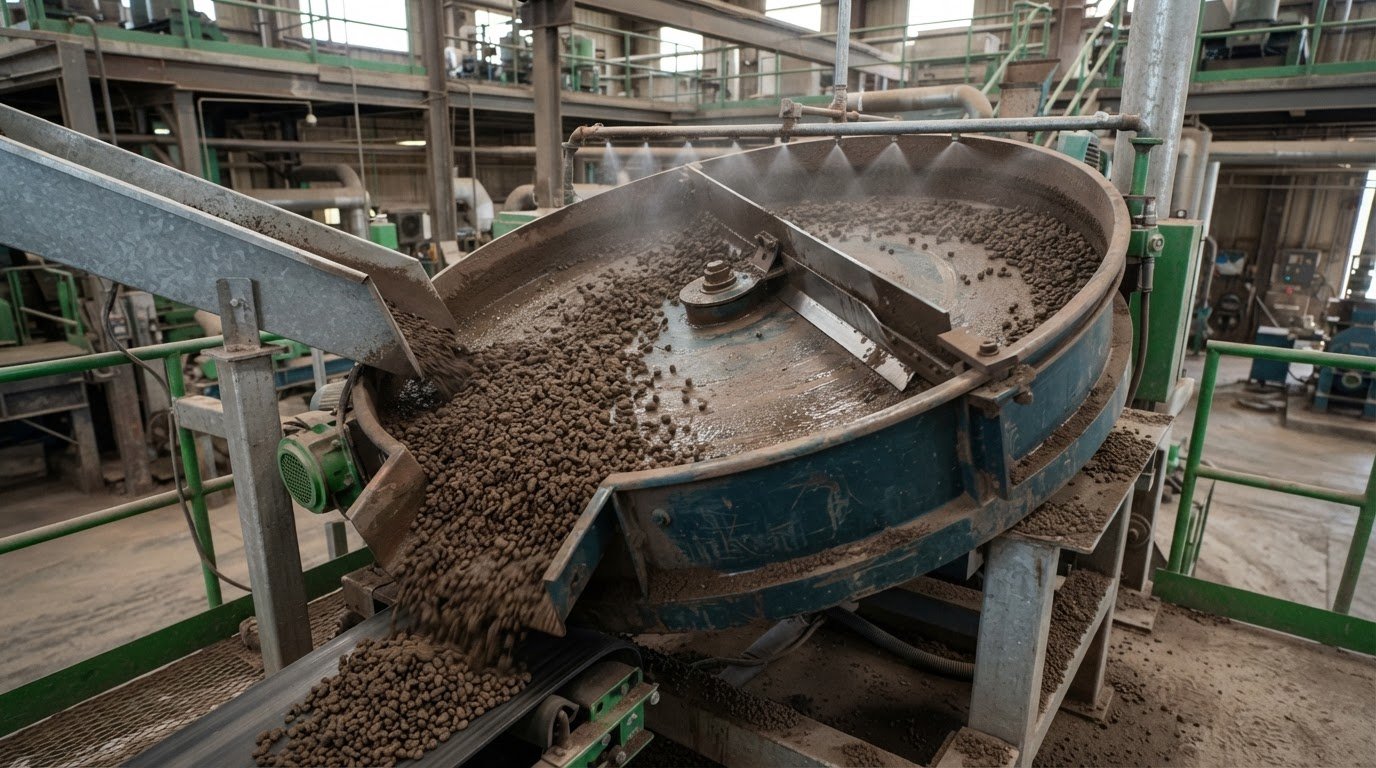
Disc pelletizing forms granules through particle agglomeration as material rolls across an inclined pan. Disc granulation has a reported efficiency of 80-85%, while pan settings and feed conditions influence the resulting size distribution.
Adjusting Disc Granulation Controls
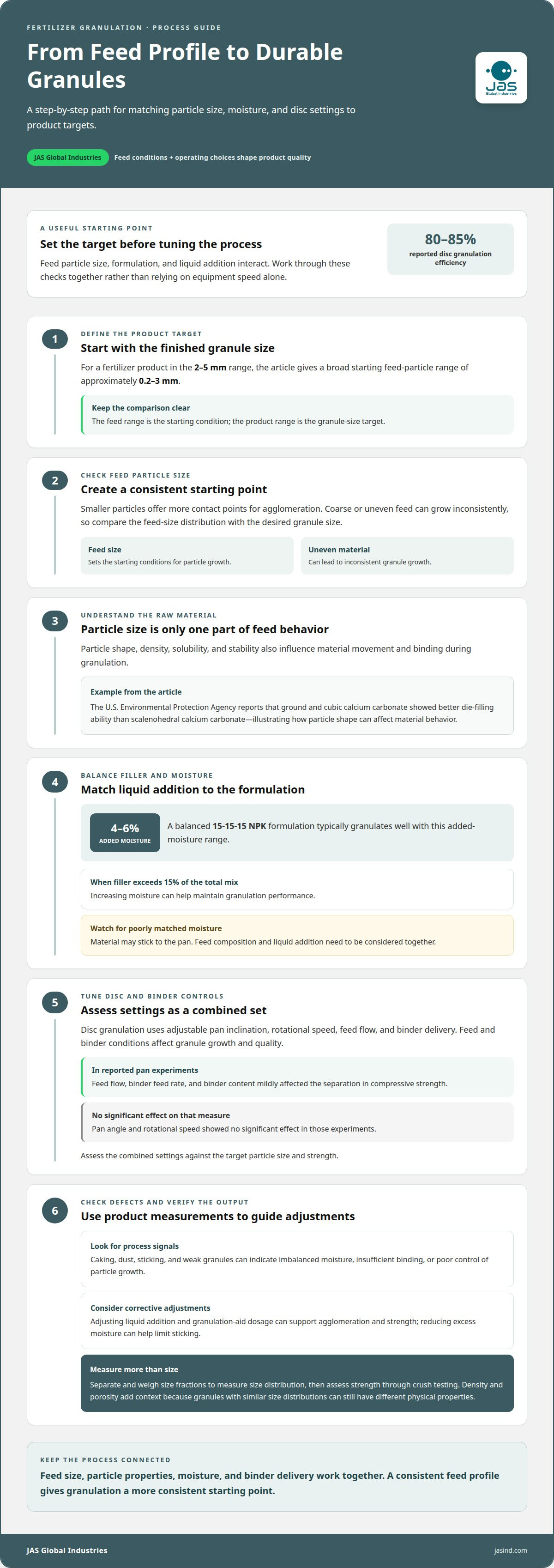
Disc granulation uses adjustable pan inclination, rotational speed, feed flow, and binder delivery to guide particle formation. These controls matter because feed and binder conditions affect granule growth and quality. In reported pan experiments, feed flow, binder feed rate, and binder content mildly affected the separation in compressive strength. Pan angle and rotational speed showed no significant effect on that measure in those experiments. Operators assess the combined settings against target particle size and strength.
Filler and Moisture Effects
Filler content changes the blend’s moisture needs, while moisture helps particles bind during agglomeration. A balanced 15-15-15 NPK formulation typically granulates well with 4-6% added moisture. When filler exceeds 15% of the total mix, increasing moisture can help maintain granulation performance. Moisture that is poorly matched to the formulation can also make material stick to the pan, so feed composition and liquid addition need to be considered together.
Granulation Defects and Corrections
Caking, dust, sticking, and weak granules can indicate imbalanced moisture, insufficient binding, or poor control of particle growth. Adjusting liquid addition and granulation-aid dosage can support agglomeration and granule strength; reducing excess moisture can help limit sticking. In the United States, worker-safety rules address dust exposure and process hazards, while environmental controls address particulate and vapor emissions. Specific obligations depend on the materials and facility operations. The U.S. Environmental Protection Agency notes that producing smaller urea granules requires a higher seed-particle recycle rate, increasing fines and emissions.
Controlled-release fertilizers use engineered granules to release nutrients gradually. Their release properties can support precise plant nutrition and help minimize leaching or runoff. Disc pelletizing can shape granules, but the formulation and process determine the final particle properties and release behavior.
Raw material particle size distribution
Feed particle size sets the starting conditions for agglomeration: smaller particles offer more contact points, while coarse or uneven materials can grow inconsistently. For a 2-5 mm fertilizer product, a broad starting range of approximately 0.2-3 mm is used. Raw material structure, density, solubility, and stability also affect how formulations respond during granulation.
Which raw material properties affect granulation? Particle size and shape influence contact between materials; density, solubility, and stability affect movement and binding. For example, the U.S. Environmental Protection Agency reports that ground and cubic calcium carbonate showed better die-filling ability than scalenohedral calcium carbonate, illustrating how particle shape can affect material behavior.
Particle size and liquid addition interact. The amount and addition rate of granulating liquid affect the resulting particle size because liquid distribution changes how particles bind and grow. Compare the feed size distribution with the target granule size, then assess whether liquid is distributed evenly through the blend. Excess moisture can make material stick to equipment, while uneven wetting can cause different parts of the batch to grow differently.
How can granule size, strength, and uniformity be measured? Separate and weigh size fractions to measure size distribution, then assess strength through crush testing. Density and porosity add context: similar size distributions can still produce granules with different physical properties. These measurements help compare formulations and determine whether a change in raw material configuration improves the product.
Size distribution matters after production, too. Granules must withstand handling and support consistent nutrient application in agriculture. Their formulation and structure can also influence nutrient release, particularly for controlled-release products. A well-matched raw material profile gives the process a more consistent starting point. For additional formulation support, explore fertilizer granulation aids, which can help promote particle agglomeration and granule strength.
Equipment design for throughput, energy use, and product quality
Equipment selection connects feedstock behavior with production targets and downstream processing. Consider throughput, energy demand, and granule quality together.
Feedstock and Product Selection Factors
Process selection matches feedstock characteristics and product requirements to equipment design. Feed properties, desired granule properties, reaction requirements, and capital and operating expenses all inform the configuration. Listed energy consumption is 50 kWh per ton for fluidized-bed granulation, 60 kWh per ton for drum granulation, and 70 kWh per ton for disc granulation. These figures help frame equipment choices alongside throughput and quality targets.
Granulation Time and Productivity
Granulation time affects how production capacity aligns with the required endpoint. Longer growth can change particle size and distribution, while setting an endpoint around a target average size or distribution index supports consistent production. In reported pan experiments, particle size affected bulk density more than operating parameters. A lower pan inclination angle produced a stronger difference between pan and product samples, showing why sampling location matters when assessing uniformity.
Mixer-to-Dryer Production Systems
Mixer-to-dryer systems combine feed preparation and moisture removal in a linked production sequence. They are commonly used for high-moisture materials such as animal manures. A mixer can blend solids and liquids before granulation, while the dryer reduces moisture afterward. This configuration connects feed consistency with final granule strength and quality, making the material’s moisture behavior central to process development.
Drying, Screening, and Recycle Rates
Drying, cooling, screening, and recycle determine how much material becomes usable on-size product. Wet-granulated fertilizer should be dried and cooled; rotary dryers tumble pellets through drying air. Screening separates on-size granules, while oversize material is crushed and recycled with undersize material. This recycle returns feed for further growth, but also adds circulating load. A typical drum-plant recycle ratio is 4:1, linking recycle management with granulation efficiency and production flow.
Drum granulation process and operating parameters
Drum granulation is a non-pressure, tumble-growth method. Particles move across a bed of fines as binder spray makes surfaces tacky and helps them collect more material. The reported granulation efficiency is 85-90%, but the result depends on the formulation and operating parameters. The central control task is balancing liquid addition, particle movement, and recycle so granules grow without excessive sticking or fines.
For high-nitrogen formulations, the process parameters include steam pressure of 0.15 to 0.25 MPa and material temperature between 55 and 65 degrees Celsius. These values describe a specific formulation context, not a universal setting for every fertilizer. Drum speeds of 12, 18, and 24 rpm can produce different outcomes with the same mixing ratio. Adjust speed and binder delivery together, then assess how the resulting granules grow and hold together.
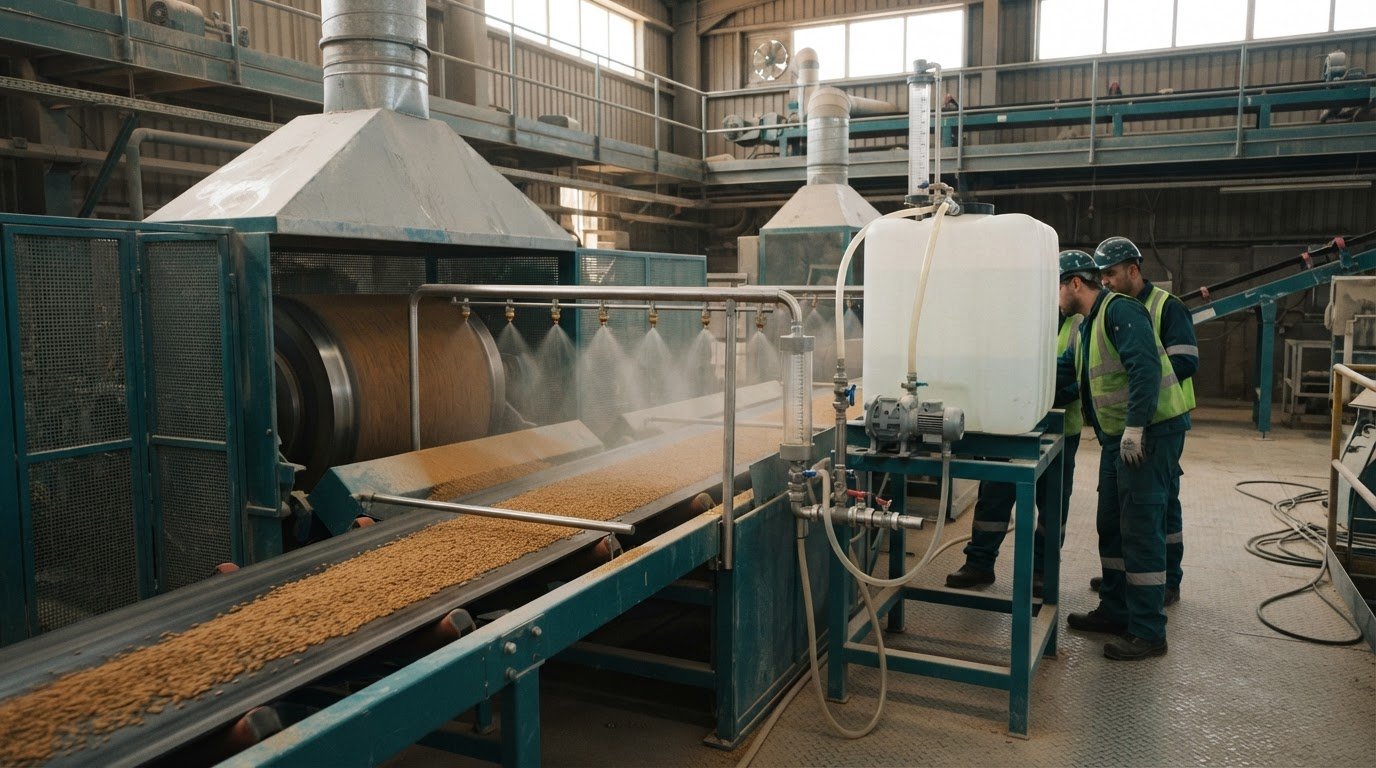
Binder feed and moisture influence both growth and handling. The amount and addition rate of granulating liquid affect particle size; excess moisture can make material stick to equipment. In a drum, binder spray supports particle agglomeration by making fines tacky, while uneven application can lead to inconsistent growth. The critical Stokes number for industrial-scale NPK granulation is approximately 700, a process measure associated with granule growth.
Temperature also matters for nutrient stability. Above 100-105°C, sensitive nutrients require careful control of thermal decomposition. Traditional production screens granules to separate on-size product; oversize material is crushed and recycled with undersize material. Use size distribution, granule strength, and moisture as linked indicators when refining drum settings. A controlled approach tunes liquid, speed, temperature, and recycle around the product formulation rather than treating each setting in isolation.
If binder selection is a process challenge, explore fertilizer granulation aids to support particle agglomeration and granule strength.
JAS Global Industries: Fertilizer Anti-caking Agents
JAS Global Industries offers Fertilizer Anti-caking Agents for fertilizer handling challenges that persist after granulation. Caking can interfere with free-flowing product movement during storage and application, while dust formation can affect handling during production and transport. These issues call for attention to post-granulation behavior as well as granule formation.
For caking concerns, fertilizer anti-caking agents address product handling. For dust concerns, Fertilizer Dust Suppressants meet a separate handling need. The appropriate focus depends on the difficulty affecting the finished fertilizer; one additive should not be assumed to solve every granulation issue. JAS Global Industries also offers Fertilizer Granulation Aids for processes focused on particle agglomeration.
Contact JAS Global Industries to discuss fertilizer handling and additive needs.
Move From Process Insight to the Next Improvement
Use operating data from your line to identify the next change worth testing. A clear product-quality target, paired with observations of process behavior, helps teams focus development on the factors that matter most. Optimizing fertilizer granulation process performance means more than adjusting equipment. It means aligning formulation, operating decisions, and finished-product handling with defined production needs.
For post-granulation handling challenges, JAS Global Industries offers Fertilizer Anti-caking Agents and Fertilizer Dust Suppressants. Its Mining Flotation Collectors serve a distinct need in mineral processing. Identify the challenge most relevant to your operation and make it the starting point for a focused discussion.
Contact JAS Global Industries to discuss your fertilizer process needs. Each well-chosen improvement can help build a more consistent path from production to product handling.
Frequently Asked Questions
What Are Fertilizer Granulation Aids?
Fertilizer granulation aids are additives that support particle agglomeration and help granules develop strength. Some function as binders during formation, while other additives address handling issues afterward. The distinction matters: a granulation aid supports granule formation, whereas an anti-caking agent addresses clumping during storage or handling. Selection depends on the formulation, granulation method, and desired product properties.
What are the main fertilizer granulation methods and how do they compare?
Main methods include wet granulation in drums or pans, fluidized-bed granulation, dry roller compaction, extrusion, and tower granulation. Wet methods use liquid to help particles bind; dry granulation compresses raw materials between rollers without water or binder. Fluidized beds use moving air to support particle growth. Tower granulation uses molten material and avoids a separate drying step. Feedstock properties and product targets guide method selection.
What are the steps for optimizing a fertilizer granulation process?
Start by defining the finished product’s acceptance criteria, including size distribution, strength, moisture, and handling needs. Characterize the feed materials and choose equipment suited to their properties and the formulation. Establish a reproducible operating baseline, adjust process variables in a controlled way, and compare results with the criteria. Finally, assess whether the endpoint supports downstream drying, screening, storage, and application.
What are typical operating conditions for fertilizer drum and pan granulators?
Operating conditions depend on formulation, feed behavior, and target granule properties. In a drum, operators coordinate material movement with binder or liquid addition, temperature, and recycle. A pan’s inclination and rotational speed affect material movement, while feed and binder delivery influence growth. The practical operating window is the combination that produces the target product without excessive sticking, fines, or unstable granule formation.
How can granulation energy use and production costs be reduced?
Reduce avoidable energy demand by matching equipment capacity to feed and production targets, controlling moisture before drying, and limiting unnecessary recycle. Closed-loop systems, waste-heat recovery, and alternative energy sources can also reduce environmental impact. Screening and crushing oversize material for reuse can recover product, but excessive circulating material adds process load. Evaluate energy use alongside on-size yield, drying demand, and product quality.