


A fertilizer defect doesn’t always begin where it appears. Caking in a finished product, for example, may point to moisture exposure, material characteristics, process conditions, or storage history. Effective troubleshooting fertilizer quality issues starts with evidence, not assumptions based on the symptom alone.
It’s understandable to want a quick adjustment when product quality changes. But an unplanned process change can create new defects, and the same symptom can have different causes depending on the fertilizer and how it was handled. The right corrective action depends on the conditions behind the problem.
This guide explains how to classify defects from observable signs, narrow possible causes through representative sampling and process checks, and compare corrective actions systematically. You’ll also learn how to validate changes against documented results before making them part of routine production. From material variation to storage-related caking, the goal is a clear path from symptom to cause to a measured response.
Key Takeaways
- Classify the defect from observable evidence before deciding what to change.
- Trace potential causes across incoming materials, formulation, production stages, handling, and storage.
- Use inspection, representative samples, lab tests, and process records to investigate different parts of the problem.
- Keep affected lots traceable and verify corrective actions before making release or rework decisions.
- When troubleshooting fertilizer quality issues, consider anti-caking treatment only when evidence points to caking and supports that response.
How to recognize fertilizer quality issues before changing the process
A load arrives with hard lumps, or operators notice more dust at discharge than usual. That visible defect is a clue, not a confirmed root cause. It may reflect a product deviation, handling conditions, or both. Before changing the process, check the relevant customer specification and identify which product property or handling outcome appears to be out of range.
Quality troubleshooting means identifying, testing, and correcting a documented product or process deviation. A single observation can prompt an investigation, but a recurring, measurable difference from a specification or established baseline provides stronger evidence. When troubleshooting fertilizer quality issues, distinguish the material’s properties from what happened to it during cooling, storage, transport, or discharge.
Which fertilizer defects should trigger an investigation?
Record what you can observe without assigning a cause. Caking may appear as lumps; dust may collect in the air or on surfaces; and fines may appear as an unexpectedly large share of small particles. Segregation can show up as visible variation across a pile or package, while irregular granules may differ in size, shape, or surface appearance. Since symptoms can emerge at different stages, note where and when they appear.
- Caking: Document lump size, location, and whether material breaks apart during normal handling. For background on the function of fertilizer anti-caking agents, see the linked overview. Consider an additive only if evidence supports caking as the diagnosed issue.
- Dust and fines: Note where dust collects and whether fine particles are visible in a sample. Visual inspection can flag a concern, but it doesn’t quantify particle distribution.
- Segregation: Record where variation occurs, such as within a package or across a stockpile, and compare samples from relevant locations.
- Irregular granules: Describe differences in size, shape, or appearance, then compare them with the applicable product specification.
A symptom-to-evidence record makes observations useful: describe the defect, identify its location and timing, and note which measurement or comparison could confirm it. Don’t treat appearance alone as proof of a particular cause.
What information should operators record first?
Start with the product grade, batch or lot identification, sampling location, and observation time. Add photographs or written descriptions where useful, and keep each sample clearly identified. Record recent changes in feed materials, operating conditions, packaging, or the storage environment. These details can help distinguish a lot-specific issue from a change that affects production or handling more broadly.
Keep the customer specification alongside the observations. A property that looks different isn’t automatically out of specification, and a handling problem may affect product condition without proving the original product was defective. Consistent records give the investigation a reliable starting point.
How fertilizer composition, processing, and storage can affect quality
A similar-looking defect can have different causes. A change in incoming material may affect granule formation; drying or cooling conditions may influence the finished product; and moisture exposure during storage may alter how it handles. Treat each explanation as a hypothesis and test it against the product specification, batch records, and measurements. Don’t assume one cause applies to every fertilizer or defect.
Review the process in sequence: incoming material, formulation, granulation, drying, cooling, handling, and storage. For example, a shift in particle size distribution could relate to feed material, granulation, or screening. Visual inspection may reveal a difference, but measurement is needed to establish particle size, moisture, or composition. Use a suitable validated method and compare results with the relevant product specification.
How can composition and moisture relate to caking?
Some fertilizer products are hygroscopic, meaning they readily take up moisture from the surrounding air. Others are less sensitive. Moisture absorption may contribute to caking, but composition, handling, and storage conditions can also play a part. Check measured moisture against the product-specific specification using a suitable validated method. Don’t apply a universal moisture threshold. Confirm the limit and method for the material under investigation.
Which process and storage conditions should be reviewed?
Compare granulation consistency, drying and cooling records, and production deviations with the timing and location of the defect. Then review available records for storage duration, packaging condition, temperature history, and moisture exposure. Handling or screening observations can help narrow the investigation, but they don’t prove a single root cause. For laboratory work, identify samples clearly and follow a suitable collection protocol, such as the guidance on fertilizer troubleshooting tests.
- Incoming material: Check supplier or receipt records and compare representative samples for relevant properties.
- Formulation: Review batch sheets and confirm composition through an appropriate analytical method.
- Granulation: Compare operating records and particle size distribution across affected and unaffected material.
- Drying and cooling: Review recorded conditions and measure finished-product moisture using the applicable method.
- Handling and storage: Inspect transfer points, packaging, and storage records. Compare samples from different locations or stages.
This evidence helps distinguish a material or process change from a storage-related effect before you select a response. If the findings indicate caking, an additive may be worth evaluating alongside process, packaging, or storage adjustments. JAS Global Industries supplies fertilizer anti-caking agents and offers technical consulting. Explore fertilizer process support after documenting the defect and operating conditions.
How to compare fertilizer troubleshooting tests and corrective options
A useful test answers a specific question. Visual inspection can locate an apparent defect, but it can’t quantify moisture or particle size. Process records can reveal changes in operating conditions, but they don’t confirm a product property. Laboratory analysis can measure selected properties, but the findings are only as reliable as the sample, method, and test conditions.
A representative sample is material collected using a consistent plan so it reflects the lot or condition being investigated, rather than a convenient handful. This matters because biased or inconsistently handled samples can make comparisons misleading. Keep sample identification consistent, document the source and handling, and follow the applicable product specification and test method.
Which tests help confirm a suspected quality defect?
Choose measurements based on the suspected issue and specification, with qualified laboratory or technical input where needed. Consider moisture, particle size distribution, or caking tendency only when relevant to the product and investigation. Record the method, sample source, test conditions, and any stated uncertainty. This context helps distinguish a meaningful difference from variation in collection or testing.
- Visual inspection: Quickly locates visible changes, but doesn’t establish a measured property or root cause.
- Representative sampling: Provides material for comparison or testing. Inconsistent collection can distort the results.
- Laboratory testing: Measures selected properties using an appropriate method, but doesn’t explain process history on its own.
- Process-record review: Helps identify changes that coincide with the defect, but timing alone doesn’t prove causation.
How should corrective options be evaluated?
Match the response to the confirmed cause. If evidence points to moisture exposure, assess storage or handling controls before assuming a chemical treatment is needed. If production records and measurements point to an operating condition, consider a process adjustment. Where caking is established as the issue, a relevant specialty additive may be evaluated alongside other suitable controls, not presumed to be the answer.
Use a controlled trial with documented baseline conditions and agreed success criteria. Change one defined factor where practical, then compare results using the same sampling plan and test method. Before adopting a change, assess product compatibility, process fit, handling effects, and customer requirements. Document trade-offs as well as the intended improvement. Guidance on fertilizer storage and handling can also inform a review of storage-related controls.
This evidence-led approach makes troubleshooting fertilizer quality issues more systematic: test the suspected cause, select a proportionate response, and verify the outcome before standardizing a change.
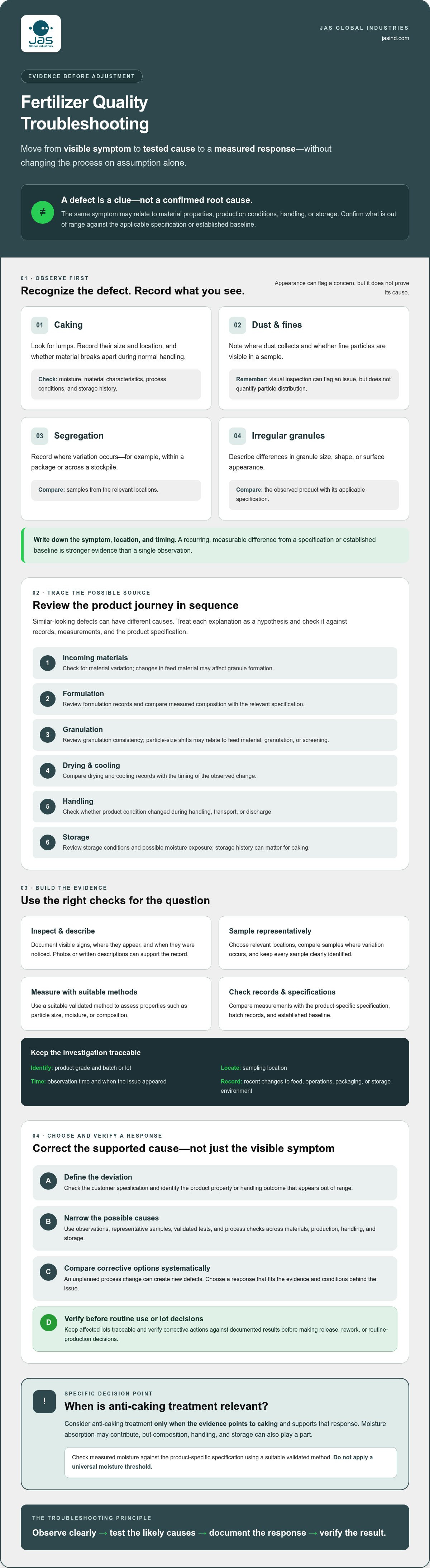
How to troubleshoot fertilizer quality issues step by step
A structured investigation protects product traceability and helps prevent a quick fix from obscuring the real cause. Before making a process change, assign responsibility for the investigation, define the quality question, and agree on what evidence would confirm or rule out the suspected cause.
How can a team run a controlled investigation?
Keep the scope focused. Where appropriate, compare affected material with a documented reference using a consistent sampling approach. Set baseline measurements before a trial, and decide in advance which follow-up results will indicate improvement. Changing one relevant factor at a time makes results easier to interpret. If production constraints require other changes, record them as potential confounding factors.
- Define the defect. Describe the observed deviation, where it occurs, and which product requirement or baseline it differs from.
- Contain affected material. Identify potentially affected batches or lots, preserve their traceability, and follow site procedures before making release, rework, or disposal decisions.
- Gather evidence. Assemble sample details, production and handling records, observations, and the relevant product specification. Record recent changes that could be connected to the issue.
- Test potential causes. Select measurements that address the quality question. Compare affected material with a suitable reference using comparable sampling and test conditions.
- Trial a corrective action. Choose an action that matches the evidence, document the baseline, and change one relevant factor at a time where operationally practical.
- Verify the outcome. Repeat the selected measurements, compare results with the agreed criteria, and check whether the outcome persists before standardizing the change.
How should corrective actions be verified?
Use the same measurement method and comparable sampling conditions for baseline and follow-up checks. A single favorable result may not show that a change is reliable across production. Review results across relevant batches or operating periods, and record any changes in feed materials, settings, handling, or storage that could affect the comparison. If results are mixed, revisit the suspected cause rather than adding another adjustment without evidence.
Maintain lot identification throughout the investigation. Site procedures should govern the status and disposition of potentially affected material. A promising trial result alone doesn’t determine whether a lot can be released or reworked.
For complex or recurring issues, technical consultation may help assess whether a specialty chemical application fits the documented conditions. JAS Global Industries offers technical consulting and process optimization, and supplies fertilizer specialty chemicals including anti-caking agents, dust suppressants, coloring agents, and granulation aids. The relevant option depends on the diagnosed issue, not the symptom alone. Discuss a documented fertilizer process issue with JAS when the evidence points to a specialty chemical application.
When fertilizer anti-caking agents or technical support may be appropriate
Consider an additive only when evidence supports the diagnosed defect and the process conditions make that option relevant. When troubleshooting fertilizer quality issues, caking is not automatically proof that an anti-caking treatment is needed. Moisture exposure, packaging, storage, or handling may be the more direct cause, and addressing those conditions may be the better first step.
When might a fertilizer anti-caking agent be considered?
Consider a fertilizer anti-caking agent when testing and operating records confirm, or strongly indicate, a caking concern. Before selecting a treatment, ask technical specialists to assess compatibility with the product, application process, and applicable quality requirements. An anti-caking agent isn’t a general remedy for dust, segregation, irregular granules, or every storage issue. Match the response to the evidence.
Compare options against the established cause. If records indicate that moisture entered through damaged packaging or unsuitable storage, correcting that exposure may be more relevant than changing the treatment. If evidence points to caking despite appropriate process and storage controls, evaluating an anti-caking agent may be reasonable. JAS Global Industries supplies fertilizer anti-caking agents and provides technical consulting. Results depend on the product and operating conditions.
What information should teams prepare for technical support?
A useful technical discussion starts with evidence. Assemble the product grade, affected batch history, defect description, and relevant product specification or customer requirements. Include sampling methods and locations, test results, process records, and available storage or handling history. Note recent changes as well. Together, these details help specialists assess whether the issue may relate to a chemical application or another part of the process.
- Product and lot: Identify the grade and affected batches, and distinguish them from unaffected material.
- Defect evidence: Describe when and where the symptom appears, with measurements and test conditions where available.
- Operating context: Share relevant production, packaging, storage, and handling records.
- Requirements: Provide the specification or customer criteria the product is expected to meet.
Keep the discussion focused on the observed issue and the evidence gathered, rather than starting with a preferred additive or process change. This gives technical support a sound basis for assessing possible next steps and whether a specialty chemical application is appropriate. To discuss a documented fertilizer quality issue with JAS, share your product, defect, process, and test details.
Turn fertilizer quality findings into confident action
Effective troubleshooting fertilizer quality issues begins with evidence. Classify the defect, trace potential causes across materials, production, and storage, then use appropriate tests to guide a proportionate response. A visible symptom can direct an investigation, but it doesn’t confirm the root cause.
Keep affected lots traceable, document baseline conditions, and verify any corrective action under comparable conditions before standardizing a change. Anti-caking agents may be relevant when findings support caking; other defects may call for process, packaging, storage, or handling adjustments instead.
JAS Global Industries has served industrial sectors since 1998. It supplies fertilizer anti-caking agents and offers technical consulting and process optimization. If you’ve documented the product, defect, process conditions, and test results, discuss your fertilizer quality challenge with JAS. A clear evidence base can make the next conversation more focused and the next step more informed.
Frequently Asked Questions
Why does fertilizer cake during storage?
Fertilizer can cake because of several interacting factors, including product properties, moisture exposure, storage conditions, and handling. Lumps alone don’t identify the cause. Check representative samples and review batch, packaging, and storage records, then compare relevant measurements with the product specification. Depending on the evidence, a suitable response might involve adjusting storage or handling practices, reviewing process conditions, or assessing an additive. Avoid selecting a treatment based on appearance alone.
How do you test fertilizer quality problems?
Start by defining the observed defect and collecting traceable, representative samples. Select measurements that relate to the specification and suspected cause, such as moisture or particle size distribution where relevant. Record the sampling location, method, handling, and test conditions so results can be interpreted consistently. Compare affected material with an appropriate reference. If the correct test method or meaning of a result is uncertain, seek qualified laboratory or technical input before deciding what to change.
Can fertilizer quality issues be fixed with an anti-caking agent?
Sometimes. An anti-caking agent may be appropriate when caking is confirmed or strongly supported by evidence and the treatment fits the product and process. It isn’t a universal solution for dust, segregation, or inconsistent granulation. First establish the likely cause and review applicable product requirements. Then assess any proposed treatment through a controlled, documented trial with technical guidance, using agreed criteria to evaluate the outcome before adopting a change.
What causes fertilizer granules to break or produce excess fines?
Possible contributors include granulation conditions, product composition, drying or cooling, transfer, storage, and mechanical handling. These are hypotheses, not a diagnosis. Compare traceable samples from relevant process stages, review operating records, and measure particle size distribution using a suitable method. Change one relevant factor at a time where practical. If several variables must change together, document them because that can make it harder to determine which change influenced the result.
How can you tell whether a fertilizer problem comes from production or storage?
Compare traceable samples taken at appropriate points, such as after production and after storage, if available. Review batch records alongside packaging condition, storage history, and handling events. Differences between samples can help narrow the investigation, but only if sampling and test methods are comparable. Check results against the product specification before assigning a cause. A sample collected after storage alone may not show whether the defect was present when production ended.
When should a fertilizer manufacturer seek technical troubleshooting support?
Seek specialist support when defects recur, test results conflict, process changes have uncertain effects, or a documented investigation hasn’t clarified the cause. Prepare product grade and batch details, applicable specifications, defect observations, sample information, test results, process records, and storage history. This evidence helps technical specialists assess possible process adjustments or relevant specialty chemical options. JAS Global Industries offers technical consulting and process optimization, and supplies fertilizer anti-caking agents when the diagnosed issue makes them relevant.