

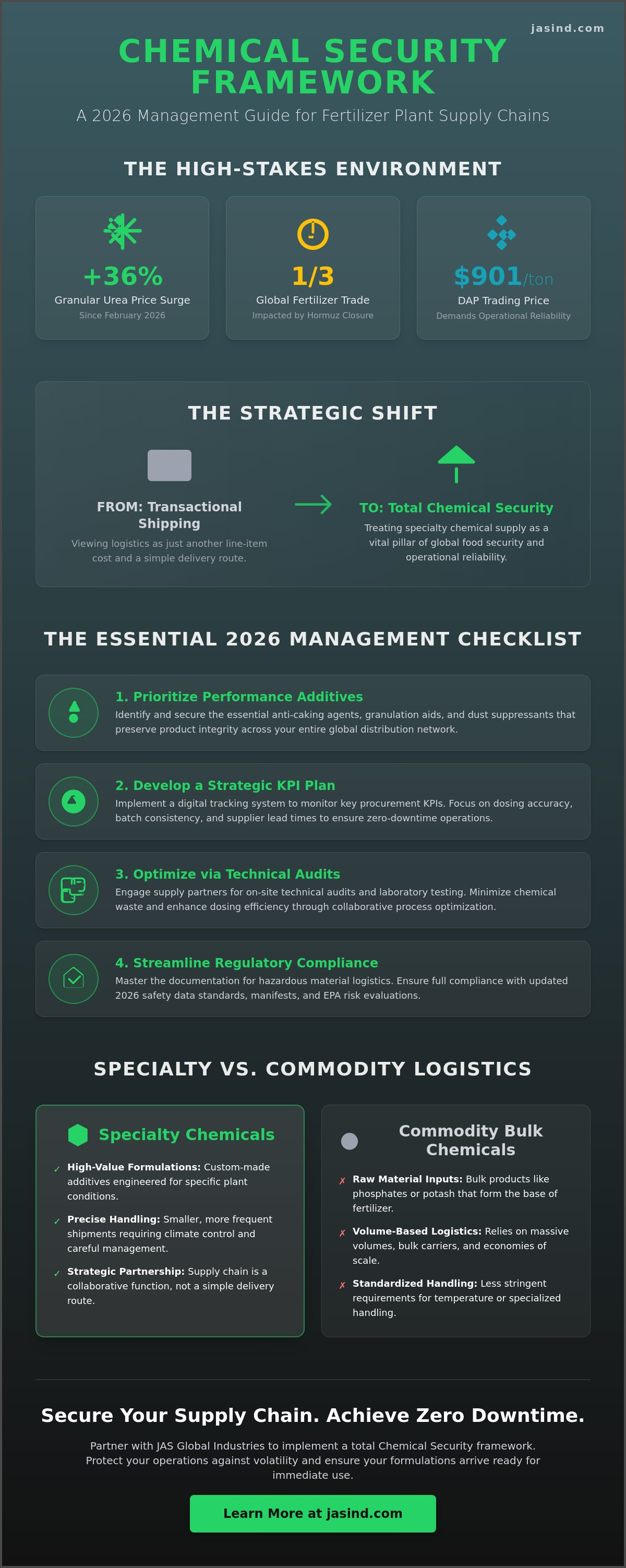
Granular urea prices in New Orleans have surged 36% since February 2026, while the closure of the Strait of Hormuz now impacts nearly one third of the global fertilizer trade. These figures prove that your logistics strategy is no longer just a line item. It's a pillar of global food security. You understand that a single shipment of degraded anti-caking agent or a missed regulatory deadline can halt production during critical planting windows. When DAP trades at $901 per ton, operational reliability is your only defense against extreme market volatility.
Mastering specialty chemicals supply chain management for fertilizer plants requires a shift from transactional shipping to a model of total chemical security. We're here to help you secure your operations against disruptions and ensure your formulations arrive ready for immediate use. This 2026 management checklist provides the framework to achieve zero-downtime supply and full compliance with the latest EPA risk evaluations issued on May 5, 2026. You'll learn how to optimize chemical dosing to reduce waste and navigate the complex maritime regulations that define our current industrial landscape.
Key Takeaways
- Identify the essential role of performance additives like anti-caking agents and granulation aids in preserving product integrity across global distribution networks.
- Develop a strategic chemicals management plan focused on procurement KPIs like dosing accuracy and batch consistency to ensure zero-downtime operations.
- Optimize your specialty chemicals supply chain management for fertilizer plants through technical audits and on-site laboratory testing that minimize chemical waste.
- Streamline regulatory compliance by mastering the documentation requirements for hazardous material logistics, including updated 2026 safety data standards and manifests.
- Transition toward a "Chemical Security" framework that treats specialty chemical supply as a vital pillar of global food security and long-term operational reliability.
Understanding the Role of Specialty Chemicals in Fertilizer Supply Chains
Specialty chemicals in the fertilizer industry are not mere commodities; they're high-value performance additives designed to solve specific functional challenges. These include anti-caking agents, dust suppressants, and coloring agents. Unlike the bulk raw materials that form the base of the product, these performance chemicals determine the final physical state and marketability of the fertilizer. In the context of specialty chemicals supply chain management for fertilizer plants, these additives act as the final safeguard for product integrity. They are the quiet guardians of global food security.
As of May 2026, the industry has pivoted toward sustainable, bio-based surfactants and tailor-made formulations. This shift responds to tightening environmental regulations and a global demand for lower carbon footprints in agricultural inputs. Modern plants now require formulations that aren't just effective, but also compliant with the latest ecological standards. This evolution demands a more agile approach to procurement and logistics.
The Critical Nature of Anti-caking and Dust Suppression
Caking during long-distance maritime transport can render thousands of tons of product unsalable. With MAP prices reaching $939 per ton as of April 2026, even a 5% loss due to caking represents a massive financial hit. High-performance anti-caking agents must possess specific chemical markers: low viscosity for easy application, high thermal stability, and excellent moisture barrier properties. Beyond economics, dust suppressants are vital for safety. Fine fertilizer dust in bulk handling facilities creates respiratory hazards and combustible environments. Effective dust control ensures a safer workspace and minimizes material loss during transfer.
Specialty Chemicals vs. Commodity Bulk Chemicals
The Essential Chemicals Management Plan Checklist for Fertilizer Plants
A robust chemicals management plan is no longer a back-office document. It is a strategic framework that ensures operational reliability and protects your bottom line. In an era where fertilizer prices remain volatile, with Urea at $866 per ton as of May 2026, every drop of additive must be accounted for. Effective specialty chemicals supply chain management for fertilizer plants transforms these additives from simple inputs into assets that safeguard your production schedule. This plan must be integrated into your core Standard Operating Procedures (SOPs) to ensure that technical support from your partners is just a phone call away when process deviations occur.
Your 2026-ready digital tracking system should provide real-time visibility into chemical inventory and consumption rates. This data allows for the establishment of clear procurement KPIs. You must track lead time, dosing accuracy, and batch consistency with surgical precision. Because the federal CFATS program has remained unrecorded since its expiration in July 2023, plants must adopt voluntary Chemical Security Best Practices to mitigate risks. Building this culture of security ensures that your facility remains an indispensable pillar of global food infrastructure.
Phase 1: Procurement and Sourcing Strategy
- Evaluate Supplier R&I: Verify that your partner has the Research and Innovation (R&I) capabilities to adapt formulations to your specific ore or feedstock.
- Network Resilience: Assess the strength of the supplier's global distribution network. Ensure they maintain active, reliable hubs in key regions like Dubai, Riyadh, and Amman to bypass current maritime chokepoints.
- Ethical Sourcing: Verify sustainability certifications and the ethical origin of all chemical reagents to meet 2026 environmental transparency standards.
Phase 2: Storage and On-site Handling
- Standardize Storage: Sensitive additives like granulation aids require strict temperature and humidity controls. Standardize these conditions to prevent product degradation before use.
- Automated Dosing: Implement automated dosing systems. These units eliminate human error and significantly reduce chemical waste, ensuring you only use what is necessary for optimal performance.
- Safety Audits: Conduct regular safety audits for hazardous material storage areas. This proactive approach prevents accidents and ensures your facility remains compliant with evolving international safety codes.
By treating your supply chain as a series of specialized additive solutions rather than simple transactions, you build the long-term stability required for modern industrial success. This checklist isn't just about logistics; it's about manufacturing relationships that stand the test of global market shifts.
Beyond Logistics: Technical Audits and Process Optimization
The most resilient supply chain is the one that minimizes consumption through technical precision. While logistics focus on the movement of goods, specialty chemicals supply chain management for fertilizer plants achieves its highest value during the application phase. Over-dosing is a common form of waste that puts unnecessary pressure on your procurement cycles and increases operational costs. On-site laboratory testing is the only way to determine the exact dosing requirements for your specific batch of raw materials. By conducting regular technical audits, plants can reduce their chemical footprint while maintaining the highest product quality.
Process optimization fees aren't just costs; they're strategic investments that provide a clear ROI. When a plant reduces its anti-caking agent consumption by even 10%, the financial recovery is immediate. This is especially true when global container rates sit at $2,286 as of May 7, 2026. Custom formulations have already solved yield issues in complex environments like the phosphate mines of Tunisia and the nitrogen facilities in Egypt's Nile Delta. These regions face unique mineralogical challenges where standard, off-the-shelf reagents simply fail. Our role as a partner is to ensure that your specialty chemicals supply chain management for fertilizer plants is optimized for these specific local conditions.
The Value of Tailor-Made Formulations
One-size-fits-all chemicals don't work in a diverse global market. A formulation that performs in the damp climates of Northern Europe will likely fail in the extreme heat and low humidity of the Middle East. Developing a custom reagent starts with a comprehensive audit of the plant’s specific mineralogy and climatic stress factors. We move from rigorous laboratory testing to pilot implementation to ensure the product performs under real-world pressure. Specialized additives, such as custom-engineered granulation aids, can significantly reduce the energy required for grinding and drying processes, lowering your plant's overall carbon footprint.
Implementing On-Site Technical Support
Technical consultants act as the bridge between chemical theory and plant reality. Their role is to identify and troubleshoot operational bottlenecks before they lead to production downtime. Training your staff on the safe and efficient handling of specialty chemicals is a core pillar of our "Manufacturing Relationships" philosophy. This creates a continuous feedback loop between the plant floor and the chemical manufacturer. The data gathered during these interactions informs the next generation of formulations, ensuring your operations remain as innovative as they are reliable.
Navigating Global Regulatory Hurdles and Hazardous Material Logistics
Regulatory compliance in 2026 is a moving target. The EPA's final rule on pesticide tolerance limits, effective April 22, 2026, and the May 5, 2026 risk evaluation for 1,2-dichloroethane have reshaped the industrial landscape. These updates demand a rigorous documentation trail. Every shipment must be backed by a precise Certificate of Analysis (COA), an updated Material Safety Data Sheet (MSDS), and comprehensive shipping manifests. In the context of specialty chemicals supply chain management for fertilizer plants, these documents are more than paperwork; they're the legal proof of your product's safety and quality.
Compliance as a Competitive Advantage
Staying ahead of environmental mandates isn't just about avoiding fines. It's about market access. As of 2026, the demand for biodegradable anti-caking agents and sustainable dust suppressants has opened new opportunities in highly regulated European and North American markets. Adhering to international standards builds immediate trust with global fertilizer buyers who prioritize ESG metrics. Active participation in trade associations ensures you're never surprised by policy shifts. This allows you to pivot before your competitors do. We view compliance not as a hurdle, but as a commitment to manufacturing relationships that last.
Mitigating Supply Chain Disruptions
Geopolitical instability, such as the closure of the Strait of Hormuz, has impacted nearly one third of the global fertilizer trade. A resilient specialty chemicals supply chain management for fertilizer plants relies on multi-hub manufacturing. Operating production sites in Egypt, China, and Saudi Arabia provides the geographic diversity needed to bypass regional chokepoints. Safety stock strategies must be balanced against the specific shelf life of performance chemicals. Using digital tracking to manage a "first-in, first-out" inventory model prevents degradation while ensuring a buffer against logistics delays. This proactive approach turns supply chain pressure into operational stability.
If you're ready to secure your logistics against global volatility, contact our specialized additive experts today to discuss a tailored supply strategy.
Strategic Partnerships: Why Chemical Security is the Future of Fertilizer
True chemical security is built on partnerships that transcend the traditional buyer-supplier dynamic. At JAS Global Industries, we don't just sign contracts. We manufacture relationships. This philosophy is the cornerstone of specialty chemicals supply chain management for fertilizer plants in an increasingly volatile global market. By positioning ourselves as a Global Visionary Partner, we ensure that your facility isn't just surviving market shifts; it's leading through them. The World Bank's weighted average price index for fertilizers reached 208.70 in April 2026. This represents a 61.48% increase from April 2025. In such a high-stakes environment, the stability of your performance additive supply is a vital shield for your operational margins.
Our mission is inextricably linked to global food and water security. Every batch of anti-caking agent or dust suppressant we distribute is a contribution to a more stable world. We understand that your plant is a pillar of modern infrastructure. Our role is to provide the technical industrial expertise that keeps that pillar standing. By integrating our specialized additives into your long-term strategy, you secure the flowability and quality required to feed a growing population. This transition from a transactional model to one of shared responsibility ensures that your production remains resilient against any geopolitical or economic disruption.
The "JAS Cares" Approach to Industrial Excellence
Social and environmental responsibility isn't a secondary goal. It's the foundation of our chemical formulations. The "JAS Cares" designation reflects our commitment to creating sustainable additives that protect both the product and the planet. Reliable chemical supply has a direct impact on local agricultural communities by ensuring that high-quality fertilizers reach the soil without degradation. We're building a legacy of quality and trust. This commitment ensures that every relationship we manufacture contributes to the foundational needs of society like food and water security. It's about being a responsible corporate citizen while maintaining industrial excellence.
Getting Started: Your 2026 Supply Chain Audit
Initiating a technical audit is the first step toward long-term stability. Our experts conduct a comprehensive review of your current chemicals management plan. We identify opportunities for dosing optimization and waste reduction. A recurring bulk chemical supply contract offers more than just logistics. It provides price stability in a market where transportation costs surged over 50% in the year leading up to March 2026. This proactive approach secures your inventory against future geopolitical disruptions and ensures consistent product quality. Contact our Dubai headquarters to optimize your fertilizer plant supply chain and begin your transition toward total chemical security today.
Securing Your Operations for a Resilient Agricultural Future
The industrial landscape of 2026 requires more than just reactive logistics. It demands a strategic overhaul of specialty chemicals supply chain management for fertilizer plants to protect both your margins and global food security. You've seen how technical audits and precision dosing reduce waste; while proactive compliance with May 2026 EPA standards prevents costly operational delays. Since 1998, JAS Global Industries has provided the technical expertise needed to master these complexities through every market shift. Our global presence and dedicated R&I centers allow us to develop custom formulations specifically for the high-stakes mining and fertilizer sectors.
It's time to move beyond transactional contracts and embrace a partnership built on reliability and long-term value. We're ready to help you transform your chemical inventory into a strategic asset that ensures total operational stability. Partner with JAS Global Industries for chemical security and operational excellence to safeguard your facility's future. By manufacturing relationships and distributing quality, we can build a more secure foundation for the world's food and water resources together. Your journey toward a zero-downtime supply chain starts with a single technical audit.
Frequently Asked Questions
What are the core components of a chemicals management plan for fertilizer plants?
A robust plan centers on three pillars: precise procurement KPIs, automated dosing, and a digital tracking system for real-time consumption data. It ensures that specialty chemicals supply chain management for fertilizer plants moves from a transactional cost to a strategic advantage. By integrating supplier technical support into standard operating procedures, plants can mitigate process deviations before they impact yield or product quality.
How do specialty chemicals like anti-caking agents affect the fertilizer supply chain?
Anti-caking agents act as a critical safeguard for product flowability during long maritime voyages. Without these performance chemicals, granular products can fuse into solid blocks; this leads to expensive mechanical reclamation or total product rejection at the destination port. This protection is vital when fertilizer price indices show a 14.05% increase in a single month as of April 2026.
Can custom chemical formulations reduce overall production costs in fertilizer plants?
Custom formulations reduce costs by eliminating the waste associated with "one-size-fits-all" reagents. Tailor-made granulation aids specifically lower the energy required for drying and recycling, which accounts for a significant portion of plant overhead. Precise dosing, determined by on-site laboratory testing, ensures you only consume the exact amount of chemical needed for your specific raw material profile and climatic conditions.
What are the biggest regulatory challenges for specialty chemical logistics in 2026?
The 2026 landscape is defined by the EPA's final risk evaluations for chemicals like 1,2-dichloroethane and updated pesticide tolerance limits effective April 22, 2026. Additionally, the lack of federal reauthorization for programs like CFATS since July 2023 forces plants to adopt voluntary security standards. Navigating these jurisdiction-specific rules requires an agile documentation process, including real-time updates to Certificates of Analysis and safety manifests.
How does JAS Global Industries ensure the reliability of its global chemical supply?
Reliability is maintained through a diversified manufacturing footprint across Egypt, China, and Saudi Arabia. This multi-hub strategy allows us to bypass regional chokepoints like the Strait of Hormuz, which currently impacts nearly 33% of global trade. We manage specialty chemicals supply chain management for fertilizer plants from our Dubai headquarters to ensure seamless cross-border logistics and consistent quality across all continents.
Why is technical consulting necessary for optimizing fertilizer granulation and dust control?
Technical consulting is essential because chemical performance varies based on local humidity and ore mineralogy. Consultants provide the on-site troubleshooting necessary to identify bottlenecks in the granulation loop or dust suppression systems. This hands-on approach trains plant staff in safe handling and creates a vital feedback loop that informs future formulation improvements and long-term operational stability.
What is the impact of specialty chemicals on global food security?
Specialty chemicals are the linchpin that ensures essential nutrients actually reach the soil. By preventing caking and degradation, these additives protect the global supply of nitrogen, phosphate, and potash. In a market where nearly one third of trade is threatened by geopolitical instability, ensuring every ton of fertilizer remains flowable is a direct contribution to global stability and hunger prevention.
How can fertilizer plants manage the risks of hazardous material transport?
Risk management starts with a rigorous documentation trail, including Certificates of Analysis, MSDS, and accurate shipping manifests. Plants must also implement specialized storage solutions that account for extreme climates to prevent chemical degradation during transit. Working with a Global Visionary Partner ensures that hazardous logistics are handled with the professional precision required to meet international safety codes and environmental mandates.