
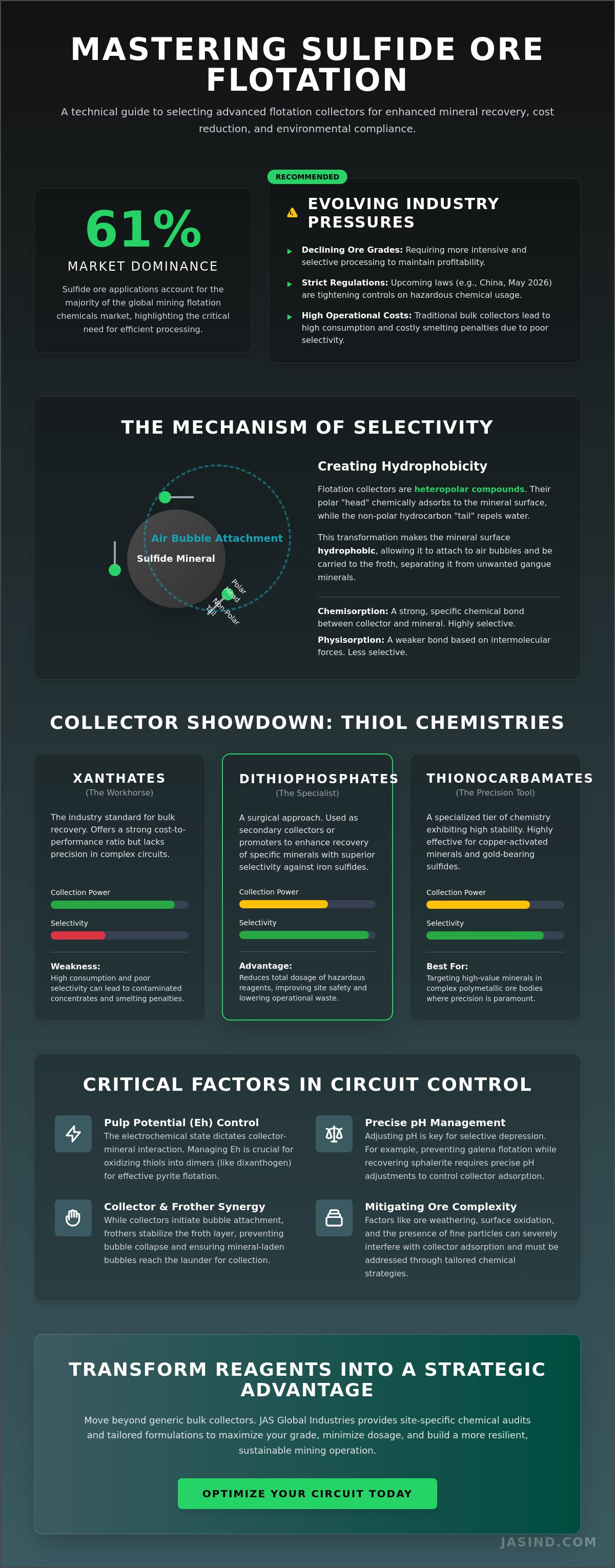
Sulfide ore applications account for 61% of the global mining flotation chemicals market, yet the industry's continued reliance on generic bulk collectors is rapidly becoming a liability for mineral security. You're likely facing the dual challenge of declining ore grades and increasingly strict global regulations, such as the hazardous chemical safety laws implemented in China on May 1, 2026. It's clear that traditional xanthates often lead to high consumption costs and poor selectivity in complex circuits. Finding the right flotation collectors for sulfide ore processing is no longer just a technical choice; it's a necessity for maintaining operational viability and environmental trust.
This guide will empower you to master the technical nuances of mineral recovery through a deep-dive comparison of modern collector chemistries and circuit strategies. You'll learn how to transition from generic reagents to precision-engineered thiol formulations that maximize grade while minimizing dosage requirements. We'll examine specific performance data and environmental strategies to help you build a more resilient, sustainable mining operation. At JAS Global Industries, we're dedicated to manufacturing relationships and distributing quality to secure the foundational needs of a changing world.
Key Takeaways
- Master the science of selectivity by understanding how heteropolar organic compounds manipulate the mineral-water interface to drive recovery.
- Compare the cost-to-performance ratios of standard xanthates against selective dithiophosphates to identify the most effective flotation collectors for sulfide ore processing.
- Analyze the operational benefits of integrating high-density flash flotation within your existing grinding and traditional recovery circuits.
- Identify proven methods for mitigating the negative impact of ore weathering, surface oxidation, and fine particle interference on collector adsorption.
- Learn how site-specific chemical audits and tailored formulations from JAS Global Industries transform reagent consumption into a strategic operational advantage.
The Mechanism of Selectivity in Sulfide Mineral Flotation
Success in mineral recovery depends on the precision of the chemical interface. Flotation collectors for sulfide ore processing function as heteropolar organic compounds. They consist of a polar "head" group that anchors to the mineral surface and a non-polar "tail" that extends into the aqueous phase. This molecular orientation is the foundation of hydrophobicity. When these molecules align correctly, they transform a water-loving mineral surface into one that repels water, allowing air bubbles to carry the target minerals to the surface.
Adsorption is not a singular event; it's a complex transformation of the mineral-water interface. In sulfide matrices, we distinguish between chemical and physical adsorption. Chemisorption involves a specific chemical reaction between the collector and the mineral surface, creating a robust, localized bond. Physisorption relies on weaker intermolecular forces. For modern operators, selectivity is the "Golden Metric" for profitability. It determines whether you recover high-grade concentrate or simply move large volumes of valueless gangue. With collectors representing 42% of the flotation chemicals market in 2026, choosing the wrong mechanism is an expensive operational error.
Hydrophobicity and Bubble Attachment
The effectiveness of a collector is measured by the contact angle it creates at the mineral-water-air triple point. A higher contact angle indicates a more stable attachment between the mineral particle and the air bubble. Increasing the hydrocarbon chain length of a collector typically enhances mineral hydrophobicity but can simultaneously reduce the reagent's solubility in the pulp. While collectors create the initial attachment, frothers support these collector-laden mineral bubbles. This partnership ensures bubbles survive the journey to the surface without collapsing, which is vital for maintaining high recovery rates in complex circuits.
Electrochemical Control of Sulfide Flotation
Sulfide minerals are semiconductors, meaning their flotation behavior is governed by the Pulp Potential (Eh). This electrochemical state dictates whether a thiol collector will oxidize into a dimer, like dixanthogen, which is often necessary for the flotation of minerals such as pyrite. Managing pH levels is equally critical for flotation collectors for sulfide ore processing. For example, depressing galena while floating sphalerite requires precise pH adjustments to prevent premature collector adsorption. In polymetallic ores, the interplay between collectors and depressants ensures that only target minerals reach the froth. This precision supports the global demand for critical minerals required for renewable energy infrastructure and water security projects.
Comparative Analysis of Thiol Collectors: Xanthates vs. Dithiophosphates
Efficiency in the mill depends on matching chemical strength with mineralogical reality. Standard xanthates have long served as the industry's primary tool for bulk recovery. They offer a strong cost-to-performance ratio for simple ores where aggressive collection is required. However, their high collection power often comes at the expense of selectivity. As global demand for critical minerals drives a 5.8% CAGR in the mineral flotation collectors market through 2035, operators are shifting toward more nuanced reagent regimes. Relying solely on bulk collectors often leads to high reagent consumption and contaminated concentrates that increase smelting penalties.
Dithiophosphates (DTPs) provide a more surgical approach. Unlike xanthates, DTPs are often used as secondary flotation collectors for sulfide ore processing to enhance the recovery of specific minerals like galena or precious metals. They are less powerful than xanthates but offer superior selectivity against iron sulfides like pyrite. This balance is essential for mines operating under the environmental regulatory pressures of 2026, where reducing waste is as important as increasing yield. Using DTPs as promoters allows for a reduction in the total dosage of more hazardous xanthates, improving the site's safety profile.
Performance in Acidic vs. Alkaline Pulps
Dithiophosphates remain active in low pH environments where xanthates would rapidly decompose. Reagent decomposition doesn't just waste money; it introduces unpredictable variables into the flotation circuit. When xanthates break down, they release carbon disulfide, which creates safety risks and environmental concerns. Choosing a collector based on the specific mineralogy and the circuit's pH profile prevents these efficiency losses. It's often more sustainable to select a stable, pH-tolerant collector than to spend heavily on lime for pulp alkalinity adjustment.
Selectivity Against Iron Sulfides
Recovering copper while depressing pyrrhotite requires chemical precision. While PAX provides aggressive bulk recovery, specialized thionocarbamates offer significantly higher selectivity against iron-bearing gangue minerals. Reducing gangue recovery directly lowers smelting penalties and improves the environmental compliance profile of the site. Leveraging advanced mining flotation collectors allows engineers to tailor their approach to the specific complexities of their ore body. This precision is the key to maintaining profitability as mines transition to lower-grade, complex deposits.
Flash Flotation vs. Traditional Flotation Circuits for Sulfide Ores
Operational success in modern mills depends on where recovery happens. While traditional circuits utilize rougher, scavenger, and cleaner stages to hit grade targets, they often over-grind already liberated minerals. Flash flotation changes this. By placing recovery within the grinding circuit, specifically the cyclone underflow, operators extract high-grade minerals at high pulp densities. This prevents coarse, liberated particles from being lost in the later scavenger stages or becoming too fine for efficient recovery.
Reagent kinetics are the deciding factor for this setup. Traditional stages allow for 10 to 20 minutes of residence time, giving chemicals plenty of time to work. Flash cells operate in seconds. Because of this, flotation collectors for sulfide ore processing in flash circuits must adsorb almost instantly. Slow reagents result in minerals bypassing the froth and returning to the mill. This leads to energy loss and the creation of "slimes," which are fine particles that are notoriously difficult to capture in downstream stages.
Reagent Dosing Strategies for Flash Circuits
Handling pulp densities as high as 70% solids requires a specific chemical strategy. High-density environments boost collision frequency but also increase the risk of non-selective entrainment. You'll need aggressive collectors with rapid kinetic profiles to stabilize mineral-bubble attachment. The synergy between frothers and collectors is vital here. A balanced reagent suite helps coarse particles stay stable in the turbulent conditions of the grinding circuit. Integrated flash circuits have improved overall plant recovery by 2% to 4% in several field applications by capturing minerals at their peak liberation point.
Energy and Water Efficiency Comparisons
Flash flotation is a key tool for hitting the sustainability targets of the 2026 mining sector. Every ton recovered early is a ton that doesn't need downstream grinding, pumping, or cleaning. This reduces the energy intensity of the mill and the volume of solids sent to tailings facilities. There's a strong technical synergy between flash cells and JAS Global Industries grinding aids. By optimizing the particle size distribution during the initial grind, these aids ensure more minerals are liberated at a size suitable for flash recovery. This protects water security by lowering the chemical and energy footprint of tailings processing, reinforcing our role as a global guardian of industrial resources.
Challenges in Modern Sulfide Processing: Oxidation and Ore Complexity
Complexity defines the current state of global mineral extraction. As high-grade deposits deplete, operators must process complex polymetallic sulfides and weathered ore bodies. Surface oxidation is a primary barrier. It creates a hydrophilic layer that prevents thiol collectors from bonding with the mineral matrix. This interference leads to high reagent consumption and poor recovery rates. With the global mining flotation chemicals market valued at US$12.8 billion in 2026, the financial stakes of inefficient recovery are immense.
Managing "slimes" presents another technical hurdle. Fine particles often coat larger mineral grains or create a stable, non-selective froth that traps gangue. This "slime coating" prevents flotation collectors for sulfide ore processing from reaching the target mineral surface. Additionally, water quality variability in arid regions complicates the chemical balance. Using recycled or brackish water introduces ions that compete with collectors, requiring a more robust and adaptable reagent strategy. Addressing these challenges is vital for maintaining the water security of the regions where we operate.
Overcoming Surface Oxidation
Surface oxidation doesn't mean a mineral is unrecoverable. Sulfidization agents like sodium hydrosulfide (NaHS) can "reset" these tarnished surfaces by creating a fresh sulfide layer. This allows standard collectors to re-establish a bond. However, precision is key. Over-sulfidization can act as a depressant. Innovative collectors designed for oxidized minerals provide a more stable alternative. During transition zone mining, where oxide and sulfide minerals coexist, maintaining recovery requires a hybrid approach. You'll need to balance pH and pulp potential to ensure both mineral types report to the concentrate.
Handling Refractory and Fine-Grained Ores
Refractory ores often require ultra-fine grinding to achieve liberation. This increases the total surface area and, consequently, collector consumption. To manage this, operators use dispersants to prevent hetero-coagulation, ensuring that fine target minerals don't attach to gangue particles. A strategic bimodal dosing approach is often the most effective. This involves combining a powerful bulk collector for coarse particles with a highly selective promoter for the fines. By integrating specialized mining flotation collectors into your circuit, you can navigate these complexities without sacrificing grade or recovery. This level of technical control is essential for the 45% of global demand originating in the Asia-Pacific region, where ore complexity is a daily operational reality.
Custom Chemical Formulations: The JAS Global Industries Advantage
Off-the-shelf reagents often fail to account for the mineralogical variability inherent in complex deposits. A generic approach to flotation collectors for sulfide ore processing can lead to significant recovery losses that directly impact operational margins. At JAS Global Industries, we move beyond bulk supply. We treat chemical additives as precision tools designed for the specific challenges of your ore body. Our Research and Innovation (R&I) team develops tailored formulations that address unique mineral matrices, ensuring that selectivity and kinetics are optimized for your particular circuit requirements.
Technical Consulting and Process Audits
Effective recovery begins with empirical data. Our technical consulting services include comprehensive on-site process audits and laboratory testing to identify hidden bottlenecks, such as non-selective entrainment or collector starvation in scavenger cells. By developing custom dosing strategies, we help operators reduce reagent waste and chemical runoff. This integrated approach ensures that your collectors work in harmony with our broader suite of frothers and depressants, creating a stable, high-yielding flotation froth that meets your grade targets.
Reliability in Mineral Security
Mineral security is a vital pillar of modern infrastructure. By improving the recovery of essential metals, we support the foundational goals of global food and water security. We don't just sign contracts; we build long-term value. Our philosophy of "Manufacturing Relationships" ensures you have a steady, reliable partner in an increasingly volatile market. Consistent quality is our baseline, and sustainable innovation is our mission. Contact JAS Global Industries for a technical audit of your flotation circuit to see how precision chemistry can transform your recovery rates and environmental compliance profile.
Securing the Future of Mineral Recovery
Navigating the 5.2% CAGR growth of the global mining flotation market through 2033 requires more than just standard reagents. It demands a shift toward precision chemistry. You've seen how specific thiol selections and the integration of flash circuits transform recovery rates in complex ore bodies. Mastering the technical nuances of flotation collectors for sulfide ore processing is the most direct path to reducing waste and ensuring environmental compliance. By moving beyond bulk supply to site-specific solutions, you protect both your margins and the foundational resources our society depends on.
Since 1998, JAS Global Industries has served as a visionary partner for the world's most critical industries. We provide the technical industrial expertise required to solve your most persistent recovery bottlenecks. Our on-site technical audits and custom formulation development ensure every reagent is optimized for your unique mineralogy. With a strategic global presence, we maintain the steady supply chains necessary for mineral security.
Optimize Your Mineral Recovery with JAS Global Mining Solutions. It's time to build a more resilient, sustainable operation together.
Frequently Asked Questions
What are the most common collectors used for sulfide ore processing?
Thiol-based chemicals like xanthates and dithiophosphates are the most common flotation collectors for sulfide ore processing. Xanthates, such as Potassium Amyl Xanthate (PAX), provide aggressive bulk recovery for simple ores. Dithiophosphates offer higher selectivity, making them ideal for complex polymetallic circuits where iron sulfide depression is required. These reagents effectively create the hydrophobic mineral surfaces necessary for air bubble attachment.
How does flash flotation improve the efficiency of a sulfide circuit?
Flash flotation improves efficiency by recovering fully liberated minerals directly from the grinding circuit cyclone underflow. This early extraction prevents "over-grinding," which often creates difficult-to-recover fine particles. By capturing target minerals at a high pulp density, operators can increase overall plant recovery while reducing the energy load on downstream scavenger and cleaner stages. It's a vital strategy for protecting mineral security.
Can oxidized sulfide minerals be recovered using standard xanthates?
Standard xanthates generally fail to recover oxidized sulfide minerals because the surface oxidation layer prevents the collector from bonding. To overcome this, operators use sulfidization agents like NaHS to "reset" the mineral surface with a fresh sulfide layer. However, using specialized flotation collectors for sulfide ore processing designed for tarnished minerals is often more reliable than relying solely on xanthate-based regimes in weathered transition zones.
What is the difference between a collector and a frother in mining?
A collector modifies the mineral surface to make it water-repellent, while a frother stabilizes the air bubbles within the pulp. Collectors ensure the target mineral attaches to the bubble, but the frother creates the stable, persistent froth required to carry that mineral to the overflow. Without the proper synergy between these two chemical additives, bubbles would collapse before the concentrate could be recovered.
Why is pH control critical when using dithiophosphate collectors?
Control of pH is critical because it dictates the ionic state of the dithiophosphate molecule and the surface charge of the target mineral. Dithiophosphates are uniquely stable in acidic environments where xanthates would decompose, but their selectivity against pyrite often peaks in specific alkaline ranges. Precise pH management ensures that these collectors adsorb only on target minerals while leaving gangue minerals in the tailings.
How do custom chemical formulations impact the ROI of a mining operation?
Custom chemical formulations improve ROI by reducing reagent consumption and increasing the final concentrate grade. Tailoring a collector to a specific ore body's mineralogy eliminates the need for excessive dosing of generic bulk chemicals. This precision reduces smelting penalties and chemical waste, directly lowering the operational cost per ton of recovered metal. It transforms chemical supply into a strategic operational advantage.
What are the environmental considerations for modern flotation reagents?
Modern flotation reagents must comply with increasingly strict environmental laws, such as the global hazardous chemical safety regulations updated in 2026. The industry is shifting toward biodegradable, non-toxic collectors that reduce the ecological impact of tailings dams. JAS Global Industries supports this through our "JAS Cares" initiative, focusing on sustainable chemistries that protect regional water security while maintaining high performance standards.
How does JAS Global Industries ensure reagent quality during international transit?
JAS Global Industries ensures reagent quality through strategic supply chain management and a global presence rooted in our twenty-five-year history. We utilize specialized packaging and climate-controlled logistics from our Dubai hub to prevent the chemical decomposition of collectors during international transit. This commitment to distributing quality ensures that every shipment arrives at the mine site with its technical specifications and performance capabilities fully intact.