
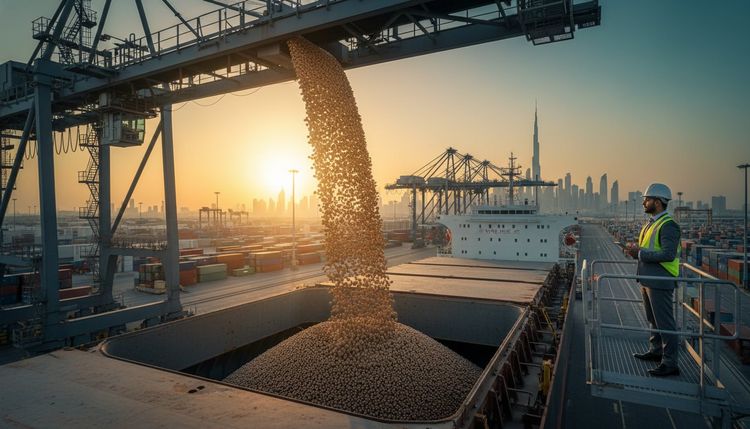
Can your current moisture barrier survive a thirty day maritime transit through high humidity without turning your cargo into a solid block? It's a question that keeps global logistics managers awake at night. The process of selecting anti-caking agent for NPK fertilizer has evolved from a simple commodity purchase into a critical safeguard for global resource stability. You already understand that severe clumping leads to more than just product loss. It triggers expensive customer claims and erodes the trust you've built within your distribution network.
This guide empowers you to master the technical and commercial criteria needed to ensure NPK flowability across every link of your global supply chain. We'll show you how to achieve a zero-caking guarantee while simultaneously optimizing your dosing costs. You'll gain a clear roadmap for aligning your operations with the 2026 EU biodegradability standards and new microplastics regulations. We'll examine the balance between chemical affinity and logistical stressors to ensure your product remains free-flowing from the factory to the field.
Key Takeaways
- Identify the core mechanisms of granule degradation to prevent adhesive bond formation and manage critical relative humidity effectively.
- Evaluate the performance shift from traditional powders to high-efficiency liquid coatings and hybrid formulations for superior surface protection.
- Streamline the process of selecting anti-caking agent for NPK fertilizer by aligning chemical grade with specific storage and environmental stressors.
- Protect global cargo integrity during extreme maritime transit by addressing temperature and humidity fluctuations in tropical zones.
- Implement a strategic technical audit to move beyond commodity purchases toward high-efficiency, customized chemical additives that maximize ROI.
Why NPK Fertilizers Cake: Understanding the Mechanisms of Product Degradation
Caking is a silent thief of industrial value. It turns premium granules into unusable, solid blocks during storage and transit. This process is formally defined as the formation of strong adhesive bonds between fertilizer granules. It's a chemical betrayal of product integrity that disrupts global logistics and creates massive product loss. Understanding What is an Anti-Caking Agent? starts with recognizing that caking isn't a single event. It's a series of microscopic failures triggered by environmental and chemical stressors.
NPK blends are inherently hygroscopic. Each specific formulation has a Critical Relative Humidity (CRH). When ambient humidity surpasses this threshold, the granules pull moisture from the air. This moisture creates a thin layer of concentrated brine on the granule surface. When the environment dries, these dissolved salts recrystallize. This "crystal bridging" mechanism creates solid, physical connections between particles. Mechanical pressure in large-scale silos or bulk transport vessels compresses these bridges. The weight of the stack forces granules together, making the resulting clumping nearly impossible to break without damaging the product.
The Impact of Chemical Composition on Caking
Chemical grade dictates long-term stability. High-urea NPKs respond to moisture with much more volatility than ammonium nitrate-based blends. Urea is particularly sensitive to humidity, often leading to rapid surface dissolution. Residual acidity and chemical impurities also act as catalysts for granule degradation. Multi-component NPK fertilizers are significantly more prone to caking than straight fertilizers. This is because the interaction between different nutrients often lowers the CRH of the entire blend. This inherent complexity makes selecting anti-caking agent for NPK fertilizer a strategic necessity rather than a simple procurement choice.
Physical Factors: Particle Size and Temperature
Granule geometry directly influences shelf life. Smaller particles offer a higher surface area relative to their volume. This increases moisture absorption rates and accelerates the formation of crystal bridges. Temperature also plays a decisive role in product stability. "Thermal cycling" occurs when warehouse or container temperatures fluctuate. This triggers repetitive dissolution and recrystallization cycles. Each cycle strengthens the bonds between granules, turning a free-flowing product into a hardened mass. Cooling the product before packaging is a critical safeguard. Skipping this step traps latent heat inside the bags; this heat creates a microclimate that facilitates caking before the product even enters the supply chain.
Comparing Anti-Caking Technologies: Internal, External, and Hybrid Formulations
The transition from traditional talc-based powders to advanced liquid coatings represents a significant leap in industrial efficiency. While powders were once the industry standard, they often fail to meet the rigorous demands of modern, high-speed logistics. Advanced liquid formulations offer a more uniform application, ensuring that every granule receives a consistent protective layer. This shift is particularly critical when selecting anti-caking agent for NPK fertilizer in 2026, as new European Union regulations now restrict intentionally added microplastics. Only agents meeting specific biodegradability criteria are permitted on the market, forcing a move toward sustainable, high-performance chemistry.
Effective protection relies on the synergy between hydrophobic carriers and active surfactants. These components work in tandem to repel moisture while simultaneously reducing the surface tension that leads to granule adhesion. Peer-reviewed research, such as the Performance Evaluation of Coating Agents, demonstrates that the right chemical balance can drastically improve storage stability. For producers aiming to secure their global supply chains, choosing a partner with expertise in specialized fertilizer anti-caking agents is the first step toward achieving zero-caking goals.
External Coating Agents: The First Line of Defense
External coatings function as a physical moisture barrier. Film-forming agents create a protective envelope around each granule, shielding it from atmospheric humidity. Surfactants within these coatings reduce the capillary forces that typically form between touching particles. Historically, paraffin-based carriers dominated the market due to their low cost and excellent water repellency. However, vegetable oil-based carriers have emerged as the premium sustainable alternative. These bio-based options provide comparable performance while ensuring full compliance with 2026 environmental standards.
Internal Additives: Managing Crystal Habit
Internal agents operate at the molecular level during the granulation process. They modify the crystal habit of the salts, making the resulting crystals more fragile or less likely to form strong inter-granular bonds. This is particularly beneficial in high-humidity production environments where surface coatings alone might be insufficient. While external coatings manage the environmental stressors during transit, internal additives provide the foundational stability required during the initial curing phase. Hybrid systems, which combine both internal and external technologies, represent the gold standard for high-value specialty fertilizers.
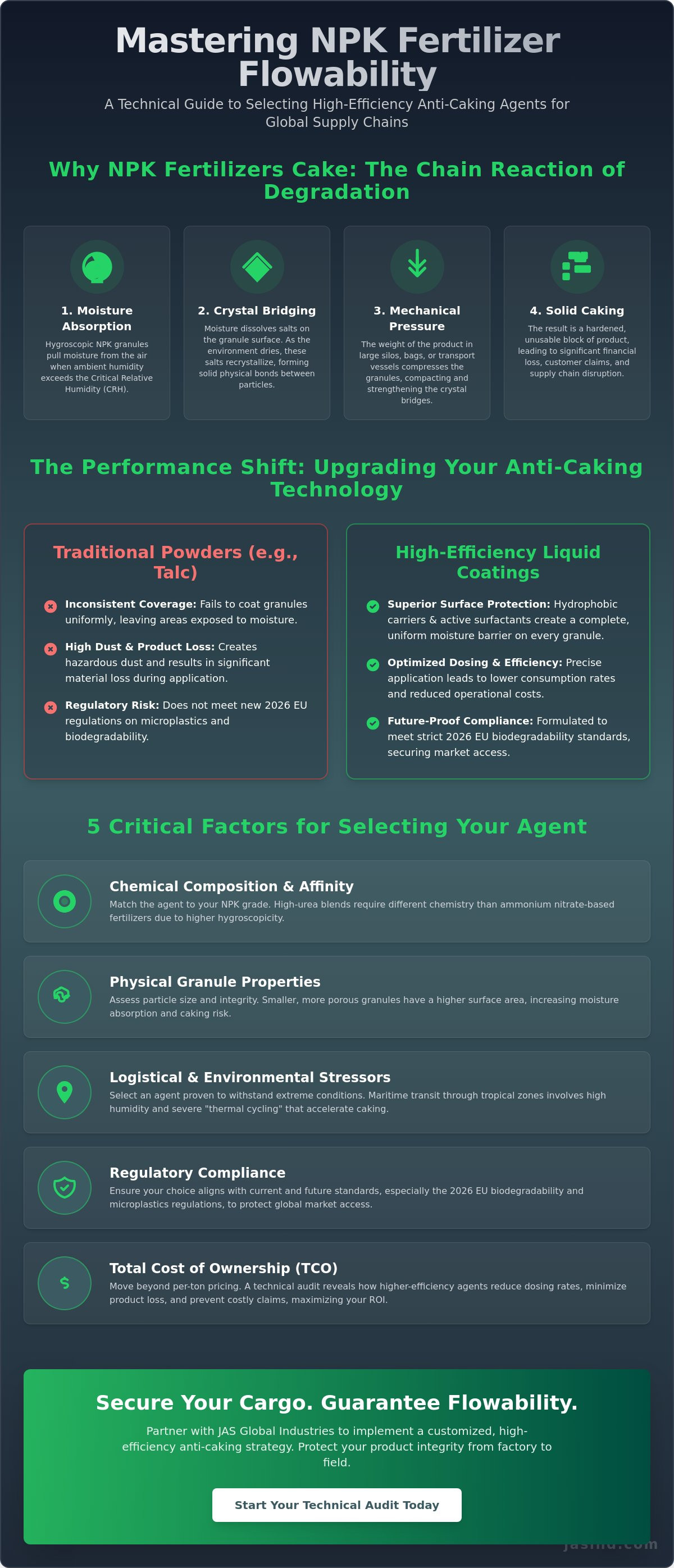
5 Critical Factors for Selecting the Optimal Anti-Caking Agent
Precision in procurement ensures the long-term security of your industrial assets. When selecting anti-caking agent for NPK fertilizer, you must look beyond the initial price point to evaluate how a chemical performs under the specific stressors of your supply chain. An agent that works for a 3-month domestic storage cycle will often fail during a 12-month global export journey. Success requires a checklist that balances chemical affinity with operational realities.
- Chemical Grade and Polarity: The agent's molecular structure must match the surface energy of your NPK formulation to ensure a durable bond.
- Storage Duration: Formulations must be stress-tested for your specific timeline; whether that is 90 days in a local warehouse or a full year in international transit.
- Thermal Stability: The agent must remain chemically stable at your plant's dosing temperature, typically between 60°C and 90°C, without degrading or losing viscosity.
- Regulatory Alignment: Ensure every additive meets the EU 2019/1009 standards and regional environmental mandates regarding biodegradability and microplastic content.
- Cost-per-Ton Efficiency: True value is found in dosing accuracy. High-efficiency agents often require lower application rates, reducing the total cost per treated ton compared to cheaper, high-volume alternatives.
Matching the Agent to NPK Grades
NPK fertilizers are not a monolithic product category. High-Nitrogen (N) grades are notoriously hygroscopic; they require agents with superior moisture-blocking capabilities to prevent rapid surface dissolution. Conversely, high-Potash (K) blends are physically abrasive. This grit can strip away standard coating films during handling. "Universal" agents frequently fail in specialized NPK production lines because they cannot address these opposing physical demands. You need a tailored approach that respects the unique chemistry of your specific nutrient ratios.
Optimizing the Dosing Process
The most advanced chemical is useless without uniform coverage. Achieving a consistent microscopic film requires calibrated spraying systems or high-efficiency drum mixers. If the dosing rate is too high, you risk "oily" granules that clump due to liquid bridging; if it's too low, dust becomes a major safety and quality hazard. Integrating your anti-caking strategy with existing Fertilizer Granulation Aids creates a process synergy that improves granule hardness from the start. This holistic view ensures that your anti-caking efforts work with your production chemistry, not against it.
Navigating Global Logistics: Performance in High-Humidity and High-Temperature Environments
Global supply chains are the ultimate stress test for fertilizer integrity. Moving NPK from temperate production hubs to tropical or desert destinations involves the "Equator Challenge." During maritime transit, temperatures inside bulk carriers fluctuate wildly. This creates temperature gradients that drive moisture migration. If your strategy for selecting anti-caking agent for NPK fertilizer doesn't account for these gradients, you risk arriving with a solidified cargo. Selecting anti-caking agent for NPK fertilizer requires a deep understanding of these logistical stressors to prevent massive product loss and operational delays.
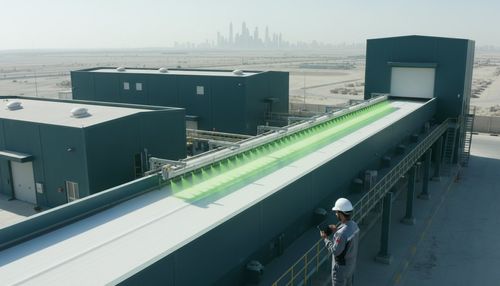
High-temperature environments like the Middle East demand agents with exceptional thermal stability. A common objection from procurement officers is whether these chemicals can truly survive a Dubai or Riyadh summer. They must. Premium formulations maintain their protective film even when surface temperatures exceed 50°C. This prevents the "caking in the bag" phenomenon that destroys end-user satisfaction. When the farmer opens the bag, the product must flow. Anything less is a breach of trust and a threat to your brand reputation in competitive markets.
Safety is equally critical during these long journeys. High-quality anti-caking agents must also function as Fertilizer Dust Suppressants. During bulk handling at major ports, dust creates respiratory hazards and explosion risks. A multi-functional agent ensures the product remains stable and safe from the ship's hold to the final application. It's about protecting both the physical asset and the people who handle it throughout the value chain.
Maritime Transport and Moisture Migration
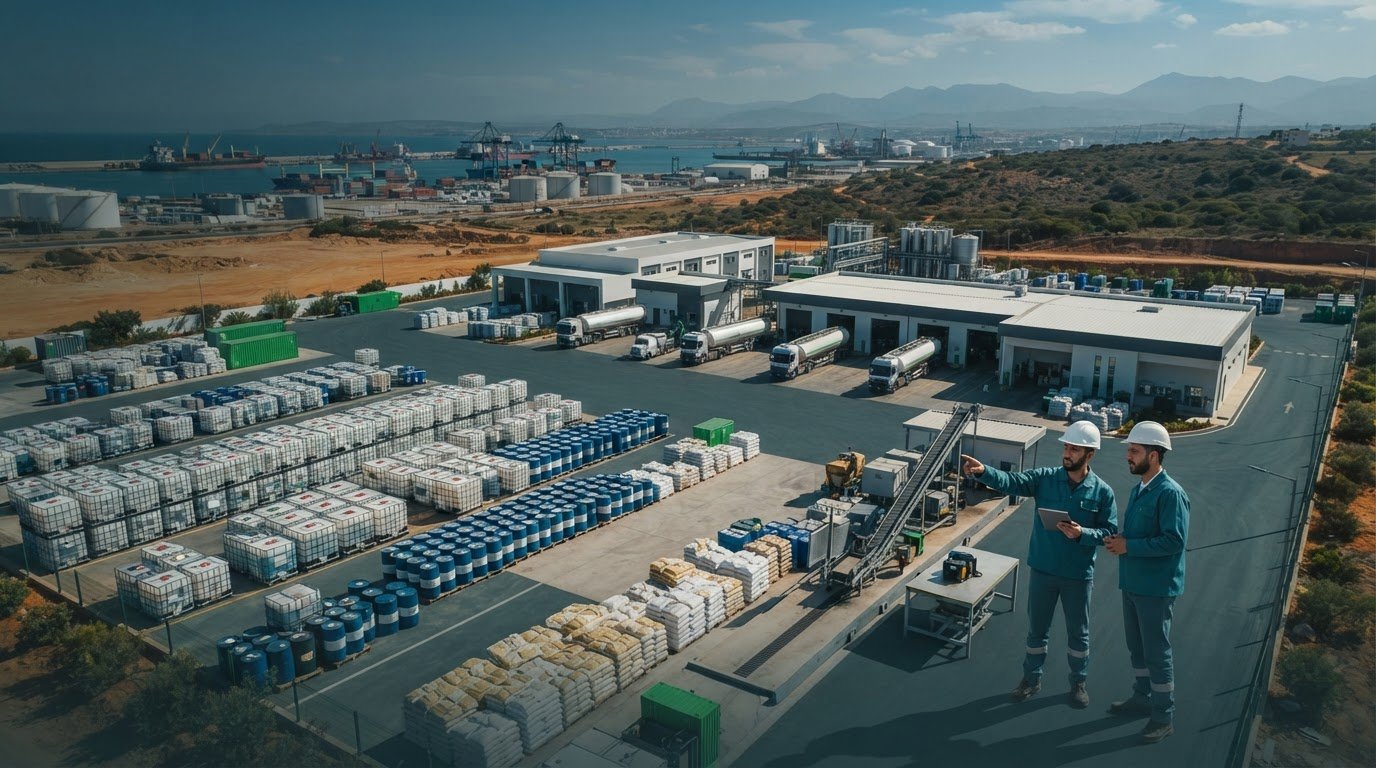
Bulk carriers act as giant incubators for chemical reactions. As a vessel moves through different climate zones, moisture within the fertilizer pile moves toward the cooler surfaces. This localized increase in moisture triggers rapid crystal bridging. Specialized agents maintain flowability by creating a barrier that resists this moisture flux. You aren't just buying a chemical; you're buying insurance against quality claims in your most valuable export markets. This protection ensures that the product arriving at the destination port matches the quality of the product that left the factory.
Sustainability and Global Compliance in 2026
2026 marks a decisive turning point for the industry. The shift toward biodegradable anti-caking agents is now a regulatory requirement in the EU and North America. Forward-thinking producers are already future-proofing their operations against upcoming microplastic bans. JAS Global ensures all formulations meet the latest environmental safety data sheets (SDS) and global compliance standards. This approach secures your market access while fulfilling your corporate responsibility to the planet. It's a commitment to long-term stability in an increasingly regulated global market.
If you need to secure your cargo against extreme climates, explore our range of Fertilizer Anti-caking Agents designed for global resilience.
Strategic Implementation: Transitioning to High-Efficiency Specialty Chemical Additives
Strategic implementation marks the final step in securing your production chain. The process of selecting anti-caking agent for NPK fertilizer shouldn't begin with a catalog; it should begin with a diagnosis. Transitioning to high-efficiency specialty chemicals is a commitment to operational excellence. It replaces reactive troubleshooting with proactive protection. Identifying the root cause of granule failure through a technical audit ensures that the chemical solution matches the physical reality of your plant.
Off-the-shelf agents often lead to suboptimal results and wasted capital. While they might offer a lower initial price, they lack the specificity required for complex NPK blends. Customization provides a superior return on investment. Tailor-made formulations account for your specific raw material variability, regional climate stressors, and storage timelines. By matching the chemical profile of the additive to the unique nutrient ratios of your fertilizer, you achieve higher dosing accuracy and lower application rates. This precision reduces chemical waste and prevents the "oily" granule issues discussed in previous sections.
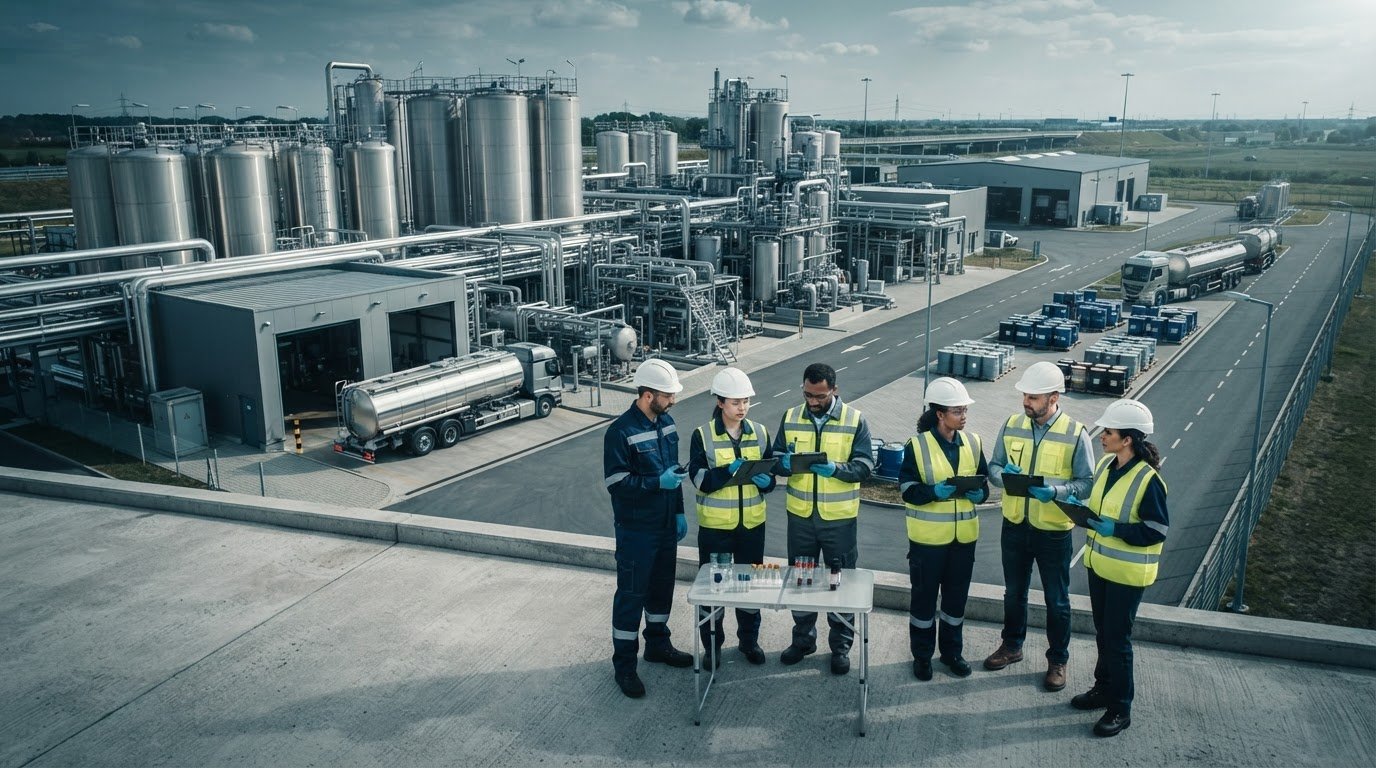
On-site laboratory testing and trial runs are essential for a safe transition. These trials allow you to verify performance under real-world conditions before full-scale implementation. JAS Global acts as more than a supplier; we're a vital guardian of your product's stability. Our role is to provide the industrial expertise and technical support needed to navigate the complexities of modern agriculture. We focus on the fundamental needs of the industry: security, reliability, and long-term value.
The JAS Global Technical Audit Process
Our audit process begins with a comprehensive analysis of your raw material variability. We examine how different sources of phosphate or potash affect the final granule's hygroscopicity. Optimizing dosing equipment is the next priority. We ensure your spraying systems deliver uniform coverage, which is critical for reducing chemical consumption. Finally, we assist in developing a site-specific Chemicals Management Plan. This plan ensures the safe handling and storage of reagents, aligning your facility with global safety standards.
Long-term Partnerships for Process Efficiency
Value creation extends far beyond the initial sale. True efficiency requires continuous monitoring and formulation adjustment as environmental conditions or raw materials change. We leverage our global Research and Innovation (R&I) centers to solve unique regional caking problems, from the humidity of Southeast Asia to the heat of the Middle East. This collaborative approach ensures your production remains resilient against shifting market demands and regulatory evolutions. Secure your fertilizer quality with a technical consultation from JAS Global to ensure your cargo remains free-flowing and compliant through 2026 and beyond.
Securing Global Nutrient Stability through Chemical Precision
The evolution of global supply chains and environmental mandates has transformed the process of selecting anti-caking agent for NPK fertilizer into a strategic imperative. You've seen how moisture migration and crystal bridging compromise cargo integrity during extreme transit. Success in 2026 requires more than just a surface coating; it demands a deep alignment between chemical formulation and logistical reality. Protecting your assets requires a move from commodity procurement to specialized process optimization.
Since 1998, our global R&I centers have focused on protecting the stability of critical resources through tailor-made formulations for specific NPK grades. We provide the on-site technical support and process optimization needed to ensure your product remains free-flowing from the factory to the field. Don't leave your brand reputation to chance in high-humidity markets. Reliability is built on technical expertise and a commitment to global responsibility.
Request a Technical Audit for Your Fertilizer Plant to optimize your dosing costs and guarantee zero-caking performance. Let's work together to ensure your product reaches the farmer in perfect condition.
Frequently Asked Questions
What is the most common cause of caking in NPK fertilizers?
Moisture ingress remains the primary driver of granule degradation. When NPK blends are exposed to humidity above their Critical Relative Humidity (CRH), surface salts dissolve into a concentrated brine. As conditions dry, these salts recrystallize into solid bridges between particles. This physical bonding is often exacerbated by the mechanical pressure of high-stack storage in warehouses or silos.
How do I determine the correct dosing rate for an anti-caking agent?
Determining the optimal dosing rate requires a technical evaluation of the granule's total surface area and chemical composition. Typically, rates are calculated based on the weight of the fertilizer, often ranging from 0.5 to 2.0 kg per ton. Factors like granule porosity and expected storage duration dictate whether a higher concentration is necessary to ensure long-term stability across the supply chain.
Are biodegradable anti-caking agents as effective as paraffin-based ones?
Modern biodegradable formulations offer performance parity with traditional paraffin-based carriers while ensuring regulatory security. These advanced bio-agents utilize plant-based oils and specialized surfactants to create a resilient moisture barrier. While paraffin was historically favored for its low cost, the 2026 shift toward sustainability has driven the development of high-efficiency green alternatives that meet strict biodegradability criteria without compromising protection.
Can anti-caking agents also help with dust suppression?
Most high-quality coating agents are designed to serve as multi-functional protectors that include dust suppression properties. By creating a cohesive microscopic film on the granule surface, they prevent the attrition and abrasion that generate fine particles during handling. This dual action is essential for maintaining a safe working environment and protecting the product's physical integrity during bulk handling at major ports.
What is the difference between internal and external anti-caking agents?
Internal agents are integrated during the granulation phase to modify the crystal habit of the fertilizer salts, making them less likely to form strong bonds. External agents are applied as a post-production coating to provide a physical moisture barrier. When selecting anti-caking agent for NPK fertilizer, many producers choose a hybrid approach to secure both the internal structure and the external surface for maximum shelf life.
How does temperature during packaging affect caking potential?
Packaging fertilizer while it's still warm creates a microclimate inside the bag that facilitates moisture migration. If the product temperature exceeds 45°C during bagging, latent heat continues to drive chemical reactions and dissolution cycles. Cooling the granules before application ensures that the anti-caking agent remains stable and that the product doesn't solidify before it reaches the end user in tropical or desert climates.
Will using an anti-caking agent affect the nutrient release profile of the fertilizer?
Standard anti-caking and dust-suppressing agents are applied at such low concentrations that they don't significantly impact the nutrient release profile. They're designed to break down or disperse once the fertilizer is applied to the soil and exposed to significant moisture. Their primary mission is to protect the product during the logistical phase without compromising its agricultural performance or chemical availability in the field.
What regulatory standards should I look for in 2026?
In 2026, compliance with the EU Fertilizing Products Regulation (2019/1009) is the global benchmark for safety and sustainability. You should specifically verify that your agents meet the new biodegradability criteria for polymers and are free from intentionally added microplastics. Aligning with REACH standards ensures your product maintains market access across Europe and North America while fulfilling your corporate environmental responsibilities.