

Fertilizer production accounted for 35.2% of the global anti-caking market in 2025, yet many facilities still treat chemical application as a matter of guesswork. If you're relying on static application rates, you're likely sacrificing profit to either product clumping or excessive chemical costs. Precise anti-caking agent dosage optimization is the only way to balance operational efficiency with the absolute product stability required for global distribution. It's a strategic alignment of chemical kinetics with the logistical journey of the resource.
It's frustrating to watch high-quality fertilizer turn into unsellable blocks because of a shift in humidity or a minor dosing error. You've likely seen how over-dosing can eat into margins without providing additional protection. This technical guide provides the framework to master chemical dosing, allowing you to eliminate waste and protect your resource through every stage of its journey. We'll explore the critical intersection of environmental variables and chemical properties to help you identify the exact minimum dosage required for peak performance.
Key Takeaways
- Identify the economic risks of dosing errors and how precise application prevents product degradation while protecting operational safety.
- Analyze how Particle Size Distribution and chemical composition dictate the surface area coverage required for hygroscopic fertilizer salts.
- Master anti-caking agent dosage optimization through accelerated lab protocols and flowability metrics that accurately predict field performance.
- Apply a 5-step framework to map environmental variables across your supply chain, ensuring product stability from production to the final destination.
- Explore the impact of specialized technical audits and advanced chemical technologies in securing the integrity of vital global resources.
The Critical Role of Anti-Caking Agent Dosage Optimization in Global Logistics
Industrial efficiency relies on the seamless movement of bulk materials. When fertilizer or minerals cake, the result is more than just a handling delay. It's a compromise of resource integrity. Product degradation leads to uneven application in the field, while clumping in silos creates significant safety risks for personnel. Precise anti-caking agent dosage optimization acts as the primary defense against these failures. It's a guardian of global resource stability and a cornerstone of supply chain security. Without this technical precision, the stability of critical global resources remains at risk.
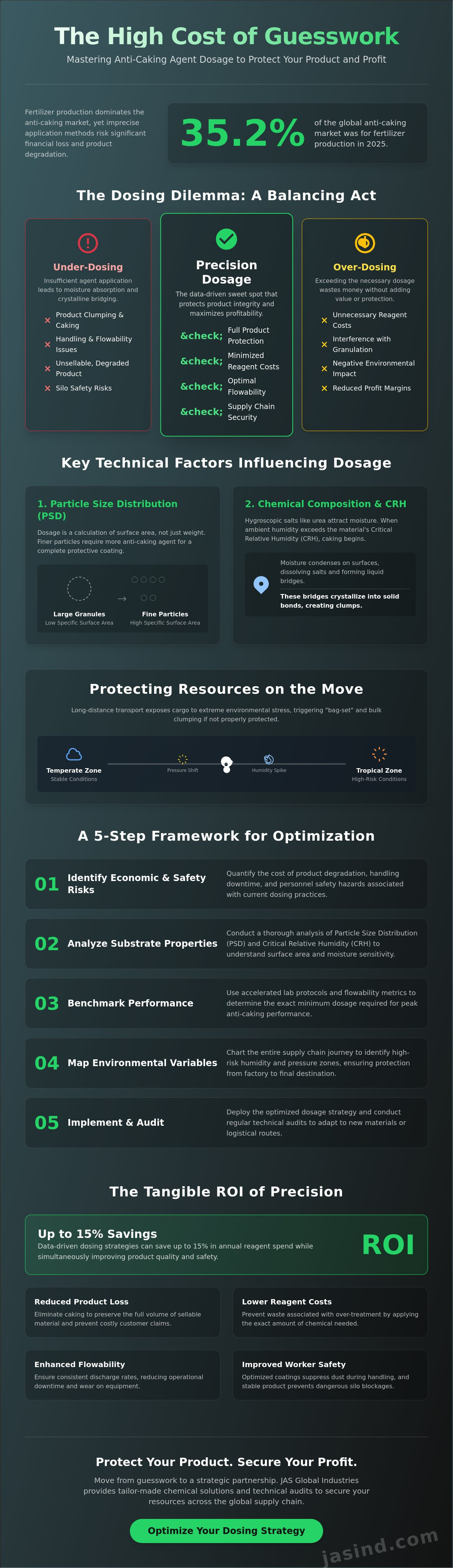
Standardized application rates are often fundamentally inefficient. While generic industry ranges of 0.5% to 2.0% are common, this broad approach ignores the specific chemistry of the substrate. Under-dosing leaves the product vulnerable to moisture and crystalline bridging. Conversely, over-dosing creates unnecessary costs and can interfere with downstream processes like granulation or coloring. True industrial maturity requires a "Total Cost of Quality" framework. This approach balances reagent expenditure against mineral recovery, flowability, and the preservation of the final product's value.
Understanding the Logistics of Resource Protection
Long-distance maritime transport subjects resources to extreme environmental stress. A cargo ship traveling through diverse climate zones experiences rapid shifts in humidity and pressure. These fluctuations trigger "bag-set" or bulk clumping in the hold, especially when passing through high-humidity regions like Dubai or tropical corridors. An effective Anti-caking agent must be calibrated to withstand these specific logistical challenges. Transitioning from a simple supplier mindset to a strategic partnership allows for chemical management that anticipates these stressors. Protection isn't a static feature; it's a dynamic response to the logistical journey.
Economic Benchmarks for Optimization
The financial impact of anti-caking agent dosage optimization is measurable and immediate. By moving away from generic bulk application, facilities achieve a higher ROI on their chemical spend while ensuring product security. Key economic benefits include:
- Reduced product loss: Eliminating clumping preserves the full volume of sellable material and prevents customer claims.
- Lower reagent costs: Precise application prevents the waste associated with unnecessary over-treatment.
- Enhanced flowability: Consistent discharge rates reduce operational downtime and equipment wear.
- Dust suppression: Optimized coatings reduce secondary dust formation during handling, improving worker safety.
Documented industrial outcomes show that moving toward a data-driven dosing strategy can save up to 15% in annual reagent spend. This efficiency doesn't just improve the bottom line. It demonstrates a commitment to sustainable resource management and corporate responsibility. When you optimize your dosage, you protect your product and your profit simultaneously.
Technical Factors Influencing Optimal Chemical Dosing
Achieving anti-caking agent dosage optimization requires a deep understanding of the substrate's physical and chemical profile. It's not a fixed percentage. It's a calculation based on surface area and environmental thresholds. Particle Size Distribution (PSD) is the most critical physical factor. Smaller granules possess a significantly higher specific surface area per unit of mass. This requires a higher dosage to ensure every particle receives a uniform protective coating. Without this precision, the finest particles remain untreated, acting as the primary sites for moisture absorption and subsequent clumping.
The chemical composition of the resource also dictates the dosing strategy. Hygroscopic salts, such as ammonium nitrate or urea, have varying Critical Relative Humidity (CRH) levels. When ambient humidity exceeds the CRH, water vapor begins to condense on the particle surface. This moisture dissolves the salt, forming liquid bridges that crystallize into solid bonds as temperatures drop. Compliance with FDA regulations for anti-caking agents ensures that these chemical interventions remain within safe, established limits while providing necessary stability for the global supply chain.
Mechanisms of Moisture Control and Surface Tension
Effective dosing relies on reducing the surface tension of the moisture film on the particle. This reduction prevents the formation of strong liquid bridges between granules. Hydrophobic barriers further protect the resource by repelling atmospheric moisture, ensuring a long shelf life even in challenging climates. The required dosage of an anti-caking agent is directly proportional to the specific surface area of the substrate particles. For facilities seeking to refine these processes, exploring customized chemical solutions can provide the necessary technical edge to maintain product integrity.
The Impact of Pressure and Storage Time
Storage conditions introduce variables that lab tests often overlook. Static pressure at the base of a high-capacity silo is vastly different from the dynamic pressure experienced during transport. These forces compress the granules, increasing contact points and accelerating the caking process. Time is another critical variable. Reagent efficacy can degrade over a 6-month cycle, especially if the initial application was uneven. Understanding these long-term stressors is essential for Fertilizer Anti-caking: Ensuring Quality and Flowability across the entire supply chain.
Temperature at the point of application also influences success. High-viscosity agents require heating to ensure they atomize correctly in the spray chamber. If the agent is too thick, it forms droplets rather than a film. This leads to localized over-dosing and widespread under-protection. Success is found in the balance of temperature, pressure, and chemistry.
Evaluating Performance: Benchmarking Anti-Caking Efficacy
Reliability in industrial chemistry is built on measurable performance. You cannot manage what you do not measure. True anti-caking agent dosage optimization relies on empirical data rather than industry averages. Laboratory protocols, specifically accelerated caking tests, provide a predictive window into long-term stability. These tests compress months of storage stress into days, allowing for rapid iteration of chemical formulations. By understanding how anti-caking agents work at a molecular level, facilities can move beyond reactive troubleshooting toward proactive resource protection.
Flowability metrics serve as the primary indicators of dosage success. The angle of repose and discharge rates provide concrete data on how a treated resource will behave in a silo or a spreader. Advanced analytical techniques, such as Scanning Electron Microscopy (SEM), allow our technical teams to evaluate coating uniformity. This visualization ensures that the reagent is distributed evenly across the substrate, preventing the "blind spots" that lead to localized clumping. Tailor-made formulations consistently outperform off-the-shelf chemicals because they are calibrated to the specific mineralogy and PSD of your product.
Laboratory Testing Protocols
Standardized pressure tests simulate the crushing weight of high-capacity silos in a controlled environment. We use humidity chambers to stress-test dosage levels across various climate profiles, ensuring stability from the factory floor to the final destination. The "Caking Index" provides a quantifiable method for comparing reagent performance. This index allows for the objective ranking of different formulations, ensuring that the selected dosage provides maximum protection with minimum chemical volume. It's a precise science that eliminates the uncertainty of bulk application.
Translating Lab Data to Plant-Scale Operations
Scaling factors are critical for industrial success. A 1kg lab sample behaves differently than a 50-ton-per-hour production line. Success requires adjusting the laboratory-derived dosage to account for the mechanical realities of full-scale spray chambers and conveyor systems. The JAS approach integrates on-site laboratory support to facilitate real-time process optimization. This integration allows for immediate adjustments to dosage as environmental conditions shift. Seasonal climate changes often cause dosage drift; having a robust benchmarking system in place ensures that your anti-caking agent dosage optimization remains effective throughout the year, protecting your resource regardless of the weather.
A 5-Step Framework for Anti-Caking Dosage Optimization
Transitioning from theoretical benchmarks to operational excellence requires a structured methodology. Anti-caking agent dosage optimization isn't achieved through a single test. It's the result of a rigorous, five-step framework designed to secure the resource at every touchpoint of its journey. This process moves from the molecular characterization of the substrate to the real-time monitoring of full-scale production lines. Precision at this level ensures that your chemical spend translates directly into product security and global stability.
- Step 1: Substrate Characterization. We analyze the physical and chemical properties of the fertilizer or mineral, identifying the specific crystal habits that drive clumping.
- Step 2: Environmental Mapping. This involves identifying humidity and temperature extremes across the entire supply chain.
- Step 3: Reagent Selection. We match chemical functionality, such as amine-based or oil-based coatings, to the specific requirements of the substrate.
- Step 4: Pilot-Scale Dosing. Establishing a baseline using controlled application on a small production run prevents large-scale waste.
- Step 5: Continuous Monitoring and Refinement. Automated dosing systems adjust for process fluctuations, ensuring consistent protection.
Step 1 & 2: The Foundation of Precision
A successful dosing strategy begins with a comprehensive chemical audit of the raw materials. We identify inherent caking tendencies by analyzing hygroscopicity and surface morphology. Environmental mapping then tracks the "Logistical Journey" from a production facility, such as a Dubai plant, to the final end-user. Critical Relative Humidity acts as the definitive threshold where atmospheric moisture begins to compromise the physical integrity of the granule. Understanding these variables allows us to predict where the resource is most vulnerable during long-term storage or maritime transit.
Step 3, 4, & 5: Execution and Refinement
Execution relies on matching the right chemistry to your specific infrastructure. We select between aqueous and non-aqueous formulations based on your plant's application capabilities. During pilot runs, nozzle calibration is paramount to ensure the agent atomizes correctly and provides a uniform film. Without this mechanical precision, even the most advanced anti-caking agent dosage optimization will fail to prevent localized clumping. Implementing a feedback loop between the storage warehouse and the production lab ensures that real-time data informs future dosing decisions. For a customized assessment of your production line, consult with our technical engineering team to identify optimization opportunities.
JAS Global Industries: Tailor-Made Solutions for Global Resource Security
JAS Global Industries doesn't just provide chemicals. We provide stability. Since 1998, our Research and Innovation (R&I) centers have developed advanced chemical technologies that protect the fundamental resources of modern society. We move beyond simple bulk supply by prioritizing anti-caking agent dosage optimization as a core service. This technical precision reduces reagent waste and reflects our deep commitment to industrial sustainability. By refining the application process, we help our partners transform their operations into models of efficiency and reliability. We act as a vital guardian of the global supply chain, ensuring that essential materials reach their destination in peak condition.
Our history is rooted in technical excellence and ethical purpose. We understand that the stability of critical global resources depends on the reliability of the chemicals used to process them. Our R&I teams focus on creating high-performance agents that meet the evolving needs of the mining and fertilizer sectors. Whether it's through advanced dust suppressants or specialized flotation collectors, our goal is to provide the foundational support necessary for modern infrastructure. We don't just sell products; we deliver the expertise required to manage them responsibly through every stage of the resource lifecycle.
Technical Consulting and On-Site Audits
Our engineering teams are active in the field, working directly on the production floor. They conduct on-site laboratory testing to identify specific bottlenecks and improve industrial plant yields. For complex operations like phosphate and potash mining, generic solutions are insufficient. We develop custom chemical dosing strategies that account for unique mineralogy and environmental stressors. This "Formulated Solutions" approach ensures long-term operational reliability. Through rigorous anti-caking agent dosage optimization, we ensure that every gram of reagent contributes to the security of the final product. Our audits provide a clear roadmap for reducing costs while maximizing output quality.
Partnering for Stability and Security
We view our clients as long-term partners in global resource management. Our dualistic philosophy of "Security & Protection" defines every industrial partnership we build. With sales and service offices spanning Africa, Asia, and Europe, our global reach is matched by local technical expertise. We operate manufacturing plants strategically positioned to ensure seamless logistics and resource security. This infrastructure allows us to respond rapidly to the needs of critical industries worldwide. Our presence in diverse markets ensures that we understand the local challenges our partners face. If you're ready to enhance your process efficiency, Contact JAS Global Industries for a Technical Audit to secure your supply chain today.
Securing Global Resources Through Technical Precision
Industrial stability isn't a byproduct of volume; it's a result of precision. Mastering anti-caking agent dosage optimization allows your facility to move beyond reactive clumping management toward proactive resource protection. By integrating substrate characterization with environmental mapping, you ensure your product maintains peak flowability from the factory floor to the final end-user. This technical discipline reduces operational waste and reinforces your role as a reliable contributor to global infrastructure.
JAS Global Industries has specialized in tailor-made formulations since 1998. With a global presence and offices in Dubai, Riyadh, and Lisbon, we provide the local expertise and on-site laboratory testing required for true process optimization. Our mission is to partner with you to achieve long-term operational reliability and resource security across your entire supply chain.
Take the next step in refining your plant's efficiency. Request a Professional Technical Audit for Your Plant to identify specific opportunities for optimization. We look forward to securing your resource integrity and driving industrial excellence together.
Frequently Asked Questions
What is the typical dosage range for fertilizer anti-caking agents?
Typical dosage ranges for fertilizer anti-caking agents generally fall between 0.5 and 2.0 kg per metric ton of finished product. These figures serve as baseline estimates but don't account for specific substrate chemistry or environmental stressors. Achieving true precision requires a technical audit to determine the exact minimum volume necessary for long-term stability and resource protection. Relying on generic industry averages often leads to either product failure or unnecessary chemical expenditure.
How does relative humidity affect the required dosage of anti-caking agents?
Relative humidity impacts dosage requirements by influencing the moisture absorption rate of hygroscopic granules. As ambient humidity approaches the Critical Relative Humidity of the resource, the risk of liquid bridging increases significantly. Higher humidity zones necessitate increased surface coverage to maintain a hydrophobic barrier. This barrier prevents atmospheric moisture from dissolving the salt surface, which is the primary cause of crystallization and clumping during storage.
Can I use the same dosage for different types of NPK fertilizers?
Using a uniform dosage across different NPK grades is often inefficient and technically risky. Each formulation has a distinct chemical profile and moisture sensitivity level that dictates its caking tendency. High-nitrogen grades typically require more intensive treatment than potash-heavy blends due to their higher hygroscopicity. Tailoring the application to the specific grade is essential for effective anti-caking agent dosage optimization and operational cost control.
What are the risks of over-dosing anti-caking agents in mining flotation?
Over-dosing anti-caking agents in mining applications can interfere with downstream flotation kinetics and mineral recovery. Excessive chemical concentration often coats the mineral surfaces indiscriminately, which reduces the selectivity of flotation collectors. This leads to lower recovery rates and can cause unintended issues with frother stability. Maintaining a precise dosage ensures that the anti-caking agent protects the material without compromising the efficiency of the extraction process.
How do I calculate the ROI of optimizing my anti-caking agent dosage?
ROI is calculated by measuring the reduction in product loss and reagent waste against the cost of the optimization process. You should track the decrease in unsellable caked material and the lower volume of secondary dust generated during handling. These operational savings, combined with a reduction in customer claims and handling delays, provide a clear financial justification for a technical dosing audit and long-term process refinement.
Is there a difference in dosage requirements for bulk vs. bagged storage?
Bulk storage typically requires higher dosages due to the extreme static pressure found at the base of high-capacity silos. This pressure forces granules together, accelerating the formation of solid bridges between particles. Bagged storage is prone to bag-set during stacking, especially when pallets are tiered high in a warehouse. Both scenarios require specific chemical calibrations to ensure flowability over 6-month storage cycles in varying climate conditions.
How often should I re-evaluate my dosage optimization strategy?
You should re-evaluate your dosage strategy seasonally or whenever raw material sources change significantly. Shifts in the physical properties of the substrate, such as moisture content or mineral purity, can render a previous dosing rate ineffective. Regular audits ensure that your anti-caking agent dosage optimization remains aligned with current environmental conditions and production variables. This proactive approach maintains the stability of your resource regardless of external fluctuations.
What role does particle size play in anti-caking chemical requirements?
Particle size is a primary driver of chemical requirements because it determines the total surface area that must be coated. Smaller granules or high concentrations of fines significantly increase the specific surface area per ton of material. This physical reality requires a higher volume of anti-caking agent to achieve the uniform film necessary to prevent clumping. Precise sizing analysis is a foundational step in determining the most efficient dosing rate for any industrial facility.