
What if the difference between a high-performing desalination plant and a costly operational failure isn't the hardware itself, but the invisible molecular shield protecting it? In an era where global water security is a primary concern, the strategic application of Reverse Osmosis Chemicals is no longer just a maintenance task. It's a critical pillar of industrial stability. You've likely felt the pressure of rising energy costs and the frustration of frequent downtime caused by persistent membrane fouling. These challenges are especially acute in regions like the Middle East, where complex feedwater chemistry demands more than off-the-shelf solutions.
We understand that protecting your infrastructure is about more than just avoiding replacement costs. It's about ensuring a reliable, high-purity water output for the communities and industries you serve. This guide will show you how advanced chemical formulations and technical auditing can optimise your system's efficiency. You'll learn how to extend membrane lifespan, navigate new EPA regulations on PFAS, and implement a chemistry strategy that turns your water treatment facility into a model of sustainability and performance.
Key Takeaways
- Learn why generic solutions fail in high-pressure environments and how precision chemistry ensures long-term membrane stability.
- Identify the specific mechanisms of mineral scale formation and the advanced antiscalants required to prevent calcium and barium sulfate deposition.
- Understand the critical balance between microbial control and membrane safety when selecting Reverse Osmosis Chemicals for complex industrial systems.
- Discover the two-step framework for designing a high-efficiency dosing strategy through comprehensive feedwater analysis and technical system audits.
- Explore how tailor-made formulations and R&I-driven auditing provide the security needed to protect global water resources while reducing energy consumption.
The Critical Role of Specialty Chemicals in Reverse Osmosis Systems
The stability of modern industry depends on a steady supply of high-purity water. This isn't just a technical requirement; it's a foundation for global resource security. While Reverse osmosis (RO) technology provides the mechanism for purification, the true performance driver is the chemistry that protects the system. Generic water treatment chemicals often fall short in high-pressure environments. They lack the specific molecular architecture needed to handle the intense concentration of salts at the membrane surface. High-quality Reverse Osmosis Chemicals are designed to provide precise protection, ensuring that membranes remain functional for years rather than months.
At JAS Global Industries, we view RO efficiency as a pillar of sustainability. Our approach shifts the focus from reactive cleaning to proactive protection. By integrating advanced chemical development with technical auditing, we safeguard the infrastructure that supports global life and industry. We don't just supply products; we act as a guardian for your most critical assets.
Understanding Membrane Fouling and Scaling
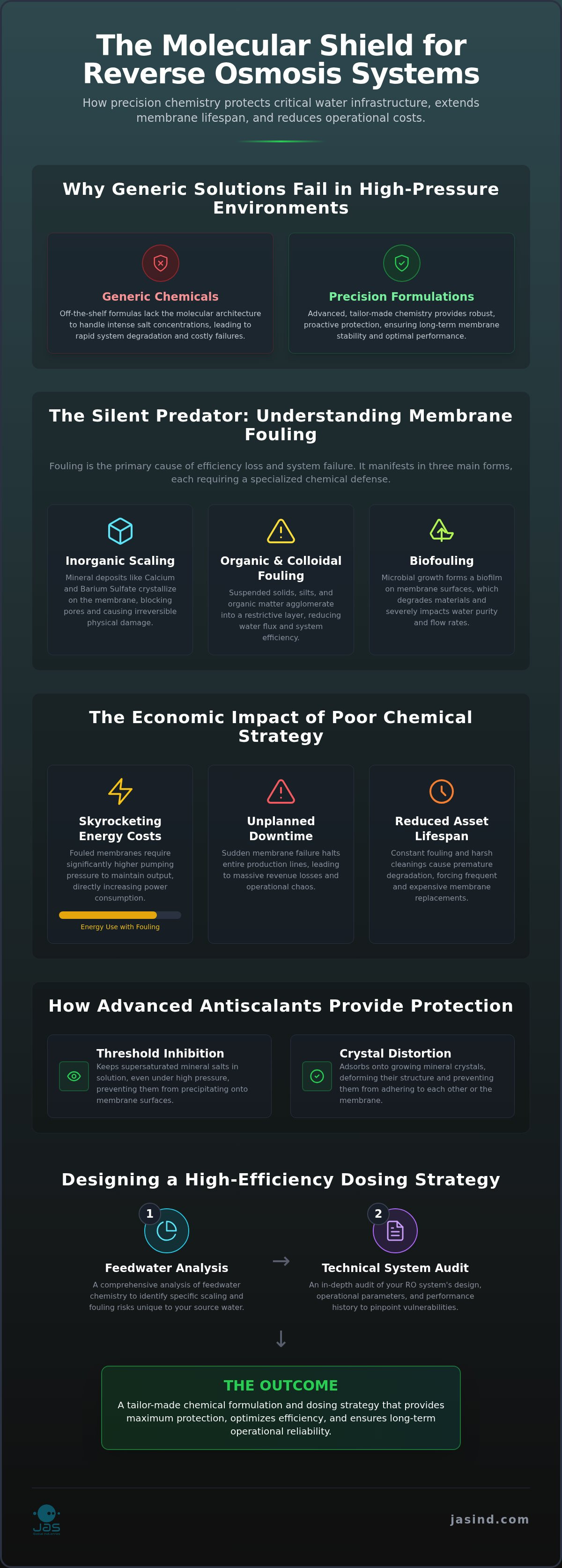
Fouling is the silent predator of operational efficiency. It manifests in three primary forms: inorganic scaling, organic fouling, and biofouling. Feedwater chemistry determines which threat is most prevalent. In regions like the Middle East, high mineral content leads to rapid scale formation. Without precise inhibition, these deposits create irreversible physical damage. The membrane pores become blocked, reducing flux and eventually forcing a total system replacement. Using specialized Reverse Osmosis Chemicals ensures these minerals stay in solution, preventing the crystalline growth that destroys equipment.
The Economic Impact of Operational Reliability
Operational reliability is a financial imperative. When a membrane fails, the costs extend far beyond the price of a replacement component. Unplanned downtime can halt entire production lines, leading to significant revenue losses. There's also a direct link to energy consumption. As membranes become fouled, the system requires higher pumping pressure to maintain water flow. This increase in pressure translates directly into higher power costs. Investing in premium specialty formulations provides a long-term ROI by maintaining low energy requirements and extending the intervals between cleanings. Reliability isn't an accident; it's a result of calculated chemical strategy.
Advanced Antiscalants and Dispersants: Preventing Mineral Deposition
Antiscalants are specialty chemicals that interfere with scale formation mechanisms, acting as a primary defense against system degradation. In high-pressure RO environments, mineral concentration quickly exceeds solubility limits. Without intervention, minerals like Calcium Carbonate, Calcium Sulfate, and Barium Sulfate crystallize on the membrane surface. This process doesn't just reduce efficiency; it creates physical barriers that are often impossible to remove through standard cleaning. These products are vital components of the pretreatment chemicals suite, ensuring that the purification process remains uninterrupted.
Threshold inhibition is the ability to keep supersaturated salts in solution. By employing high-performance Reverse Osmosis Chemicals, operators can push system recovery rates beyond traditional limits without risking catastrophic scaling. Beyond mineral scaling, the presence of suspended solids and silt requires the use of dispersant agents. These chemicals maintain particles in a state of repulsion. This prevents them from settling or agglomerating into a restrictive layer on the membrane, which is essential for maintaining consistent flux.
Threshold Inhibition and Crystal Distortion
Modern antiscalants operate through a process of crystal lattice distortion. When mineral nuclei begin to form, the chemical molecules adsorb onto the growing crystal surface. This interference prevents the crystals from growing into their natural, rigid structures. Instead, they become deformed and lose their ability to adhere to surfaces. While traditional polyphosphates were once common, advanced high-performance polymers now offer superior stability. These polymers don't degrade as easily and provide more reliable protection across a wider pH and temperature range. Using these advanced Reverse Osmosis Chemicals allows for a more stable and predictable operation.
Managing High-Silica and Complex Feedwater
Silica scaling represents a unique challenge, particularly in brackish water RO systems. Unlike mineral scales, silica is exceptionally difficult to dissolve once it precipitates. It forms a glass-like coating that effectively ruins the membrane. Managing this requires specialized antiscalants designed for high-salinity and high-recovery operations. For a broader context on how these strategies fit into a total site plan, see our guide on industrial water treatment.
Selecting the right chemical profile is a technical necessity. It requires an understanding of the specific ions present in your source water. You can consult with our technical team to determine the optimal dosing for your specific feedwater chemistry. This proactive approach ensures your infrastructure remains secure and your water output stays consistent.
Microbial Control and Membrane Preservation: Biocides and Cleaning Agents
Biofouling is one of the most persistent challenges in industrial water treatment. It occurs when microorganisms colonize membrane surfaces, creating a biological layer that resists standard flow. Unlike the mineral deposition discussed in previous sections, biofouling is a dynamic, living process. Effective management requires a sophisticated suite of Reverse Osmosis Chemicals specifically formulated to penetrate these biological barriers without compromising the structural integrity of the polyamide layers. When bacteria establish a foothold, they produce a protective slime that can lead to rapid pressure drops and reduced water quality.
Selecting between non-oxidising and oxidising biocides is a critical technical decision. Oxidising agents, while powerful, can cause irreversible oxidative damage to thin-film composite membranes. Non-oxidising biocides offer a targeted alternative. They disrupt the cellular metabolism of microbes without attacking the membrane material itself. This selection is essential for the long-term preservation of the core components of a reverse osmosis system, especially during periods of system standby or transport. Stagnant water in these phases can accelerate microbial growth, making membrane preservatives a necessity for safeguarding your investment.
Strategies for Effective Biofilm Management
Biofilm is significantly more resilient than mineral scale. It forms a protective extracellular matrix that shields bacteria from environmental stressors and chemical attacks. A successful control strategy often involves a combination of continuous low-level dosing and periodic high-concentration shock treatments. This dual approach prevents the establishment of mature colonies. For large-scale industrial water systems, sustainable biocide options are increasingly preferred. These formulations provide the necessary microbial control while minimizing the environmental footprint of the discharge water, aligning technical performance with global responsibility.
Selecting the Right Membrane Cleaning Protocol
Even with robust pretreatment, scheduled maintenance is necessary to restore flux and maintain efficiency. The choice of cleaning agent depends entirely on the nature of the foulant identified during system monitoring. Low pH cleaners are effective for removing inorganic scale and metal hydroxides. Conversely, high pH cleaners are required to dissolve organic matter, oils, and biological remains. Utilizing specialty 'CIP' (Clean-In-Place) chemicals ensures maximum recovery of system performance. Operators must monitor recovery rates post-cleaning to validate the efficacy of the chosen Reverse Osmosis Chemicals. This data-driven approach allows for the refinement of maintenance schedules, moving the operation from reactive repairs to a state of reliable, proactive protection.
Designing a High-Efficiency Chemical Dosing Strategy
Selecting the correct Reverse Osmosis Chemicals is only the first step in a broader operational mandate. True efficiency is born from a rigorous, data-driven strategy that treats the RO system as a dynamic asset rather than a static machine. Many operators make the mistake of applying chemicals based on generic manufacturer recommendations. This often leads to sub-optimal performance. A high-efficiency dosing strategy requires a move toward precision engineering, ensuring that every drop of chemical serves a specific protective purpose. This level of accuracy is essential for maintaining the stability of global water resources and the reliability of industrial infrastructure.
To achieve this, we recommend a five-step framework designed to maximize membrane longevity and system recovery:
- Step 1: Conduct a comprehensive feedwater analysis to identify the exact profile of potential foulants.
- Step 2: Perform a technical audit of current system performance, focusing on recovery rates and differential pressure.
- Step 3: Utilize predictive software to model scale formation and determine the precise dosage requirements for your specific conditions.
- Step 4: Implement a custom dosing strategy using high-purity chemical reagents tailored to your feedwater chemistry.
- Step 5: Continuously monitor the Silt Density Index (SDI) and flux to refine the approach in real-time.
The Importance of Feedwater Analysis
Precision begins with a deep understanding of your source water. Measuring pH, temperature, and specific ion concentrations, such as Calcium (Ca), Magnesium (Mg), Iron (Fe), and Silica (SiO2), is non-negotiable. These parameters aren't static. Seasonal variations can drastically shift the fouling potential of your system, requiring adjustments to your chemical dosing. Refer to our antiscalants for high-efficiency reverse osmosis for technical specifics on how different ions interact with specialized inhibitors.
Optimizing Dosing for Operational Reliability
Reliability is often compromised by the misconception that more chemistry equals more protection. Over-dosing is a significant risk. Excess Reverse Osmosis Chemicals can act as foulants themselves, leading to secondary scaling or providing a nutrient source for microbial growth. By optimizing your dosage, you reduce your environmental footprint and lower operational costs. Implementing automated dosing systems allows for a real-time response to water quality changes, ensuring the system remains in its ideal operating window. If you're looking to enhance your facility's output, you can request a technical performance audit to identify immediate optimization opportunities.
Strategic Water Treatment: The JAS Global Industries Approach
JAS Global Industries operates at the intersection of technical innovation and global responsibility. Since 1998, we've positioned ourselves as more than a chemical supplier. We're a guardian of industrial stability and a protector of the world's most critical resources. One-size-fits-all chemistry consistently fails global industries because it ignores the unique nuances of local feedwater. Our Dubai-based R&I centers allow us to develop Reverse Osmosis Chemicals that address specific regional challenges, from the high-salinity environments of the Middle East to the complex mineral profiles found in global mining operations. This synergy between advanced chemical development and technical consulting ensures that your infrastructure remains secure and efficient.
Our commitment to innovation is driven by a sense of ethical purpose. We understand that water security is a foundational requirement for modern society. By providing advanced Reverse Osmosis Chemicals, we help industries reduce their environmental footprint while maintaining the high-purity output required for their processes. This proactive approach moves beyond simple transactions. We build long-term partnerships based on reliability, technical expertise, and a shared goal of sustainable resource management.
Custom Formulations for Complex Feedwater
Complex feedwater requires a tailored response. We specialize in developing site-specific chemicals that target unique mineral profiles, preventing the irreversible damage caused by unexpected scaling or fouling. For large-scale desalination plants and mining facilities, even a minor improvement in process efficiency can lead to significant energy savings and reduced operational costs. Our focus remains on creating sustainable and cost-effective chemical technologies that don't compromise on performance. By optimizing the molecular structure of our antiscalants and biocides, we ensure that your membranes operate at peak flux for as long as possible.
Global Logistics and Technical Support
Industrial operations require an unwavering supply chain. We've established a robust logistics network that ensures supply chain security across MEA, Asia, and Europe. This geographic reach allows us to support major infrastructure projects with the same level of precision and care, regardless of location. Our technical support extends beyond delivery. We provide on-site laboratory testing and comprehensive technical audits to identify optimization opportunities within your existing systems. These audits are a prerequisite for selecting the right chemical strategy and are essential for maintaining long-term membrane health.
The stability of your water treatment process is our priority. If you're ready to move from reactive maintenance to a state of proactive protection, we can help. Contact JAS Global Industries for a Technical Water Audit and discover how our custom formulations can safeguard your operations and contribute to global water security.
Securing the Future of Industrial Water Infrastructure
Protecting your industrial assets requires more than just mechanical maintenance. It demands a strategic alignment of specialty chemistry and technical expertise. We've explored how advanced antiscalants prevent mineral deposition and why biocides are essential for biological security. By moving from reactive cleaning to proactive protection, you ensure the longevity of your membranes and the stability of your operations. Precision in dosing isn't just about cost savings. It's about maintaining the integrity of the world's most vital resource.
Since 1998, JAS Global Industries has acted as a foundational industry presence. We leverage our advanced R&I centers in Dubai to develop tailor-made Reverse Osmosis Chemicals that meet the specific needs of complex feedwater. Our global reach across the Middle East, Africa, Asia, and Europe ensures that your supply chain remains secure. Reliability is a choice made through precise engineering and a commitment to global resource protection. It's a partnership that extends beyond chemicals to encompass long-term operational stability.
Optimize your water treatment with JAS Global specialty chemicals to safeguard your facility's performance. Together, we can build a more sustainable and water-secure future for your industry.
Frequently Asked Questions
What are the most common chemicals used in reverse osmosis systems?
The primary chemicals include antiscalants for scale inhibition, biocides for microbial control, and specialized cleaning agents for membrane restoration. These Reverse Osmosis Chemicals work in tandem to protect the system's infrastructure and maintain water quality. Acid cleaners target mineral scales, while alkaline cleaners remove organic matter and biofilms. Using the correct combination ensures that the purification process remains uninterrupted and efficient.
How do RO antiscalants prevent membrane scaling?
Antiscalants function through threshold inhibition and crystal lattice distortion. They interfere with the crystallization process of minerals like calcium carbonate and barium sulfate. By deforming the crystal structure, these chemicals prevent minerals from adhering to the membrane surface. This ensures that supersaturated salts remain in solution and are safely discharged as brine. It's a proactive method that prevents physical damage to the equipment.
Can I use generic biocides in my reverse osmosis plant?
Generic biocides are often unsuitable for RO plants because many contain strong oxidizers that cause irreversible membrane damage. Specialized non-oxidizing biocides are preferred for their ability to eliminate microorganisms without attacking the thin-film composite layer. Using incompatible chemicals can lead to rapid salt passage and premature membrane replacement. Proper selection is critical for maintaining the biological security of the system without compromising hardware.
What is the difference between a dispersant and an antiscalant in RO?
Antiscalants focus on preventing the growth of mineral crystals from dissolved ions. Dispersants work differently by keeping existing suspended solids, like silt or clay, from agglomerating and settling on the membrane. Both are essential for maintaining flux, but they target different types of foulants within the feedwater. A balanced strategy often combines both to handle complex water chemistries that contain both dissolved minerals and particulates.
How often should I clean my reverse osmosis membranes?
Cleaning should occur when normalized flux drops by 10% to 15% or when differential pressure increases by the same margin. Waiting longer can lead to irreversible fouling that standard cleaning protocols cannot resolve. Regular monitoring of system data ensures that maintenance is performed at the optimal moment to restore performance. This data-driven approach prevents the accumulation of stubborn deposits that can permanently reduce system capacity.
What is the role of a technical audit in chemical selection?
A technical audit provides the data necessary to match chemical formulations with your specific feedwater chemistry. It identifies the root causes of fouling and evaluates current system recovery rates. This process moves the operation away from generic dosing and toward a precision strategy that maximizes membrane longevity and efficiency. It's a foundational step that ensures the chosen chemistry addresses the actual challenges present in your facility.
Are JAS Global RO chemicals compatible with all membrane brands?
Our Reverse Osmosis Chemicals are formulated to be compatible with all major thin-film composite and cellulose acetate membrane brands. We prioritize membrane safety by using high-purity ingredients that don't compromise the integrity of the polyamide layer. This universal compatibility ensures that our solutions can be integrated into any industrial water treatment facility. Our formulations are tested to meet the rigorous standards of leading membrane manufacturers.
How do specialty chemicals help in reducing RO energy consumption?
Specialty chemicals lower energy costs by keeping membrane surfaces free from restrictive scale and biofilm layers. When membranes remain clean, the system requires less pumping pressure to maintain the desired permeate flow. This direct reduction in operational pressure translates to lower kilowatt-hour usage and improved plant sustainability. It's a calculated way to improve the environmental footprint of large-scale industrial operations while reducing overhead costs.