
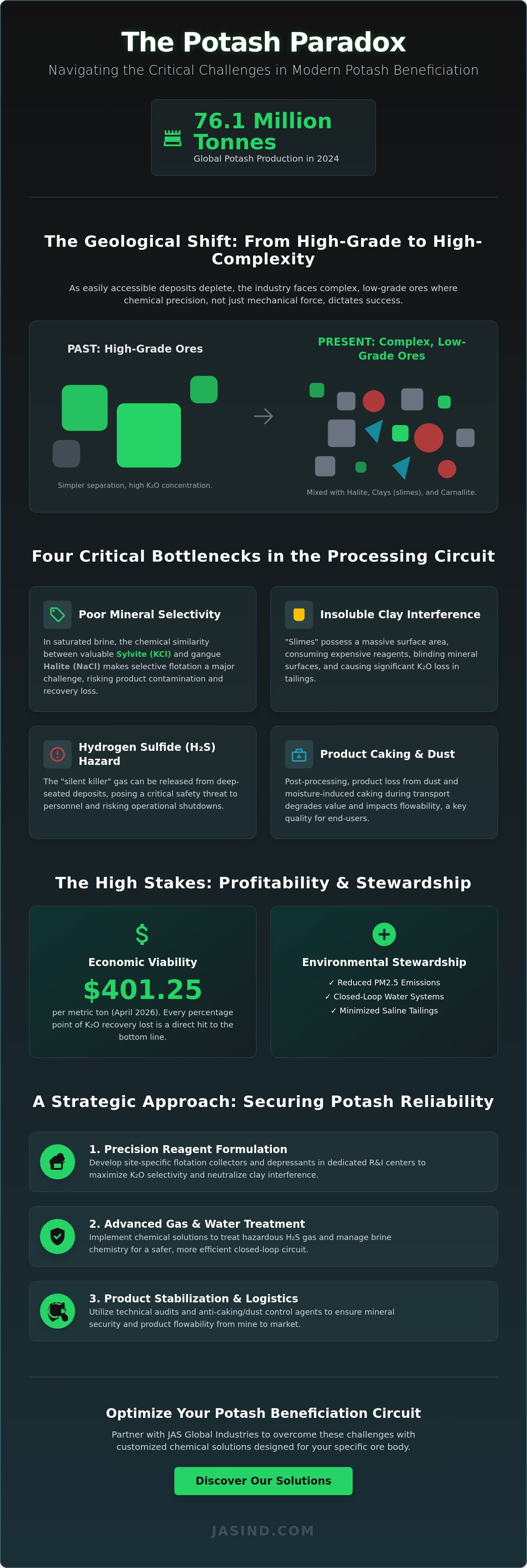
With global potash production reaching 76.1 million tonnes in 2024, the industry faces a critical paradox: demand is rising, but the ease of extraction is vanishing. The most significant challenges in potash mining beneficiation are no longer purely mechanical; they've evolved into complex chemical puzzles that dictate the stability of our global food supply. You're likely seeing the impact of declining ore quality on your processing costs, alongside the constant pressure to manage hazardous H2S byproducts and prevent product loss from dust and caking during export. With muriate of potash spot prices reaching US$401.25 per metric ton in April 2026, every percentage point of recovery matters more than ever.
We understand that maintaining high K2O recovery rates while reducing your environmental footprint is a delicate balance. This technical guide explores the advanced strategies and reagent customizations required to overcome these hurdles and ensure a stable, flowable final product. We'll examine the shift toward precision flotation collectors, modern gas treatment, and the stabilization techniques that protect your mineral assets from the mine to the global market.
Key Takeaways
- Adapt to the geological shift toward complex, low-grade ores by prioritizing chemical precision over traditional mechanical separation methods.
- Navigate the most pressing challenges in potash mining beneficiation by neutralizing insoluble clay interference and improving mineral selectivity in saturated brine.
- Protect operational integrity and personnel by addressing the "silent killer," Hydrogen Sulfide (H2S), with advanced chemical gas treatment solutions.
- Optimize recovery rates through site-specific reagent formulations developed in dedicated R&I centers rather than relying on standard, off-the-shelf alternatives.
- Ensure long-term mineral security and product flowability with technical audits designed to withstand the rigors of global logistics.
The Evolving Landscape of Potash Beneficiation
Potash beneficiation is the vital separation of potassium-bearing minerals, primarily sylvite, from gangue materials like halite and insoluble clays. As global production capacity is projected to reach 76.0 million tons of K2O by 2028, the industry faces a pivot point. We're moving away from the high-grade deposits of the past toward complex, low-grade ores. This geological shift makes beneficiation the definitive bottleneck in the global fertilizer supply chain. If the processing circuit isn't optimized, the global food system loses its foundation. Overcoming the challenges in potash mining beneficiation requires a transition from generic solutions to site-specific chemical interventions.
The two primary Potash processing methods, froth flotation and solution mining, now require higher levels of chemical precision. Beneficiation is a process of increasing mineral concentration through physical and chemical separation. Without this concentration, the raw ore remains economically unviable and technically unusable for high-grade fertilizer production. In 2024, Canada produced an estimated 25 million tonnes of muriate of potash, proving that scale is possible, but maintaining that scale requires evolving beyond legacy techniques.
The Critical Role of Mineralogy in Beneficiation
The mineralogical structure of the deposit dictates the entire processing strategy. Sylvinite remains the preferred ore due to its simpler separation requirements, but we're seeing an increase in Carnallite processing. Carnallite introduces magnesium into the brine, complicating the chemistry of the entire circuit. The presence of insoluble clays represents one of the most persistent challenges in potash mining beneficiation. These "slimes" have a massive surface area that consumes expensive reagents, often leading to significant product loss. In an era where Canada holds 1.1 billion tonnes of reserves, maximizing K2O recovery isn't just a goal; it's an economic necessity to offset the costs of deeper, more complex mining.
Drivers of Modern Process Innovation
Efficiency is the new standard for global resource protection. Rising energy costs have turned the spotlight on mechanical efficiency, driving the adoption of specialized mining grinding aids to reduce power consumption during comminution. With the average retail price for potash sitting at $493 per ton in May 2026, the margin for error in the beneficiation circuit has narrowed. Every ton of lost K2O represents a failure in resource stewardship. Simultaneously, environmental stewardship has moved from a corporate value to a regulatory requirement. In Canada, facilities must report PM2.5 emissions annually, forcing a rethink of how dust is managed in the plant. Modern innovation focuses on closed-loop water systems and the reduction of high-salinity tailings. These advancements ensure that we don't just extract resources, but we protect the environments that host them.
Technical Bottlenecks in Potash Flotation and Separation
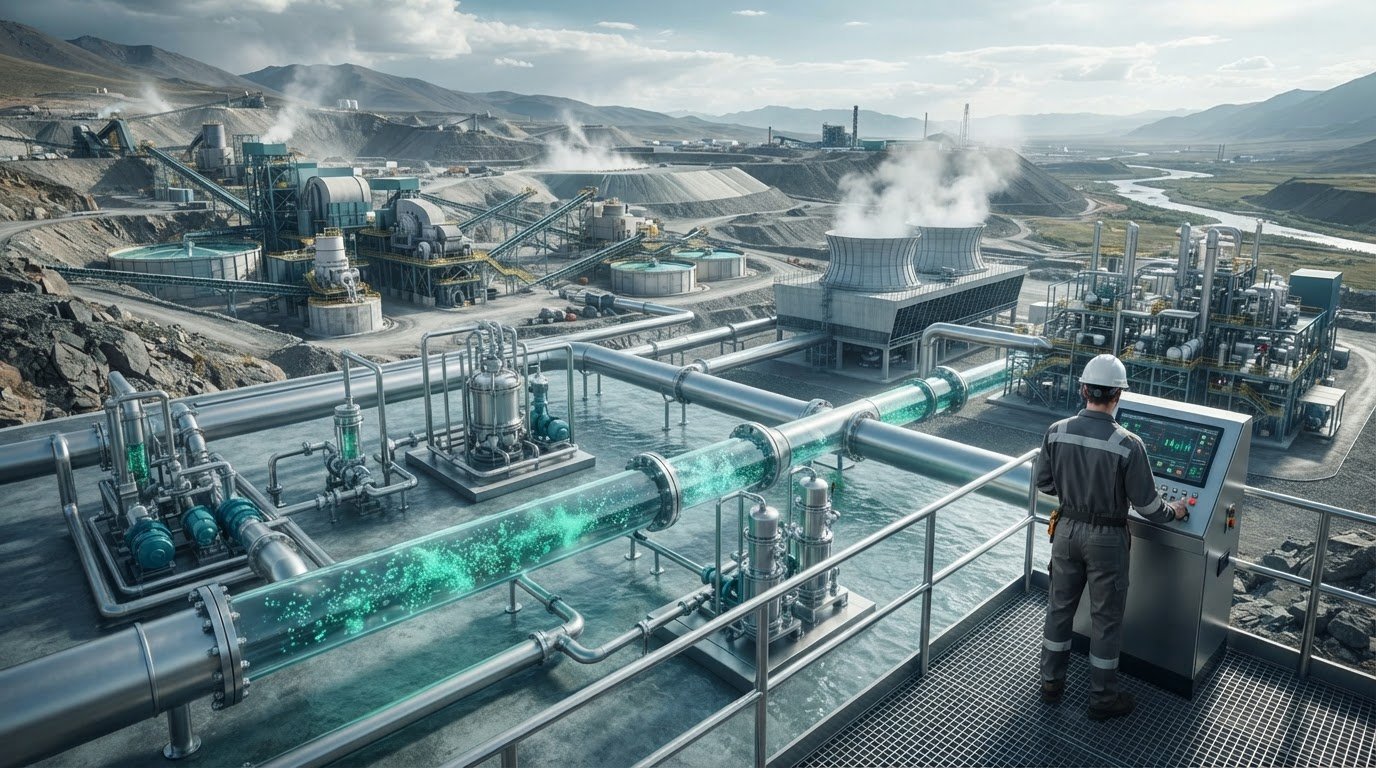
The flotation circuit is the operational heart of any potash plant. It's here where the economic viability of a mine is determined. Unlike many other mineral processes, potash flotation occurs in a saturated brine environment. This creates unique chemical conditions where the difference between recovery and waste is measured in milligrams of reagent per ton. One of the primary challenges in potash mining beneficiation is maintaining selectivity between Sylvite (KCl) and Halite (NaCl). These minerals share similar physical properties, making the chemical specificity of your collectors the only line of defense against product contamination.
Brine chemistry and temperature also play decisive roles. A shift of just a few degrees in the flotation cells can alter the adsorption kinetics of your reagents, leading to "lazy" froth or poor mineral attachment. Beyond the recovery of the mineral itself, operators must manage the technical risks associated with complex ore bodies. This includes addressing the dangers of hydrogen sulfide that can be released when processing certain deep-seated deposits. Technical bottlenecks aren't just about mineral counts; they're about the safe, stable management of the entire chemical environment.
Overcoming Insoluble Clay Interference
Insoluble clays, often referred to as "slimes," are the most common disruptors in the circuit. These particles possess a massive surface area and a high ionic charge, which allows them to effectively "blind" the sylvite surfaces. When this happens, your primary collectors attach to the clay instead of the potash, leading to skyrocketing reagent costs and plummeting recovery rates. Effective desliming requires a dual approach. While mechanical hydrocyclones remove the bulk, chemical optimization using specialized mining depressants is essential to neutralize the remaining fine particles. By passivating the clay surfaces, you ensure that your collectors remain available for their intended target.
Collector and Frother Synergy
The relationship between amine-based collectors and frothers is a delicate balance of stability and transport. Collectors must be tailored to the specific grain size and mineralogy of the ore. Using a generic, off-the-shelf amine often leads to over-dosing, which creates a brittle froth that drops minerals before they reach the launder. Conversely, a high-performance frother must control bubble size to maximize carrying capacity without creating a permanent foam that resists downstream collapse. Industry data suggests that moving from generic reagents to custom-tailored formulations can reduce reagent consumption by up to 15%. This synergy doesn't just lower costs; it stabilizes the entire flotation bank against the natural variability of the ore body.
Environmental and Operational Hazards in Potash Circuits
Potash circuits operate under extreme conditions. High salinity isn't just a processing hurdle; it's a threat to infrastructure and community safety. Protecting these assets is a core pillar of global resource security. The challenges in potash mining beneficiation extend beyond the flotation cell into the very atmosphere and groundwater surrounding the site. Reliability is the foundation of trust. We don't just supply chemicals; we safeguard the stability of critical infrastructure. Maintaining this stability requires a deep understanding of the chemical interactions that occur long after the mineral has been separated.
The aggressive nature of chloride-rich brines creates a constant state of chemical warfare within the plant. These fluids eat through steel and concrete with relentless efficiency. Without the strategic application of Water Treatment Corrosion Inhibitors and Scale Inhibitors, the lifespan of multimillion-dollar infrastructure is severely compromised. Reliability is built on protection. By mitigating chemical degradation, we ensure that the facilities responsible for global food security remain operational for decades. This isn't just about maintenance; it's about the ethical stewardship of global resources. We protect the assets that feed the world.
Mitigating H2S Risks in Solution Mining
Hydrogen Sulfide (H2S) is the "silent killer" of the potash industry. In solution mining, organic matter decomposition within the brine circuit often leads to lethal H2S buildup. While some focus on managing gas at the cooling pond, proactive prevention starts within the circuit itself. Utilizing high-performance Mining Odor & Gas treatment solutions alongside specialized Water Treatment Biocides prevents the biological activity that generates these hazardous gasses. This dual-action approach secures the work environment. It ensures operational continuity without the risk of sudden toxicity spikes. Safety is a non-negotiable standard for a global guardian.
Tailings Management and Water Recovery
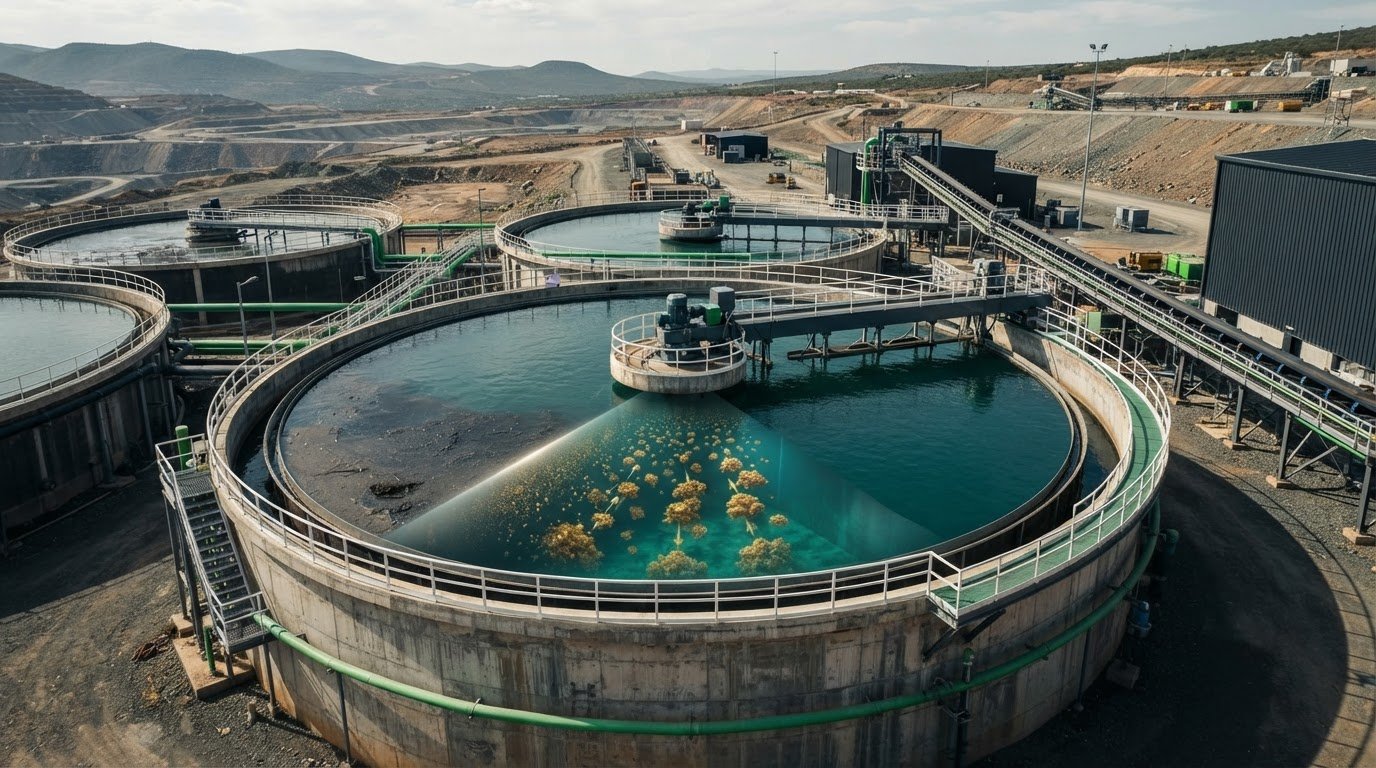
Efficiently managing the byproduct of beneficiation is critical for maintaining a mine's license to operate. High-salinity tailings pose a significant risk to local aquifers if not handled with precision. A key focus in the Environmental Aspects of Potash Mining is the stabilization of waste and the recovery of process water. Advanced Mining Flocculants play a decisive role here. They facilitate rapid settling and effective dewatering. This allows operators to recycle water back into the circuit. It reduces the total water footprint. It creates more stable, compact tailings piles that resist leaching and protect the surrounding ecosystem for future generations.
Strategic Chemical Interventions for Process Optimization
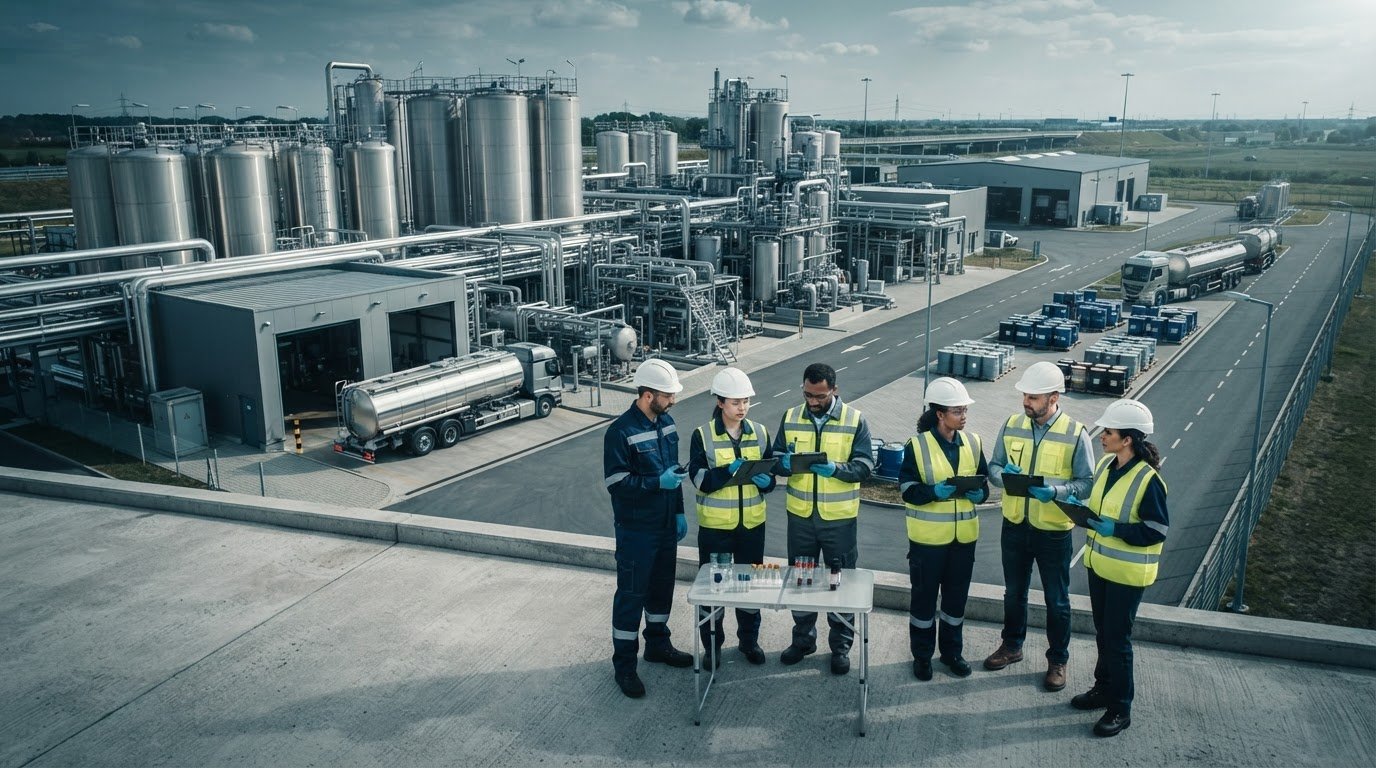
Optimizing the beneficiation circuit requires a shift from bulk mechanical handling to precision chemical intervention. Generic, off-the-shelf industrial chemicals often fail to address the geological variability of modern deposits. These challenges in potash mining beneficiation demand a more sophisticated approach. We believe that reliability is engineered through technical audits and on-site laboratory testing. By analyzing the specific mineralogy of a site, we develop custom Mining Flotation Collectors and Frothers that maximize K2O recovery. This level of customization is the only way to protect the economic viability of low-grade ore bodies. While some industry perspectives focus solely on binders for final pelletization, we recognize that true mineral security begins much earlier in the circuit.
Reducing energy consumption is another critical pillar of process optimization. Our Mining Grinding Aids improve comminution efficiency, allowing for finer liberation of sylvite at a lower power cost. This directly impacts the bottom line while reducing the operational carbon footprint. Efficiency is not just a metric; it's a commitment to global resource stewardship. By refining the upstream reagents, we ensure that the feed for downstream granulation is of the highest possible quality. This holistic approach bridges the gap between raw extraction and a market-ready product.
Precision Dosing: A Data-Driven Approach
Inconsistent ore feed is a primary driver of reagent waste. Using real-time monitoring to adjust reagent flows allows operators to respond instantly to fluctuations in clay content or mineral grade. The economic impact of over-dosing is significant, often leading to brittle froth and contaminated concentrates. Conversely, under-dosing results in immediate recovery loss. We develop tailor-made collectors specifically for high-clay ores, ensuring that the chemical dosage remains optimized regardless of feed variability. Data-driven dosing turns a volatile process into a stable, predictable operation.
Ensuring Post-Beneficiation Quality
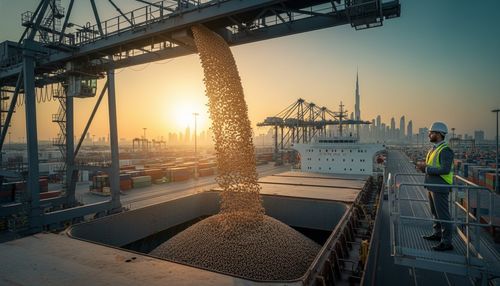
Beneficiation doesn't end at the dryer; it ends when the product reaches the end user in perfect condition. Anti-caking agents are essential for maintaining the flowability of potash during maritime transport. Without these strategic interventions, the moisture absorbed during global transit can turn a high-value cargo into a solid, unworkable mass. We integrate specialized Fertilizer Dust Suppressants and Fertilizer Anti-caking Agents to protect the physical integrity of the mineral. Additionally, the application of Fertilizer Coloring Agents serves as a vital tool for brand identity and product safety, ensuring that different grades are easily identifiable across the global supply chain. Secure your recovery rates and product stability today by exploring our full range of Potash Mining Chemicals.
The JAS Approach: Securing Global Potash Reliability
JAS Global Industries acts as a global guardian for mineral stability. We recognize that the challenges in potash mining beneficiation aren't just technical hurdles; they're risks to the global food supply chain. Our mission is to provide the reliability required to stabilize these critical resources. Through our dedicated R&I centers, we don't just ship chemicals. We develop custom formulations specifically engineered for the unique mineralogy of your mine site. This precision ensures that your recovery rates remain high even as ore quality fluctuates.
A significant gap in the industry is the failure to connect upstream beneficiation with downstream quality. If the flotation circuit isn't optimized, residual impurities can exacerbate caking and dust issues during export. Our technical synergy between Mining Flotation Collectors and Fertilizer Anti-caking Agents ensures that the mineral is protected from the moment of liberation until it reaches the farmer's field. This holistic protection is what distinguishes a supplier from a long-term partner. Our presence spans the globe, providing on-the-ground technical support from our headquarters in Dubai to operations across Europe and Asia. This reach allows us to respond to regional variations in ore quality with local precision and global expertise.
From Mine to Market: A Holistic Solution
Partnerships are built on transparency and technical excellence. Our technical consulting and process audits serve as the foundation of every collaboration. We prioritize sustainable, cost-effective chemical technologies that reduce waste and maximize recovery. For industrial stability, we offer long-term bulk chemical supply contracts. These agreements secure your supply chain against market volatility and ensure consistent product performance year after year. We focus on three core pillars of service:
- Technical Audits: Comprehensive on-site evaluations to identify recovery bottlenecks.
- Custom Formulation: Tailor-made reagents designed for specific ore bodies and brine chemistries.
- Supply Security: Reliable bulk delivery systems that protect your operational continuity.
Next Steps for Operations Managers
Operations managers need results that are both immediate and enduring. Leveraging over 25 years of experience in specialty chemicals, we provide the insights needed to navigate the evolving challenges in potash mining beneficiation. We invite you to take the next step in securing your facility's output. You can Optimize your potash recovery with JAS Global solutions by requesting a comprehensive process audit today. Our team will analyze your current reagent regime and identify specific opportunities for recovery enhancement and cost reduction. Let's build a more stable and productive future for your potash operations.
Securing the Future of Global Potash Production
The path to sustainable mineral recovery requires a shift from standard mechanical handling to advanced chemical precision. We've explored how neutralizing clay interference, managing hazardous H2S byproducts, and applying site-specific reagents are critical to maintaining high K2O recovery rates. Successfully navigating the challenges in potash mining beneficiation means looking beyond the extraction phase to ensure the physical stability of the mineral throughout the global logistics chain.
Since 1998, JAS Global Industries has served as a foundational presence in the industry. Through our multiple Global R&I Centers, we develop tailor-made formulations that address your specific ore variability. We don't just provide chemicals; we offer long-term partnerships rooted in security and reliability. Our mission is to protect the stability of the resources that sustain global infrastructure and food security.
Partner with JAS Global for Expert Mining Chemical Solutions and optimize your circuit for the complexities of tomorrow. Let's build a more resilient and productive potash industry together.
Frequently Asked Questions
What are the most common challenges in potash flotation?
The primary challenges in potash flotation include the selective separation of sylvite from halite and the management of insoluble clay particles. Because these minerals share similar physical characteristics, relying on mechanical separation isn't enough. Precision chemistry through Mining Flotation Collectors is required to ensure high K2O recovery. These reagents must remain effective in saturated brine environments where temperature and ionic strength constantly fluctuate.
How does hydrogen sulfide (H2S) form in potash mining operations?
Hydrogen sulfide (H2S) typically forms through the decomposition of organic matter trapped in deep-seated potash deposits. During solution mining or cooling pond management, this biological activity releases lethal gas into the circuit. Operators manage this "silent killer" using Mining Odor & Gas treatment solutions and Water Treatment Biocides. These interventions neutralize the gas at the source, protecting personnel and maintaining operational safety.
Why is clay content a major problem for potash beneficiation?
Clay content represents one of the most persistent challenges in potash mining beneficiation due to the high surface area and ionic charge of clay particles. These "slimes" absorb expensive collectors, preventing them from attaching to the target sylvite. Without specialized Mining Depressants to passivate these surfaces, reagent consumption skyrockets while recovery rates plummet. Effective desliming is essential for maintaining a cost-effective beneficiation circuit.
How can anti-caking agents improve the value of potash fertilizers?
Anti-caking agents preserve the market value of potash by maintaining its flowability during long-term storage and maritime transit. Potash is highly hygroscopic; it absorbs moisture and forms solid masses that are difficult to unload and apply. By applying Fertilizer Anti-caking Agents and Dust Suppressants, producers ensure the final product remains a high-quality, export-ready mineral that meets global buyer specifications without physical degradation.
What is the difference between solution mining and froth flotation for potash?
Solution mining involves injecting heated brine into underground deposits to dissolve the potash, which is then pumped to the surface for recrystallization. Froth flotation is a surface-based process where crushed ore is mixed with reagents to separate sylvite from halite. While solution mining is ideal for very deep deposits, froth flotation remains the standard for shallower ores where mechanical liberation is more energy-efficient.
How do grinding aids reduce energy costs in mining?
Mining Grinding Aids reduce the energy required to crush and grind raw ore to its liberation size. These chemical additives prevent the re-agglomeration of fine particles and improve the throughput of the grinding circuit. By increasing the efficiency of the comminution process, operators can significantly lower their total power consumption. This directly impacts the bottom line while supporting the broader goal of sustainable resource management.
Can specialized reagents improve the recovery of low-grade potash ores?
Specialized reagents are the key to unlocking the economic potential of low-grade potash ores. As high-grade deposits are depleted, custom-tailored collectors and frothers provide the selectivity needed to extract potassium from complex mineral matrices. These precision chemicals allow mines to maintain high K2O recovery even when faced with high gangue concentrations. It's a strategic shift from bulk processing to targeted chemical intervention.
What role do flocculants play in sustainable tailings management?
Mining Flocculants are essential for rapid solids settling, which allows for the immediate recycling of process water. This reduces the total water footprint of the mine and ensures that tailings piles are more stable and compact. Effective tailings management protects local groundwater from high-salinity contamination. By utilizing advanced flocculation techniques, operators can meet environmental regulations while maintaining a responsible and secure production cycle.