
The difference between a seamless global supply chain and a total loss of product flowability often rests on a fraction of a percent of a chemical additive. By 2026, the global market for these stabilizers is projected to reach $1.8 billion, reflecting their critical role in protecting industrial resources from the costly reality of caking. You understand that clumping in storage isn't just a logistical nuisance; it represents significant product loss and the high cost of re-processing materials that should've remained free-flowing. Selecting the right organic vs inorganic anti-caking agents is no longer a simple binary choice. It's a strategic decision that impacts your environmental compliance and your bottom line.
Discover the technical differences, performance metrics, and industrial applications of these agents to optimize your fertilizer and chemical production. We'll show you how to maintain product flowability during international shipping while reducing dust emissions and optimizing dosing costs. This comparison examines how molecular surface tension control and physical moisture barriers define the next generation of industrial stability and resource security.
Key Takeaways
- Identify how crystalline bridges and hygroscopicity compromise the integrity of industrial powders and fertilizers.
- Evaluate the technical performance of organic vs inorganic anti-caking agents by comparing physical moisture barriers with surface-active chemistry.
- Learn how inorganic silicates act as effective spacers and moisture scavengers to maintain particle separation.
- Understand the role of organic surfactants in creating hydrophobic films that prevent liquid bridge formation during maritime shipping.
- Discover why hybrid formulations provide the most reliable protection for complex global supply chains and resource stability.
The Mechanics of Caking in Industrial Powders and Fertilizers
Caking represents a fundamental failure in material stability. It's the physical and chemical fusion of discrete particles into a solid mass. This process occurs through the formation of crystalline bridges, which act as anchors that lock granules together. When soluble components on a particle's surface dissolve and subsequently re-crystallize, they transform a manageable powder into a monolithic block. For global distribution networks, maintaining flowability is essential for resource security. Producers must evaluate the technical merits of organic vs inorganic anti-caking agents to prevent these structural failures before they reach the end user.
Atmospheric moisture is the primary catalyst for this degradation. Hygroscopicity describes a material's inherent tendency to pull water from the surrounding air. When the relative humidity exceeds a material's critical point, surface dissolution begins. This creates a liquid film that eventually dries into a solid bridge as temperatures shift. In the high-stakes environment of global fertilizer distribution, this technical failure can halt agricultural cycles and disrupt supply chains. This Anti-caking agent overview provides a baseline for understanding how different additives resist these environmental forces.
Primary Drivers of Product Agglomeration
Moisture migration is a silent thief of quality. As fertilizer granules cool within a silo, water vapor travels from the warm core toward the cooler exterior. This movement creates localized saturated zones where chemical reactions thrive. Post-production crystallization follows, as residual salts solidify into hard connections between granules. Additionally, mechanical deformation occurs under the immense weight of industrial piles. The pressure literally forces particles together, increasing the contact area and facilitating bridge formation. Without intervention, the weight of the material itself becomes its own worst enemy.
The Economic Cost of Caking
Product rejection at a port of entry is a logistical nightmare. When bulk shipments arrive caked, they trigger immediate safety hazards and equipment downtime. Unloading a hardened silo requires specialized labor and high energy consumption for re-grinding operations. These inefficiencies don't just hurt margins; they damage long-term partnerships and brand reputation. Reliability is the currency of the global chemical trade. Ensuring product integrity through the correct choice of organic vs inorganic anti-caking agents is a foundational step in protecting that professional standing. It's about more than just chemistry; it's about the stability of the global infrastructure.
Inorganic Anti-Caking Agents: Physical Barriers and Moisture Absorption
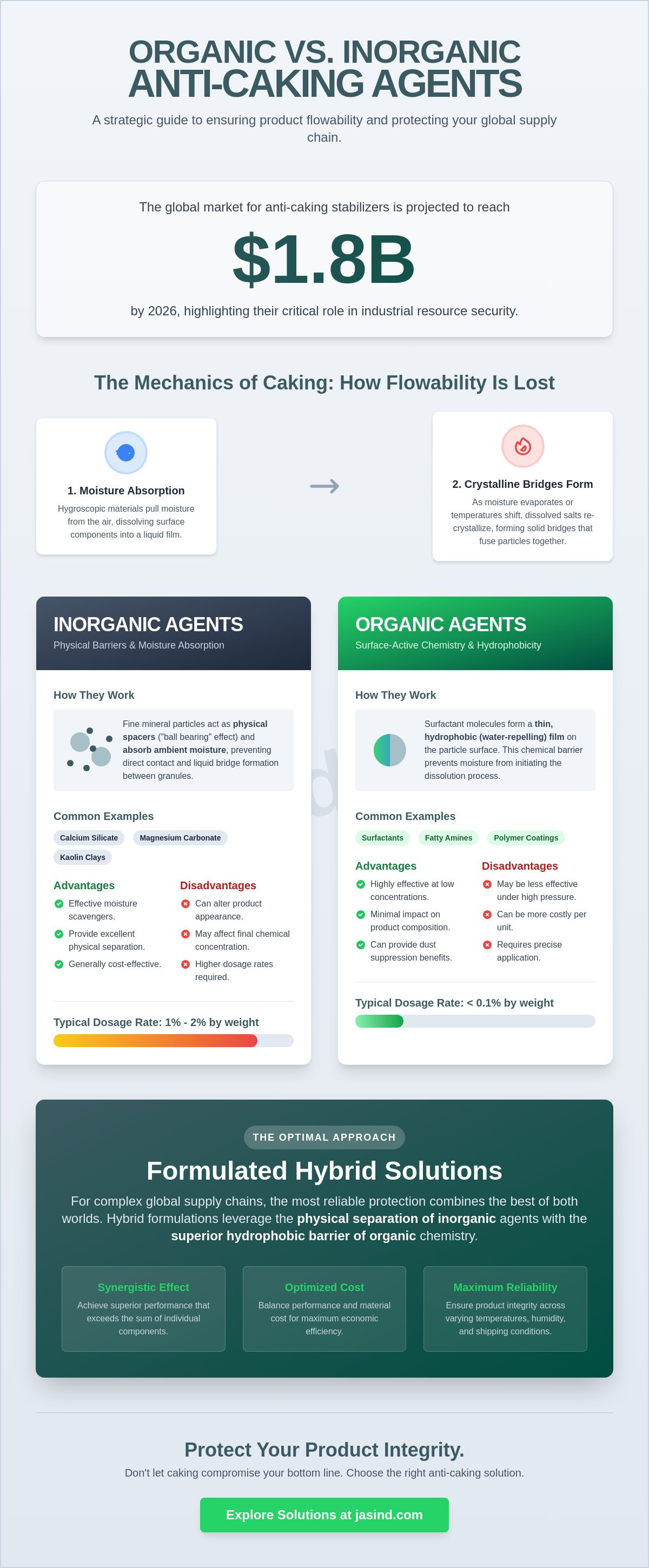
Inorganic agents provide a mechanical solution to the problem of particle fusion. Unlike their organic counterparts, these mineral-based additives function primarily as physical spacers. They coat the surface of granules to prevent direct contact between reactive surfaces. When evaluating organic vs inorganic anti-caking agents, the inorganic category is defined by its role as a sacrificial moisture scavenger. By absorbing atmospheric water before it can reach the substrate, these agents prevent the dissolution that leads to crystalline bridging. They act as a protective buffer, ensuring the core material remains dry and discrete.
Common industrial examples include calcium silicate, magnesium carbonate, and kaolin clays. These minerals are prized for their high surface area and porous structures. They excel in environments where bulk materials are prone to leakage or "sweating" during storage. Understanding how anti-caking agents work is vital for selecting the right mineral for your specific substrate. While these minerals are effective, they often require higher dosage rates, sometimes reaching 1% to 2% by weight, to ensure total coverage. This bulk addition can alter the final product's appearance or chemical concentration.
Mechanism of Physical Separation
Fine inorganic powders create a "ball bearing" effect between larger granules. By increasing the physical distance between particles, they reduce the likelihood of fusion under the weight of a storage pile. This separation is particularly effective for high-porosity materials that tend to bleed liquid components during storage. The efficiency of these agents is directly proportional to their surface area. A finer particle size in the additive allows for more comprehensive coverage of the host material, effectively insulating it from environmental triggers and pressure-induced deformation.
Pros and Cons of Inorganic Formulations
Thermal stability is a significant advantage of mineral-based agents. They remain effective in high-temperature drying processes where some organic compounds might degrade. However, this stability comes with a logistical trade-off. The fine nature of these powders often leads to "dusting," a secondary handling issue that can impact air quality and worker safety. In some cases, the use of specialized anti-dusting agents is required to mitigate these effects. While cost-effective in bulk, the logistical burden of handling large volumes of mineral dust must be weighed against their protective benefits. They remain a reliable choice for heavy industrial applications where chemical simplicity and moisture scavenging are the primary goals.
Organic Anti-Caking Agents: Surface-Active Chemistry and Hydrophobicity
Organic solutions represent a shift from physical separation to molecular protection. While inorganic agents act as spacers, organic additives utilize surface-active chemistry to alter the particle's fundamental relationship with moisture. These agents create a thin, hydrophobic film around each granule. This barrier prevents the formation of liquid bridges, the precursors to solid crystalline bonds. When comparing organic vs inorganic anti-caking agents, the primary advantage of the organic approach is its efficiency. It doesn't require bulk volume to succeed. Instead, it relies on precise chemical orientation to ensure resource stability and long-term storage integrity.
The core of this technology lies in surfactants. These molecules possess dual properties: a polar head that bonds to the fertilizer or chemical substrate and a non-polar tail that repels water. This molecular shielding is a critical component of The Science of Anti-Caking Agents. Key chemical groups used in these formulations include fatty amines, sulfonates, and specialized vegetable-based oils. Because they work at the molecular level, organic formulations require significantly lower dosages than mineral powders. Often, a few kilograms per ton provide superior protection compared to the much larger volumes required for inorganic coatings.
The Role of Fatty Amines and Surfactants
Fatty amines are the workhorses of organic anti-caking. They orient themselves systematically on the granule surface to create a dense, water-repellent barrier. This molecular coating prevents moisture absorption by neutralizing the surface energy that would otherwise attract atmospheric humidity. The effectiveness of these coatings depends heavily on the carbon chain length of the amine. Longer chains generally provide a more robust hydrophobic shield; however, they must be balanced for viscosity and ease of application during the production process. This precision ensures that even in high-humidity environments, the product remains free-flowing.
Sustainability and Environmental Considerations
Modern organic agents prioritize global responsibility. Many of these formulations are now designed for high biodegradability, ensuring they don't accumulate in the soil after the fertilizer is applied. This alignment with international environmental regulations is essential for long-term agricultural health. Choosing between organic vs inorganic anti-caking agents involves balancing this environmental impact with specific production needs. By requiring lower dosage rates, organic agents also reduce the carbon footprint associated with chemical logistics. Shipping fewer tons of additives translates to lower fuel consumption and reduced emissions across the entire supply chain. It's a technical solution that supports both industrial performance and environmental stewardship.
Performance Comparison: Organic vs Inorganic Formulations
Choosing between organic vs inorganic anti-caking agents requires a deep understanding of operational logistics. It's not just about the chemistry on the granule; it's about how that chemistry survives a six-month storage cycle in a humid port. Inorganic minerals often struggle in maritime environments. Once their porous structures reach saturation, they can no longer scavenge moisture. In contrast, organic surfactants maintain a constant hydrophobic barrier. This film doesn't "fill up" like a mineral sponge. It repels water continuously, ensuring product flowability remains intact from the plant to the final destination.
Compatibility with secondary additives is a major operational concern for global producers. Many fertilizer manufacturers use coloring agents to distinguish their brand or indicate nutrient content. Inorganic powders can dull these colors, leading to a dusty, unappealing final product. Organic coatings are transparent and integrate seamlessly with both coloring agents and Fertilizer Dust Suppressants. This synergy ensures that your product looks as good as it performs. Long-term stability tests show that while inorganic agents are excellent for short-term drying, organic films provide superior protection over six months or more, especially in fluctuating temperatures.
Application Efficiency and Dosing
Application methods define your plant's infrastructure requirements. Organic agents are typically applied via liquid spraying systems, which allow for high-precision dosing at rates of 0.5 to 1 kg per ton. Inorganic agents usually require heavy-duty powder feeders to manage dosages of 5 to 20 kg per ton. This twenty-fold difference in volume impacts every stage of your supply chain. Molecular films provide more uniform coverage across the granule surface, whereas mineral dusts can settle or migrate during transport. This uniformity is why organic systems are often more reliable for high-value chemical products.
Choosing the Right Agent for Your Substrate
Substrate compatibility is the final piece of the puzzle. Urea and Ammonium Nitrate fertilizers have high hygroscopicity, making them ideal candidates for organic coatings that block moisture at the molecular level. Complex NPK blends might benefit from a multi-stage approach that considers the specific salt chemistry of the mixture. For mining reagents and industrial minerals, the choice depends on the specific surface energy of the material. Specialized Technical Consulting and Process Optimization can help bridge the gap between lab theory and plant-scale reality. Secure your supply chain with high-performance Fertilizer Anti-caking Agents designed for global stability.
Formulated Solutions: The Hybrid Approach to Global Quality
The global supply chain in 2026 is too volatile for a one-size-fits-all strategy. When industrial materials cross multiple climate zones, a single additive often reaches its technical limit. This is where the debate over organic vs inorganic anti-caking agents evolves into a discussion of synergy. Hybrid formulations are emerging as the gold standard for resource protection. By combining the immediate moisture-scavenging power of inorganic carriers with the long-lasting hydrophobicity of organic surfactants, producers can achieve a level of stability that neither category offers alone. It's about building a multi-layered defense against the environmental triggers that cause product degradation.
Customization is the key to this approach. A shipment of Potash destined for a tropical port requires a different chemical profile than Urea stored in a temperate silo. JAS Global Industries prioritizes this nuance through advanced Research and Innovation (R&I). We don't just supply additives; we engineer stability. This ensures that critical minerals and fertilizers remain free-flowing, protecting the integrity of the global food and energy infrastructure. Comparing organic vs inorganic anti-caking agents shows that while each has merits, their combination often provides the most robust security for high-value bulk shipments.
Tailor-Made Chemical Technologies
Effective protection begins with a deep technical understanding of the production environment. JAS Global conducts comprehensive audits of industrial plants to develop custom dosing strategies that account for specific humidity levels and storage durations. Our on-site laboratory testing simulates the exact stresses of long-distance maritime transport. In one recent case study, a client optimized flowability for a 45-day sea voyage by switching to a hybrid system. This transition eliminated product rejection at the destination and significantly reduced the need for secondary re-processing. We focus on the practicalities of your operation to ensure every kilogram of additive delivers maximum value.
Securing the Future of Global Resources
Chemical stability is a foundational pillar of global security. When fertilizers clump or mining reagents fail, the impact ripples through the entire economy. Innovation in this sector focuses on developing cost-effective, sustainable additives that respect the environment while providing uncompromising performance. We view our role as a guardian of these essential resources. By refining the balance between different chemical agents, we help our partners maintain operational continuity and minimize waste. Reliable infrastructure depends on reliable chemistry. It's our mission to provide the tools necessary for a stable and sustainable industrial future.
Contact JAS Global Industries for a Technical Audit of your process to ensure your production meets the highest standards of stability and efficiency.
Securing Global Supply Chains with Advanced Stability
Strategic material protection is the foundation of industrial reliability. Navigating the technical landscape of organic vs inorganic anti-caking agents reveals that performance depends on precise environmental alignment. While inorganic minerals offer essential physical separation, organic surfactants provide the molecular resilience needed for challenging maritime transport. The most secure supply chains now rely on hybrid formulations to ensure consistent flowability across diverse climate zones. This dual approach provides a comprehensive shield against the environmental triggers that threaten product integrity.
JAS Global Industries has been an indispensable pillar of the chemical and mining sectors since 1998. Headquartered in Dubai with a robust global distribution network, we operate multiple R&I centers dedicated to engineering tailor-made formulations. We don't just supply additives; we protect the stability of critical global resources. Our commitment to excellence ensures your products remain discrete and manageable from production to application. Optimize Your Fertilizer Flowability with JAS Global Solutions. Together, we can ensure the integrity of your industrial assets and the efficiency of your global operations.
Frequently Asked Questions
What is the primary difference between organic and inorganic anti-caking agents?
Inorganic agents rely on bulk mineral spacers to create physical distance between particles. Organic agents use surface-active surfactants to modify the granule's surface energy and repel water at a molecular level. This fundamental distinction defines the application method and the volume of additive required for effective protection. While inorganic options focus on moisture scavenging, organic solutions prioritize the creation of a continuous hydrophobic barrier.
Which anti-caking agent is best for ammonium nitrate fertilizers?
High-hygroscopicity materials like ammonium nitrate require robust moisture protection, making organic or hybrid formulations the most effective choice. These agents create a continuous hydrophobic film that prevents the salt from absorbing atmospheric humidity. This shielding is essential for maintaining stability during long-term storage and maritime transport in high-humidity regions. It ensures the fertilizer remains free-flowing despite its natural tendency to attract water.
Are organic anti-caking agents biodegradable and safe for the soil?
Modern organic formulations are designed for high biodegradability to ensure long-term soil health and environmental compliance. These agents break down naturally after application, preventing chemical accumulation in agricultural land. Selecting a responsible supplier ensures that your organic vs inorganic anti-caking agents meet international ecological standards while protecting your product. This alignment with sustainability goals is a critical factor for global agricultural exporters.
Can inorganic anti-caking agents cause dust problems in industrial plants?
Inorganic mineral powders are frequently associated with increased dust emissions during handling and application. Because they're applied as dry fines, they can easily become airborne, creating safety hazards and requiring secondary dust suppression measures. This is a primary reason why some plants transition to liquid-based organic systems that eliminate these particulate issues. Reducing dust improves worker safety and minimizes the loss of additive material during the coating process.
How much anti-caking agent is typically required per ton of fertilizer?
Dosing rates vary significantly based on the chosen technology and the material's specific needs. Organic agents typically require between 0.5 and 1.5 kilograms per ton of material. Inorganic agents generally require much higher volumes, often ranging from 5 to 20 kilograms per ton, to achieve the same level of surface coverage. This difference in volume impacts your storage requirements and the overall logistical costs of your production line.
How do anti-caking agents affect the final quality of industrial minerals?
Anti-caking treatments preserve the physical integrity and market value of industrial minerals by ensuring they remain free-flowing. Without these additives, minerals can fuse into large masses that are impossible to unload or process. Proper treatment maintains the particle size distribution and prevents the degradation of the product's chemical concentration. It ensures that your resources reach the end user in a ready-to-use, professional condition.
What happens if a fertilizer is stored without anti-caking treatment?
Storing untreated fertilizer often leads to catastrophic product loss due to spontaneous agglomeration. Within days or weeks, atmospheric moisture triggers crystalline bridge formation, turning bulk granules into solid blocks. This results in significant re-processing costs, equipment damage, and potential rejection by international customers at the port of entry. It's a risk that compromises both your financial margins and your reputation for reliability.
Can anti-caking agents be combined with fertilizer coloring agents?
Anti-caking agents are highly compatible with fertilizer coloring agents when formulated correctly. Organic coatings are particularly beneficial as they provide a clear finish that enhances the vibrancy of the pigment. This combination allows producers to maintain both the visual branding and the structural stability of their fertilizer products. It's a strategic way to ensure your product stands out in the market while remaining operationally stable.