

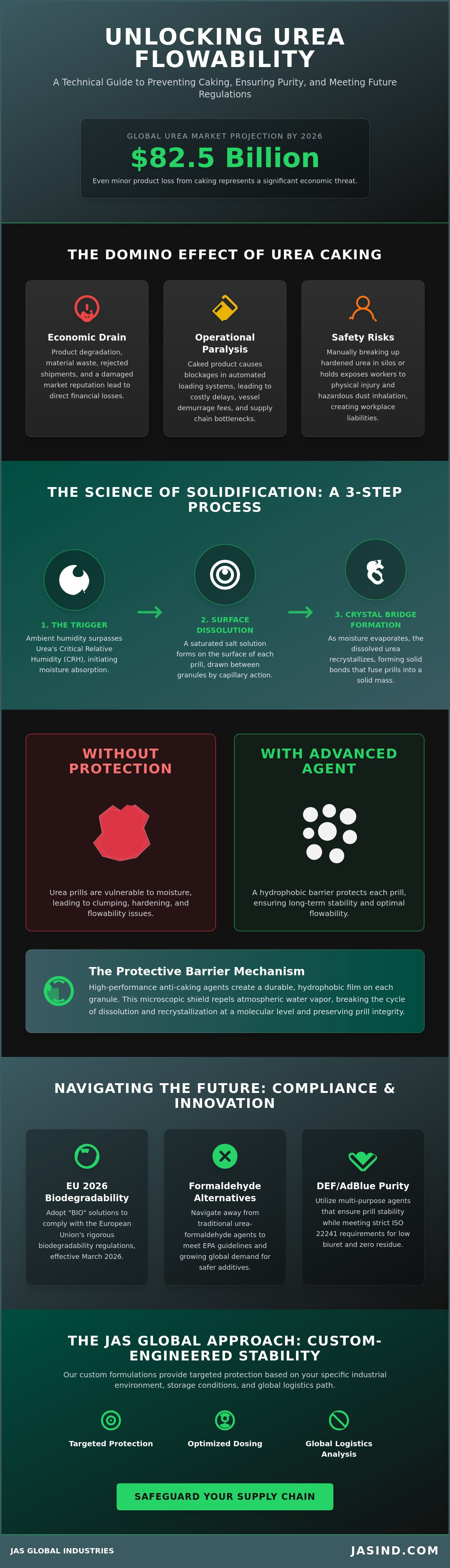
With the global urea market projected to reach a valuation of up to $82.5 billion by 2026, even a minor percentage of product loss due to caking represents a significant threat to global resource stability. You understand that maintaining prill integrity is about more than just aesthetics; it's a matter of preventing the hard lumping and equipment blockages that can paralyze a supply chain. Selecting a high-performance anti-caking agent for urea manufacturing has become a strategic necessity, especially as the industry faces new pressures from the European Union's March 2026 biodegradability regulations and the EPA's recent focus on formaldehyde emissions.
We agree that your operations shouldn't have to choose between technical performance and environmental responsibility. This technical guide will help you discover how specialized anti-caking agents optimize urea flowability, ensure prill integrity, and safeguard your global supply chain efficiency. We'll examine the transition toward "BIO" solutions and provide a roadmap for maintaining technical grade purity while meeting the rigorous standards set for 2026 and beyond.
Key Takeaways
- Identify the economic impact of product degradation and how to safeguard automated loading systems through superior moisture management.
- Master the chemical mechanisms behind crystal bridge formation and the critical humidity points that compromise urea stability.
- Navigate the global regulatory shift away from formaldehyde by adopting a compliant, high-performance anti-caking agent for urea manufacturing.
- Optimize production efficiency by determining the ideal dosing points and precision application methods for external coatings.
- Discover the advantages of custom-engineered formulations that provide targeted protection based on your specific industrial environment and logistics path.
The Impact of Caking on Urea Manufacturing and Global Logistics
The stability of the global urea supply chain depends on physical consistency. When urea prills fuse together, the result is more than a logistical hurdle; it's a direct economic drain. Product degradation during long-term bulk storage leads to material waste and increased operational costs. For producers, the stakes are high. A shipment of caked urea leads to rejected loads and a damaged market reputation. Maintaining flowability is essential for the seamless operation of automated loading and unloading systems in international ports. Without a reliable anti-caking agent for urea manufacturing, these systems face frequent blockages that delay vessel turnaround times and inflate demurrage fees.
Understanding The Science of Urea Caking reveals that moisture absorption and crystal bridging are the primary culprits. Beyond logistics, safety remains a priority. Manually breaking up hard-caked urea masses in silos or warehouses exposes workers to physical risks and dust inhalation. As we move toward 2026, the industry demands higher performance from additives. New environmental standards and the push for biodegradable solutions mean that anti-caking strategies must evolve to protect both the product and the planet.
Maritime Transport and Humidity Challenges
Cross-continental shipping presents the most hostile environment for urea stability. Fluctuating temperatures and high humidity levels in bulk carrier holds trigger the hygroscopic nature of urea. Pressure-induced caking often occurs in the bottom layers of these holds. The weight of thousands of tons of product accelerates crystal formation at the contact points. In silos, this phenomenon manifests as "tunnelling." The center of the mass flows out, but hardened walls of product remain. This waste is nearly impossible to recover without specialized, costly intervention.
Meeting Technical Grade Urea (DEF/AdBlue) Requirements
Technical grade urea, used for Diesel Exhaust Fluid (DEF) or AdBlue, requires a higher standard of purity. Traditional additives often contain contaminants that fail the strict ISO 22241 requirements for DEF production. Manufacturers must balance physical prill stability with low biuret levels and zero residue. The industry is shifting toward multi-purpose anti-caking agent for urea manufacturing solutions. These agents provide the necessary surface protection for agricultural urea while maintaining the chemical integrity required for sensitive technical applications. This dual-purpose approach ensures that producers can serve both markets without compromising on quality or compliance.
The Science of Urea Caking: Mechanisms and Chemical Triggers
Urea caking is more than a logistical inconvenience; it's a complex chemical evolution. At its core, caking is the transformation of free-flowing granules into a solid mass through the formation of microscopic crystal bridges. This process begins when the ambient relative humidity exceeds the Critical Relative Humidity (CRH) of urea. Once this threshold is crossed, the surface of each prill begins to adsorb moisture, creating a saturated salt solution. Using a high-performance anti-caking agent for urea manufacturing is the primary defense against this chemical trigger.
Surface tension and capillary action then draw this liquid into the narrow gaps between adjacent granules. As environmental conditions shift, this moisture evaporates, leaving behind solid crystalline connections. The severity of this bonding is often dictated by prill size distribution. A higher concentration of "fines" or smaller particles increases the total number of contact points within a bulk mass. More contact points mean more opportunities for bridging. This rapidly accelerates the solidification of the entire load, turning a manageable granular product into a single, unworkable block.
Hygroscopicity and Recrystallization
The molecular behavior of urea is inherently hygroscopic. It possesses a high affinity for atmospheric water vapor. When temperatures fluctuate during storage or transit, a destructive cycle of dissolution and recrystallization occurs. Even minor temperature drops can cause moisture to condense and dissolve the urea surface. When the temperature rises again, the urea recrystallizes, fusing the prills together. Effective anti-caking agents function by creating a durable, hydrophobic barrier. This microscopic film breaks the cycle by preventing water vapor from interacting with the urea surface at the molecular level.
Physical vs. Chemical Caking Factors
Internal factors also play a critical role. Residual moisture content trapped within the prill during the prilling tower stage can migrate to the surface over time. This internal moisture acts as a hidden catalyst for caking long after the product has been bagged or stored. Additionally, mechanical pressure in large-scale storage silos induces a "creeping" effect. The weight of the upper layers physically deforms the prills at the bottom. This deformation increases the contact area between granules and strengthens the chemical bonds. Crystal bridging is the primary cause of industrial caking. By selecting a specialized anti-caking agent for urea manufacturing, producers can manage these physical stressors and chemical triggers effectively.
Evaluating Anti-Caking Technologies: Beyond Urea Formaldehyde
Industrial standards for urea additives are undergoing a fundamental transformation. For decades, urea formaldehyde (UF) served as the default stabilizer. However, the regulatory landscape of 2026 has shifted the focus toward safer, more sustainable chemistry. Proposed European Union regulations as of March 2026 require anti-caking agents to meet specific biodegradability criteria. Simultaneously, the U.S. EPA's February 2026 focus on formaldehyde emission standards signals an industry-wide move away from traditional carcinogenic materials. Selecting a modern anti-caking agent for urea manufacturing now requires balancing high-performance moisture resistance with strict environmental compliance.
Manufacturers must choose between internal granulation aids and external coatings. Internal additives are incorporated into the urea melt to improve prill strength and reduce the formation of fines. External coatings, however, provide the primary defense against atmospheric moisture. The most effective strategies often combine these approaches. Modern performance metrics have evolved beyond simple flowability. Producers now evaluate additives based on their ability to suppress dust, maintain prill integrity under mechanical stress, and provide long-lasting hydrophobicity during global export.
Surfactant-Based Coating Formulations
Surfactant technology has become the cornerstone of moisture protection. Formulations utilizing fatty amines and sulfonates effectively reduce the surface tension of the urea prill. This prevents the "wetting" that leads to crystal bridging. Specialized oils serve as the carrier for these active molecules, ensuring uniform coverage across the entire bulk mass. In tropical climates, where humidity regularly exceeds the critical relative humidity of urea, the longevity of these coatings is vital. High-efficiency surfactants maintain a stable hydrophobic barrier even during the temperature spikes common in equatorial maritime transport.
Comparing Traditional and Modern Agents
The transition from Urea Formaldehyde to advanced synthetic or bio-based coatings involves a complex cost-benefit analysis. While traditional agents might offer lower initial material costs, they often require higher dosing rates and carry significant regulatory risks. Modern anti-caking agent for urea manufacturing solutions, such as the non-carcinogenic "Freeflow" brand or the "UltraCot" series, provide superior performance at lower application rates. The shift toward "BIO" solutions is also supported by the EPA’s February 2023 exemption of natural additives like rice bran wax. These modern agents ensure that urea producers remain compliant with the USDA’s National List of Allowed Substances, which was renewed in February 2026. Investing in high-efficiency, biodegradable technology safeguards your market access and protects your long-term brand reputation.
Optimizing the Dosing Process in Urea Manufacturing Lines
Precise dosing is the bridge between chemical capability and operational reality. In a high-volume production environment, even minor fluctuations in application rates can lead to significant financial loss or product failure. Effective cost control requires a dosing system that responds dynamically to the production load. If the application is too light, the anti-caking agent for urea manufacturing won't provide a continuous hydrophobic film. Conversely, excessive application creates an oily product that attracts dust and complicates downstream handling. Achieving the perfect balance ensures that every prill leaves the facility with maximum protection.
A critical technical synergy exists between fertilizer granulation aids and anti-caking agents. By using high-performance granulation aids during the initial formation process, manufacturers produce smoother, harder prills with fewer surface defects. This improved substrate requires less external coating to achieve total coverage. It's a holistic approach to stability; the granulation aid optimizes the internal structure while the anti-caking agent secures the surface. Integrating these two stages reduces overall chemical consumption and enhances the final product's resistance to mechanical stress.
Spray Systems and Nozzle Configuration
Uniform coverage depends entirely on the configuration of the spray headers. Achieving the optimal droplet size is essential for maximum surface area coverage without creating "wet spots." If droplets are too large, they fail to distribute evenly across the moving bulk mass. If they're too small, they drift into the dust extraction system. Modern facilities integrate dosing pumps with belt scale data to automate the process. This ensures that the flow of the anti-caking agent for urea manufacturing scales perfectly with the real-time production rate, maintaining consistency during start-up or shutdown phases.
Troubleshooting Common Application Issues
Operational teams must stay vigilant against the 'fines' cycle. Small urea particles, or fines, have a much higher surface-area-to-volume ratio than standard prills. These particles disproportionately absorb the coating, leaving larger prills under-protected. Managing the screening process is vital to keep coating consumption within the targeted range. Prill temperature also plays a decisive role in application success. Higher prill temperatures increase the rate of coating absorption into the urea matrix, potentially reducing the surface protection available for long-term storage. To ensure your dosing line is operating at peak efficiency, consult with our technical specialists for a comprehensive system audit.
Custom Formulations: The JAS Global Approach to Urea Stability
Industrial processes aren't static. A standardized, one-size-fits-all chemical often fails to address the unique variables of a specific manufacturing plant. Factors such as local ambient humidity, the specific purity of raw materials, and the length of the intended storage cycle all influence how urea behaves. At JAS Global, we recognize that an effective anti-caking agent for urea manufacturing must be as specialized as the facility it serves. Our Research and Innovation (R&I) process moves beyond basic supply; we conduct extensive laboratory simulations to replicate your exact environmental conditions and feedstock variations.
This tailored approach ensures that our formulations provide the precise balance of hydrophobicity and surface tension reduction required for your specific logistics path. Whether you are shipping to tropical regions or storing product in high-pressure silos, our chemicals are engineered to perform. We remain committed to developing sustainable and cost-effective technologies that meet the rigorous global standards of 2026. By optimizing the chemistry for your specific needs, we reduce unnecessary chemical consumption and maximize the value of your final product.
Technical Consulting and Process Audits
Our technical teams don't just ship products. We provide comprehensive on-site process audits to identify hidden bottlenecks in your urea handling and storage systems. Site-specific laboratory testing ensures that our additives are perfectly compatible with your plant’s unique chemistry. This level of precision prevents the 'creeping' effect and crystal bridging discussed in previous chapters. We provide ongoing operational troubleshooting to our global partners, ensuring that your production line remains optimized as seasonal climates shift. This collaborative model transforms the supplier relationship into a long-term technical partnership focused on stability.
Global Reliability and Ethical Supply
Protecting the world's most critical resources requires a robust and responsive supply chain. JAS Global leverages strategic manufacturing hubs in Dubai, Riyadh, and Cairo to provide rapid delivery to major urea-producing regions. This proximity allows us to respond to urgent operational needs without the delays typical of cross-continental logistics. We view our role not merely as a chemical supplier, but as a global guardian of fertilizer quality and food security. By ensuring that every ton of urea reaches the field in peak condition, we support the stability of the global agricultural sector. Our anti-caking agent for urea manufacturing serves as a vital component in this mission. Contact our technical team for a custom urea process audit and discover how our tailor-made formulations can secure your supply chain efficiency.
Securing Global Urea Supply Chains for 2026 and Beyond
The evolution of industrial urea production requires a transition from generic chemicals to precision-engineered protection. Maintaining prill integrity during cross-continental transit is a complex challenge that demands more than a surface-level solution. It's about integrating advanced chemistry with site-specific operational audits to ensure your product remains free-flowing and compliant with the latest global environmental standards. We've seen how the shift toward biodegradable, non-formaldehyde solutions is no longer optional but a strategic necessity for market access.
Selecting a high-performance anti-caking agent for urea manufacturing is a critical step in safeguarding your market reputation and supply chain efficiency. Since 1998, JAS Global has stood as a reliable guardian of industrial quality. Our global R&I centers and manufacturing hubs provide the technical consulting and advanced formulations needed to solve the most difficult caking challenges. We don't just supply chemicals; we protect the stability of essential global resources through long-term technical partnerships.
Optimize Your Urea Flowability with JAS Global Specialty Chemicals. Let's work together to build a more resilient and efficient manufacturing future.
Frequently Asked Questions
What is the primary cause of caking in urea manufacturing?
Crystal bridging is the fundamental cause of caking. It occurs when atmospheric moisture dissolves the urea surface, creating a saturated salt solution that later evaporates. This cycle leaves behind solid crystalline bonds between adjacent prills, transforming free-flowing granules into a hardened mass.
How do anti-caking agents for urea differ from those used in NPK fertilizers?
Urea requires specialized hydrophobic barriers because it's significantly more hygroscopic than most NPK blends. While NPK agents often manage complex chemical reactions between different mineral salts, an anti-caking agent for urea manufacturing focuses specifically on preventing moisture-induced recrystallization and managing high critical humidity thresholds.
Can anti-caking agents be used for technical grade urea (AdBlue)?
Yes, but they must meet rigorous purity standards to avoid contaminating Diesel Exhaust Fluid (DEF) systems. Standard agricultural additives can leave residues that fail ISO 22241 requirements. We provide specialized, zero-residue formulations designed to maintain prill stability without compromising the technical grade purity required for AdBlue production.
What is the recommended dosage for anti-caking agents in urea production?
Typical dosage rates range from 0.5 to 1.5 kilograms per metric ton of urea. The exact requirement depends on the prill's surface area, the concentration of fines, and the intended storage duration. Our technical teams determine the precise dosing through site-specific laboratory simulations to ensure maximum cost-efficiency.
Are modern urea anti-caking agents environmentally safe?
Modern formulations are increasingly bio-based and biodegradable to meet the 2026 regulatory standards proposed by the European Union. The industry is moving away from formaldehyde-based products toward "BIO" surfactants. These agents provide the necessary protection while ensuring compliance with global environmental export requirements and USDA organic standards.
How does the prill temperature affect the efficiency of the coating agent?
Prill temperature directly influences the rate of coating absorption into the urea matrix. If the urea is too hot, the agent may penetrate the prill rather than staying on the surface. This reduces the effective hydrophobic barrier and requires a higher dosing rate to maintain the same level of moisture protection.
What is the shelf life of urea treated with high-performance anti-caking agents?
Treated urea can maintain its flowability for six to twelve months under controlled storage conditions. High-performance agents extend this window by resisting the pressure-induced caking and humidity fluctuations common in long-term bulk storage. This ensures the product remains marketable even after cross-continental shipping.
How do JAS Global anti-caking agents improve dust suppression?
Our agents utilize advanced surfactants that reduce the surface tension of the urea prill, which prevents the abrasive friction that creates fine particles. By binding residual fines to the larger prills, the formulation significantly improves air quality in handling facilities. This dual-action approach secures the product's physical integrity while protecting worker health.