
The stability of a global supply chain often hinges on the crush strength of a single four-millimeter sphere. You know that high recycle loads and granule degradation don't just waste material; they erode your profit margins and damage your reputation. Implementing specialized Fertilizer Granulation Aids is no longer a luxury; it's a technical necessity for facilities aiming to maintain operational excellence in 2026. At JAS Global Industries, we view these chemical solutions as essential tools for protecting Global Food Security and Manufacturing Relationships through consistent quality.
This guide will help you master the technical selection of granulation additives to enhance granule integrity and significantly reduce your recycle ratios. You'll gain the insights needed to lower operational costs while adhering to the strictest global sustainability standards. We'll provide a clear roadmap for optimizing your granulation process to ensure your product arrives at its destination exactly as intended.
Key Takeaways
- Understand how high-performance Fertilizer Granulation Aids act as a cornerstone for global food security by maintaining granule integrity across the supply chain.
- Discover the chemical mechanisms of agglomeration and how managing surface tension leads to superior granule hardness and reduced dust.
- Learn to identify the most effective binder for your specific substrate, whether processing DAP, MAP, Urea, or complex NPK blends.
- Master a technical framework for optimizing chemical dosing to significantly decrease plant recycle ratios and enhance overall production yield.
- Explore the advantages of custom-engineered formulations designed to meet the unique environmental and mechanical demands of your specific facility.
The Strategic Role of Fertilizer Granulation Aids in Global Supply Chains
Fertilizer Granulation Aids are specialty chemical reagents designed to promote substrate coalescence during the manufacturing phase. These additives ensure that individual particles bond into uniform, robust spheres. Technical stability is a cornerstone of global food security. Without structural integrity, the nutrients required to sustain 8 billion people would never reach the field. The Granulation process dictates how effectively a commodity fertilizer transitions into a high-value export. It's a critical bridge between raw chemical production and global distribution.
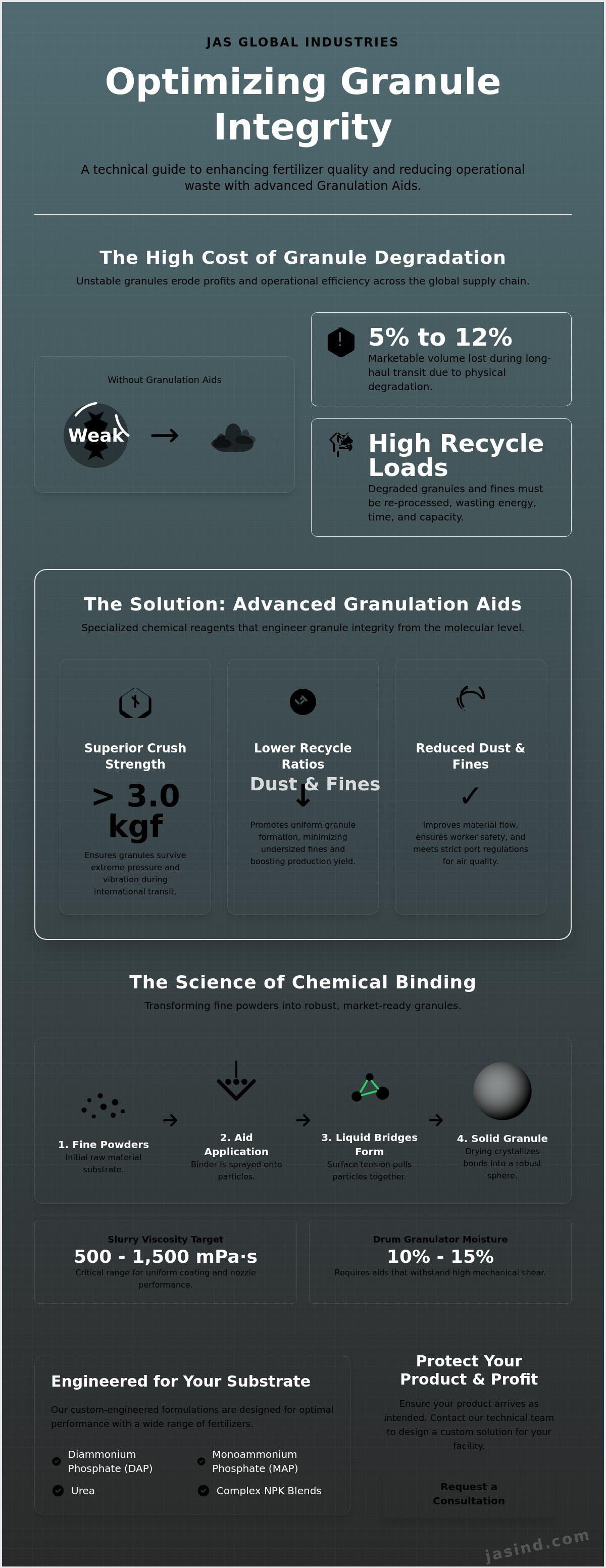
Engineers measure success through specific physical performance metrics. Crush strength for Diammonium Phosphate (DAP) must typically exceed 3.0 kgf to survive international transit. Porosity levels must remain low to prevent moisture absorption and subsequent caking. Size distribution ensures a consistent spread pattern for the end-user. High-quality Fertilizer Granulation Aids allow manufacturers to hit these targets consistently, even when working with variable raw material grades.
The Impact of Granule Hardness on Distribution
Maritime transport subjects bulk cargo to extreme vertical pressure and vibration. Granules at the bottom of a 50,000-ton vessel must withstand immense static loads. These specialty reagents optimize granule density, which directly influences nutrient release profiles. By preventing the formation of fines and dust, these aids ensure that the material remains free-flowing. High-density granules resist crushing during multi-stage handling, maintaining the precise calibration required for modern agricultural machinery. Quality is security. Precision matters in the hold and on the farm.
Economic Implications of Product Degradation
Product loss during ship-to-shore transfer is a significant financial drain. Industry data shows that physical degradation can result in a 5% to 12% loss of marketable volume during long-haul transit. This isn't just a loss of material; it's a loss of energy and labor. Modern ports now enforce strict regulatory requirements for dust control to protect local air quality and worker safety. Exporters don't just ship nutrients; they ship reliability. Fertilizer Granulation Aids protect brand value by ensuring that the physical integrity of the product reflects the technical excellence of the manufacturer at every stage of the journey. This consistency protects market share in a competitive global landscape where reputation is everything.
Mechanisms of Agglomeration: The Science of Chemical Binding
Agglomeration transforms fine powders into robust, spherical particles. This process relies on Fertilizer Granulation Aids to manage the liquid-solid interface effectively. In wet granulation, the slurry viscosity must remain within a narrow window, typically between 500 and 1,500 mPa·s, to ensure uniform coating. High-viscosity slurries often require chemical surfactants to reduce internal friction and prevent nozzle clogging. These chemical aids alter the surface tension of the fertilizer substrate, allowing the liquid phase to spread evenly across the particle surfaces.
The transition from liquid to solid states is a critical phase in the granulator. Initially, liquid bridges form as droplets collide with particles. As the heat from the drying process evaporates the solvent, these bridges crystallize into permanent solid structures. Research into the Pilot Plant Production of Granular NPK Fertilizer demonstrates that precise control over these binding mechanisms directly impacts the final granule's crush strength and solubility. Chemical aids accelerate this transition, promoting rapid and uniform granule formation while minimizing the recycling of undersized fines.
Wet vs. Dry Granulation Requirements
Drum granulators typically operate with moisture levels between 10% and 15%. This environment requires additives that can withstand high mechanical shear. Pan granulators, by contrast, rely on a finer spray and a more delicate moisture-substrate interface to manage coalescence. Managing high-viscosity fertilizer slurries involves using dispersants that maintain flowability even at high solid concentrations. These specialized Fertilizer Granulation Aids ensure that the material moves through the system without scaling or build-up.
The Chemistry of Interfacial Adhesion
Binding efficiency is heavily influenced by the molecular weight of the polymers used. Polymers with a molecular weight between 50,000 and 200,000 Daltons provide the ideal balance between sprayability and tensile strength. Temperature also plays a role; most binders see a performance peak between 60°C and 80°C. Variations in pH can neutralize certain ionic binders, making pH-stable formulations essential for complex NPK blends. Capillary forces act as the primary driver for initial particle clustering, drawing solids together through the negative pressure created within the interstitial liquid voids.
Ensuring the structural integrity of your product is essential for global food security. Discover how our technical solutions can optimize your production efficiency and reduce waste in your facility.
Comparative Analysis: Selecting the Right Binder for Your Substrate
Selection of the correct binder is a foundational step in ensuring global food security. It's a technical decision that impacts the entire supply chain. Producers must balance raw material costs with the physical requirements of the final product. Reliability in the field begins with the integrity of the granule in the plant. Choosing the wrong additive leads to dust generation, product loss, and compromised safety during transport.
Lignosulfonates remain the industry standard for traditional NPK production. These organic binders are cost-effective and provide reliable adhesion. They act as natural plasticizers, making the slurry more manageable. However, high-performance synthetic polymers are becoming essential for extreme durability. These advanced Fertilizer Granulation Aids typically operate at inclusion rates as low as 0.5 to 1.5 kg per ton. While starches offer a 100% bio-based profile, they often struggle in high-humidity regions where relative humidity exceeds 70%. In these environments, starches can absorb moisture, leading to premature softening of the granule.
Sustainability profiles have shifted significantly heading into 2026. Regulatory frameworks now prioritize biodegradability and the reduction of microplastic residues. Modern synthetic polymers are engineered to break down after soil application, ensuring that high performance doesn't come at an environmental cost. This balance of technical strength and ecological responsibility is the hallmark of modern industrial chemistry.
Lignosulfonates vs. Advanced Polymers
Organic lignins provide a steady, reliable bond for standard agricultural grades. They're the preferred choice when manufacturing costs are the primary constraint. Advanced polymers are different. They're utilized when granules require a 20% to 30% increase in crush strength for long-distance export. Many facilities now use synergistic blends. By combining the immediate tackiness of lignosulfonates with the structural lattice of synthetic polymers, producers achieve a superior finish that resists abrasion during bulk handling.
Specialized Aids for Phosphates and Potash
Phosphate-based fertilizers like DAP and MAP have a unique internal porosity. This requires Fertilizer Granulation Aids with low viscosity to ensure deep penetration into the granule core. Without this penetration, the outer shell becomes brittle and prone to shattering. Potash derivatives present a different challenge. They're naturally hygroscopic and pull moisture from the air. Custom formulations for potash include moisture-barrier properties that prevent caking. For micronutrient-enriched blends, these aids ensure that elements like zinc or boron stay locked within the matrix, preventing nutrient segregation during shipping.
Process Optimization: Reducing Recycle Loads and Enhancing Yield
Efficiency defines the modern granulation plant. It's the difference between a profitable operation and one struggling with rising energy costs. High-performance Fertilizer Granulation Aids stabilize the production circuit by controlling the liquid phase of the slurry. When operators integrate these aids, they directly influence the mechanical strength of the green granules. This strength is vital. It prevents premature crushing during the transition from the granulator to the dryer. By 2025, industry standards suggest that a 15% reduction in recycle ratios can decrease overall fuel consumption in the drying circuit by approximately 9%.
Technical audits provide the roadmap for these improvements. A 2024 analysis of NPK production facilities found that plants conducting quarterly audits identified 12% more process bottlenecks than those relying on automated sensors alone. These audits focus on the granulation loop. They pinpoint where fines originate. If the recycle load is too high, the system chokes. This reduces the net yield of on-spec product. Monitoring the return on investment for chemical additives isn't just about the cost per ton; it's about the daily tonnage gain. If a binder increases the first-pass yield by 5%, a 1,000 TPD plant gains 50 tons of sellable product every day.
Strategies for Reducing Recycle Volumes
Better agglomeration reduces the volume of under-sized particles that fall through the primary screens. When fewer fines return to the head of the circuit, the granulator operates with a more consistent particle size distribution. This consistency is essential for Global Food Security. It ensures farmers receive uniform nutrients that flow easily through application equipment. Reducing the recycle volume also lowers the electrical load on elevators and conveyors, extending the life of critical infrastructure. A 10% reduction in recycle volume typically translates to a 6.5% increase in total throughput capacity.
Dosing and Laboratory Testing Best Practices
- Establish a baseline using on-site laboratory testing to measure crush strength and abrasion resistance.
- Identify the optimal addition point, which is typically at the slurry spray bar or the feed entry of the drum.
- Calibrate dosing pumps weekly to ensure precision within a 0.5% tolerance range.
Achieving a uniform binder distribution ensures that every seed particle receives the exact surface tension required for stable agglomeration. Without this precision, the circuit suffers from "cycling," where the granulator alternates between being too wet and too dry. This instability wastes resources and risks product quality. We focus on the foundational needs of the industry through technical precision.
Discover how our chemical solutions support your operational goals and contribute to global stability. Explore our Fertilizer Granulation Aids and enhance your plant yield today.
JAS Global Solutions: Custom Formulations for Industrial Reliability
JAS Global Solutions leverages 25 years of industrial chemical manufacturing expertise to solve complex production challenges. We recognize that every plant operates under distinct environmental and mechanical conditions. This reality makes off-the-shelf solutions obsolete. Our technical teams develop tailor-made formulations that integrate seamlessly with your specific machinery and raw material profiles. By focusing on site-specific chemistry, we ensure that our Fertilizer Granulation Aids deliver peak performance where generic alternatives fail.
Our global Research and Innovation (R&I) centers serve as the backbone for operational troubleshooting. We don't believe in distant support. Instead, we use these hubs to simulate plant environments and stress-test our chemical solutions before they ever reach your facility. This proactive strategy is part of the "JAS Cares" commitment. We understand that stabilizing the fertilizer supply chain is essential for global food security. By ensuring that every granule meets rigorous standards, we help producers maximize output and protect the world's most vulnerable populations from supply chain volatility.
Technical Consulting and On-Site Support
Reliability isn't a happy accident. It's the result of rigorous professional audits. JAS engineers conduct deep-dive assessments of industrial workflows to eliminate inefficiencies and improve yields. In a 2024 case study, a partner facility achieved a 12% increase in operational reliability and a measurable reduction in recycle ratios after implementing our recommended protocols. Our service offices in global hubs like Dubai and Lisbon ensure that logistical hurdles never compromise your production schedule. We manufacture relationships while we distribute quality. Our teams also provide hands-on training for plant operators to ensure that dosing systems are calibrated for maximum efficiency.
The Future of Fertilizer Additives
Looking toward 2026, the industry faces new pressures for sustainability and performance. JAS is leading the transition toward moisture-resistant granulation technologies that prevent degradation during long-range transport. We're currently perfecting the next generation of eco-friendly binders. These products provide the same industrial-strength adhesion as traditional chemicals but with a vastly improved biodegradable profile. These advancements help plants meet strict environmental mandates without sacrificing the physical quality of the final product. Integrating these advanced Fertilizer Granulation Aids into your process is the most effective way to future-proof your operations against changing climate conditions and regulatory shifts.
Securing the Future of Global Agricultural Yields
Efficiency in 2026 requires more than standard chemistry. It demands a precise alignment between substrate properties and chemical binding agents to minimize recycle loads and maximize plant throughput. High-performance Fertilizer Granulation Aids are the essential components that bridge this gap, ensuring structural integrity across global supply chains. At JAS Global Solutions, we leverage 25+ years of industrial chemical expertise to solve these complex manufacturing challenges. Our R&I centers, located in major industrial hubs worldwide, focus on creating custom formulations that drive industrial reliability while supporting the critical mission of Global Food Security. We've built our reputation on being a quiet giant in the industry, providing the foundational stability needed for modern infrastructure.
The path to a more sustainable and productive facility starts with data-driven insights. We're ready to help you refine your process and achieve superior product quality. Consult with our technical experts for a custom granulation audit to optimize your operations today. By partnering with an experienced global visionary, you're not just improving a product; you're safeguarding the future of global nutrition. Your commitment to excellence ensures a stable food supply for a growing world.
Frequently Asked Questions
What are the primary benefits of using fertilizer granulation aids?
Fertilizer granulation aids increase production throughput by 15% and improve granule uniformity across the batch. These additives reduce the recycling ratio in the manufacturing plant, which saves energy. By streamlining the process, they contribute to global food security through more efficient nutrient distribution.
How do granulation aids affect the final crush strength of the fertilizer?
These chemical solutions increase the final crush strength of granules by 20% to 40% compared to untreated products. This structural integrity is vital for long-distance shipping. It ensures that the fertilizer survives 50 foot drops in industrial silos without shattering into unusable fines.
Can granulation aids help in reducing the dust levels during handling?
Yes, applying specialized fertilizer granulation aids reduces fugitive dust levels by 90% during storage and transshipment. The additives create a smoother surface skin on each granule. This protects the health of workers at global ports and prevents significant product loss during bulk handling.
Are these chemical additives compatible with organic fertilizer production?
Specific formulations are OMRI listed and meet the 100% natural ingredient requirements for certified organic farming. We offer bio-based binders derived from lignin or vegetable oils for these applications. These sustainable options ensure that organic producers maintain their certification while improving their product's physical quality.
How do I determine the correct dosing rate for my specific fertilizer blend?
The standard dosing rate ranges from 0.5 to 2.5 kg per metric ton of finished fertilizer. Our technical team determines the precise amount through laboratory pilot tests on your specific NPK blend. We analyze your raw material moisture and chemical composition to optimize the application for your facility.
Will using a granulation aid impact the nutrient release profile of the fertilizer?
Standard granulation aids don't alter the nutrient release profile or the chemical availability of the fertilizer. They function as physical binders that hold the particles together rather than chemical barriers. This means the NPK analysis remains stable, and crops receive nutrients exactly as the manufacturer intended.
What is the environmental impact of synthetic polymer-based binders?
Modern synthetic binders must meet a 60% biodegradability threshold within 28 days to prevent soil accumulation. Through our "JAS Cares" initiative, we've ensured our 2026 product line complies with the latest REACH environmental standards. We focus on chemistry that supports water security and long-term soil health.
How does JAS Global Industries customize formulations for different climates?
We adjust the viscosity and setting times of our additives based on regional humidity levels and 12 month temperature averages. For tropical regions with 80% humidity, we utilize moisture-resistant polymers. This customization ensures the product remains effective from the high-heat manufacturing floor to the final distribution point.