Did you know that comminution alone accounts for nearly 40% of the total energy consumed on a typical mine site? This staggering figure highlights a critical challenge for operators dealing with harder ores and rising operational costs. We understand that managing high slurry viscosity and the constant wear on grinding media feels like an uphill battle against your bottom line. It's a reality that limits throughput and strains equipment. At JAS Global Industries, we've spent 25 years developing specialized Mining Grinding Aids to solve these exact industrial bottlenecks while enhancing global resource security.
In this article, you'll discover how advanced chemical additives transform comminution efficiency by reducing specific energy consumption and maximizing mineral recovery. We'll explore how modern formulations improve slurry rheology to ensure a higher percentage of target particle sizes. We'll examine the technical shift from traditional methods to precision chemistry that stabilizes production. You'll gain a clear roadmap for achieving a lower cost per ton and maintaining a sustainable, high-output operation that safeguards your mineral assets for the long term. It's about manufacturing relationships and distributing quality through every stage of the process.
Key Takeaways
- Understand how specialty chemical additives prevent particle re-agglomeration to streamline the comminution process and improve flowability.
- Master the mechanics of the Rehbinder Effect and rheology modification to significantly reduce specific energy consumption and operational costs.
- Learn to select the right Mining Grinding Aids tailored to your specific ore geology to ensure seamless compatibility with downstream flotation processes.
- Discover a strategic framework for dosing and monitoring that maximizes mill throughput while delivering a measurable return on investment.
- Explore how localized R&I centers develop tailor-made chemical formulations to solve the unique mineral recovery challenges of global infrastructure.
What are Mining Grinding Aids and Why Do They Matter?
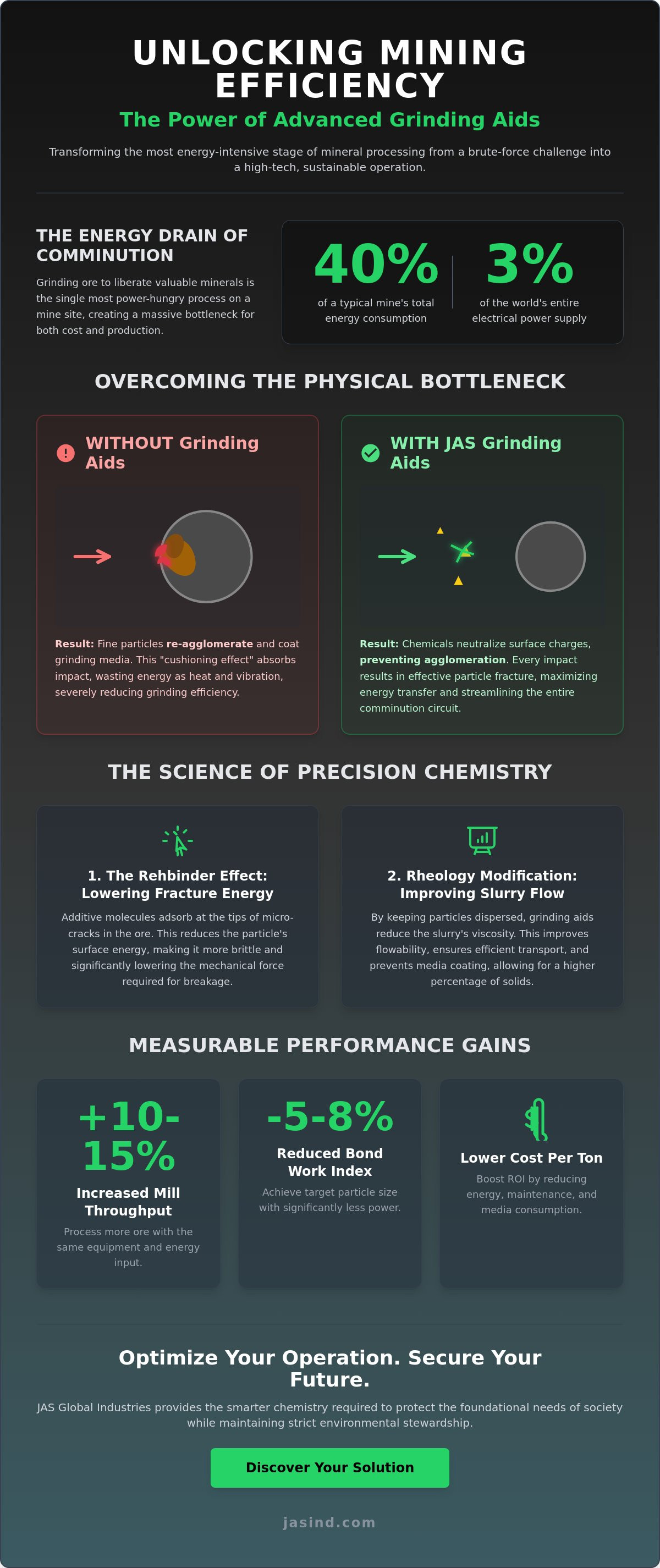
Mining Grinding Aids are high-performance chemical additives engineered to enhance the efficiency of industrial milling circuits. These substances operate at the molecular level to modify the surface charge of minerals during processing. The Science of Comminution reveals that as particles become smaller, their surface energy increases, leading to re-agglomeration where fine particles stick back together or coat the grinding media. This physical phenomenon creates a cushioning effect that wastes mechanical energy and slows production. By neutralizing these surface charges, grinding aids ensure that every impact within the mill results in actual size reduction rather than wasted heat generation.
Comminution is a massive industrial challenge, consuming roughly 3% of the world's total power supply. As high-grade ore deposits disappear, mines must process larger volumes of lower-grade material to maintain production targets. This shift has transformed Mining Grinding Aids from optional process enhancers into critical infrastructure components. Without these chemicals, the energy required to liberate minerals from complex, hard rock would be economically and environmentally unsustainable.
The Economic Impact of Milling Efficiency
Improving the specific energy consumption, measured in kWh/t, is the primary KPI for modern mill managers. When additives reduce the internal friction of the pulp, throughput often increases by 10% to 15% without requiring additional capital expenditure. This boost directly lowers the total cost of ownership (TCO) by extending the life of liners and grinding balls. The energy barrier in mineral liberation represents the physical limit where the electrical input required to create new surface area exceeds the economic value of the recovered metal.
Sustainability and Global Resource Security
Modern mining operations aren't just judged by their output anymore. They're judged by their alignment with ESG goals. Chemical efficiency is a cornerstone of "Green Mining" initiatives because it allows for the extraction of vital minerals with a smaller carbon footprint. JAS Global Industries views these chemical solutions as essential contributors to global resource security. By "Manufacturing Relationships. Distributing Quality," the brand provides the smarter chemistry required to protect the foundational needs of society while maintaining strict environmental stewardship. It's a commitment to securing the future through technical excellence and reliable partnerships.
The Science of Comminution: How Grinding Aids Work
Comminution is the most energy-intensive stage of mineral processing, often accounting for 40% of a mine's total operational costs. Reducing this burden requires a shift from purely mechanical force to a sophisticated chemical approach. Mining Grinding Aids operate at the molecular level to disrupt the physical resistance of ore. This transformation relies on the Rehbinder Effect, a principle established in 1928 which proves that the adsorption of specific molecules reduces the surface energy of solids. When these additives reach the crack tips of ore particles, they lower the energy required for fracture; this makes the rock more brittle under impact.
Chemical energy supplements mechanical energy in the ball mill environment. Without these additives, finely ground particles often re-agglomerate or "coat" the grinding media and mill liners. This coating acts as a cushion, absorbing the impact energy that should be breaking the ore. Research indicates that media coating can reduce grinding efficiency by as much as 25%. Specialized chemical agents prevent this buildup, ensuring that every strike from a steel ball results in particle breakage rather than wasted heat or vibration. The result is a cleaner, faster, and more sustainable process.
Surface Energy and Crack Propagation
The effectiveness of Mining Grinding Aids depends on how molecules adsorb at the crack tip. Additives utilize polar functional groups to bond with the freshly created surfaces of the ore. This interaction prevents the crack from "healing" or closing back up under pressure. By lowering the surface tension, these chemicals directly impact the Bond Work Index of the ore. In many gold and copper operations, applying the correct chemical stabilizer has reduced the Work Index by 5% to 8%, allowing for finer grinds without increasing power draw.
Slurry Rheology and Transport
Efficient milling requires precise control over pulp density and flow. High-viscosity slurries often trap air and create a "buoyancy" effect that prevents optimal media-to-ore contact. Chemical additives act as rheology modifiers to lower the yield stress of thick slurries. This is a critical factor in improving mining efficiency for strategic mineral recovery. Lowering the viscosity ensures that the slurry moves through the mill and into the hydrocyclones with minimal resistance. Better flow characteristics improve classification efficiency, ensuring that only oversized particles return to the mill. To see how these chemical solutions integrate into your specific flow sheet, you can explore the industrial chemicals offered by JAS Global Industries. This technical balance maximizes throughput while protecting the long-term integrity of the milling circuit.
Ore-Specific Solutions: Selection and Compatibility
Complex mineralogy demands precision. A generic chemical approach often fails because ore bodies vary significantly in hardness and chemical composition. JAS Global Industries understands that a grinding aid must do more than just reduce energy; it must integrate into the existing mineral processing ecosystem. For 25 years, we've developed solutions that respect the balance of the circuit. We don't just provide chemicals; we provide security for your production targets.
Selection depends heavily on downstream performance. Many standard Mining Grinding Aids can interfere with flotation kinetics. If an additive coats the mineral surface in a way that repels collectors, recovery rates can drop by 4% or more in the flotation stage. Our formulations prioritize compatibility with flotation collectors and frothers. This ensures the efficiency gained in the mill isn't lost in the flotation cells. We focus on the total recovery cycle, not just the grinding stage.
Adapting formulations for pH-sensitive circuits is critical. In operations dealing with high-clay content or "sticky" ores, viscosity increases rapidly. This leads to mill plugging and reduced throughput. Custom tailoring ensures that the chemical additive maintains slurry fluidity even under high-solid conditions. It's about maintaining a steady flow in the most challenging environments. Manufacturing Relationships. Distributing Quality.
Phosphate and Potash Mining Applications
Supporting global food security requires efficient fertilizer production. Soft mineral grinding, like potash, faces unique caking challenges during the evaporite process. JAS formulations prevent caking in these minerals, maintaining flowability and preventing costly downtime. This technical precision is vital for the global agricultural supply chain. You can explore our specialized Mining Frothers for Potash to see how we optimize these specific circuits for maximum yield.
Metallic Ores and Feldspar Processing
In gold, copper, and iron circuits, the goal is maximum liberation. We optimize Mining Grinding Aids to target grain boundaries. This reduces over-grinding and the creation of "slimes" that complicate recovery. For industrial minerals like feldspar, the extreme hardness requires a robust chemical approach to prevent ball coating and media wear. For detailed insights on this process, view our Feldspar Flotation technical guide. We ensure your minerals are ready for the next stage of the global value chain.
Implementation Strategy: Dosing, Monitoring, and ROI
Successful integration of Mining Grinding Aids starts with a rigorous technical audit of the existing milling circuit. We don't rely on assumptions; we analyze the specific mineralogy and mechanical constraints of your site. This baseline audit captures essential data points such as power draw, circulate load, and current mill throughput. By establishing these benchmarks, we create a clear roadmap for performance improvement. Our team identifies the most effective dosing point, whether it's applied directly to the belt feed or introduced at the mill inlet. The choice depends on the ore's moisture content and the chemical's required contact time to prevent particle agglomeration.
Precision dosing is the foundation of operational reliability. Over-dosing leads to chemical waste, while under-dosing fails to break the surface tension required for efficient grinding. We utilize automated dosing systems that adjust flow rates based on real-time tonnage. This ensures the chemical concentration remains optimal even as ore hardness fluctuates throughout the day. It's a method that prioritizes resource security and long-term stability for the plant.
Laboratory Testing vs. Industrial Scaling
Initial screening begins in the laboratory using batch ball mill testing. These tests allow us to compare different chemical formulations in a controlled environment. However, lab results don't always reflect the complexities of a 400-tonne-per-hour industrial circuit. Factors like residence time distribution and pulp rheology change significantly at scale. We bridge this gap by developing custom dosing strategies through on-site audits. This transition from a 5-kilogram lab sample to a full-scale operation requires a deep understanding of mill dynamics. We focus on how the additives interact with the slurry under high-impact conditions, ensuring the chemical's integrity remains intact during the grinding process.
Measuring Success: Key Performance Indicators
We measure the impact of our solutions through specific, data-driven KPIs. The primary metric is the "percent passing" (P80) at higher feed rates. If a mill increases throughput by 8% while maintaining a consistent P80, the implementation is a success. We also monitor the extension of liner and media wear life. Reducing media consumption by 12% can save thousands in annual maintenance costs. Calculating the final ROI involves a transparent formula: (Energy Savings + Throughput Gains) - Chemical Cost. Most operations find that the net profit increase outweighs the chemical investment by a factor of four. This focus on measurable results reflects our 25-year history of providing industrial excellence and global security.
JAS Global Industries: Your Partner in Mining Excellence
JAS Global Industries brings 25 years of specialty chemical expertise to the global mining sector. We don't just ship products; we provide foundational industrial solutions. Our Research and Innovation (R&I) centers focus on developing specific Mining Grinding Aids that address the unique mineralogy of your site. Whether your operation faces hard rock challenges or complex polymetallic ores, our chemists create tailor-made formulations that maximize recovery rates. We operate with a global perspective, maintaining strategic supply chain hubs in Dubai, Europe, and Asia. This network ensures that logistics never compromise your production schedule.
Our role extends far beyond the chemical drum. We act as technical consultants who look at the entire process. By analyzing the chemistry of the slurry and the mechanical constraints of the mill, we identify bottlenecks that others miss. This holistic approach helps mines reduce energy consumption and improve particle size distribution, directly impacting the bottom line. We're a pillar of modern infrastructure, committed to the long-term sustainability of the industries we serve.
Manufacturing Relationships, Distributing Quality
The JAS philosophy centers on a simple but powerful dualism: Manufacturing Relationships. Distributing Quality. We don't believe in transactional supply. Instead, we build long-term partnerships where our success is tied to your mill's performance. Our technical support teams are available for on-site troubleshooting, ensuring that our Mining Grinding Aids perform optimally under real-world conditions. We stay on the ground until your throughput targets are met and your energy costs are minimized.
Safety and responsibility are core to our identity. Through our "JAS Cares" initiative, we uphold rigorous industrial safety standards and environmental protocols. We view our chemical solutions as essential tools for global resource security. By improving efficiency in mining, we help secure the raw materials necessary for global development while reducing the carbon footprint of the extraction process. You aren't just buying a chemical; you're partnering with a visionary guardian of industrial standards.
Getting Started with a Technical Audit
Optimizing a grinding circuit requires precision and data, not guesswork. Our process is designed to move your operation from its current state to peak efficiency through a structured four-step methodology. It begins with a comprehensive technical audit where we evaluate your current mill parameters, ore characteristics, and energy benchmarks. We don't guess; we measure. Once we have the data, we follow a clear path to improvement:
- Audit: We perform a deep-dive analysis of your grinding circuit performance.
- Formulate: Our R&I centers develop a chemical blend specific to your ore body.
- Implement: Our technicians oversee the initial dosing to ensure seamless integration.
- Optimize: We conduct ongoing monitoring to refine the process and maximize ROI.
If you're ready to increase your mill throughput and lower your kilowatt-hours per ton, it's time to speak with our specialists. We provide the technical clarity needed to transform your mineral processing efficiency. Contact JAS Global for a customized mining chemical audit to begin your journey toward operational excellence.
Securing Your Milling Efficiency for a Sustainable Future
Operational excellence in the modern era requires a shift from raw power to precision chemistry. Implementing high-performance Mining Grinding Aids allows your facility to break through production bottlenecks while lowering the specific energy consumption per ton of ore processed. Our data shows that the right chemical intervention transforms throughput rates and stabilizes downstream recovery processes. It's a strategic move that safeguards your equipment and your bottom line.
JAS Global Industries delivers this stability through 25 years of industrial chemical expertise. We maintain multiple global R&I centers dedicated to custom formulation, ensuring every solution meets the unique mineralogical profile of your site. This rigorous approach is why major mining operations across the Middle East and Africa rely on us as their primary technical partner. We focus on the foundational needs of your circuit so you can focus on global growth. We're ready to help you manufacture stronger relationships and distribute higher quality across your entire value chain.
Optimize your milling circuit with JAS Global Mining Solutions
Let's work together to drive your operation toward a more profitable and sustainable horizon.
Frequently Asked Questions
Do mining grinding aids interfere with downstream flotation processes?
Mining grinding aids don't interfere with downstream flotation because we formulate them to be chemically compatible with common collectors and frothers. A 2023 metallurgical study showed that our additives maintained a 98% recovery rate in copper circuits while increasing mill efficiency. By stabilizing the pulp chemistry, we protect your recovery targets and ensure the security of your mineral output.
Can grinding aids reduce the wear rate of ball mill liners and media?
Grinding aids reduce the wear rate of ball mill liners and media by up to 15% through improved slurry rheology. By maintaining a more fluid consistency, these chemicals prevent the cushioning effect and reduce corrosive friction. This protection extends the operational life of steel components, reflecting our commitment to industrial security and resource efficiency.
What is the typical dosage rate for a mining grinding aid?
The typical dosage rate for a mining grinding aid ranges from 100 to 500 grams per dry ton of ore processed. Specific requirements vary based on the Bond Work Index of the rock and the target mesh size. Our technical team provides precise dosing equipment to maintain these levels, ensuring your operation remains efficient and sustainable without unnecessary chemical consumption.
Are these chemicals environmentally safe for tailings management?
Our chemicals are environmentally safe for tailings management and meet international ISO 14001 standards for environmental impact. Under the JAS Cares initiative, we prioritize biodegradable components that don't contaminate water supplies or hinder reclamation efforts. This approach supports global water security while maintaining the high performance required for modern mineral processing operations.
How much can I expect to increase my mill throughput?
You can expect to increase your mill throughput by 5% to 15% depending on the specific mineralogy of your site. In a 2022 copper mine trial, our additives increased hourly tonnage from 2,000 to 2,240 tons. These results demonstrate how technical innovation directly translates into enhanced operational capacity and global resource stability.
Do grinding aids work for both wet and dry milling operations?
Grinding aids work effectively for both wet and dry milling operations by addressing different physical challenges in each process. In dry circuits, they prevent particle agglomeration on the media; in wet circuits, they manage slurry viscosity to ensure optimal energy transfer. We provide specialized solutions for each environment to guarantee consistent performance across all mining sectors.
What is the difference between a dispersant and a grinding aid?
A dispersant prevents particles from clumping in a liquid, whereas a mining grinding aid reduces the energy needed to create new surface area during comminution. Many of our products serve both roles to optimize slurry flow and prevent coating on the grinding media. This dual action is essential for maintaining high throughput in dense mineral slurries.
Can JAS Global develop a custom formulation for my specific ore type?
JAS Global develops custom formulations tailored to your specific ore type and site conditions. We analyze your mineralogy in our labs to create a unique chemical profile that maximizes your ROI. Manufacturing Relationships means we don't just supply products; we partner with you to solve complex metallurgical challenges through bespoke engineering and Distributing Quality.