
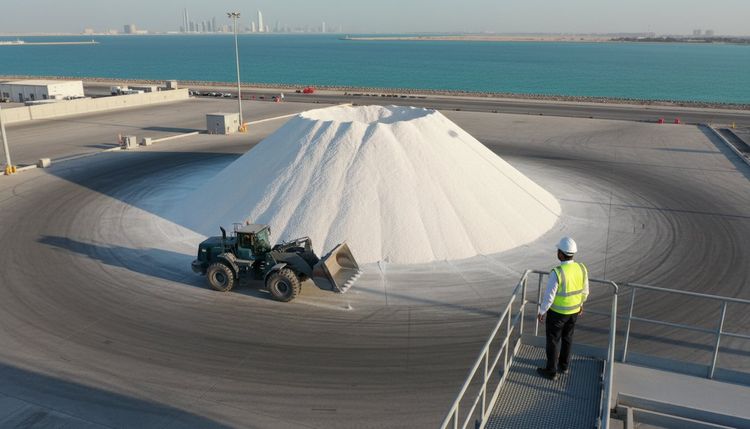
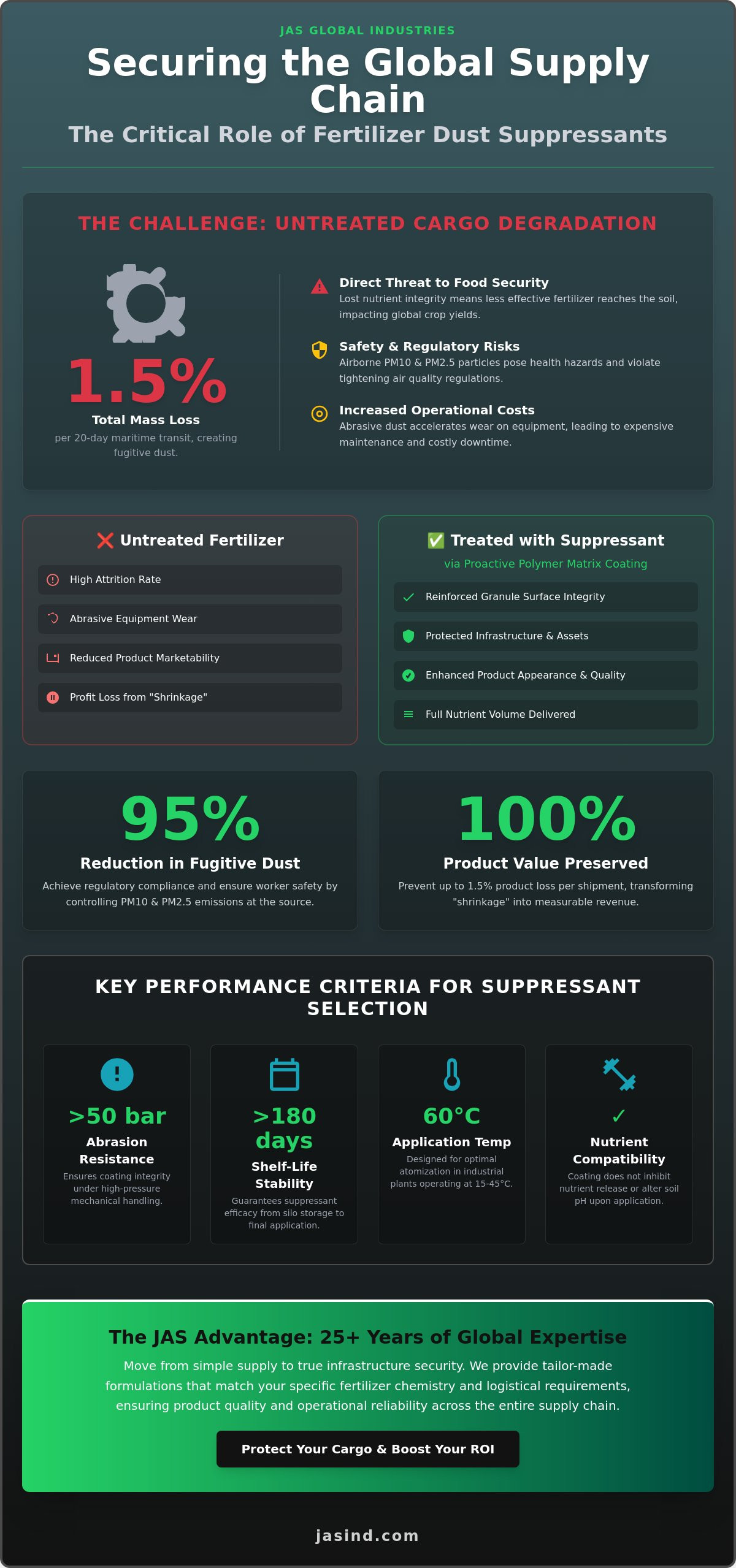
A single shipment of bulk fertilizer can lose up to 1.5% of its total mass to fugitive dust during a standard 20-day maritime transit. For industrial operators, this isn't just a line-item loss; it's a direct threat to the integrity of the global food supply chain. You've likely felt the pressure of tightening air quality regulations and the rising costs of equipment maintenance caused by abrasive particles. Effective Fertilizer Dust Suppressants are no longer optional additives. They're essential tools for preserving product marketability and ensuring worker safety across every terminal and vessel. At JAS Global Industries, we understand that protecting these materials is fundamental to maintaining global stability.
Choosing the right solution requires a balance of chemical performance and commercial viability. This guide helps you master the technical criteria needed to protect your cargo from degradation and reduce emissions by as much as 95%. We'll examine the specific benchmarks for long-distance transport, environmental compliance, and equipment longevity. By the end, you'll have a strategic framework to select suppressants that serve both your bottom line and our shared mission of global food security. We're here to help you move from simple supply to true infrastructure security.
Key Takeaways
- Discover how specialized coatings safeguard nutrient integrity, transforming dust control into a critical pillar of global food security.
- Identify the technical benchmarks for Fertilizer Dust Suppressants, focusing on abrasion resistance and shelf-life to ensure stability during long-term storage.
- Calculate the true ROI of dust management by quantifying revenue lost to "shrinkage" and the reduction in abrasive wear on industrial infrastructure.
- Implement a strategic buying framework that matches specific fertilizer chemistries with your operation's unique logistics and transport requirements.
- Leverage global expertise and tailor-made formulations to ensure product quality and operational reliability across the entire supply chain.
What are Fertilizer Dust Suppressants and Why Do They Matter?
Fertilizer Dust Suppressants are specialty chemical coatings engineered to bind fine particles and prevent attrition during storage, transport, and application. These additives create a microscopic film over the fertilizer granule, ensuring that the product remains intact from the manufacturing plant to the farmer's field. For industrial producers, these suppressants represent more than just a clean workspace; they're a critical component of global food security. When nutrients are lost as fugitive dust, the efficiency of the entire agricultural supply chain drops. Preventing this loss at scale ensures that the intended volume of nitrogen, phosphorus, or potassium actually reaches the soil.
Industrial operations are shifting away from reactive dust collection systems toward proactive chemical prevention. While traditional Dust abatement methods often rely on mechanical vacuums or water sprays, modern chemical suppressants address the root cause of the issue. It's also vital to distinguish these from anti-caking agents. Anti-caking additives prevent the formation of salt bridges and clumps during high-humidity storage. In contrast, dust suppressants focus on surface integrity. Most high-performance operations use both to maintain a free-flowing, dust-free product.
The Science of Fugitive Dust in Fertilizers
Fugitive dust stems primarily from attrition. This occurs when granules rub against each other or equipment surfaces, shearing off small fragments. The crush strength of a granule, typically measured in kilograms of force, dictates its resistance to this mechanical stress. Modern Fertilizer Dust Suppressants utilize chemical bonding to reinforce the particle surface. Unlike simple physical oils that merely weigh down dust, these formulations use polymers to create a resilient, elastic matrix. This matrix absorbs energy during handling, significantly reducing the generation of fines.
Primary Benefits for Industrial Producers
- Health and Safety: Effective suppressants reduce airborne particulate matter, specifically PM10 and PM2.5, by up to 95 percent in enclosed loading facilities.
- Product Marketability: Treated fertilizers exhibit a richer color and a professional finish that signals quality to end-users.
- Regulatory Compliance: Meeting international environmental standards becomes easier when fugitive emissions are controlled at the source rather than managed through complex filtration.
JAS Global Industries brings twenty-five years of expertise to this field. We view these chemical solutions as essential pillars for infrastructure stability. By protecting the integrity of every granule, we help secure the resources that feed the world. Our approach focuses on long-term value and the broader human impact of chemical reliability.
Evaluating Performance: Key Criteria for Suppressant Selection
Performance metrics define the success of Fertilizer Dust Suppressants in high-volume logistics. Selecting an agent requires a deep understanding of the physical and chemical stressors present during transit and storage. Industrial operators must prioritize long-term efficacy over initial cost to ensure global food security remains uncompromised by product loss or degradation.
Abrasion resistance serves as the primary metric for long-term effectiveness. We define abrasion resistance as the ability of a coating to maintain integrity under 50 bar of pressure. Without this durability, the protective layer shatters during mechanical handling, leading to immediate dust generation at the point of discharge. Shelf-life stability is equally critical. Protective coatings must remain active for 180 days or more. If a suppressant degrades in the silo, dust levels spike during the final application phase, creating safety hazards for end-users.
Operational climates dictate chemical requirements. Most industrial plants operate between 15°C and 45°C, but the chemical agent often requires heating to 60°C for optimal atomization. Compatibility ensures no interference with fertilizer nutrient availability. The coating cannot inhibit nutrient release or alter the pH of the soil upon field application. Organizations should evaluate specialized industrial additives that maintain these delicate chemical balances.
Technical Specifications to Monitor
Viscosity profiles determine dosing accuracy. A high-quality suppressant maintains a stable centipoise range across fluctuating plant temperatures. This stability prevents nozzle clogging and ensures even distribution across the granules. Safety remains a non-negotiable priority. Flash points must exceed 93°C (200°F) to minimize fire risks in enclosed storage facilities. Bio-based agents often offer higher safety margins than traditional solvent-based alternatives, reducing the risk profile of the entire facility.
Environmental and Safety Certifications
Modern agricultural standards demand high biodegradability. As global oversight tightens, a survey of fertilizer regulations confirms that environmental compliance is a central pillar of industrial export strategy. Feed-safe applications are necessary when fertilizers enter supply chains for specialized animal nutrition blends. All agents must provide comprehensive SDS documentation to meet OSHA and GHS requirements. Reliability in these areas protects the brand's reputation and ensures smooth passage through international customs. JAS Global Industries focuses on these foundational needs to support the broader human impact of modern infrastructure.
The Economic Impact: ROI of Advanced Dust Control
Investing in high-performance Fertilizer Dust Suppressants is a strategic recovery plan. It is not a simple overhead cost. Bulk fertilizer handlers often see 0.5% to 2.0% of total product mass vanish as airborne particles during transfer. On a 60,000-ton vessel, a 1% loss means 600 tons of revenue literally blows away. This is shrinkage in its most literal form. It represents a direct hit to the bottom line that advanced chemical additives can eliminate.
Beyond product loss, dust acts as an aggressive industrial abrasive. It grinds down conveyor bearings, clogs hydraulic systems, and accelerates the wear on loaders. Facilities that achieve an 80% reduction in fugitive dust frequently see equipment lifespans increase by 25% or more. Maintenance cycles become predictable. Emergency repairs decrease. This reliability is vital for maintaining the infrastructure that supports global food security.
Safety remains the most critical factor. Dust explosions in confined storage areas pose a massive liability and a threat to human life. Adhering to safety standards like NFPA 654 protects workers and lowers insurance premiums. At JAS Global Industries, we live by the philosophy of Manufacturing Relationships. Distributing Quality. Delivering a clean, dust-free product ensures long-term buyer loyalty. It proves that your operation prioritizes excellence and environmental responsibility.
Direct vs. Indirect Cost Savings
Direct savings are easy to track through tonnage recovery. You sell every ton you manufacture. Indirect savings are found in the maintenance logs. A 2022 industry analysis showed that effective dust management reduces facility cleaning labor by 40%. It also prevents the "off-spec" claims that arise when dust settles and cakes in downstream storage. Protecting your brand reputation in the global export market provides a competitive edge that lasts for decades.
Case Study: Maritime Logistics Efficiency
Loading fertilizer at major hubs like the Port of Jebel Ali or the Port of Rotterdam requires precision. Dust clouds often trigger environmental shutdowns by port authorities. These pauses cause demurrage fees that cost thousands of dollars per hour. High-quality suppressants maintain the flowability of granules even in high-humidity transit zones like the Suez Canal or the Port of Durban.
- Demurrage Prevention: Constant loading speeds avoid port penalties.
- Humidity Resistance: Suppressants prevent clumping during long sea voyages.
- Regulatory Compliance: Meeting strict air quality standards at international terminals.
When the product arrives at its destination in pristine condition, the relationship between the supplier and the buyer is reinforced. This consistency is the foundation of a stable global supply chain.
Buying Guide: Choosing the Right Suppressant for Your Fertilizer
Selecting the correct Fertilizer Dust Suppressants is a strategic decision that impacts both operational safety and global food security. A systematic approach ensures your investment yields measurable results. Follow this four-step framework to optimize your selection process.
- Step 1: Identify fertilizer chemistry. Different substrates require specific chemical affinities. Urea, NPK, DAP, and Potash all interact differently with coating agents.
- Step 2: Define your logistics chain. Consider your storage duration. Material sitting for 60 days in a humid coastal warehouse requires a more robust moisture barrier than material shipped immediately by rail.
- Step 3: Conduct a technical audit. Examine your existing dosing system. Inconsistent application leads to "hot spots" of dust and wasted product. Inefficient spray patterns can waste up to 15% of chemical volume.
- Step 4: Pilot testing. Compare "off-the-shelf" solutions against "tailor-made" formulations. Custom blends often reduce total chemical consumption by 12% to 18% while providing superior coverage for specific particle size distributions.
Matching Chemistry to Substrate
Urea-specific challenges center on high hygroscopicity. Since urea absorbs moisture at 72% relative humidity, it's prone to rapid caking and fine dust formation. NPK blends present a different hurdle. They involve diverse particle sizes and potential chemical reactions between components that require a stable, non-reactive coating. Phosphate fertilizers, specifically DAP and MAP, have unique attrition profiles. These granules are susceptible to physical breakdown during 50-foot drops in storage silos. Effective Fertilizer Dust Suppressants must penetrate the surface pores of these specific substrates to bind fines effectively and maintain granule integrity.
Operational Dosing Strategies
Spray nozzle optimization is the foundation of efficiency. You must achieve 100% surface coverage with minimal liquid volume. Most high-performance systems operate with a dosage rate between 0.5 and 2.0 kg per ton. It's a precise balance. Too little product leaves the material unprotected; too much can cause flowability issues in downstream equipment. Integration with granulation aids provides a holistic process improvement. This synergy strengthens the granule from the core to the surface. It ensures the fertilizer remains intact from the plant to the farm. Manufacturing Relationships. Distributing Quality.
Ensure your operations meet global standards for safety and efficiency. Partner with JAS Global Industries for high-performance chemical solutions.
The JAS Advantage: Global Expertise in Fertilizer Chemistry
JAS Global Industries stands as a vital guardian of global food security. We don't just provide chemical additives; we build the foundational infrastructure that keeps industrial operations running smoothly. Our 25-year legacy is built on a simple, powerful philosophy: "Manufacturing Relationships. Distributing Quality." This dual focus ensures that every client receives both technical excellence and a partner they can trust for the long term. Since 1999, we've evolved into a "quiet giant" of the chemical sector, focusing on the essential needs of society.
Our specialized Research and Innovation (R&I) centers are the heartbeat of our operation. We develop tailor-made formulations for Fertilizer Dust Suppressants that address the specific physical properties of your product. Whether you're handling urea, potash, or NPK blends, our chemists engineer solutions that survive the rigors of global transport. With strategic manufacturing locations in Dubai, Riyadh, and North Africa, we maintain a localized presence that minimizes lead times and maximizes supply chain resilience.
Why JAS Global Industries is Your Visionary Partner
Our "JAS Cares" initiative reflects our deep commitment to sustainable industrial practices. We believe that chemical solutions should enhance safety without compromising the environment. This mission-oriented approach makes us more than a vendor; we're a visionary partner. We combine our global reach with specialized expertise in the Middle Eastern and African markets, where we've spent decades navigating unique logistical and climatic hurdles.
- On-site technical audits to identify application inefficiencies.
- Customized dosing strategies that have reduced chemical consumption by 12% in recent plant optimizations.
- Troubleshooting support for complex mechanical application systems to prevent nozzle clogging.
- Proactive consultation to align chemical usage with local environmental mandates.
Securing Your Supply Chain
Industrial-scale operations require absolute certainty. We offer reliable bulk chemical supply contracts that eliminate the risks of production downtime. Our continuous R&D efforts ensure that our Fertilizer Dust Suppressants stay ahead of emerging environmental regulations and global safety trends. We focus on water and food security, recognizing that our additives play a crucial role in the global supply chain. By optimizing your plant’s performance, we help protect your margins and your reputation. Our team doesn't just deliver a product; we stay until the application process is flawless.
Ready to improve your facility's efficiency? Contact our technical team for a process audit and discover the JAS advantage.
Secure Your Supply Chain with Superior Dust Control
Effective dust management isn't just a maintenance task; it's a strategic necessity for global food security. Selecting the right Fertilizer Dust Suppressants requires a rigorous evaluation of chemical compatibility and environmental resilience. Since 1998, JAS Global Industries has led the sector by manufacturing relationships and distributing quality through its network of global R&I centers. We've proven our formulations in the most demanding Middle Eastern and African climates where standard solutions often fail. Protecting your product's integrity ensures you're contributing to a more stable global infrastructure. It's about more than just compliance. It's about reliability. Our technical teams translate twenty-five years of industrial expertise into specialized additives that safeguard your operations and the communities they serve. You deserve a partner that understands the high stakes of modern agriculture and water security. We're ready to help you optimize your industrial output with precision chemistry that stands the test of time and terrain.
Partner with JAS Global Industries for Advanced Fertilizer Solutions
Your journey toward a more sustainable and efficient operation starts today.
Frequently Asked Questions
What is the difference between a dust suppressant and an anti-caking agent?
Dust suppressants focus on physical particle retention by binding fine dust to larger granules. Anti-caking agents prevent chemical crystal bridging between granules during long-term storage. Our 25 years of industrial experience shows that while they serve different roles, using both ensures product stability. This dual approach protects the granules from the factory to the farm.
Can fertilizer dust suppressants be applied to all types of granular fertilizers?
Most granular fertilizers, including Urea, DAP, and NPK blends, benefit significantly from fertilizer dust suppressants. These coatings adapt to the specific surface tension and porosity of each unique substrate. We ensure every application supports global food security by maintaining nutrient density and preventing material degradation during handling.
How much dust suppressant is typically required per ton of fertilizer?
Industrial operators typically apply between 0.5 and 2.5 kilograms of suppressant per metric ton of fertilizer. This precise dosage minimizes operational costs while providing 100% surface coverage across the batch. Proper calibration prevents excess runoff and ensures the material remains safe for workers to handle in confined spaces.
Are modern fertilizer dust control coatings environmentally safe?
JAS Global Industries prioritizes sustainability by using bio-based raw materials that comply with the 2022 Global Harmonized System (GHS) standards. Our "JAS Cares" initiative ensures these coatings don't harm aquatic life or soil microbes. We're committed to protecting water security through responsible chemistry that meets or exceeds current global environmental regulations.
What happens if a fertilizer is not treated for dust control before shipping?
Shipping untreated fertilizer often results in a 3% to 5% loss of total product mass through dust generation at transfer points. This dust creates explosive hazards in ship hulls and causes respiratory issues for port workers. It's a significant risk that compromises both human safety and the economic value of the bulk cargo.
How does temperature affect the application of dust suppressants?
Viscosity decreases as temperature increases, making 60 degrees Celsius the ideal application point for most industrial coatings. If the ambient temperature falls below 20 degrees, the suppressant won't atomize correctly through the spray nozzles. Consistent heat management is critical for achieving a uniform, protective barrier on every individual granule.
Can JAS Global Industries create custom formulas for specific mineral ores?
We engineer bespoke chemical solutions for over 15 specific mineral types, including potash, phosphate rock, and sulfur. Our R&D team has successfully optimized formulas for 50 global mining sites since 1998. We don't just provide chemicals; we manufacture relationships through technical precision and site-specific testing to ensure maximum adhesion.
Is it possible to integrate coloring agents with dust suppressants?
You can easily integrate liquid dyes into our fertilizer dust suppressants to achieve specific branding and product differentiation goals. This 2-in-1 solution reduces the equipment footprint on the production line and streamlines the coating process. It's a reliable way to distribute quality while ensuring your product is instantly recognizable in the market.