
Did you know that grinding operations often consume as much as 40 percent of a mine site's total energy budget? This massive power requirement makes the comminution circuit a primary target for cost control and operational security. You've likely seen how mill bottlenecks and inconsistent particle sizes disrupt your entire production flow. High energy prices and declining ore grades create a persistent challenge for modern operators. Utilizing advanced Mining Grinding Aids is a strategic necessity. Optimizing throughput. Securing recovery.
This article explains how these chemical solutions reduce specific energy consumption and maximize capacity in mineral processing. You'll discover how chemical optimization transforms your mill into a high-performance asset. We'll preview the latest 2026 market trends, including glycol-based chemistries and custom formulations for critical minerals like lithium. This guide provides a clear roadmap for achieving better mineral liberation and higher final recovery through technical partnership and precise chemical application. By focusing on ROI and energy efficiency, you can turn your grinding circuit into a pillar of stability and long-term value.
Key Takeaways
- Mitigate the impact of escalating energy costs by optimizing the comminution process, which accounts for nearly half of a mine's total power consumption.
- Leverage the Rehbinder effect to reduce mineral surface hardness through strategic chemical adsorption and surface energy modification.
- Distinguish between the unique chemical demands of dry and wet grinding environments to maintain consistent particle size distribution and process stability.
- Implement a rigorous technical audit and dosing strategy for Mining Grinding Aids to overcome mill throughput bottlenecks and improve mineral liberation.
- Secure global resource stability by utilizing tailor-made formulations specifically engineered for complex phosphate, potash, and base metal ores.
The Economic Impact of Grinding Efficiency in Modern Mining
Mining grinding aids are specialized chemical reagents engineered to optimize the comminution process. In the context of industrial mineral processing, these additives are not mere supplements. They are strategic tools for operational stability. By modifying the physical properties of the slurry and the surface energy of the ore, these chemicals facilitate more efficient breakage. This leads to higher throughput and finer particle size distributions without increasing the mechanical load on the system. High-performance chemistry ensures that the mill operates at peak capacity while maintaining the integrity of downstream processes.
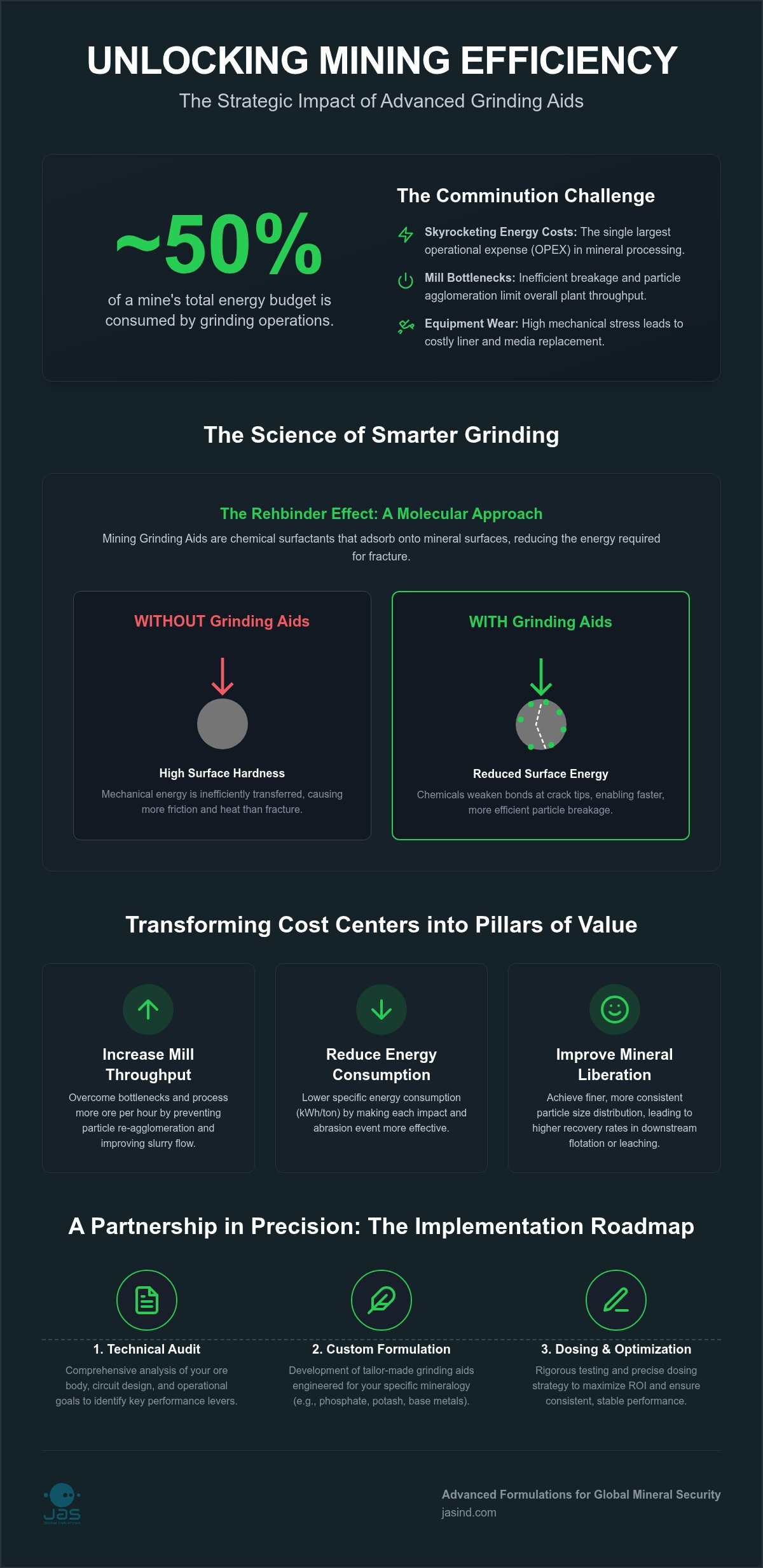
The urgency for chemical intervention is driven by a stark reality. Comminution remains the most energy-intensive stage of mineral extraction, often accounting for up to 50% of a mine's total energy consumption. As global energy prices remain volatile in 2026, the cost of processing each ton of ore has become a critical metric for survival. Traditional mechanical methods are reaching their physical limits. Operators are now turning toward chemical optimization to protect their margins and ensure long-term resource security. This shift represents a move from brute force to technical precision.
Comminution: The Mining Industry's Largest Energy Consumer
Energy demand is concentrated heavily in the grinding circuit. Whether a plant utilizes a SAG mill or a traditional Ball mill, the power required to reduce rock to the necessary liberation size is immense. Vertical mills offer some improvements, but mechanical upgrades alone are no longer sufficient to meet 2026 sustainability targets. We've reached an energy-intensity plateau where the cost of incremental mechanical gain often exceeds the value of the recovered mineral. Mining Grinding Aids break this cycle. They target the rock at a molecular level, reducing the energy required for fracture and preventing the re-agglomeration of fine particles that often causes mill bottlenecks.
Mitigating Rising Operational Costs with Chemical Reagents
Calculating the true value of chemical aids requires looking beyond the initial purchase price. The return on investment is found in the reduction of operational expenditures (OPEX) across the entire circuit. Optimized slurry rheology reduces the friction and impact wear on mill liners. It also slows the consumption of grinding media. These savings, combined with increased throughput, create a compelling economic case for chemical adoption. Grinding efficiency is the ratio of mineral liberation to energy input. Improving this ratio is the most direct path to a more profitable and sustainable operation. By framing these chemicals as protectors of equipment and energy, JAS Global Industries helps partners transform their cost centers into centers of excellence.
The Science Behind Mining Grinding Aids: Mechanics and Performance
Effective comminution is more than a mechanical struggle. It's a chemical challenge. Within the complex environment of Mineral processing, Mining Grinding Aids function as critical performance multipliers. These reagents work by modifying the surface energy of mineral particles at the moment of fracture. This phenomenon, known as the Rehbinder effect, involves the chemical adsorption of surfactants onto the mineral surface. By reducing the surface hardness and crack tip resistance, the chemistry allows for faster breakage with less mechanical force. It's a fundamental shift from brute energy to molecular precision.
Consistency in the mill depends on stable slurry rheology. Without chemical intervention, fine particles often behave unpredictably, increasing viscosity and creating "dead zones" within the mill. Advanced aids ensure that the slurry remains fluid and the grinding media stays clean. This prevents the "coating" effect where fine ore sticks to the balls, which otherwise significantly reduces impact efficiency. Maintaining a clean grinding surface ensures that every strike counts toward liberation. Protecting the mechanical integrity of the circuit starts with controlling the fluid dynamics of the ore.
Reducing Surface Energy and Preventing Agglomeration
The molecular mechanism of these surfactants is focused on the freshly fractured surface. As rock breaks, it exposes high-energy sites that naturally seek to re-bond or attract other fine particles. This leads to agglomeration and a "cushioning" effect that absorbs impact energy without breaking the ore. Mining Grinding Aids saturate these sites instantly. They prevent fine particles from re-welding under the intense pressure of the mill. By eliminating this cushioning, the reagents ensure that the impact energy is transferred directly to the larger ore particles. This process optimizes the breakage rate and prevents energy waste.
Impact on Particle Size Distribution and Downstream Flotation
Achieving a narrow particle size distribution (PSD) is the primary goal for any mill operator. Generic grinding processes often produce "slimes," or ultra-fine particles, that are too small for effective recovery. These slimes coat larger minerals and consume excessive reagents during flotation. Chemical aids provide the control necessary to minimize over-grinding. By producing a more uniform product, they set the stage for higher recovery rates in the flotation cells. This integrated approach to mining solutions ensures that efficiency gains in the grinding circuit translate directly to the final concentrate grade. To explore how these formulations can protect your specific ore body, consider an audit of your current chemical consumption.
Strategic Application: Dry vs. Wet Grinding Circuits
Mining operations select grinding environments based on the mineral's end-use and the specific characteristics of the ore body. Dry and wet circuits present distinct physical challenges that require specialized Mining Grinding Aids. While dry circuits often struggle with powder flow and electrostatic adhesion, wet circuits must manage complex fluid dynamics and water chemistry. Choosing the correct formulation depends entirely on the moisture content and the desired final particle size. Strategic chemical application ensures that the circuit remains a stable pillar of production rather than a bottleneck.
The choice between these environments also impacts the broader energy profile of the site. High-density wet grinding is often more energy-efficient for large-scale base metal recovery, while dry grinding is preferred for industrial minerals where moisture is detrimental. Integrating tailored chemical solutions with energy-efficient grinding technologies allows operators to hit throughput targets that were previously unreachable. This synergy between mechanical design and chemical performance is essential for modern resource security.
Enhancing Throughput in Dry Ball Mill Operations
In dry grinding of minerals such as feldspar or industrial sands, "pack set" is a significant operational hurdle. This occurs when ultra-fine particles coat the grinding media or mill liners, creating a cushioning layer that absorbs impact energy. Grinding aids neutralize the electrostatic forces that cause this adhesion. This increases the flowability of dry powders, allowing for faster discharge and reduced recirculating loads. These reagents also optimize air separator efficiency by ensuring particles remain dispersed as individual units rather than forming loose clusters that report incorrectly to the oversize stream.
Optimizing Slurry Rheology in Wet Grinding Processes
Wet grinding is the global standard for base metal and phosphate extraction. The primary challenge here is managing the viscosity of high-density slurries. As solid concentrations increase, the slurry becomes more resistant to flow, which slows the mill discharge rate and increases power consumption per ton. Advanced aids utilize specialized surfactant chemistry to reduce internal friction between particles. This allows operators to maintain high solids loading while ensuring the slurry remains fluid and manageable.
In these wet environments, water quality and pH levels significantly impact reagent effectiveness. It's vital that the chosen aids don't interfere with downstream flotation collectors or frothers. JAS Global Industries engineers these formulations to be chemically compatible with the entire processing circuit. This protective approach ensures that efficiency gains in the mill don't compromise final mineral recovery. Reliable chemistry provides the stability needed for long-term operational success.
Implementation Guide: Testing, Dosing, and Process Audits
Success in the grinding circuit depends on precision. Generic chemical applications often yield inconsistent results because ore mineralogy changes across the deposit. Mining Grinding Aids must be tailored to the specific hardness and texture of the rock. A comprehensive technical audit is the first step toward optimization. This audit identifies existing bottlenecks and establishes baseline performance metrics. Key Performance Indicators (KPIs) like energy consumption per ton, throughput in tons per hour (tph), and particle size distribution (PSD) provide the data needed for continuous improvement. Process stability is maintained through automated dosing systems that respond to real-time changes in mill conditions. These systems act as a safeguard against human error and fluctuating feed conditions. Reliability is built into the process from day one.
Laboratory Testing and Pilot Scale Evaluation
Before full-scale plant implementation, rigorous laboratory testing is essential. We use the Bond Ball Mill Work Index (BWI) to measure the energy required for breakage. By comparing BWI results with and without chemical aids, we can quantify potential energy savings. These simulations allow us to analyze how custom formulations interact with the specific mineralogy of your ore. Establishing this baseline in a controlled environment minimizes risk and ensures that the transition to industrial-scale application is seamless. It's about building a foundation of reliability before the first drop of reagent enters the circuit. Pilot scale evaluations further bridge the gap between the lab and the production floor.
Precision Dosing Strategies for Maximum Yield
Choosing the right dosing point is a critical decision for any mill operator. Adding the chemical to the feed belt ensures thorough mixing with the dry ore, while mill inlet dosing provides immediate interaction with the slurry. The choice depends on the circuit design and the specific goals of the operation. Modern facilities now utilize real-time sensor data to adjust feed rates based on fluctuating ore hardness. This dynamic approach prevents over-dosing and ensures that the chemical concentration remains optimal for breakage. Performing regular technical audits is necessary to maintain dosing precision and account for long-term changes in ore characteristics. To secure your plant's future performance, schedule a comprehensive process audit with our technical team today.
JAS Global Industries: Advanced Formulations for Global Mineral Security
JAS Global Industries stands as an indispensable pillar of modern industrial infrastructure. Since 1998, we've functioned as a vital guardian of the world's most critical mineral resources. We don't just supply chemicals. We provide the technical stability necessary for global resource security. Our mission centers on transforming industrial challenges into sustainable, high-performance operations. By leveraging our global network of R&I centers, we develop Mining Grinding Aids that solve local operational bottlenecks on a global scale. We balance technical expertise with ethical responsibility. This commitment ensures that our partners achieve maximum efficiency while maintaining a focus on long-term environmental stewardship.
Our approach is rooted in reliability and established trust. We understand that every ore body has a unique geological signature. Generic solutions often fail to protect the margins of complex mining projects. We focus on creating tailor-made formulations that address specific mineralogical hurdles. Whether managing ultra-hard rock or high-clay content, our chemistry provides the steady performance required for industrial success. We are not merely a vendor; we are a dedicated technical partner focused on the fundamental needs of the mining industry.
Tailor-Made Chemical Solutions for Complex Ores
Complex ores require precise chemical intervention. We specialize in customizing grinding aids for phosphate, potash, and base metal operations where traditional methods fall short. Our formulations are engineered to handle the specific surface chemistry of these minerals, ensuring optimal liberation. There is also a deep synergy between efficient comminution and final product integrity. For instance, the particle size control achieved through our reagents directly influences the effectiveness of anti-caking agents used in the final mineral product. By preventing over-grinding and managing PSD, we ensure the mineral remains stable during global transport. Recent partnerships have demonstrated significant energy reductions, proving that our tailor-made approach secures both operational yield and cost-effectiveness.
Global Logistics and Technical Support for Mining Operations
Operating from our headquarters in Dubai, we provide a reliable bridge to the world's most active mining hubs. Our significant presence across EMEA and Asia allows us to maintain supply chain security for critical reagents. We don't believe in transactional logistics. Instead, we offer long-term partnerships that include on-site technical support and dosing system management. Our experts work directly on the production floor to ensure our Mining Grinding Aids are performing at peak levels. This hands-on presence minimizes downtime. It maximizes recovery. It protects the stability of your entire processing circuit. By combining global reach with local technical expertise, we provide the reassurance that modern mining operations require to thrive in a volatile market. This commitment to security often includes site safety protocols; learn more about how forensic-grade detection kits can help maintain a secure and professional environment.
The transition toward more efficient comminution is a strategic necessity for the global mining industry. High energy costs and declining ore grades demand a shift from mechanical brute force to molecular precision. By implementing advanced Mining Grinding Aids, operators can break the energy-intensity plateau while securing a narrow particle size distribution. This consistency is the foundation for improved mineral liberation and higher final recovery rates. We've seen how tailor-made chemistry transforms mill bottlenecks into pillars of operational stability. Protecting your margins requires more than just reagents; it requires a deep technical understanding of your specific ore body.
As a trusted industrial partner since 1998, JAS Global Industries provides specialized technical consulting for process optimization. Our global manufacturing and R&I centers are dedicated to solving your most complex operational challenges. We invite you to optimize your mining process with a JAS Global technical audit. Let's work together to build a more sustainable and reliable infrastructure for the world's critical resources. Your path to increased mill capacity and lower energy consumption starts with technical precision and a committed partnership.
Frequently Asked Questions
What are mining grinding aids and how do they work?
Mining grinding aids are specialized chemical reagents designed to optimize the comminution process by modifying the surface energy of mineral particles. They work primarily through the Rehbinder effect; where chemical adsorption onto the mineral surface reduces its hardness and resistance to fracture. This prevents fine particles from re-welding under pressure and eliminates the cushioning effect that often reduces impact efficiency. By maintaining a clean grinding environment, these aids ensure that mechanical energy is transferred directly to the ore.
How much energy can grinding aids save in a typical mining circuit?
Implementing high-performance chemistry can lead to substantial reductions in specific energy consumption. Since comminution often accounts for nearly 50 percent of a mine's total power usage, even modest improvements in breakage efficiency translate into major cost savings. Most operations report a clear return on investment through increased mill throughput and lower kilowatt-hours per ton. The exact savings depend on ore mineralogy and circuit design; which is why we emphasize technical audits to establish precise performance benchmarks.
Do grinding aids affect downstream flotation or leaching processes?
Compatibility with downstream processes is a critical design requirement for our formulations. While generic chemicals might interfere with collector adsorption or froth stability; JAS Global Mining Grinding Aids are engineered to be chemically neutral in flotation and leaching circuits. We conduct extensive laboratory testing to ensure that efficiency gains in the mill don't compromise final mineral recovery. Our technical team monitors the entire processing chain to maintain the integrity of your final concentrate grade.
Can grinding aids be used in both wet and dry grinding mills?
Grinding aids are effective in both wet and dry environments, though the chemical mechanisms differ between the two. In dry circuits; the focus is on neutralizing electrostatic charges to prevent "pack set" and improve powder flowability. In wet circuits; the reagents primarily manage slurry rheology and viscosity to increase discharge rates. We provide tailor-made formulations specifically designed for the moisture content and physical requirements of your specific mill type; ensuring stable production regardless of the environment.
Are JAS Global grinding aids compatible with different types of grinding media?
Our formulations are fully compatible with all standard grinding media, including forged steel balls, cast iron, and ceramic media. The chemistry actually protects the media by preventing the "coating" effect; where ultra-fine particles stick to the surface and absorb impact energy. By keeping the media clean and exposed, our aids maximize the frequency and intensity of effective collisions. This reduces the overall consumption rate of grinding media per ton of processed ore; further lowering operational costs.
How do I determine the correct dosage of a grinding aid for my ore type?
Determining the optimal dosage requires a combination of laboratory simulation and on-site technical audits. We utilize Bond Ball Mill Work Index tests to measure breakage rates across varying chemical concentrations. Once a baseline is established, automated dosing systems use real-time sensor data to adjust feed rates based on fluctuating ore hardness and mill load. Regular monitoring ensures that the dosage remains precise; preventing chemical waste while maintaining the desired throughput and particle size distribution throughout the production cycle.
What is the impact of grinding aids on mill liner wear and maintenance?
Grinding aids have a positive impact on mill maintenance by optimizing slurry rheology and reducing internal friction. Better fluid dynamics within the mill prevent the formation of "dead zones" and ensure a more uniform distribution of the ore. This leads to more consistent wear patterns on mill liners and reduces the mechanical stress on the drive system. By facilitating more efficient breakage, these reagents allow the mill to achieve production targets without the excessive impact force that accelerates liner degradation.
How do grinding aids improve the particle size distribution of the final product?
Chemical aids provide greater control over the breakage process, resulting in a significantly narrower particle size distribution. They prevent the over-grinding that produces "slimes" or ultra-fine particles that are difficult to recover in downstream flotation. By ensuring that more of the ore reports to the target size fraction, these aids improve mineral liberation and overall plant yield. This precision is essential for modern operations that process complex or low-grade ores where recovery margins are tight.