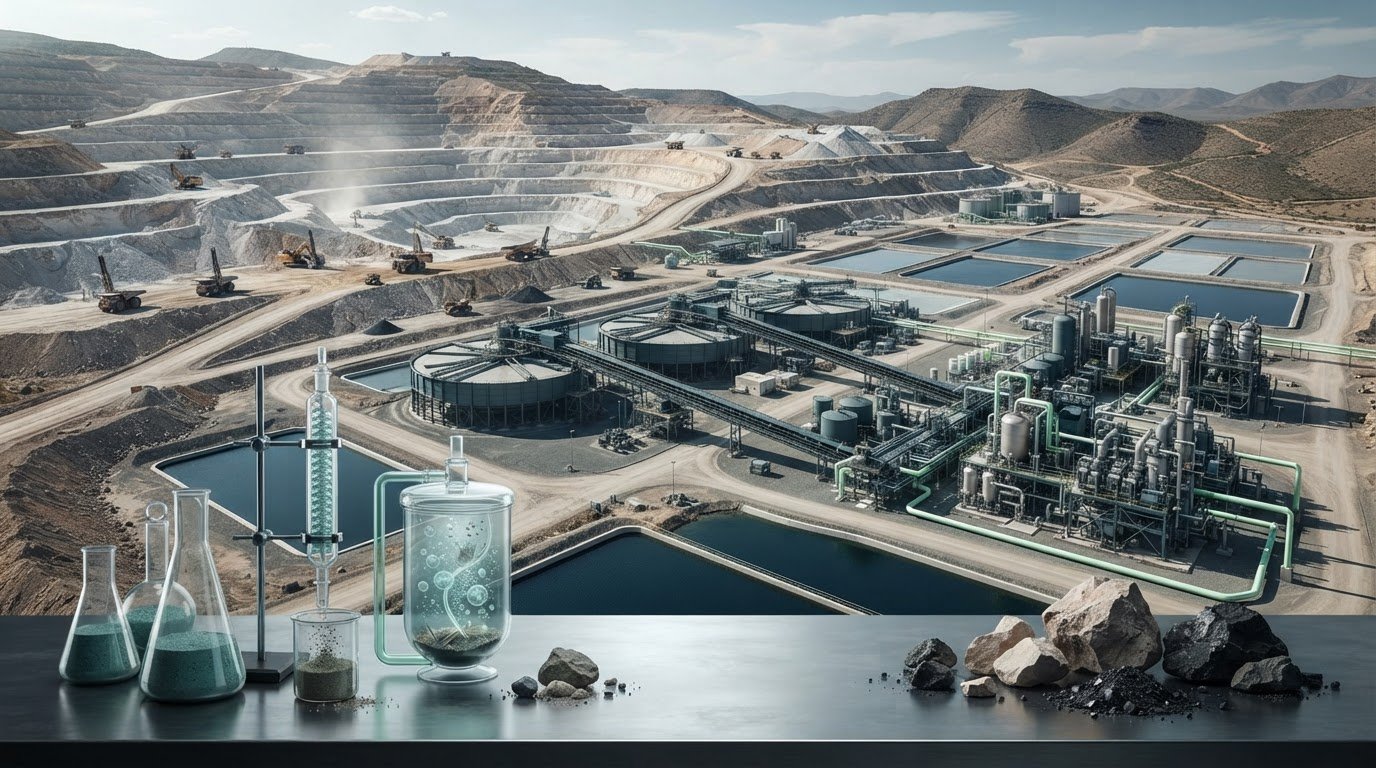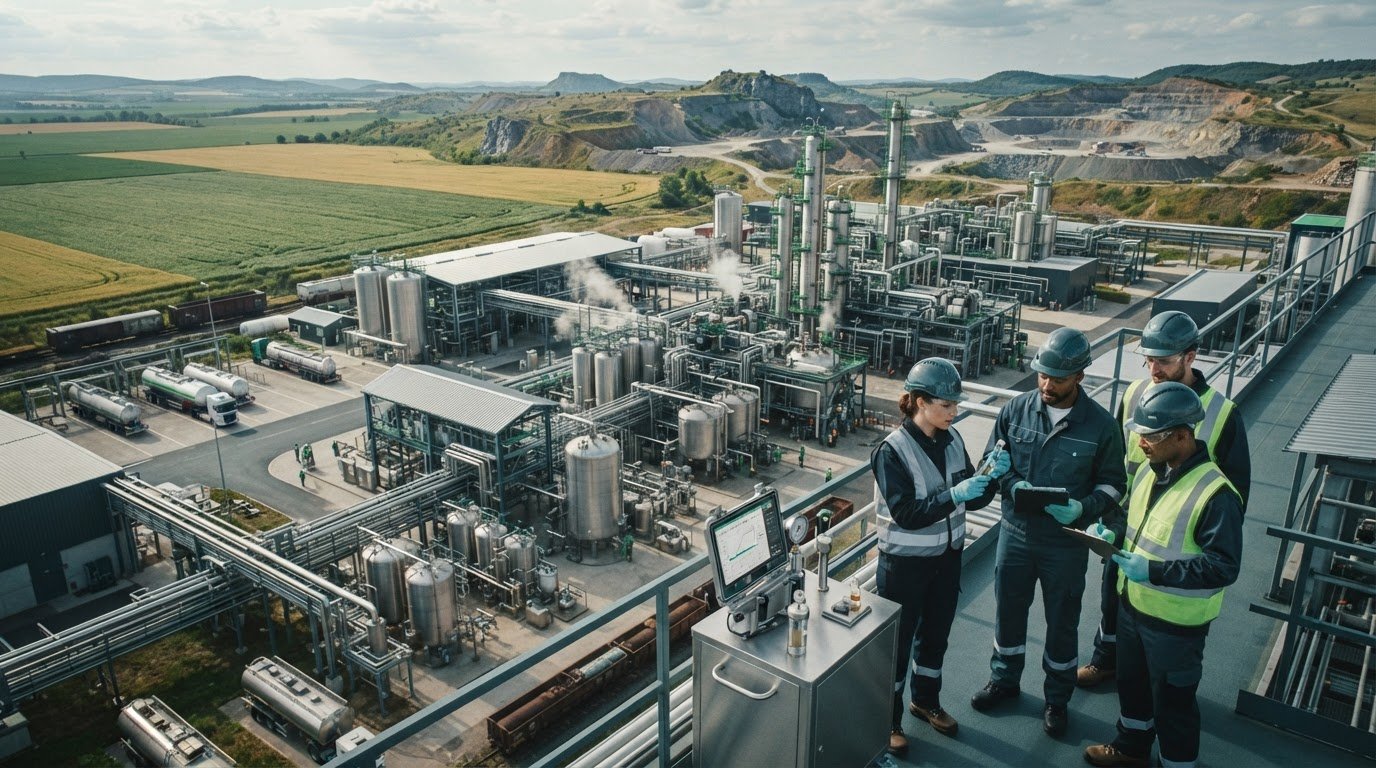

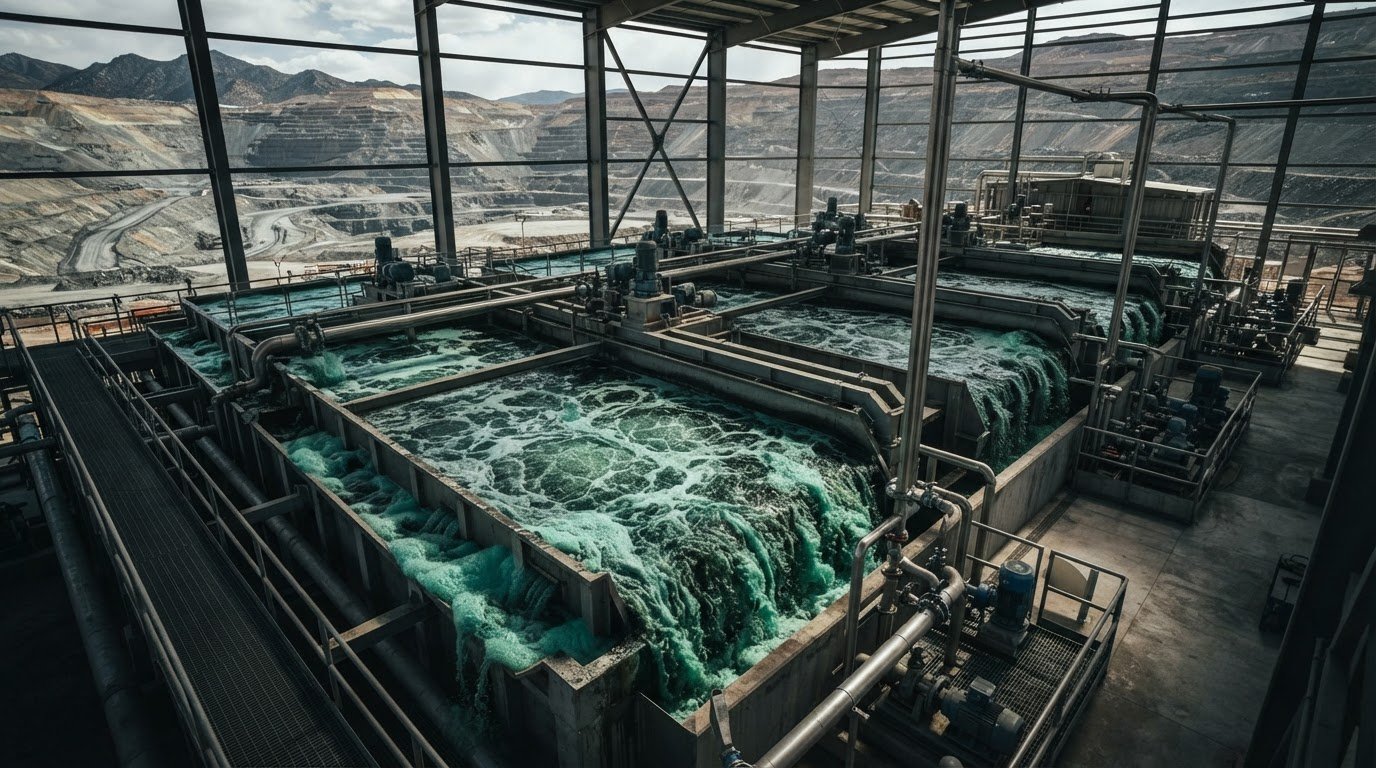
What if the frother that creates the most persistent foam is also limiting concentrate grade? In flotation, bubble size and froth stability influence recovery kinetics and the risk of gangue entrainment. Mining Frothers must therefore be matched to the ore, particle size, water chemistry, and operating conditions, rather than selected for froth persistence alone. Excessive dosage can increase reagent use, while unstable froth can undermine recovery and selectivity.
Finding the right balance is especially challenging in complex polymetallic ores, where fast kinetics and fine-particle selectivity must work together. This guide explains how alcohol-based, polyglycol-based, and blended frothers affect bubble interfaces, froth behavior, and mineral recovery. It also covers practical ways to assess dosage and frother-collector interactions, helping concentrator teams balance recovery and grade without unnecessary reagent use. JAS Global Industries develops tailored specialty chemical formulations and provides plant process optimization for distinct mineralogy challenges. The sections ahead connect frother chemistry to flotation performance and bulk supply planning for mining operations.
Key Takeaways
- Understand how frother chemistry supports bubble formation and helps limit coalescence in flotation circuits.
- Compare alcohol-based, polyglycol, and blended Mining Frothers by how molecular structure can influence froth persistence and water carry.
- Use gas holdup, bubble size, and froth stability as practical measures when assessing flotation performance.
- Adjust dosing strategies with attention to circuit stage and process-water chemistry to balance recovery with gangue selectivity.
- Explore how ore-specific formulations, dosage optimization, and bulk supply planning can support stable concentrator operations.
Fundamentals of Mining Frothers in Mineral Froth Flotation
Mining Frothers are surface-active agents that adsorb at air-water interfaces, lower dynamic surface tension, and help control bubble formation and persistence. Their performance depends on interfacial behavior, including the critical coalescence concentration (CCC), the concentration at which bubble merging is sufficiently inhibited under defined conditions to maintain a more stable bubble population.
In a flotation cell, agitation disperses air through the pulp. Frother molecules orient at the gas-liquid boundary, with water-attracting regions interacting with the aqueous phase and water-repelling regions oriented toward the gas. This interfacial layer helps resist drainage and rupture of the liquid films between colliding bubbles. For an overview of the broader process, see Fundamentals of froth flotation. Frothers are one part of the wider mining solutions for resource security used to support mineral processing.
The Gas-Liquid Interface and Bubble Coalescence Prevention
Below the CCC, bubbles may collide and merge more readily, producing a coarser, less uniform bubble population. As frother concentration approaches and reaches the CCC, coalescence is suppressed. Adding more frother beyond that point may not further reduce bubble size and can change froth persistence or water recovery. CCC depends on the frother and operating conditions, so determine it using the actual process water and pulp rather than treating it as a universal dosage.
Bubble size is commonly characterized by the Sauter mean diameter, or d32, which relates bubble volume to surface area. There is no single optimal d32 for every ore or circuit. Smaller bubbles can provide more surface area for particle collisions, while an excessively persistent fine-bubble froth may carry more water and entrain fine gangue. The useful target balances collision opportunity with drainage and concentrate selectivity.
Distinguishing Frothers from Collectors and Depressants
Frothers primarily modify gas-liquid interfaces. Collectors act mainly on mineral surfaces, increasing the hydrophobicity of target particles so they can attach to bubbles. Depressants work in the opposite direction for selected minerals, reducing their tendency to float. Each reagent has a distinct role, but their effects meet at the bubble-particle interface.
A frother with unintended collecting behavior may promote attachment of non-target minerals, weakening selectivity and concentrate grade. A suitable frother supports bubble formation and a manageable froth, while the collector conditions valuable mineral surfaces for attachment. Together, these actions help hydrophobic particles travel with bubbles into the froth and overflow to the launder, while limiting unwanted water and gangue transfer.
Chemical Classes of Industrial Frothers: Chemistry and Selectivity
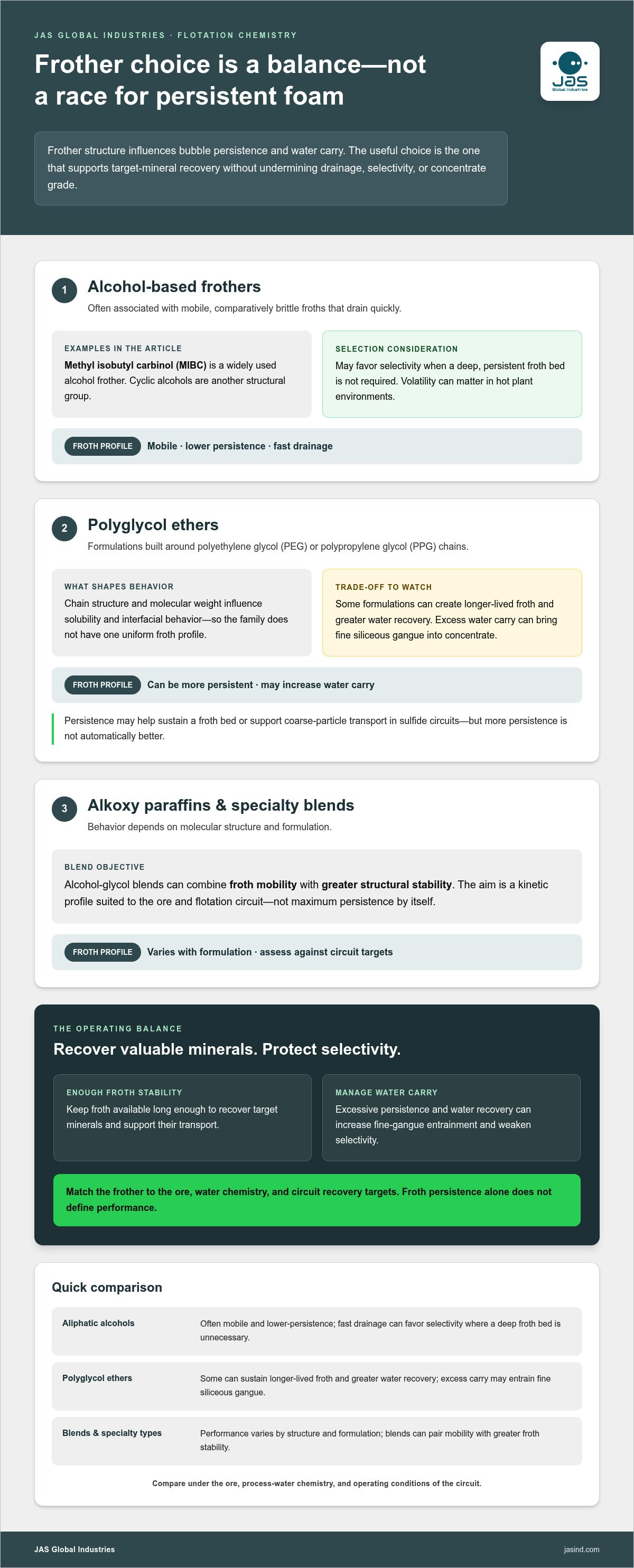
Industrial frothers are commonly grouped as aliphatic alcohols, polyglycol ethers, and formulated blends. Their molecular structure influences how they adsorb at the gas-liquid interface, how long bubbles persist, and how much water reports to the froth. The practical choice is a balance: the froth must last long enough to recover target minerals, but excessive persistence and water carry can increase fine gangue entrainment or weaken selectivity.
| Frother family | Typical froth behavior | Selection consideration |
|---|---|---|
| Aliphatic alcohols | Often produce mobile, lower-persistence froths | Can suit circuits where selectivity and froth drainage matter |
| Polyglycol ethers | Often support more persistent froth and greater water carry | May help sustain froth beds, but excess persistence can increase entrainment |
| Alkoxy paraffins and specialty blends | Behavior varies with molecular structure and formulation | Assess against ore, water chemistry, and the circuit’s recovery targets |
Aliphatic Alcohols: Characteristics and Applications
Methyl isobutyl carbinol (MIBC) is a widely used alcohol frother. Cyclic alcohols are another structural group, with performance depending on molecular features and operating conditions. Alcohol frothers are often associated with comparatively brittle, fast-draining froths, which can favor selectivity when a deep, persistent froth bed is not required. Their volatility can also matter in hot plant environments. Review product handling guidance and safety data, and consider temperature when evaluating storage, dosing, and process performance. For the broader principles behind these surface-active materials, see surfactant chemistry.
Polyglycol Ethers: Persistence and Water Carry
Polyglycol ethers are built around polyethylene glycol (PEG) or polypropylene glycol (PPG) chains with ether functionality. Chain structure and molecular weight influence solubility and interfacial behavior, so the family does not have one uniform froth profile. Compared with many alcohol frothers, some polyglycol formulations can create longer-lived froth and greater water recovery. That persistence may support coarse particle transport or a robust froth bed in sulfide circuits, but excess water carry can bring fine siliceous gangue into concentrate.
Formulated Blends: Tuning Selectivity and Kinetics
Alcohol-glycol blends can combine froth mobility with greater structural stability. The aim is not simply maximum persistence; it is a kinetic profile suited to the ore and flotation circuit. Water salinity and other process-water variations can affect frother response, so evaluate blends under representative plant or laboratory conditions. Tailored formulations can help address complex polymetallic mineralogy. JAS Global Industries develops customized metallurgical formulations and supports dosage optimization. Explore its Mining Frothers solutions for ore-specific requirements.
Evaluating Frother Performance: Kinetics, Bubble Size, and Yield
Assess a frother by how it performs across the flotation circuit, not by foam appearance alone. Track gas holdup, bubble size distribution, froth stability, water recovery, and mineral recovery over time. These measures show whether bubbles provide enough opportunity for particle attachment while the froth remains selective and drains effectively.
The operating objective is balance. Faster recovery can increase valuable mineral recovery, but excessive froth persistence and water carry may lower concentrate grade by entraining fine siliceous gangue. In rougher and scavenger cells, flotation kinetics must also match available hydrodynamic residence time. If particles attach too slowly, they may leave the cell before recovery. If froth carries too much water, more non-target material can report to concentrate.
Critical Coalescence Concentration and Bubble Hydrodynamics
CCC95 is a test-specific measure of the frother concentration associated with 95% of a defined bubble-coalescence suppression response. To estimate it, run a controlled two-phase column test without mineral solids. Hold water, temperature, airflow, and sampling conditions steady, then increase frother concentration in measured steps. Record bubble size at each dose, plot the response, and identify the concentration near the response plateau. Keep the response definition and fitting method consistent across tests. CCC95 values for custom glycol blends require laboratory verification for the ore body and process water.
Bubble size distribution matters because particle-bubble collision and attachment depend on both bubble surface area and particle behavior. Smaller bubbles can offer more area, while an overly fine or unstable distribution may not support effective transport. Gas holdup, the gas volume fraction within the pulp, can shift with impeller speed and airflow. Change these variables systematically. Higher agitation or air input can alter bubble breakup, coalescence, and residence, so compare frother tests under representative conditions rather than attributing every change to chemistry.
Froth Stability and Water Recovery Management
Static foam persistence measures how long foam remains after generation stops. Dynamic froth stability describes behavior under continuous aeration, feed, and overflow, making it more relevant to operating cells. Water recovery measures the water reporting to concentrate and provides a practical indicator of entrainment risk. As water recovery rises, fine gangue can travel with the froth even without strong bubble attachment.
Interpret stability alongside froth overflow velocity, concentrate water content, and downstream dewatering load. A fast, wet overflow may raise throughput but increase entrainment and thickener or filtration demand. A slower, draining froth may improve grade but risk losing slow-floating values. When evaluating Mining Frothers, compare these indicators with recovery and grade by circuit stage, then adjust dosage or operating conditions to fit the required kinetic and selectivity profile.
Operational Best Practices: Dosing, Process Water, and Troubleshooting
Flotation performance shifts with ore feed, water chemistry, temperature, and cell conditions. A stable operating strategy treats frother addition as a controllable variable, not a fixed plant-wide setting. Multi-point dosing can distribute reagent across rougher and scavenger cells according to local froth response, rather than adding the full dose at the circuit head. Cleaner stages often need careful, incremental adjustment to protect concentrate grade while maintaining enough froth stability for recovery.
Stage Dosing and Process Control
Establish a baseline for each circuit stage, then change one variable at a time and track recovery, grade, froth depth, and water carry. Where real-time froth imaging is available, use indicators such as bubble texture, froth movement, and overflow behavior to inform a control strategy. Keep automated adjustments within operating limits and check them against assay and process data. Mining Frothers dosage should respond to circuit conditions, not just a single visual signal.
Process Water, Salinity, and Temperature
Recycled water can accumulate dissolved ions and fine solids, changing ionic strength and the way frothers behave at bubble interfaces. Hyper-saline water may suppress coalescence in some systems, but the response depends on the full water chemistry and reagent formulation. Do not assume a fixed dose reduction. Compare froth and recovery under representative water conditions, then optimize through controlled trials. Water reuse and treatment are also part of wider industrial water treatment planning.
In cold conditions, glycol-containing formulations may become more viscous, affecting flow and metering through dosing lines. Monitor delivery consistency and use appropriate temperature management based on the product’s handling guidance. Recheck dosing after seasonal or process-water changes.
Four Steps for Diagnosing Froth Collapse
- Confirm the change. Check whether collapse is isolated to one cell or affects the circuit. Review air rate, agitation, feed, and reagent delivery.
- Check recent inputs. Compare process-water quality and recent changes in ore, grinding, or upstream reagents. Look for possible hydrocarbon contamination and slime buildup on mineral surfaces.
- Run a controlled correction. Restore verified operating settings and adjust frother in measured increments. Avoid changing frother, collector, and pH conditions simultaneously, which can obscure the cause.
- Verify the response. Track froth persistence, recovery, grade, and water carry. If collapse continues, investigate contamination or surface coating through plant sampling and technical review.
For sticky, overburdened froth that obstructs launder flow, check for excessive dosage and high water carry, then reduce or redistribute addition in controlled steps. If fine gangue lowers concentrate grade, assess water recovery and froth drainage before making further adjustments. Explore tailored Mining Frothers and dosage optimization for circuit-specific process conditions.
Securing High-Yield Flotation with Custom Frother Solutions
Ore bodies vary in mineral composition, particle size, liberation, and process-water conditions. A standard frother approach may not deliver the same balance of recovery and selectivity across every circuit. Custom metallurgical formulations help concentrators respond to these differences and support consistent performance as feed characteristics change. That precision also matters beyond the plant: dependable flotation supports the recovery of minerals used across global industries.
Tailor-Made Formulations for Challenging Ore Bodies
Complex and refractory mineral systems can present competing demands: maintain bubble transport and recovery without creating persistent froth that carries unwanted gangue. Research and innovation centers can use ore-specific information to guide formulation development. Laboratory flotation tests and kinetic profiling help compare candidate chemistries under controlled conditions, while plant feedback shows how those results translate to operating circuits. This creates a practical refinement loop: test, observe, adjust, and verify against metallurgical objectives.
JAS Global Industries develops tailor-made metallurgical formulations through its research and innovation centers. The objective is to match Mining Frothers to the mineralogy and operating environment, rather than rely on a generic selection. Reviewing plant results can help fine-tune dosage and formulation as ore or water conditions evolve.
Supply Continuity for Remote Operations
Remote sites depend on reliable access to bulk reagents. Disruptions can threaten the continuity of milling and flotation, making supply planning part of process security. JAS Global Industries has manufacturing plants and an international presence, with sales and service offices across the Middle East, Africa, Asia, and Europe. For high-volume concentrators, bulk chemical supply contracts can provide a structured foundation for reagent planning and help support operating continuity.
Technical Partnership and Process Optimization
Formulation is only one part of performance. Plant audits and process surveys can identify where dosage, addition points, or circuit conditions are limiting reagent efficiency. Customized dosage optimization then connects chemical selection with measurable plant outcomes, including recovery, concentrate grade, and froth behavior. Using the required dose effectively can reduce unnecessary reagent use and help limit the material carried into tailings, while supporting stable yields.
JAS Global Industries combines specialty chemical experience dating to 1998 with technical plant auditing and customized dosage optimization. An evidence-led approach links laboratory insight, plant conditions, and supply planning. By aligning formulation, application, and bulk availability, concentrators can strengthen operational resilience and contribute to long-term global resource security.
Build a More Resilient Flotation Strategy
Strong flotation performance depends on matching frother chemistry to the ore and operating conditions. Bubble behavior, dosage, and process-water quality all influence the balance between recovery and concentrate grade. Measuring these effects across the circuit helps teams refine performance instead of relying on froth appearance alone.
JAS Global Industries has supplied specialized chemistry to mining and mineral processing operations since 1998. Its research and innovation centers develop tailor-made formulations, supported by metallurgical plant audits and dosage optimization. With its international presence across the Middle East, Africa, Asia, and Europe, the company can support supply planning alongside process improvements.
With the right technical partnership, Mining Frothers can support selective recovery and steady operations across complex ore bodies. Optimize your flotation process with Mining Frothers from JAS Global Industries.
Frequently Asked Questions
What is the primary role of a mining frother in mineral processing?
A mining frother helps create and stabilize bubbles so hydrophobic mineral particles can attach and rise into the flotation froth. It acts mainly at the air-water interface, limiting bubble coalescence and influencing bubble size, froth mobility, and water recovery. The operating goal is a froth that lasts long enough to carry valuable minerals to the launder but drains sufficiently to avoid excessive entrainment of fine gangue.
How does an alcohol-based frother like MIBC compare to a polyglycol ether?
MIBC, an alcohol-based frother, is generally associated with a more mobile, lower-persistence froth that can drain readily and support selectivity. Polyglycol ethers can produce more persistent froth and greater water carry, depending on their structure and circuit conditions. Neither family is universally better. Selection depends on ore characteristics, particle size, process water, and whether the circuit needs more froth stability or stronger drainage.
Can a mining frother act as a collector during flotation?
A frother is selected primarily to control bubbles and froth, while a collector makes target mineral surfaces more hydrophobic. Some frother chemistries may show unintended collecting effects under particular conditions, but that does not make frothers substitutes for collectors. If a frother increases attachment of non-target minerals, concentrate selectivity and grade can suffer. Evaluate frother and collector performance together, since their combined effects influence particle attachment and transport.
What is the critical coalescence concentration (CCC) of a frother?
The critical coalescence concentration, or CCC, is the frother concentration at which bubble coalescence becomes strongly inhibited under defined test conditions. Below this level, bubbles are more likely to merge; near the CCC, bubble size may become more stable. The value depends on the frother and test environment, including water chemistry and temperature. Measure it under controlled conditions rather than treating it as a universal plant dosage.
How does process water salinity affect industrial frother dosage?
Salinity changes the ionic environment at bubble interfaces and can alter frother activity, bubble coalescence, and froth behavior. The direction and size of the effect depend on the dissolved ions, frother chemistry, and other operating conditions, so salinity alone does not determine the required dose. Compare performance using representative process water, then adjust dosage in controlled steps while tracking froth stability, recovery, grade, and water carry.
What causes excessive gangue entrainment in the flotation froth phase?
Excessive gangue entrainment often occurs when fine particles are carried into concentrate with water rather than attached selectively to bubbles. High water recovery, a persistent wet froth, and inadequate drainage can increase this transfer. Overdosing frother may contribute by prolonging froth life, though feed conditions and circuit operation also matter. Monitor concentrate grade alongside water recovery and froth drainage, then make measured adjustments to reagent addition and operating conditions.
How do custom frother formulations improve mineral recovery in complex ores?
Custom formulations can be matched to an ore body’s mineralogy, particle size, and process-water conditions to balance bubble stability, flotation kinetics, and selectivity. Laboratory testing and plant metallurgical feedback help assess how a formulation performs in the circuit and guide dosage optimization. JAS Global Industries develops tailor-made metallurgical formulations and provides technical plant audits, helping concentrators refine reagent strategies for complex ores instead of relying on a one-size-fits-all approach.