
What if the difference between a profitable concentrate and a costly waste pile isn't the volume of chemicals you use, but the precision of a single molecular bond? In an industry where ore grades are steadily declining, the old methods of bulk chemical application are no longer sustainable. You've likely felt the pressure of low selectivity leading to high gangue recovery; it's a frustration that erodes margins and complicates daily operations. Using the right Mining Flotation Collectors is no longer just a line item. It's a strategic necessity for securing the stability of global resources.
Discover how advanced flotation collector chemistry optimizes mineral grade and recovery through selective attachment and tailor-made formulations. We'll show you how to transform complex ore challenges into consistent, high-grade results. This guide explores the essential synergy between molecular structure and site-specific mineralogy. You'll learn how to meet 2026 ESG disclosure requirements while securing higher recovery and lower tailings loss. We're moving beyond simple logistics toward long-term technical partnerships that protect the stability of critical infrastructure and ensure industrial resilience. It's time to prioritize precision over volume.
Key Takeaways
- Learn how collectors function as the primary engine for mineral recovery by selectively rendering target particles hydrophobic.
- Identify the critical differences between ionizing and non-ionizing Mining Flotation Collectors to ensure optimal compatibility with your specific ore type.
- Understand the risks of reagent over-dosing and how technical audits create a balanced chemical environment for higher concentrate grades.
- Discover the shift toward tailor-made formulations that address the unique challenges of ultra-fine particles and complex, poly-metallic mineralogy.
- Recognize the value of a global technical partnership in securing resource stability and optimizing plant yields through custom chemical engineering.
The Role of Flotation Collectors in Modern Mineral Processing
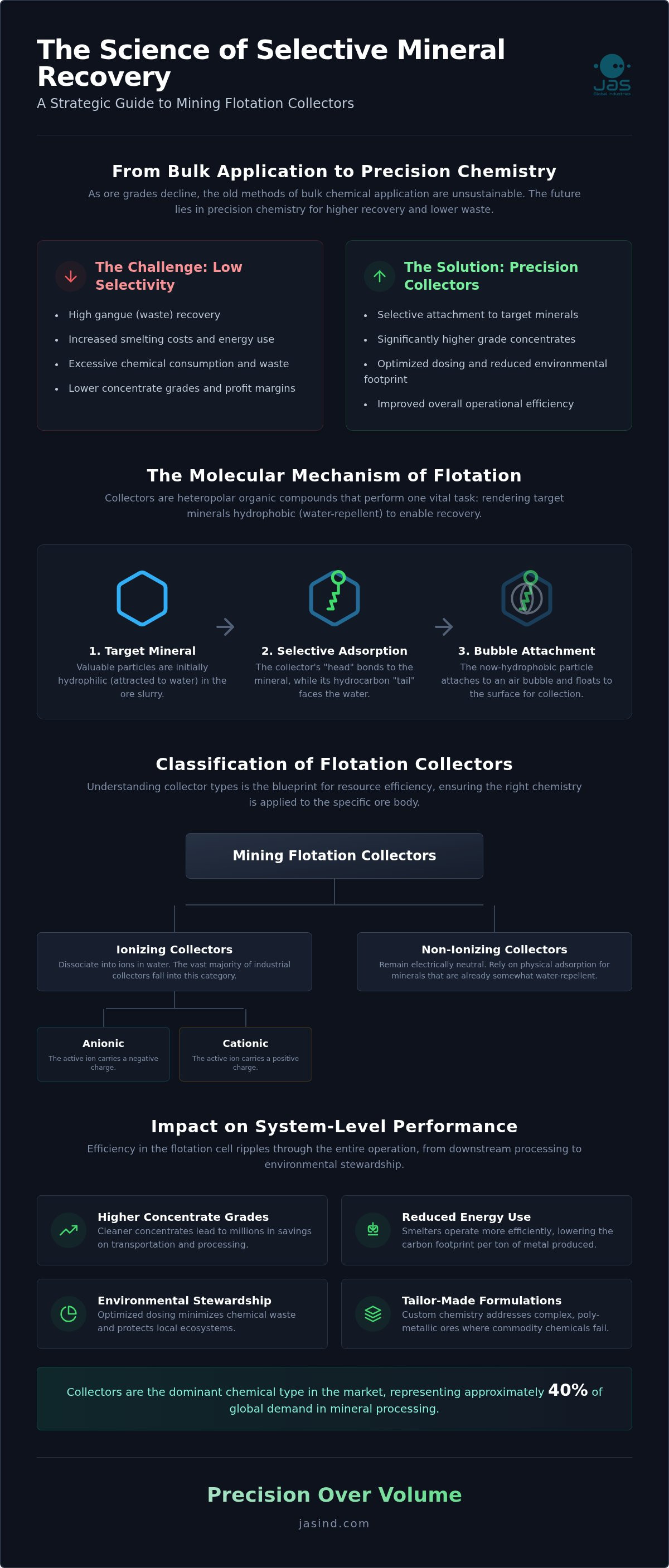
Collectors are the chemical foundation of the froth flotation process. These heteropolar organic compounds perform a singular, vital task: they render target minerals hydrophobic. By selectively attaching to specific mineral surfaces, they allow valuable particles to hitch a ride on air bubbles, separating them from worthless gangue. This mechanism isn't just a laboratory curiosity. It's the engine that drives the entire recovery circuit, turning raw earth into the materials that build our world.
Think of Mining Flotation Collectors as a strategic asset for global resource security. As high-grade deposits disappear, the ability to extract minerals efficiently becomes a pillar of modern infrastructure. Poor selectivity doesn't just lower grades. It increases smelting costs and creates massive industrial waste. The economic stakes are immense; a small increase in concentrate grade can lead to millions in annual savings on transportation and processing fees. Precision chemistry is the only way to ensure the stability of these critical global resources.
Understanding the Chemistry of Selective Attachment
Selectivity starts at the molecular level. Collectors adsorb onto mineral surfaces through either physical attraction or chemical bonding. Each molecule features a reactive "head" group that seeks out the mineral and a non-polar hydrocarbon "tail" that faces the water. This tail creates the necessary water-repellent barrier for bubble attachment. Without this precise orientation, the mineral would remain submerged, lost to the tailings pile.
In complex, low-grade ore bodies, this attachment must be surgical. Standard commodity chemicals often struggle with mineralogical variability, leading to high gangue recovery. High-performance Mining Flotation Collectors are engineered to ignore the waste material, ensuring that only the target minerals reach the concentrate. It's a delicate balance of affinity and repulsion that determines the economic viability of a modern mine. When the chemistry is right, the recovery is certain.
Impact on System-Level Mining Performance
Efficiency in the flotation cell ripples through the entire operation. When collectors deliver a cleaner concentrate, downstream processing requires significantly less energy. Smelters operate more efficiently when they aren't processing excess waste, which directly lowers the carbon footprint per ton of metal produced. Collectors are the dominant chemical type in this market, representing approximately 40% of global demand, which underscores their critical importance in industrial recovery.
Optimized dosing also plays a critical role in environmental stewardship. Using advanced mining solutions allows operators to minimize chemical waste and avoid the risks of over-dosing. This precision directly impacts tailings management, reducing the environmental footprint of the site. Reliable chemistry doesn't just improve the balance sheet. It secures the long-term license to operate by protecting local ecosystems and maximizing the life of the mine. It's a commitment to both performance and protection.
Classification of Mining Flotation Collectors by Ore Type
Chemical classification isn't just a technical exercise; it's the blueprint for resource efficiency. Mining Flotation Collectors are categorized primarily by their ability to ionize in aqueous solutions. This behavior determines how they interact with the mineral's surface charge. Ionizing collectors, which account for the majority of industrial applications, are further divided into anionic and cationic groups based on the charge of the active ion. Non-ionizing collectors remain electrically neutral, relying on physical adsorption for minerals that are already somewhat water-repellent.
Understanding these Flotation Fundamentals allows operators to navigate the complexities of modern ore bodies. The chemical backbone of a collector must align perfectly with the mineralogy of the site to ensure maximum recovery and minimal waste. The length of the hydrocarbon chain also dictates the collector's power; longer chains increase hydrophobicity but often reduce solubility. This balance is critical for maintaining stable froth conditions and reliable performance.
Anionic Collectors: Sulfides and Beyond
Anionic collectors are the industry's workhorses. They are essential for the recovery of sulfide and oxide minerals. Within this category, xanthates and dithiophosphates remain the standard for base metal flotation due to their strong affinity for metal ions. These chemicals are highly effective but require precise environmental control. For non-sulfide mineral processing, operators often turn to carboxylates and sulfonates. These reagents provide the necessary selectivity for minerals like fluorite or phosphate. Selecting the right anionic reagent ensures that valuable minerals are captured while keeping gangue recovery to a minimum. If you're managing complex deposits, investing in advanced mining solutions can help refine your chemical selection for better site performance. Anionic sulfide collectors typically operate most effectively within a pH range of 8.0 to 11.0.
Cationic and Non-Ionic Collectors
Cationic collectors operate on the opposite side of the charge spectrum. Fatty amines are the primary reagents here, playing a vital role in potash and feldspar mineral recovery. Because they carry a positive charge, they're uniquely suited for silicate minerals that anionic Mining Flotation Collectors might ignore. This specialized focus makes them indispensable for industrial mineral production and the stability of global fertilizer supplies.
Non-ionic collectors, such as non-polar hydrocarbon oils, are used for naturally hydrophobic minerals. Coal, graphite, and molybdenite often require these collectors to enhance their inherent water-repellency. In cases of extreme mineralogical complexity, amphoteric collectors provide a dual-charge capability. These specialty chemicals adapt to changing surface conditions, offering a reliable solution for poly-metallic ores that defy standard classification. Precision in these choices is what separates a high-yield operation from a costly failure.
Optimizing Collector Efficiency: Technical Audits and Dosing
In mineral processing, the impulse to increase chemical volume often leads to diminishing returns. Over-dosing Mining Flotation Collectors doesn't just waste capital; it can actually depress recovery by creating thick, unselective coatings or interfering with bubble attachment. Optimization requires a balanced chemical ecosystem where collectors, frothers, and depressants act in concert. This synergy is sensitive to site-specific conditions. Variations in water quality, ionic strength, and seasonal temperature shifts directly impact collector solubility and kinetic performance.
A professional technical audit is the only reliable way to identify these bottlenecks. Rather than treating reagents as commodities, we view them as precision tools within a complex circuit. By analyzing the entire process from grinding to tailings, we ensure that every gram of chemistry contributes to the stability of the final concentrate. This protective approach secures both the grade and the operational budget. It's a commitment to efficiency that transforms a simple supplier relationship into a vital technical partnership.
The 5-Step Dosing Optimization Framework
Achieving peak efficiency requires a systematic approach rooted in data. We follow a rigorous protocol to ensure your circuit performs at its theoretical maximum:
- Step 1: Mineralogical Characterization. We begin with a deep analysis of the feed ore to understand the specific mineral associations and liberation sizes.
- Step 2: Laboratory Bench Tests. Baseline performance is established using precise dosing increments to find the optimal recovery curve.
- Step 3: Pilot Plant Validation. We scale our findings to simulate real-world conditions, validating custom chemical strategies before full implementation.
- Step 4: Real-time Monitoring. Continuous tracking of concentrate grade and tailings loss provides the data needed for high-level security.
- Step 5: Iterative Adjustment. Technical partners stay engaged, adjusting the reagent suite as ore mineralogy evolves over the life of the mine.
Troubleshooting Common Flotation Issues
Operational challenges often stem from a lack of chemical selectivity. If you're seeing high gangue recovery, it's likely the collector is too aggressive or the dosage is exceeding the available surface area of the target mineral. Solving poor froth stability requires an analysis of the collector-frother interaction; sometimes the collector's own surfactant properties can disrupt the bubble structure created by the frother. Precision dosing prevents these conflicts.
Managing changing ore mineralogy is the greatest test of a reagent suite. Flexible formulations allow for rapid adaptation without shutting down the circuit. By partnering with a technical leader that offers bespoke solutions, mines can maintain stable production even when facing the most difficult, ultra-fine, or poly-metallic deposits. Stability isn't an accident. It's the result of disciplined optimization and a focus on the long-term value of the resource.
Tailor-Made Formulations for Complex Mineral Recovery
The era of commodity reagents is ending. Global mineral recovery now requires surgical precision. Standard Mining Flotation Collectors often fail when confronted with ultra-fine particles or complex poly-metallic structures. These traditional chemicals lack the selectivity needed to separate value from waste in low-grade deposits. To secure the stability of global resources, the industry is turning toward high-performance specialty formulations. These aren't generic products. They're engineered solutions designed to solve specific operational pain points. Protecting resources. Securing yields.
Relying on off-the-shelf chemicals is a risk to your long-term stability. A custom-engineered reagent suite offers a reliable path to higher concentrate grades and lower operational costs. If your current recovery rates are falling short of your targets, it's time to evaluate your chemical strategy. Our approach treats every mine as a unique chemical environment, ensuring that the collector backbone is perfectly matched to the ore's mineralogical signature.
Innovation in Phosphate and Potash Mining
Phosphate deposits often contain high levels of clay and other deleterious minerals. These contaminants consume reagents and disrupt the froth, leading to poor recovery. By developing bespoke chemistry for Phosphate mining, we can effectively suppress clay interference while maximizing P2O5 grade. Potash operations face similar challenges, requiring advanced amine blends to achieve superior selectivity. Since 1998, our focus has been on creating these tailor-made formulations. We balance the need for high recovery with the strict environmental standards of 2026. This dual focus protects both the environment and the industrial plant's yield.
The Role of R&I in Chemical Development
Innovation lives in the laboratory. Our global R&I centers act as the engine for site-specific development. We use advanced analytics to map the unique chemical "fingerprint" of each ore body. This process involves mapping mineral-collector interactions at the molecular level. We don't just guess. We quantify. By collaborating directly with plant managers, we accelerate the development cycle for new Mining Flotation Collectors. This partnership ensures that the final formulation is optimized for the specific water chemistry and mineralogy of the site. It is a process of collaborative innovation that builds long-term industrial resilience.
Customizing your chemical suite is the most effective way to address declining ore grades. Request a site-specific technical audit to discover how bespoke formulations can optimize your circuit. Protect your assets. Secure your recovery.
JAS Global Industries: Your Partner in Mining Excellence
Since 1998, JAS Global Industries has acted as a foundational industry presence. We don't just sell chemicals. We provide advanced mining solutions that secure the stability of critical global resources. Our role has evolved from a mere supplier to a vital global guardian, ensuring that industrial plants achieve their maximum potential through precision chemistry. With a corporate history rooted in reliability, we offer a comprehensive operational partnership that spans from initial technical audits to the reliable bulk supply of Mining Flotation Collectors. Stability. Security. Performance.
Our commitment to global resource security is reflected in every formulation we develop. As ore grades decline worldwide, the need for a responsible corporate citizen to lead the way in sustainable industrial chemistry has never been greater. We treat each client engagement as a long-term partnership focused on protecting the fundamental needs of society. By optimizing mineral recovery, we ensure the steady supply of materials essential for modern infrastructure. This mission-oriented approach distinguishes us as an indispensable pillar of the global mining industry.
Global Presence with Local Expertise
Headquartered in Dubai, our reach extends across Europe, Asia, Africa, and the Middle East. This global network is supported by multiple R&I centers dedicated to custom development and site-specific testing. We understand that mineralogy varies significantly by geography. Our on-site technical support teams ensure optimal chemical performance regardless of climate or ore complexity. Strategic logistics and robust bulk supply contracts provide the security large-scale mining operations require. We bridge the gap between global scale and local site requirements, providing a steady hand in an increasingly variable market.
Why Choose JAS for Mineral Processing?
Our expertise lies in the creation of tailor-made formulations for unique ore bodies. We recognize that mineral recovery is intrinsically linked to the chemical environment of the entire plant. By integrating water treatment and mining chemistry, we offer holistic plant management that few competitors can match. This integrated approach reduces chemical waste and optimizes yield, ensuring that your Mining Flotation Collectors function at peak efficiency within a balanced system.
We focus on long-term value. Our partnerships are built on established trust and a shared commitment to sustainable industrial practices. We don't prioritize transactional gains; we prioritize the stability of your operations. If you're ready to move beyond commodity reagents toward a high-performance chemical strategy, we're ready to lead. Contact JAS Global Industries for a technical audit of your flotation circuit and secure your operational excellence today. Protect your resources. Secure your future.
Securing Your Operational Future with Precision Chemistry
The path to industrial resilience depends on the precision of your chemical environment. As ore bodies grow more complex, the reliance on generic reagents creates unnecessary waste and operational risk. You've seen how the right Mining Flotation Collectors transform recovery rates by targeting specific mineralogy with surgical accuracy. By moving from bulk supply to a technical partnership, you ensure that every part of your circuit contributes to a stable, high-grade concentrate. It's about protecting your assets while securing the global supply of critical materials.
Since 1998, JAS Global Industries has provided the technical expertise needed to navigate these challenges. Our global R&I and manufacturing network specializes in tailor-made formulations for Phosphate and Potash, ensuring your plant meets 2026 ESG standards while maximizing yield. Don't settle for off-the-shelf solutions when site-specific data can drive significant performance gains. Optimize Your Mineral Recovery with JAS Global Technical Consulting. We're ready to help you build a more secure and efficient mineral recovery process together. Let's focus on the long-term value of your resources.
Frequently Asked Questions
What are the main types of mining flotation collectors?
Ionizing and non-ionizing represent the primary chemical categories. Ionizing collectors are further split into anionic and cationic types based on their electrical charge. Anionic reagents like xanthates are essential for sulfide recovery. Cationic amines serve industrial minerals like potash. Non-ionizing collectors, such as hydrocarbon oils, target naturally hydrophobic minerals like coal. Choosing the correct class is a strategic decision that secures the stability of your recovery circuit and prevents resource loss.
How do collectors differ from frothers in the flotation process?
Collectors and frothers perform distinct, complementary functions. Collectors render target minerals hydrophobic to ensure bubble attachment. Frothers reduce surface tension to create stable bubbles that transport those minerals to the surface. Without collectors, minerals won't attach; without frothers, bubbles burst before the concentrate can be recovered. Balancing these two chemical components is vital for the security of the flotation circuit and the protection of the final mineral grade.
Can a single collector be used for all types of ore?
Universal collectors don't exist in modern mineral processing. Each ore body possesses a unique mineralogical signature that requires a specific chemical backbone. A reagent optimized for copper sulfide will fail in a potash or phosphate environment. Using the wrong Mining Flotation Collectors increases gangue recovery and operational costs. Achieving high performance requires a tailor-made approach that aligns the collector's molecular structure with the specific surface chemistry of the target mineral.
How do I determine the optimal dosage for my flotation collectors?
Optimal dosing is determined through a rigorous, data-driven framework. It begins with comprehensive mineralogical characterization of the feed ore. Lab-scale bench tests establish the baseline, followed by pilot plant validation to simulate real-world conditions. Continuous monitoring of concentrate grade and tailings loss provides the feedback needed for iterative adjustments. This systematic process prevents the risks of over-dosing, ensuring that your chemical consumption remains efficient while securing maximum mineral recovery.
What impact does water quality have on collector efficiency?
Water quality is a critical factor in chemical performance. Factors like pH, ionic strength, and seasonal temperature shifts directly influence collector solubility and adsorption kinetics. In modern closed-loop systems, the accumulation of salts or residual reagents can interfere with selective attachment. Managing these variables requires a deep understanding of water chemistry. Technical audits help identify how your site's specific water conditions affect the efficiency of your flotation reagents and industrial yield.
How do custom chemical formulations improve mineral recovery?
Custom formulations address site-specific challenges that commodity chemicals ignore. They're engineered to handle complex issues like high clay interference in phosphate mining or the recovery of ultra-fine particles. By mapping the mineral-collector interaction at the molecular level, we create a chemical "fingerprint" for your site. This precision improves selectivity, reduces chemical waste, and secures the long-term stability of global resources. It's a move from transactional supply toward a technical partnership.
What is the difference between anionic and cationic collectors?
The primary difference lies in the electrical charge of the active ion. Anionic collectors carry a negative charge and are the industry's workhorses for sulfide and oxide minerals. Cationic collectors carry a positive charge, making them indispensable for silicate minerals, potash, and feldspar. Selecting between them depends on the surface charge of the target mineral. This fundamental choice ensures that the Mining Flotation Collectors attach only to the value, leaving the gangue behind.
Is it possible to reduce reagent costs without losing mineral grade?
Cost reduction is achievable through precise dosing and technical audits. Over-dosing doesn't improve recovery; it often leads to unselective coatings that pull waste into the concentrate. By optimizing the reagent suite, you reduce consumption and lower downstream smelting or transportation costs. This approach protects your operational budget while maintaining high concentrate grades. Stability in mineral processing comes from precision chemistry, not high volume. It's a commitment to efficiency and long-term industrial resilience.