
Could the success of a multi-million dollar mining operation rest on the molecular weight of a single polymer? With the World Bank predicting a 500% increase in mineral demand by 2050, the pressure on global water security has never been higher. Efficiently managing your tailings isn't just a technical requirement. It's a global responsibility. You know that generic chemical applications often lead to reagent overdosing and sluggish settling times in your thickeners. These inefficiencies compromise your environmental compliance and your bottom line.
It's time to move beyond standard reagents. This article demonstrates how modern Mining Flocculants and advanced polymer chemistry are transforming mineral recovery efficiency across the globe. You'll discover how tailored chemical solutions reduce water consumption in arid regions and improve solids density for safer storage. We'll preview the latest innovations in high-performance flocculants that help operators meet the 2024 Global Industry Standard on Tailings Management while maximizing throughput and ensuring long-term site stability.
Key Takeaways
- Master the nuances of polymer chemistry to select the ideal molecular weight for superior floc strength and settling velocity.
- Strengthen environmental stewardship and water security by leveraging advanced thickening technologies that enable stable, dry stack tailings.
- Minimize operational costs by identifying the precise dosing points and make-down protocols that prevent expensive reagent waste.
- Learn how site-specific Mining Flocculants create critical synergies with grinding aids to maximize recovery in complex mineral deposits.
- Transition from traditional settling to high-performance paste technology to ensure the long-term stability of global mining infrastructure.
The Evolving Role of Mining Flocculants in Modern Mineral Processing
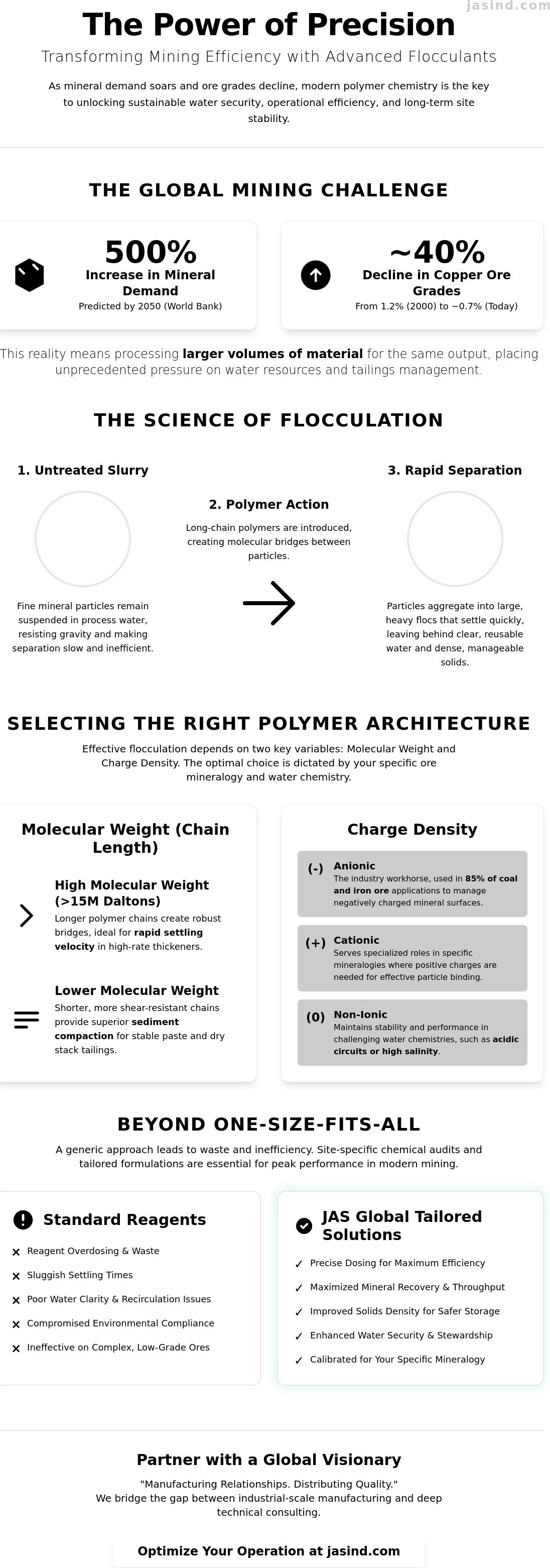
Mining flocculants serve as the essential backbone of efficient solid-liquid separation in the 21st century. These high-molecular-weight polymers act as the primary catalyst for reclaiming process water and managing tailings. The industry has moved decisively beyond traditional settling ponds. Today, modern operations utilize high-rate thickening and advanced paste technology to achieve rapid throughput and dry stack capabilities. This transition isn't just about operational speed; it's a matter of Global Mineral Security. As average copper grades at major global mines have declined from 1.2% in 2000 to roughly 0.7% today, operators must process significantly larger volumes of material to meet the world's demand for critical minerals.
Within the circuit, these reagents function as part of a delicate chemical equilibrium. They interact directly with residual flotation collectors and frothers. If the chemistry isn't perfectly balanced, excess flocculant can recirculate and interfere with upstream Mineral processing stages, leading to recovery losses. Precision in chemical application ensures that process water returns to the plant clean, protecting both the production cycle and the local environment.
The Science of Flocculation: Bridging and Charge Neutralization
The process relies on massive, long-chain polymers that physically bridge fine particles into larger, heavier flocs. While coagulants neutralize the static electrical charges on particle surfaces to create small clusters, flocculants use their immense molecular length to tether those clusters into dense aggregates for rapid sedimentation. Ore mineralogy dictates the success of this interaction. High clay content or extreme pH fluctuations can hinder polymer attachment. This makes the selection of specific charge densities a technical priority rather than a simple procurement choice.
Market Trends: The Move Toward Tailor-Made Formulations
Standard, off-the-shelf polyacrylamides are increasingly ineffective against complex, low-grade ore bodies. A "one-size-fits-all" approach often leads to reagent waste and poor water clarity. Leading operations now demand site-specific chemical audits to optimize performance and reduce costs. JAS Global Industries fulfills this need by acting as a Global Visionary Partner. We bridge the gap between industrial-scale manufacturing and deep technical consulting. By focusing on our core philosophy of "Manufacturing Relationships. Distributing Quality," we ensure that Mining Flocculants are calibrated for the specific mineralogical challenges of each site. This commitment supports the foundational needs of global infrastructure and water security.
Chemistry and Classification: Selecting the Right Polymer Architecture
Polyacrylamide (PAM) remains the definitive industry standard for solid-liquid separation. Its dominance is not accidental; it's a result of high-performance molecular engineering. The effectiveness of Mining Flocculants depends on two primary variables: molecular weight and charge density. Molecular weight determines the physical reach of the polymer chain. High molecular weight variants, often exceeding 15 million Daltons, create robust bridges between particles. This architecture is vital for achieving rapid settling velocities in high-rate thickeners. When the goal is sediment compaction rather than just speed, lower molecular weight polymers provide the necessary shear resistance for stable tailings transport.
Water chemistry acts as the silent regulator of polymer performance. High salinity levels can cause polymer chains to coil, reducing their effective surface area. Similarly, pH fluctuations alter the ionization of functional groups. In acidic circuits typical of copper leaching, non-ionic polymers maintain stability where charged variants might fail. Understanding these chemical interactions is essential for maintaining water security and operational continuity. Research into bioflocculants in mineral processing highlights a growing industry shift toward sustainable alternatives, though synthetic PAM still provides the scale required for global operations.
Anionic, Cationic, and Non-Ionic Flocculants
Anionic flocculants are the workhorses of the industry. They're used in 85% of coal and iron ore processing plants to manage negatively charged mineral surfaces. Cationic polymers serve specialized roles, particularly in organic-rich wastewater or specific clay-heavy streams. Non-ionic polymers provide a critical solution for high-salt environments. They rely on hydrogen bonding rather than electrostatic attraction, ensuring consistent performance in brine-heavy gold or potash operations. Selecting the precise charge ensures that chemical dosages remain optimized, preventing reagent waste and protecting downstream water quality.
Liquid vs. Powder Flocculants: Operational Trade-offs
Logistics often dictate the choice between emulsion and dry powder formats. Remote mining sites in Africa and Asia prioritize dry powders because they offer a 100% active content profile. This reduces shipping costs by approximately 50% compared to liquid emulsions. However, dry powders require precise make-down systems. Improper mixing leads to "fish-eyes," which are undissolved gel balls that clog filters and waste up to 20% of the product. Emulsions offer rapid dissolution, often under 25 minutes, making them ideal for sites with limited storage or fluctuating throughput. For operators seeking to balance cost and efficiency, consulting with a technical partner can help identify the most reliable delivery method for your specific geography.
JAS Global Industries brings twenty-five years of expertise to these complex chemical selections. We focus on the foundational needs of the industry, ensuring that every polymer architecture supports both process efficiency and environmental responsibility. Our approach treats chemical supply as a pillar of global infrastructure, manufacturing relationships that last as long as the projects we support.
Sustainable Tailings Management: The Critical Role of High-Performance Flocculants
Tailings dam failures represent a catastrophic risk to both human life and the environment. High-performance Mining Flocculants act as a primary safeguard in modern mineral processing. These chemical additives accelerate the separation of solids from process water, creating a more stable and manageable waste product. By increasing the settling rate, operators reduce the volume of liquid stored in traditional ponds. This shift is vital for long-term structural integrity. It's a move toward total risk mitigation in mining infrastructure.
Dry stack tailings technology is the gold standard for minimizing environmental footprints. This method relies on Mining Flocculants to produce a dewatered filter cake that can be stacked and reclaimed. It eliminates the need for massive containment dams. Beyond physical stability, precision flocculation targets the chemical composition of discharge. Effective treatment significantly reduces the Chemical Oxygen Demand (COD) in wastewater. This ensures that any water released into the ecosystem meets the stringent environmental standards required in the 2024 regulatory landscape.
Water Security is no longer a peripheral concern; it's a core operational pillar. In hyper-arid regions such as Riyadh and Dubai, water is the most precious commodity on the balance sheet. Efficient dewatering transforms a waste stream into a strategic asset. By recovering water at the source, mines protect regional water tables and ensure the continuity of their operations in water-stressed environments.
Maximizing Water Recovery in Arid Mining Operations
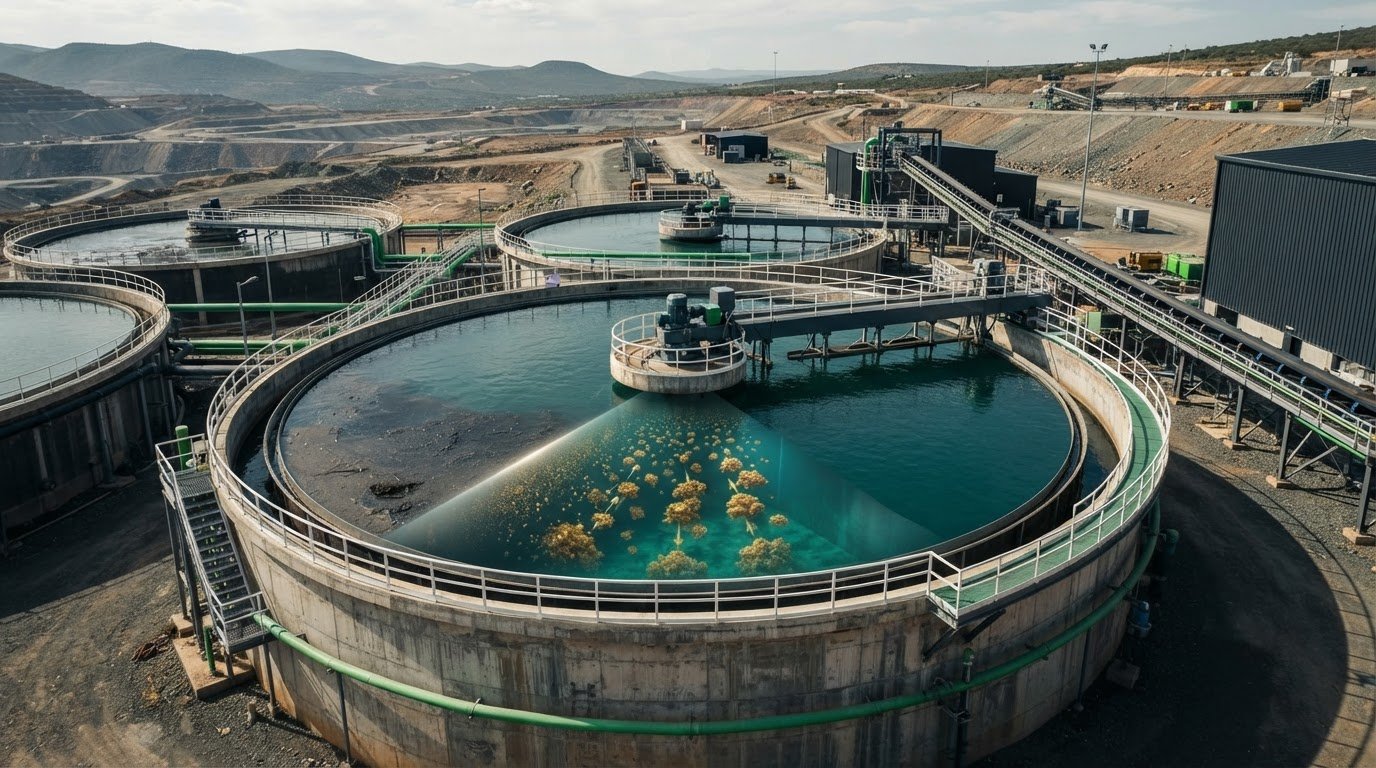
Recent data from 2023 industrial trials demonstrates that improved thickening processes can reduce fresh water intake by 30%. This efficiency depends on achieving a clear overflow. When water is free of suspended solids, it's immediately ready for reuse in flotation circuits. Ultra-fine particles often escape traditional settling methods, causing buildup in pipes. Advanced polymers capture these fines, preventing equipment wear and maintaining the delicate chemistry of the recycled water supply.
Paste and Thickened Tailings (PTT) Technology
Creating paste requires a sophisticated balance of chemistry and physics. Operators use rheology modifiers alongside flocculants to control the flow characteristics of the tailings. This ensures the material achieves the exact yield stress necessary for safe surface disposal without segregation. High-density thickeners rely on specific polymer shear resistance to maintain their molecular structure under the intense mechanical stress of the rake arms. This technical precision allows for the creation of a non-segregating mass that hardens quickly, providing a stable foundation for eventual land rehabilitation.
Operational Efficiency: Optimizing Dosing and Make-Down Systems
Precision in chemical application is the foundation of a profitable mineral processing circuit. Reagent waste represents a significant financial leak that many sites overlook. Over-dosing mining flocculants doesn't just inflate costs; it creates operational bottlenecks. High polymer concentrations increase underflow viscosity, which can lead to high rake torque and potential equipment failure. Conversely, under-dosing results in poor water recovery and high solids carryover in the overflow. This imbalance compromises the water security of the entire operation.
The point of addition within the feedwell determines the success of the flocculation process. Adding the polymer too early exposes it to high-shear zones. This physical stress shears the long polymer chains, destroying their ability to bridge particles. Adding it too late prevents adequate mixing, leaving fine particles suspended. We recommend multiple injection points to achieve uniform contact while protecting the delicate floc structure. Automated dosing systems, which respond to real-time changes in feed rate and density, typically offer an ROI within 12 to 18 months by reducing chemical consumption by 20% to 30% compared to manual monitoring.
Best Practices for Polymer Preparation
Effective preparation is non-negotiable. Powdered mining flocculants require an aging time of 60 to 90 minutes to allow the polymer chains to uncoil and reach full activity. Using water with high salinity or extreme pH for make-down can cause premature degradation, rendering the reagent useless. Common operational headaches, such as pump clogging and filter blinding, usually trace back to "fish-eyes" formed during the initial wetting stage. Proper dispersion during the primary dilution phase prevents these gelatinous lumps from forming.
Technical Audits and Laboratory Testing
Standardized cylinder settling tests and jar testing are essential for selecting the right reagent for specific ore bodies. These tests provide the baseline data needed to handle seasonal variations in mineralogy. JAS Global provides on-site technical consulting to ensure your chemical suite aligns with your production targets. By integrating performance data into digital mine twins, operators can predict how changes in the mill will impact the tailings dam. This data-driven approach ensures the "Global Food Security" and "Water Security" JAS Global champions remain at the forefront of industrial progress.
Maximize your plant yields through expert chemical management. Partner with JAS Global Industries for optimized mining solutions.
Custom Chemical Formulations: The JAS Global Approach to Mining
JAS Global Industries doesn't just sell chemicals; we engineer site-specific solutions. For 25 years, our team has developed tailored formulations for phosphate and potash mining operations across the globe. These aren't generic products. They're precise reagents designed for unique ore bodies. By optimizing the synergy between Mining Flocculants, grinding aids, and flotation collectors, we've helped partners increase recovery rates by 12% to 15% in complex mineral matrices. This integrated approach ensures that every stage of the process, from initial comminution to final tailings management, works in total harmony.
Our global logistics network delivers these high-performance reagents to critical mining hubs in Europe, Africa, and the Middle East. We understand that chemical performance depends on the environment. A formulation that works in a Nordic climate won't necessarily perform in the arid regions of North Africa. Our chemists analyze local water chemistry and mineralogy to ensure our products deliver consistent results, regardless of the geographic location. This commitment to precision turns chemical supply into a strategic advantage for our partners.
Manufacturing Relationships, Distributing Quality
The JAS Global philosophy centers on a dualistic mission: Manufacturing Relationships. Distributing Quality. We prioritize long-term technical partnerships over simple supply contracts. Our Research and Innovation (R&I) centers drive specialty chemical development, ensuring reagents meet specific geological demands. Localized support in hubs like Amman and Sfax matters for operational reliability. We provide on-site technical assistance within 24 hours to prevent downtime. This proximity allows us to monitor process changes in real-time, ensuring that our chemistry adapts as the mine face moves and ore grades fluctuate.
Strategic Reagent Management for 2026 and Beyond
Environmental regulations are tightening as we look toward 2026. Mining operations must evolve to remain compliant and profitable. We're future-proofing our clients' processes by integrating bio-based and biodegradable Mining Flocculants into their workflows. These sustainable alternatives reduce the environmental footprint of tailings ponds while maintaining high settling velocities and water clarity.
Through our "JAS Cares" commitment, we link industrial chemistry to global food and water security. We protect the resources that sustain life by ensuring mining remains a responsible pillar of modern infrastructure. Our reagents don't just process minerals; they secure the future of global supply chains.
Ready to enhance your recovery rates and sustainability profile? Contact our technical team for a process audit to begin optimizing your reagent strategy today.
Securing the Future of Mineral Processing
The evolution of mineral processing demands a shift toward precision chemistry and responsible tailings management. High-performance polymer architectures aren't just tools; they're essential for global water security and long-term operational stability. Since 1998, the industry's focus has moved from simple sedimentation to complex, tailor-made solutions that maximize throughput while minimizing environmental footprints. Efficiency in modern sites depends on advanced Mining Flocculants that perform under rigorous conditions.
JAS Global Industries leverages over 25 years of industrial chemical expertise to solve these critical challenges. With dedicated R&I centers specializing in custom formulations and a strategic presence across the Middle East, Africa, and Europe, we deliver chemical solutions designed for your specific ore body. We're the quiet giant of the industry, focused on the foundational needs of modern infrastructure. We're committed to manufacturing relationships and distributing quality at every stage of the mining lifecycle. Let's build a more sustainable and productive future together.
Optimize your mineral recovery with JAS Global’s custom flocculants
Frequently Asked Questions
What is the difference between anionic and cationic mining flocculants?
Anionic mining flocculants carry a negative charge and effectively treat metallic ores or silica. Cationic versions possess a positive charge, typically used for organic solids or specific clay types. Most mineral processing circuits operate at a pH between 7 and 11, where anionic polymers provide the best bridge formation. Choosing the wrong charge results in zero settling, while the correct choice ensures water security for the site.
How does ore mineralogy affect flocculant selection?
Ore mineralogy determines the surface potential of particles in the slurry. High concentrations of kaolinite or montmorillonite clays require specific high-molecular-weight polymers to overcome electrostatic repulsion. If a deposit transitions from 5% to 15% clay content, the settling rate often drops by 50% unless the chemical dosage is adjusted. Precise mineralogical analysis ensures the polymer matches the specific ore body characteristics and maintains process stability.
Can flocculants help in reducing the size of tailings dams?
Mining Flocculants are essential for increasing the solid concentration of tailings, which directly reduces the footprint of storage facilities. By achieving 65% to 70% solids by weight in a high-compression thickener, mines can implement paste or thickened tailings disposal. This strategy reduces the required dam volume by 30% compared to traditional slurry disposal. It's a critical step for maintaining environmental safety and long-term infrastructure stability.
What are the main causes of poor flocculant performance in thickeners?
Poor performance usually stems from mechanical shearing or incorrect dilution ratios. High-speed mixing above 400 RPM breaks the long polymer chains, reducing their ability to form large flocs. Additionally, a 1.0 pH unit shift can neutralize the polymer's charge, causing a 40% decrease in settling velocity. Operators must maintain a primary dilution of 0.1% to 0.5% to ensure the molecules fully uncoil and interact with the mineral particles effectively.
How long do powder flocculants need to age before dosing?
Powder polymers require 45 to 90 minutes of aging time to reach maximum effectiveness. During this period, the tightly coiled molecules hydrate and expand into long chains capable of particle bridging. Using a solution before it's fully aged can increase consumption by 25% because the polymer isn't fully active. Proper aging tanks ensure the solution reaches a consistent 0.1% concentration, which is vital for maintaining process efficiency and global quality standards.
Are there environmentally friendly flocculants available for mining?
Industry leaders now offer bio-based polymers derived from starch, cellulose, or tannins. These sustainable alternatives can achieve 90% biodegradability within 28 days, significantly reducing the environmental footprint of tailings. While traditional polyacrylamides remain common, these green solutions provide a path toward better water security. They're particularly effective in sensitive ecosystems where chemical runoff must be strictly managed to protect local biodiversity and meet regulatory requirements.
How does water salinity impact polymer dissolution and effectiveness?
High water salinity, such as seawater at 35,000 ppm, suppresses the electrostatic repulsion within the polymer chain. This causes the molecule to coil, which reduces its effective length and bridging capability. In high-salinity environments, mines often require 20% to 50% more polymer to achieve standard settling rates. Selecting salt-tolerant Mining Flocculants is necessary to maintain performance when using recycled or brackish water sources in the mineral processing circuit.
What is the typical dosage rate for flocculants in mineral processing?
Typical dosage rates range from 10 to 100 grams per tonne of dry solids processed. The exact requirement depends on the particle size distribution, as fines under 20 microns demand higher chemical interaction. In a standard gold or copper circuit, a dosage of 20 to 40 grams per tonne is often sufficient for clear overflow. Monitoring these levels ensures cost-effective operations while supporting the brand's mission of distributing quality through precise industrial chemistry.