
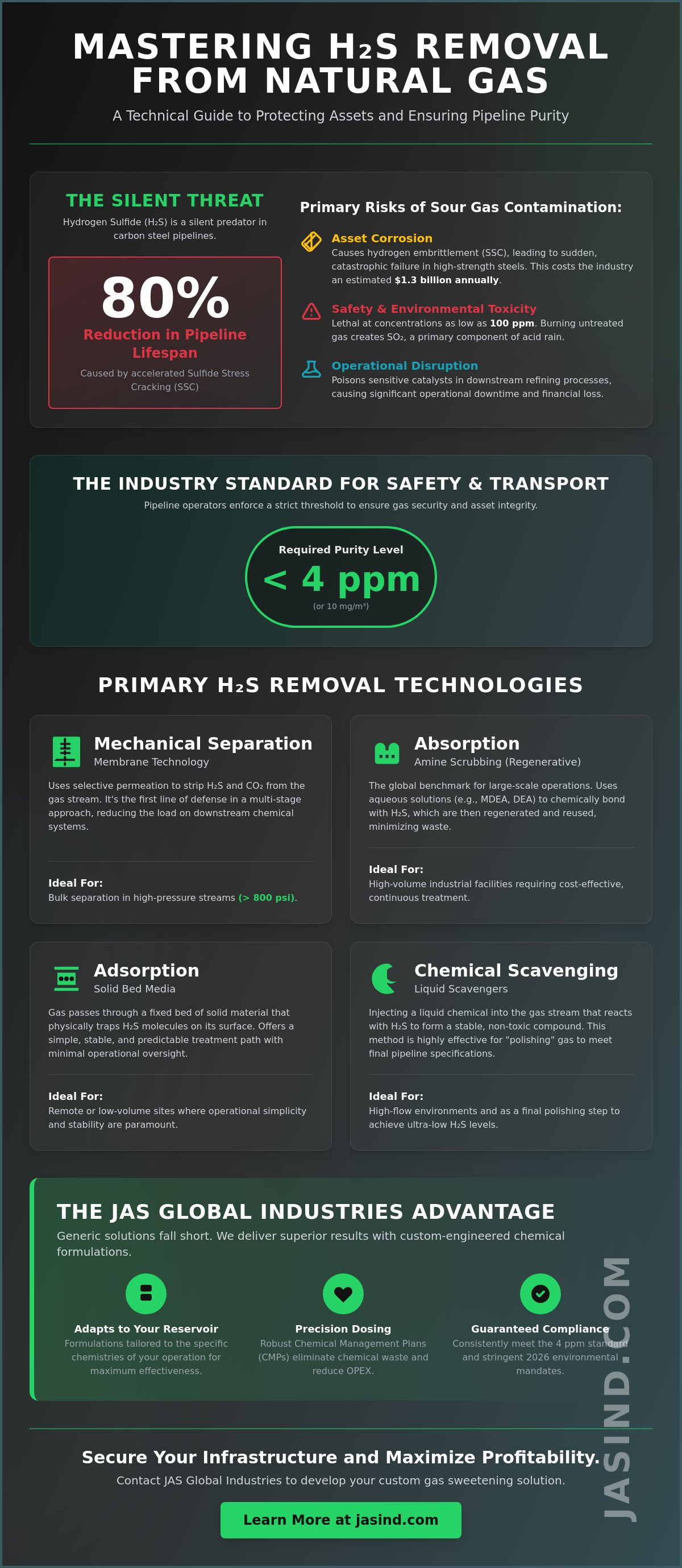
Hydrogen sulfide is not just a contaminant; it's a silent predator that can reduce the structural lifespan of a carbon steel pipeline by up to 80 percent through accelerated sulfide stress cracking. For operators, this chemical threat represents more than just a safety hazard. It's a direct drain on profitability and a constant risk to infrastructure security. Mastering h2s removal from natural gas is essential because you likely recognize the frustration of watching commodity scavengers consume your OPEX while struggling to keep pace with fluctuating gas streams.
This technical guide provides the clarity you need to navigate the choice between traditional chemistry and advanced mechanical solutions. We promise to provide the data-driven insights necessary to optimize your gas purity, ensuring you consistently meet the 4 ppm pipeline standard while protecting your long-term asset integrity. We'll examine the performance metrics of liquid scavengers versus solid bed media and mechanical separation to help you reduce chemical waste and secure the infrastructure that supports global energy security.
Key Takeaways
- Understand the critical risks of sour gas and why effective mitigation is essential for protecting global energy infrastructure and ensuring long-term asset integrity.
- Evaluate the efficiency of multi-stage approaches to h2s removal from natural gas, balancing bulk separation techniques with high-precision polishing for maximum purity.
- Determine the most cost-effective treatment path by analyzing the break-even point between chemical scavengers and regenerative systems based on daily sulfur tonnage.
- Learn to implement a robust Chemicals Management Plan (CMP) and precision dosing strategies to eliminate chemical waste while maintaining strict regulatory compliance.
- Discover how custom-engineered chemical formulations provide superior results over generic options by adapting to the specific reservoir chemistries of your operation.
Understanding Hydrogen Sulfide (H2S) in Natural Gas: Risks and Requirements
Hydrogen sulfide (H2S) represents a critical challenge for the global energy sector. This colorless, flammable gas occurs naturally in underground reservoirs, creating what the industry defines as "sour gas." Protecting global energy security requires the immediate identification and removal of this contaminant. Without effective h2s removal from natural gas, the stability of our heating, power, and manufacturing infrastructure remains at risk. It's not just a technical hurdle; it's a matter of maintaining the foundational resources that modern society relies on every day.
H2S forms through the thermal decomposition of organic matter or the action of sulfate-reducing bacteria in deep geological formations. Its presence is a primary concern for "Gas Security," as it threatens the reliability of the entire supply chain. The primary risks involve:
- Asset Corrosion: H2S causes Sulfide Stress Cracking (SSC), a form of hydrogen embrittlement that leads to sudden, catastrophic failure in high-strength steels.
- Catalyst Poisoning: Downstream refining and petrochemical processes use sensitive catalysts that H2S can deactivate, leading to massive operational downtime.
- Environmental Toxicity: The gas is lethal at low concentrations and creates acid rain when burned without treatment.
Most pipeline operators enforce strict regulatory thresholds to ensure safe transport. These specifications typically require concentrations below 4 ppm or 10 mg/m3. To meet these rigorous standards, many facilities rely on Amine gas treating technologies and specialized chemical scavengers that neutralize the sulfur components effectively.
The Economic Impact of Sour Gas
Corrosion costs the global oil and gas industry an estimated $1.3 billion annually in maintenance and replacement expenses. Sour gas streams carry a lower market value because they require extensive processing before they reach the consumer. Producers with high-sulfur reservoirs face significant price discounts or total exclusion from regional pipelines. Safety remains the highest priority; exposure to H2S at 100 ppm is immediately dangerous to life and health, making leak prevention a financial and ethical necessity.
Environmental and Safety Mandates in 2026
As we approach 2026, global standards for sulfur emissions have become increasingly stringent. Regulatory bodies now demand near-zero flaring of untreated sour gas to prevent sulfur dioxide (SO2) release into the atmosphere. Worker safety protocols have evolved to include mandatory real-time monitoring and advanced respiratory protection in areas with lethal H2S potential. Specialty chemical additives play a vital role here. They provide a sustainable path to meeting environmental mandates while preserving the integrity of the global energy supply chain and protecting the people who operate it.
Primary Technologies for H2S Removal: From Bulk Separation to Polishing
Effective h2s removal from natural gas requires a strategic division of labor within the processing plant. Operators typically categorize treatment methods into three pillars: absorption, adsorption, and chemical scavenging. Most industrial facilities adopt a multi-stage configuration to maximize efficiency and protect downstream infrastructure. They utilize bulk separation to handle high-volume acid gas concentrations and follow with polishing stages to reach strict pipeline specifications, which often mandate levels below 4 ppm.
Membrane technology serves as a critical mechanical solution for bulk separation in high-pressure gas streams, particularly those exceeding 800 psi. These systems use selective permeation to strip away CO2 and H2S before the gas enters chemical treatment units. This reduces the chemical load on secondary systems. The choice between solid-bed and liquid-phase treatments depends entirely on the daily sulfur load. Liquid scavengers dominate high-flow environments. Solid beds offer stability for remote or low-volume sites.
Absorption and Regenerative Systems
Amine scrubbing remains the global benchmark for large-scale industrial operations. This process utilizes aqueous solutions of alkanolamines, such as MDEA or DEA, to chemically bond with H2S in an absorber column. It achieves removal efficiencies exceeding 99%. For facilities producing over 20 tons of sulfur daily, the Claus Process is the standard. This sequence converts toxic gas into stable elemental sulfur for industrial use. While these regenerative plants require significant CAPEX and high energy for solvent boiling, they provide the reliable foundation necessary for global energy security.
Adsorption and Solid-Bed Scavengers
Solid-bed media provide a reliable solution for polishing or treating streams with lower sulfur concentrations. Iron Sponge technology utilizes hydrated iron oxide on wood chips to create a chemical reaction that yields iron sulfide. Modern metal oxide beds offer higher capacity and smaller physical footprints. These systems are most cost-effective when sulfur loads stay below 200 pounds per day. Operators must monitor replacement cycles closely to prevent breakthrough. Spent media presents sustainability challenges. It is often pyrophoric and requires specialized handling to ensure environmental safety. Selecting high-quality chemical additives is essential for maintaining infrastructure integrity and sustainable gas processing.
The transition from bulk removal to fine polishing ensures that gas meets safety standards without over-engineering the solution. By balancing regenerative systems for heavy lifting and solid-bed scavengers for final purity, operators maintain a steady flow of clean energy. This dual approach safeguards equipment from corrosion and supports the long-term stability of global supply chains.
Scavengers vs. Regenerative Systems: Selecting the Optimal Treatment Path
Selecting the right technology for h2s removal from natural gas requires a rigorous analysis of sulfur loading. The industry standard break-even point typically falls between 0.1 and 0.2 metric tons of sulfur per day. When sulfur production stays below this threshold, chemical scavengers offer the most efficient path. These systems require minimal infrastructure and low initial capital expenditure. They represent a flexible solution for operators focusing on speed and agility.
Regenerative systems, such as amine plants, become viable for high-capacity operations. They provide a sustainable, long-term solution for massive gas streams. Scavengers remain the superior choice for fluctuating gas volumes or remote wells where operational flexibility is paramount. Total Cost of Ownership (TCO) calculations must balance the low CAPEX of scavenger hardware against the recurring OPEX of chemical replenishment. This financial modeling ensures the long-term viability of the energy infrastructure.
Triazine and Non-Triazine Liquid Scavengers
Liquid scavengers neutralize H2S through direct chemical contact. Triazine-based solutions represent roughly 80 percent of the current market. These molecules react with H2S to form water-soluble dithiazine. However, triazine applications often face scaling challenges. High pH levels can trigger calcium carbonate precipitation. This mineral buildup restricts flow and damages equipment, leading to increased maintenance cycles.
Non-triazine alternatives serve as critical tools for high-temperature or high-CO2 environments. These formulations, often utilizing glyoxal or hemiformals, avoid the byproduct solids associated with traditional triazine. They ensure operational security in environments where mineral scaling would otherwise lead to costly downtime. Choosing the correct chemistry is a matter of protecting the integrity of the entire production chain.
Decision Matrix for Process Engineers
Engineers must weigh three primary factors to ensure infrastructure reliability and performance. These criteria move beyond simple chemistry to address the holistic needs of the site.
- Criteria 1: Gas flow and H2S concentration. High-volume streams with concentrations exceeding 500 ppm often justify the shift toward regenerative hardware to control long-term chemical costs.
- Criteria 2: Logistics and supply chain. In remote regions, the reliability of chemical deliveries is a primary risk factor. Regenerative systems reduce the dependence on constant chemical transport.
- Criteria 3: Downstream sensitivity. Process engineers must evaluate the risk of chemical carryover. Triazine can impact downstream refinery catalysts, making non-triazine options or mechanical separation more attractive for h2s removal from natural gas.
JAS Global Industries views these technical choices as foundational to global energy security. We provide the expertise to navigate these trade-offs. This ensures that industrial infrastructure remains both productive and sustainable for the long term. Manufacturing relationships and distributing quality allows us to support the critical needs of the global energy market.
Operational Safety and Chemical Management in H2S Treatment
Effective h2s removal from natural gas requires more than superior chemistry; it demands a rigorous Chemicals Management Plan (CMP). At JAS Global Industries, we view chemical supply as a pillar of industrial security. A well-executed CMP integrates procurement, application, and disposal into a single, high-reliability workflow. This structure prevents the 15% to 20% chemical waste commonly seen in unmonitored systems. In the Middle East, where ambient temperatures often exceed 50°C, specialty chemical storage requires climate-controlled logistics to prevent thermal degradation of active scavengers.
Precision monitoring is the foundation of operational safety. Gas plants now utilize online gas chromatography and laser-based sensors to achieve detection limits below 0.1 ppm. These real-time analytics allow operators to respond to sour gas spikes instantly. Reliability isn't just a goal; it's our standard.
Advanced Dosing Strategies
Moving from manual titration to automated dosing systems represents a significant leap in efficiency. Manual testing often results in "over-scrubbing," which wastes expensive reagents and increases the risk of chemical carryover. Automated skids adjust injection rates based on live flow data and H2S concentration. This precision protects downstream units from foaming and corrosion. Ensuring chemical compatibility across multi-stage treatment prevents the formation of insoluble salts that compromise equipment integrity.
The "JAS Cares" Approach to Safety
The "JAS Cares" initiative represents our commitment to the people and environments we serve. Safety protocols for handling hazardous gas-treatment reagents are non-negotiable. We provide comprehensive training that focuses on the specific risks of H2S release during chemical changeouts. Our teams utilize closed-loop systems to eliminate atmospheric exposure during transfer.
- Sustainable Disposal: We facilitate the reclamation or neutralized disposal of spent scavengers to minimize environmental footprints.
- Emergency Preparedness: Every site installation includes a localized response plan for containment and neutralization.
- Strategic Logistics: Our twenty-five-year history ensures that specialty chemicals arrive in peak condition, regardless of regional challenges.
We don't just supply additives; we secure your infrastructure. Our focus on sustainability and community well-being drives every technical decision we make. By optimizing every drop of chemical used in h2s removal from natural gas, we protect your bottom line and the environment simultaneously.
Custom Chemical Formulations: The JAS Global Approach to Gas Sweetening
Off-the-shelf solutions rarely address the volatility of complex natural gas streams. Standard scavengers might work for a time, but they often lead to downstream scaling or incomplete reaction kinetics. At JAS Global, we recognize that every reservoir possesses a distinct chemical fingerprint. Our R&I teams develop tailor-made formulations that adapt to specific H2S concentrations, CO2 ratios, and pressure profiles. This precision ensures high-efficiency h2s removal from natural gas while minimizing chemical waste. We don't just provide chemicals; we provide security. Our process optimization fees aren't just costs; they're investments in plant yield. Refining a reagent's dosage can reduce operational expenditure by 15% or more in high-volume facilities. We focus on the foundational needs of society, ensuring that energy production remains sustainable and reliable.
Manufacturing Relationships, Distributing Quality
We build long-term reliability through deep integration with oil and gas operators. In a 2022 project in the MENA region, JAS Global optimized a high-sulfur field where traditional scavengers were causing severe solid precipitation. This buildup threatened to shut down the entire production line. By introducing a proprietary liquid scavenger blend, we maintained pipeline specifications while eliminating downtime. We look at the plant as a whole. There's a vital synergy between H2S treatment and water treatment in integrated plants. Managing sulfur byproduct removal often impacts the efficiency of produced water systems. Our integrated approach ensures that chemical interactions don't compromise water security or environmental compliance. We treat every contract as a partnership, focusing on the long-term health of the asset.
Global Supply Chain and Local Support
Speed is essential in industrial operations. We leverage manufacturing centers in Dubai and Riyadh to ensure rapid deployment across the globe. This local presence allows our engineers to conduct on-site technical audits. These audits identify hidden inefficiencies, such as poor contactor performance or chemical over-injection. We've seen audits recover 10% of lost production capacity through simple process recalibration. It's about more than supply; it's about securing the infrastructure that powers society. Our twenty-five-year history provides the stable foundation your operations need to thrive. Optimize your gas treatment process with a JAS Global technical audit to ensure your facility operates at peak performance. We're the quiet giant of the industry, focused on results that matter.
Securing Gas Infrastructure Through Advanced Treatment
Achieving operational excellence in gas sweetening requires more than standard off-the-shelf products. It demands a strategic balance between mechanical bulk separation and targeted chemical polishing. Since 1998, JAS Global Industries has provided this precision through 25+ years of industrial chemical expertise. Effective h2s removal from natural gas isn't just a technical requirement; it's a fundamental step in ensuring the security of global energy infrastructure.
From our headquarters in Dubai, we manage a robust supply chain across the Middle East and Africa. Our global R&I centers develop tailor-made formulations that address the specific chemical profiles of your reservoir. We don't just supply additives. We manufacture relationships and distribute quality to protect your assets and the environment. Choosing the right treatment path reduces costs and enhances safety across your entire facility. This commitment to technical excellence ensures your operations remain resilient in an evolving energy landscape.
Partner with JAS Global for Advanced H2S Treatment Solutions
Your infrastructure deserves the reliability of a global visionary partner dedicated to your long-term success.
Frequently Asked Questions
What is the most cost-effective method for H2S removal from natural gas?
Liquid scavenger injection is the most cost-effective method for operations producing less than 100 kilograms of sulfur per day. This approach requires minimal capital expenditure compared to complex machinery. For larger facilities processing over 50 million standard cubic feet daily, regenerative amine units provide better long-term value. These systems recycle chemicals to reduce the total cost per pound of sulfur removed over a 20-year lifecycle.
How much H2S is safe to leave in natural gas for pipeline transport?
North American pipeline standards typically require H2S levels to be at or below 4 parts per million (ppm). This limit equals roughly 0.25 grains per 100 standard cubic feet of gas. Maintaining this threshold is vital for infrastructure security, as it prevents internal stress corrosion cracking in carbon steel pipes. These strict regulations ensure the safe delivery of energy to global markets without risking catastrophic line failures.
What is the difference between a scavenger and a regenerative system?
Scavengers are sacrificial chemicals, such as triazine, that react permanently with H2S and require replacement once they're spent. Regenerative systems use solvents like Methyl Diethanolamine (MDEA) that release the captured H2S in a stripping column so the chemical can be reused. While scavengers are ideal for remote, low-volume wells, regenerative plants are the standard for high-capacity industrial hubs where chemical recycling supports better sustainability and lower waste.
Can H2S be removed from natural gas without using chemicals?
Physical separation methods like membrane technology and molecular sieves allow for h2s removal from natural gas without liquid chemical reagents. Membranes use selective permeability to filter out H2S molecules, often achieving removal efficiencies of 95% or higher. These mechanical solutions are particularly useful in offshore environments where transporting and storing large volumes of liquid chemicals creates significant logistical challenges and safety risks.
What are the main safety hazards associated with H2S removal processes?
The primary hazards include acute respiratory toxicity at concentrations above 100 ppm and the formation of pyrophoric iron sulfides. H2S is a silent threat that deadens the sense of smell, making reliable electronic monitoring essential. Beyond the human risk, the chemical's corrosive nature can weaken pressure vessels by 15% or more over time if not managed. Safety protocols must focus on leak detection and specialized personal protective equipment.
How does CO2 concentration affect the efficiency of H2S removal?
High CO2 concentrations decrease efficiency by competing with H2S for active bonding sites in non-selective chemical solvents. If the CO2 to H2S ratio exceeds 3:1, standard amines may become overwhelmed, increasing chemical consumption by up to 30%. Engineers solve this by using selective amines that target H2S specifically. This precision ensures that the h2s removal from natural gas remains effective even when the raw gas stream contains high levels of acid gas.
What is a chemical management plan for an oil and gas facility?
A chemical management plan is a rigorous operational framework that coordinates the procurement, application, and disposal of industrial additives. It's a cornerstone of global infrastructure security that ensures every chemical used meets environmental and safety benchmarks. By integrating dosage tracking and inventory logistics, the plan prevents process interruptions. This strategic approach protects both the facility's mechanical integrity and the surrounding community's water and food security.
How often should H2S scavengers be replaced or replenished?
Scavengers must be replaced when they reach 100% saturation or when the gas outlet concentration exceeds the 4 ppm pipeline limit. In a typical batch reactor, this breakthrough might occur every 21 to 30 days, depending on the sulfur load and gas flow rate. Constant monitoring of the effluent gas ensures that the media is swapped before it becomes ineffective. Timely replenishment is critical to maintaining continuous compliance with transport regulations.