


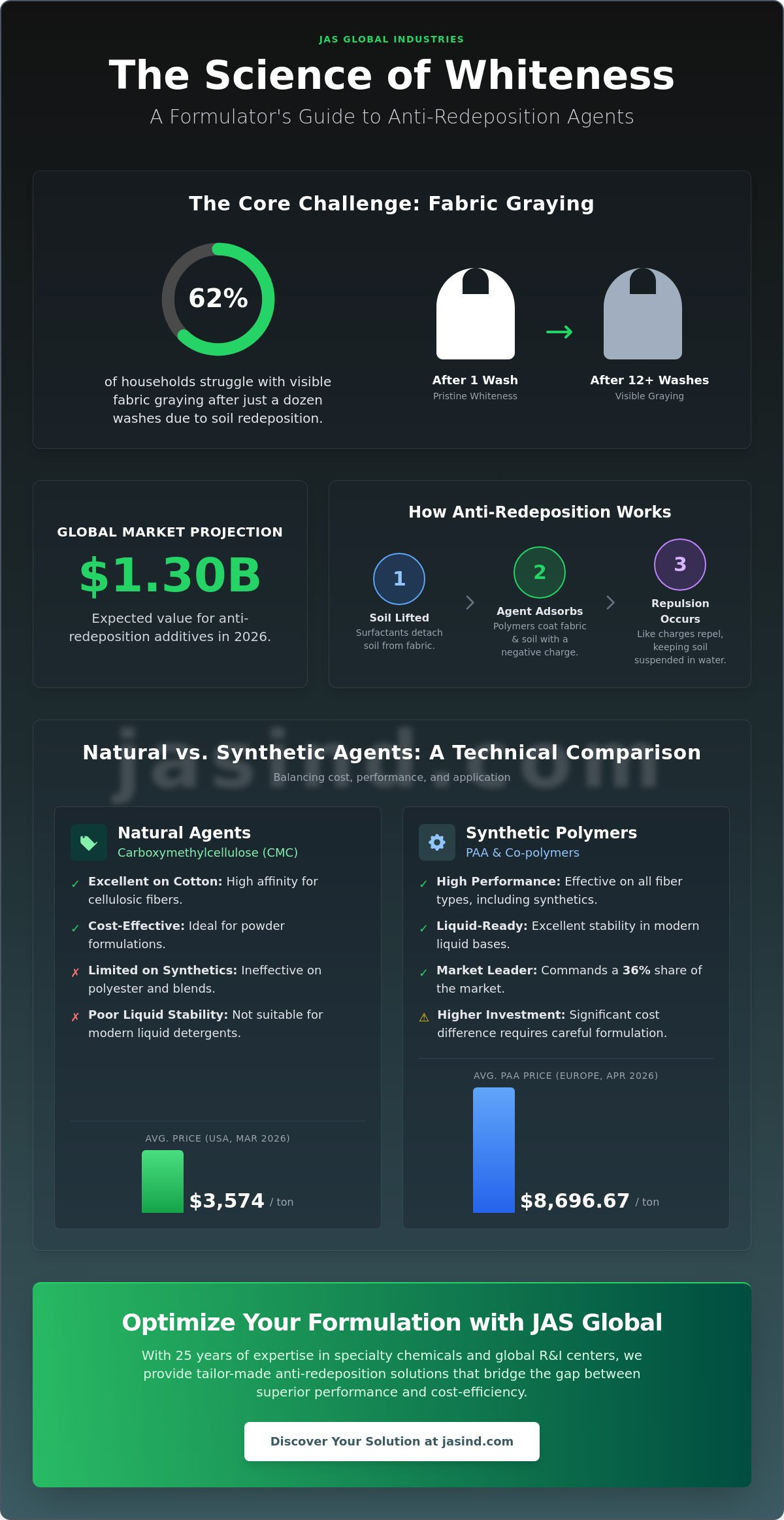
The global market for anti-redeposition additives is projected to hit USD 1.30 billion in 2026, yet 62% of the household laundry segment still struggles with visible fabric graying after just a dozen washes. You know that maintaining pristine whiteness over 20+ wash cycles is the ultimate test of a formulation's integrity. However, with Polyacrylic Acid prices averaging $8,696.67 per metric ton in Europe this April, the pressure to optimize your cost-to-performance ratio has never been higher. Choosing the correct anti-redeposition agent is now a critical factor in securing customer loyalty and industrial success.
We agree that navigating the shift toward liquid bases and stricter environmental standards requires both technical expertise and reliable supply chains. This comprehensive guide promises to help you select the precise polymers needed to bridge the gap between efficiency and superior soil-suspension. We'll explore the impact of Regulation (EU) 2026/405 published on March 2, 2026, analyze current price trends for Carboxymethyl Cellulose, and provide a roadmap for achieving unmatched formulation stability in the current market.
Key Takeaways
- Understand the fundamental role of an anti-redeposition agent in preventing soil re-attachment to maintain fabric integrity and customer satisfaction.
- Identify the technical limitations of traditional Carboxymethyl Cellulose (CMC) and when to transition to high-performance synthetic polymers for modern liquid detergent bases.
- Learn how to align polymer architecture with regional water hardness profiles to ensure consistent soil suspension across diverse global markets.
- Establish robust procurement KPIs that balance whiteness retention benchmarks with long-term formulation stability and cost-efficiency.
- Discover how JAS Global’s 25-year history in specialty chemicals provides the foundation for tailor-made solutions developed in global research and innovation centers.
What is an Anti-Redeposition Agent? Defining Quality in Detergency
At its technical core, an anti-redeposition agent is a specialty chemical additive engineered to maintain soil particles in a stable, suspended state within the wash liquor. While surfactants are responsible for the initial detachment of dirt from a surface, these agents perform the equally critical task of ensuring that once soil is removed, it doesn't re-attach to the cleaned fabric. This distinction is what separates basic cleaning from professional-grade textile maintenance. Understanding What is an Anti-Redeposition Agent? requires looking beyond the immediate wash cycle to the long-term integrity of the material.
The industrial significance of these additives is profound. In high-stakes sectors like hospitality or healthcare, maintaining the "as-new" appearance of linens over 20 or 30 cycles is a baseline requirement. Beyond aesthetics, the economic impact is a primary driver for procurement. By effectively managing soil suspension, formulators can reduce the concentration of aggressive surfactants and oxidative bleaches. This optimization protects the tensile strength of the fibers and lowers the overall chemical footprint of the detergent. With Polyacrylic Acid (PAA) prices reaching approximately $8,696.67 per metric ton in Europe during early 2026, using these agents to maximize efficiency is a strategic necessity for managing rising production costs.
The Mechanism of Soil Suspension
Detergent performance relies on complex physics at the molecular level. Anti-redeposition agents work by adsorbing onto both the fabric fibers and the suspended soil particles. This process creates a uniform negative charge across both surfaces. Because like charges repel, the resulting electrostatic repulsion keeps the soil from migrating back toward the textile. Steric hindrance acts as a secondary mechanism where long-chain polymers create a physical barrier that prevents soil particles from approaching the fiber surface. This dual-action approach ensures that even as the wash water becomes heavily laden with dirt, the fabric remains protected.
The "Graying" Phenomenon: A Formulator’s Challenge
Fabric "graying" is the visible result of cumulative soil redeposition. It's a gradual process where microscopic particles, too small to be seen after a single wash, build up over time to create a dull, dingy appearance. This phenomenon represents a significant challenge for brand reputation. While a consumer might forgive a single stubborn stain, they won't tolerate a premium detergent that allows their white garments to turn gray after five washes. Effective redeposition control is what builds long-term consumer trust. It shifts the focus from immediate detergency to total garment security. Inadequate dosing often leads to a "clean but dull" result that ultimately drives customers toward competitors who prioritize whiteness retention.
Core Chemical Categories: Natural vs. Synthetic Agents
The selection of an anti-redeposition agent depends heavily on the chemical nature of the textile and the detergent's physical format. Industrial formulators generally categorize these additives into two primary groups: natural cellulosic derivatives and synthetic polymers. While the global market is projected to reach USD 1.30 billion in 2026, the distribution between these categories is shifting. Synthetic polyacrylate or maleic copolymers are expected to command a 36.0% market share this year. This transition is driven by the rise of liquid detergents and the increasing prevalence of synthetic fibers in global textile inventories. Understanding the scientific foundations of Core Chemical Categories: Natural vs. Synthetic Agents helps procurement teams balance performance with evolving sustainability mandates like Regulation (EU) 2026/405.
Cellulosic Agents: Carboxymethylcellulose (CMC)
Carboxymethylcellulose remains a staple in powder detergent formulations due to its exceptional affinity for cotton fibers. It's a cost-effective solution, with March 2026 prices in the USA recorded at $3,574 per ton. CMC works by adsorbing onto the cellulosic surface of cotton, creating a robust barrier against soil re-attachment. However, it faces significant limitations in the modern laundry environment. It's largely ineffective on synthetic fibers like polyester and exhibits poor solubility in cold-water cycles. As the industry moves toward high-efficiency liquid formats, the traditional dominance of CMC is being challenged by its inability to remain stable in concentrated aqueous bases.
Synthetic Polymers: Polyacrylic Acid (PAA) and Beyond
Synthetic polymers, including Polyacrylic Acid and various co-polymers, offer a versatile alternative that performs across diverse fiber types. These agents are engineered to handle complex soil profiles and remain active even in hard water conditions where minerals often interfere with cleaning. Their superior performance in low-temperature washes aligns with global energy-saving trends. Unlike CMC, synthetic co-polymers maintain stability in liquid detergent formulations, preventing phase separation. To ensure your products meet these modern performance benchmarks, you can explore our specialized Home Care Co-polymer solutions designed for high-stability applications.
Sustainability is also reshaping the synthetic landscape. While synthetic polymers have traditionally been petroleum-based, recent innovations are bridging the gap. For instance, February 2026 saw the launch of 100% renewable-carbon CMC variants, signaling a broader industry move toward bio-based chemistry. Formulators must now weigh the immediate performance of high-efficiency PAA against the long-term regulatory requirements for biodegradability. This balance is essential for maintaining global market access and consumer trust in an increasingly scrutinized chemical environment.
Comparing CMC, PAA, and Co-polymers: A Technical Selection Guide
Industrial procurement requires a rigorous data-driven framework. Choosing the right anti-redeposition agent isn't just about price; it's about matching polymer chemistry to the specific soil and textile profile of your target market. While earlier sections established the broad categories, this guide focuses on the technical trade-offs between Carboxymethyl Cellulose (CMC), Polyacrylic Acid (PAA), and advanced co-polymers. According to the American Cleaning Institute's Glossary of Functional Classes, these additives must effectively counteract the attractive forces between soil and fabric to maintain textile security.
CMC remains the preferred choice for 100% cotton applications in powder formats. Its cost-effectiveness is documented, with March 2026 prices in India as low as $1,815 per ton. However, for industrial manufacturers targeting high-volume "all-fabric" detergents, PAA and co-polymers provide better value as an anti-redeposition agent. These synthetic options ensure compatibility with modern enzymes and optical brighteners. They prevent the chemical interference that can occur with natural derivatives, which often leads to reduced enzyme activity or the quenching of brightener fluorescence. For high-volume manufacturing, cost-per-wash metrics often favor co-polymers despite their higher price per metric ton. Because co-polymers are effective at lower inclusion levels, the total cost of the formulation remains competitive. This efficiency is vital in regions like China, where consumption of these additives is projected to grow at a CAGR of 5.5% through 2036.
Performance Metrics by Fabric Type
The efficiency of soil suspension varies wildly across textile substrates. CMC excels on cotton but fails to protect polyester or nylon blends. Modern consumers demand performance across mixed loads, making a multi-agent approach essential. By blending CMC with synthetic co-polymers, formulators can protect both natural and synthetic fibers simultaneously. PAA-based co-polymers offer the widest range of soil suspension. This versatility is the foundation of a reliable, high-performance brand that can survive 20+ wash cycles without visible graying.
Formulation Stability and Viscosity Control
In liquid detergent production, the physical stability of the formula is as vital as its cleaning power. Cellulosic agents like CMC often present "salting out" risks in concentrated liquid bases, leading to phase separation and customer rejection. Synthetic agents provide superior viscosity control, ensuring a clear and homogenous product at scale. For manufacturers scaling to global markets, managing the interaction between the polymer and the surfactant matrix is the primary technical hurdle. Maintaining this stability is critical for the long-term reliability of the brand and ensures the product remains a pillar of quality infrastructure.
Selection Criteria for Industrial Procurement
Procuring an anti-redeposition agent is a high-stakes decision that dictates the long-term viability of a detergent brand. It requires a strategic framework that looks beyond the laboratory to the realities of global infrastructure and environmental security. Since the publication of Regulation (EU) 2026/405 on March 2, 2026, the criteria for chemical additives have shifted toward total transparency and stricter biodegradability. Compliance isn't optional. It's a foundational pillar of modern manufacturing. With the REACH Candidate List expanding to 253 substances in February 2026, procurement teams must verify that their suppliers stay ahead of the regulatory curve. We believe in "Manufacturing Relationships" rather than just executing orders, ensuring that your supply chain is as reliable as the chemistry itself.
The Impact of Water Hardness and Ionic Strength
Calcium and magnesium ions are the primary enemies of soil suspension. These multivalent cations interact with anionic polymers, often causing them to precipitate or lose their negative charge. When an anti-redeposition agent fails to withstand high ionic strength, soil particles quickly migrate back to the fabric. This creates the dullness that consumers despise. A robust selection process must include a hard water efficacy checklist:
- Determine the average calcium carbonate levels in your target geographic region.
- Assess the sequestering capacity of the polymer to prevent ion interference.
- Conduct whiteness retention tests at varying hardness levels, specifically 150 ppm and 300 ppm.
- Verify that the polymer remains active in the presence of common water treatment scale inhibitors.
Cost Optimization without Performance Loss
Achieving the "sweet spot" in dosing is the hallmark of efficient formulation. Over-engineering a product with excessive polymer levels leads to diminishing returns and inflated costs. Conversely, under-dosing risks brand reputation. High-performance co-polymers often provide the best ROI because they allow for a reduction in total surfactant load. By optimizing the polymer-to-surfactant ratio, you can maintain superior soil suspension while lowering the overall chemical footprint. This approach is essential for navigating the rising costs of acrylic monomers, which saw price increases in North America as recently as April 23, 2026. To secure your formulation's future and optimize your cost-to-performance ratio, consult with our experts regarding our high-performance Home Care Chemicals.
Partnering with JAS Global: Tailor-Made Anti-Redeposition Solutions
JAS Global Industries has spent twenty-five years refining the specialized chemistry that supports modern hygiene and industrial infrastructure. We don't just supply a high-performance anti-redeposition agent. We provide the technical security needed to maintain textile integrity across diverse global markets. Our identity as a "Global Visionary Partner" means we prioritize the foundational needs of society, ensuring that every chemical additive contributes to long-term value. This commitment is rooted in our history of reliability and established trust, positioning us as an indispensable pillar for manufacturers who demand both quality and ethical responsibility.
Our "JAS Cares" initiative serves as the moral compass for our corporate voice. It ensures that every innovation balances peak industrial performance with the sustainable requirements of the 2026 regulatory landscape. We believe that superior soil suspension shouldn't come at the cost of environmental security. By choosing to partner with an experienced global guardian, you gain access to a supply chain that is as resilient as the polymer architectures we develop.
Custom Formulation and Technical Consulting
Our global Research and Innovation (R&I) centers specialize in developing bespoke co-polymers. We recognize that soil profiles in Riyadh differ significantly from those in Europe. We offer on-site laboratory testing and operational troubleshooting to ensure your formulation performs under specific local conditions. Technical audits conducted by our experts often lead to measurable improvements in plant yields and product consistency. Developing a tailor-made anti-redeposition agent allows you to address unique regional water hardness profiles without over-engineering your costs.
Global Reach and Reliable Logistics
Reliability is built through strategic presence and deep-rooted relationships. With operations in Dubai, Riyadh, Amman, and Europe, we ensure a seamless supply of specialty chemicals across three continents. Our volume-based procurement agreements provide the stability necessary for industrial-scale operations to thrive in a volatile market. We live by our philosophy: "Manufacturing Relationships. Distributing Quality." This dualistic approach ensures that every shipment meets our rigorous standards for excellence and supply security. Contact JAS Global Industries to optimize your home care formulations and secure your brand's technical future.
Securing the Future of Your Home Care Formulations
Achieving superior soil suspension requires a strategic alignment between chemical innovation and regional infrastructure. Selecting the right anti-redeposition agent protects your brand's reputation across 20+ wash cycles while optimizing formulation costs. With global regulations like EU 2026/405 reshaping the industry, the transition toward high-performance co-polymers is essential for maintaining market access and consumer trust. Technical stability is the foundation of global brand security.
JAS Global Industries brings twenty-five years of specialty chemical expertise, dating back to 1998, to every industrial partnership. Our global manufacturing and R&I centers across the Middle East, Africa, and Europe ensure your supply remains secure and your quality stays consistent. We provide tailor-made chemical solutions specifically designed for high-volume industrial operations. These bespoke formulations help you navigate rising material costs while delivering the pristine results your customers demand.
Request a Technical Audit for Your Home Care Formulations to enhance your plant yields and product performance today. We look forward to becoming your trusted visionary partner in sustainable innovation and global quality.
Frequently Asked Questions
What is the primary difference between a dispersant and an anti-redeposition agent?
A dispersant focuses on maintaining particle separation within the wash liquor to prevent settling or agglomeration in the bulk water. An anti-redeposition agent specifically creates an electrostatic or steric barrier between the soil and the textile fiber to prevent re-attachment. While dispersants manage the state of the dirt in the water, anti-redeposition agents secure the cleanliness of the fabric surface. Both are necessary for a high-quality formulation, but they perform distinct physical functions during the cleaning cycle.
Can CMC be used effectively in modern liquid laundry detergents?
Standard Carboxymethyl Cellulose (CMC) often lacks the solubility required for concentrated liquid formats, frequently leading to phase separation or "salting out." While specialized liquid-stable grades exist, most industrial formulators prefer synthetic co-polymers for these applications. Synthetic options maintain a homogenous liquid state even in high-surfactant environments. This ensures the product remains stable on the shelf and effective during low-temperature wash cycles.
How does water hardness affect the dosage of anti-redeposition agents?
Increased water hardness necessitates a higher dosage of anti-redeposition polymers to counteract the neutralizing effect of calcium and magnesium ions. These multivalent cations interfere with the negative charge that keeps soil suspended away from the fabric. In regions with hardness levels exceeding 200 ppm, you must select polymers with built-in sequestering capabilities. This prevents mineral-soil complexes from attaching to the textile and causing premature graying.
What are the environmental implications of using synthetic PAA polymers?
Traditional Polyacrylic Acid (PAA) polymers face increasing scrutiny due to limited biodegradability, leading to stricter standards under Regulation (EU) 2026/405 published on March 2, 2026. The industry is rapidly shifting toward bio-based alternatives and more degradable polymer backbones to align with these new mandates. These innovations ensure that detergent performance doesn't compromise global water security. Manufacturers must now balance these environmental requirements with the technical needs of modern high-efficiency washing.
How do I test the anti-redeposition efficiency of my current detergent formula?
Efficiency is measured through standardized whiteness retention tests using a spectrophotometer to track the Y-value of fabric swatches over 20 or more wash cycles. You compare the initial whiteness index to the index recorded after multiple washes in soil-laden water. A drop of less than 2 units is generally considered the benchmark for premium industrial performance. This data-driven approach removes the guesswork from formulation optimization and brand positioning.
Is it possible to combine natural and synthetic agents in one formulation?
Combining natural and synthetic agents is a standard practice for "all-fabric" detergents because it leverages the specific substrate affinities of both chemical types. CMC provides exceptional protection for 100% cotton fibers by adsorbing onto the cellulosic surface. Synthetic co-polymers extend this protection to polyester, nylon, and blended textiles. This dual-action strategy ensures consistent results across mixed laundry loads, which is a primary driver for consumer satisfaction in 2026.
What is the typical inclusion rate for anti-redeposition agents in powder detergents?
The typical inclusion rate for an anti-redeposition agent in powder detergent ranges from 0.5% to 2.0% by weight. This range provides the optimal balance between cost-per-wash and the technical requirement for soil suspension. For high-performance industrial detergents used in the hospitality sector, the rate may increase slightly to handle heavier soil loads. Formulators should test these levels against regional water profiles to avoid unnecessary over-engineering.
How does JAS Global Industries support custom chemical dosing strategies?
JAS Global Industries supports custom dosing through comprehensive technical audits and regional soil profiling conducted at our global R&I centers. We help you identify the precise polymer inclusion needed to achieve your specific whiteness retention targets without wasting raw materials. This approach minimizes chemical excess and maximizes cost-efficiency. Our twenty-five years of industrial expertise since 1998 ensures that your formulation is both technically superior and commercially viable.