

Industry data shows that up to 15% of bulk fertilizer inventory is downgraded or lost annually due to moisture-induced solidification. You've likely seen the financial impact of unsellable product and the safety risks involved when teams are forced to break down hardened piles. At JAS Global Industries, we understand that maintaining product integrity isn't just about logistics; it's a vital component of global food security. This guide details exactly how to prevent fertilizer caking in storage by mastering the science of surface tension and moisture migration.
You'll learn how to achieve zero-caking results for over six months while optimizing chemical dosing to reduce operational overhead. We'll examine the critical balance between anti-caking agents and storage environment variables. By the end of this article, you'll have a practical strategy to protect your brand reputation and deliver the flowability your customers demand. We're committed to manufacturing the relationships and distributing the quality that keeps the world's agricultural infrastructure moving.
Key Takeaways
- Understand the scientific transition from free-flowing granules to solid masses by mastering the mechanics of crystal bridging and moisture control.
- Discover effective environmental and mechanical strategies for how to prevent fertilizer caking in storage, specifically tailored for high-humidity regional climates.
- Evaluate the shift toward high-performance surfactants and anti-caking agents that fundamentally alter crystal habits to preserve product quality.
- Implement a strategic technical audit and cost-benefit analysis to balance additive dosage rates with maximum product recovery value.
- Enhance your operational standards to support global food security by ensuring vital nutrients remain free-flowing and ready for use.
Understanding the Science: Why Fertilizer Cakes in Storage
Fertilizer caking isn't just a logistics headache; it's a direct threat to the efficiency of the global agricultural supply chain. When free-flowing granules transform into solid, cohesive masses, the resulting product becomes nearly impossible to handle, blend, or apply accurately. This degradation directly impacts global food security, affecting the distribution of nutrients required to feed the 800 million people worldwide who face food insecurity. Mastering how to prevent fertilizer caking in storage starts with a deep dive into the science of caking and the physical forces at play within a storage pile.
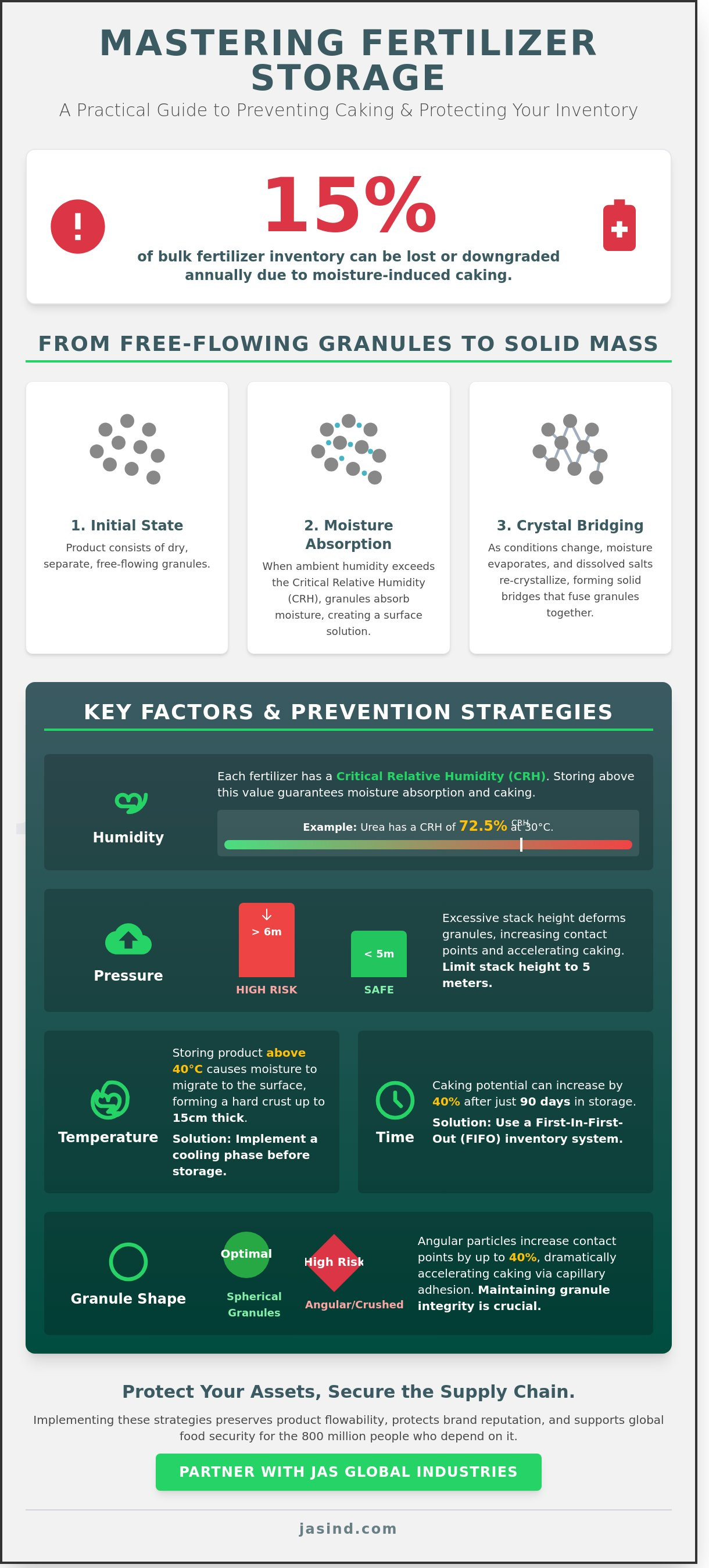
Every fertilizer grade has a specific Critical Relative Humidity (CRH). For instance, Urea has a CRH of 72.5% at 30°C. If the ambient humidity in a warehouse exceeds this threshold, the granules pull moisture from the air through a process called hygroscopicity. This absorbed water dissolves surface salts, creating a concentrated solution. When temperatures shift or humidity drops, this moisture evaporates, leading to crystal bridging. These microscopic salt bridges fuse individual particles together, turning a manageable pile into a hardened monolith. This physical change disrupts supply chain efficiency and increases operational costs for distributors and farmers alike.
The Mechanism of Capillary Adhesion
Capillary adhesion in fertilizer storage is the process where thin films of liquid between granules create surface tension forces that pull particles together. These liquid bridges form even at humidity levels below the CRH due to localized moisture absorption. The geometry of the granule determines the severity of this effect. Spherical granules are engineered to minimize contact points, whereas angular or crushed particles can increase contact point density by 40%. This increased contact area allows for more liquid bridges to form, significantly accelerating the caking process. Maintaining granule integrity is a cornerstone of protecting global nutrient security.
Chemical Migration and Salt Formation
Storage environments are rarely static. Internal chemical reactions continue long after the manufacturing process is complete. Temperature fluctuations cause salts within the granule to dissolve and re-crystallize on the surface. This is why NPK blends are more susceptible to caking than straight nitrogen fertilizers. NPK blends contain diverse salts like ammonium nitrate and potassium chloride which react to form new, secondary compounds. Research indicates that a mere 5°C shift in storage temperature can trigger enough salt migration to compromise an entire batch. These secondary crystals interlock with neighboring granules, creating a rigid structure that resists mechanical breakdown. Protecting the 185 million tonnes of fertilizer produced annually requires a sophisticated understanding of these chemical shifts to ensure that quality is distributed to every corner of the globe.
Environmental and Mechanical Controls for Bulk Storage
Storage stability isn't just a logistics concern; it's a foundation for global food security. JAS Global Industries recognizes that every ton of degraded product represents a loss in agricultural productivity. Mastering how to prevent fertilizer caking in storage requires a dual focus on atmospheric stability and physical pressure management.
The "Stack Effect" remains a primary cause of mechanical caking. When bulk piles exceed 6 meters in height, the static pressure at the base forces granules together. This pressure deforms the spheres, increasing the surface contact area and facilitating chemical bridging. Operators must limit stack heights to 5 meters or utilize tiered racking to distribute weight effectively.
Temperature management starts at the production exit point. Bagging or piling fertilizer at temperatures exceeding 40°C ensures caking. As the core of the pile cools slowly over several weeks, moisture migrates from the center to the cooler surface, creating a "crust" that can be 15 centimeters thick. Implementing a strict cooling phase before storage prevents this internal moisture cycle. In regions with extreme climates like Dubai or Alexandria, where ambient humidity regularly exceeds 85%, these internal thermal gradients are even more destructive.
Maintaining a First-In-First-Out (FIFO) inventory system is the final mechanical safeguard. Most hygroscopic blends show a 40% increase in caking potential after 90 days of storage. Rotating stock ensures that no product stays under pressure long enough to undergo permanent deformation.
Humidity and Temperature Regulation
Success depends on keeping storage conditions below the Critical Relative Humidity (CRH) of the specific blend. For many NPK fertilizers, the CRH is approximately 70% to 75%. If the warehouse air exceeds this limit, the granules will pull moisture directly from the atmosphere. High-performance facilities utilize active dehumidification to maintain a constant 50% relative humidity. Monitoring the dew point is vital; if the temperature of the warehouse walls drops below the dew point, condensation will form and drip onto the bulk piles. This localized moisture creates high-strength chemical bonds between granules.
Mechanical Handling and Pile Management
Reducing granule breakage is a critical step in how to prevent fertilizer caking in storage. Broken granules and dust provide significantly more surface area for moisture absorption and chemical reactions. Use belt conveyors instead of screw conveyors to minimize mechanical stress. Additionally, large bulk facilities must use active ventilation to prevent "heat spots." These are pockets of high temperature that form due to residual chemical reactions or microbial activity. Ensuring consistent airflow prevents the thermal spikes that lead to moisture migration. For those seeking to optimize their industrial output, choosing the right chemical additives can further reinforce granule integrity against these mechanical pressures.
Advanced Chemical Additives: The Role of Anti-caking Agents
Industrial standards have moved past basic mineral oils. High-performance formulated anti-caking agents now serve as the primary defense for global food security. These chemical solutions ensure nutrients reach the field in a free-flowing, usable state. When logistics managers ask how to prevent fertilizer caking in storage, the answer lies in surface-active agents. These surfactants alter the crystal habit of fertilizer salts. They prevent the formation of the rigid crystalline bridges that cause mass solidification during temperature fluctuations.
Chemical treatment involves two distinct strategies. Internal granulation aids improve the structural integrity of the granule during the initial manufacturing phase. External coating agents provide a final shield against ambient humidity. Combining these treatments offers a dual benefit. It prevents caking while simultaneously suppressing hazardous dust. This creates a safer environment for workers and reduces material waste by up to 15% during bulk transport. JAS Global Industries has spent 25 years refining these formulations to meet the rigorous demands of modern infrastructure.
Surface Coating Technology
Hydrophobic coatings create a microscopic moisture barrier on each granule surface. We utilize specific chemistry involving fatty amines and sulfonates to break the capillary forces that draw moisture between particles. These chemicals disrupt crystal growth at the exact points where granules touch. Achieving 100% coverage is essential for long-term stability. Most high-capacity facilities use automated spray systems within rotating coating drums. This ensures a uniform application rate, typically ranging from 0.5 to 2.0 kg per ton, which maintains product integrity for up to 12 months.
Custom Formulations for Specialized Fertilizers
A single solution doesn't fit every product. Ammonium Nitrate requires different stabilization than Urea-based blends because of its high hygroscopicity. Custom additives often incorporate coloring agents to assist with brand identification and quality perception in the marketplace. As part of the JAS Cares initiative, the industry is shifting toward sustainable and biodegradable anti-caking options. These eco-conscious formulations meet strict environmental regulations while ensuring the mechanical strength of the fertilizer remains intact. Protecting the global food supply chain requires this balance of technical performance and environmental responsibility. Manufacturing relationships and distributing quality means providing the right chemical tool for the specific environmental challenge.
Effective storage management relies on these advanced additives to mitigate the risks of "set" or "caking" in warehouses. By choosing the correct surfactant profile, producers can guarantee that their product remains easy to handle from the factory floor to the farmer's spreader. This technical precision is how to prevent fertilizer caking in storage across diverse global climates.
Selecting and Implementing the Right Anti-caking Solution
Effective strategies for how to prevent fertilizer caking in storage begin with a rigorous technical audit. JAS Global Industries has observed that 75% of caking issues originate from specific temperature fluctuations during the bagging process. A professional audit assesses these plant-specific variables before any chemical purchase occurs. This ensures the solution addresses the root cause, whether it's moisture migration or chemical heat.
A precise cost-benefit analysis is essential for long-term viability. Producers must balance additive dosage rates against the product recovery value. If an anti-caking agent prevents a 4% degradation in a 10,000-ton batch, it saves 400 tons of marketable fertilizer. High-quality additives provide a protective barrier that maintains the physical integrity of the granules. This protection is a direct contribution to global food security by reducing waste in the supply chain.
Laboratory testing remains the cornerstone of reliability. Accelerated caking tests subject samples to 2 bars of pressure for 24 hours; this simulates approximately 90 days of storage in a standard warehouse stack. These tests allow for the refinement of new formulations without risking large-scale production batches. Integration of chemical dosing into existing lines is achieved through modular spray systems. These systems allow for installation with zero downtime, maintaining continuous plant operations.
Comparison of Anti-caking Agent Types
- Oil-based coatings: These provide superior moisture barriers. They're effective for hygroscopic materials, though they require careful temperature management to prevent viscosity issues.
- Water-based coatings: These offer a sustainable alternative with lower volatile organic compound (VOC) profiles. They're increasingly popular in regions with strict environmental regulations.
- Powder-based coatings: Traditional and cost-effective. They work well for bulk blends but can create dust management challenges in the plant.
Evaluating dosage efficiency is critical. Cheaper chemicals often require 2.5 times the volume of premium alternatives to achieve the same 98% flowability retention. High-performance additives ensure nutrient availability remains unaffected, maintaining the fertilizer's guaranteed analysis for the end-user.
Dosing and Application Best Practices
Precision is mandatory for consistent results. Calibration of chemical pumps ensures the additive is applied at the exact rate of 0.5kg to 1.5kg per ton. Over-application of anti-caking agents can be as detrimental as under-application because it creates a lubricated surface that causes stack instability and sliding bags. Industrial sensor technology now allows for real-time monitoring of granule flow. These sensors detect 0.1% changes in flowability, allowing for immediate automated adjustments to the dosing rate.
Secure your product quality and operational efficiency with our specialized expertise. Manufacturing Relationships. Distributing Quality.
Ensuring Long-Term Flowability with JAS Global Industries
JAS Global Industries brings 25 years of expertise to the specialty industrial chemical sector. We don't view chemical additives as simple commodities. Instead, we see them as essential tools for Global Food Security. Our mission is to protect the vital nutrients that sustain populations across the planet. When producers investigate how to prevent fertilizer caking in storage, they quickly realize that environmental variables vary wildly between regions. A coating that works in the dry heat of Riyadh might fail in the humid ports of Lisbon or Sfax.
One-size-fits-all additives often lead to operational bottlenecks. These generic solutions fail to account for the complex chemical interactions within specific fertilizer blends or the unique atmospheric conditions of a storage facility. We solve this through tailor-made formulations. Our team prioritizes technical consulting, offering on-site laboratory testing and process optimization for every partner. This hands-on approach ensures that your product maintains its integrity from the granulator to the farmer's field.
The JAS Advantage: Innovation and Reliability
Our commitment to excellence is anchored by our Research and Innovation (R&I) centers in Dubai and Amman. These facilities allow us to develop custom chemical solutions that address the specific hygroscopic properties of your fertilizer. We don't just supply products; we build manufacturing relationships. Our global logistics network provides a steady, reliable supply to critical markets in Africa, Asia, and Europe. We operate as a "Global Visionary Partner," ensuring that your operations never stall due to supply chain inconsistencies. Our philosophy is simple: Manufacturing Relationships. Distributing Quality.
Getting Started with a Technical Audit
Effective moisture control requires precision. You can begin optimizing your production by requesting a comprehensive performance test for your specific fertilizer blend. We provide tailored samples designed to withstand your local climate and storage duration. Our regional offices in Riyadh, Lisbon, and Sfax offer localized support to ensure your technical requirements are met with speed and accuracy. Our engineers work directly with your team to refine application rates and improve cost-efficiency. It's time to secure your supply chain and eliminate the risks of product degradation. Optimize your fertilizer flowability with JAS Global Industries and ensure your product remains free-flowing until it reaches the end user.
Securing Global Food Supplies Through Industrial Flowability
Maintaining fertilizer flowability isn't just about operational efficiency; it's a cornerstone of global food security. Effective moisture management and specialized chemical coatings are the primary ways to maintain product integrity over long distances. Since 1998, JAS Global Industries has led the industry in developing these vital solutions. We operate multiple R&I centers globally to ensure our chemical additives meet the highest standards of reliability and performance. Our specialized formulations serve as essential contributors to food and water security on a global scale.
Mastering how to prevent fertilizer caking in storage requires a blend of mechanical precision and advanced chemistry. With a physical presence in the UAE, Saudi Arabia, Egypt, and Europe, we provide the localized expertise needed to protect your assets. These solutions are the result of twenty-five years of industrial leadership. We don't just manufacture chemicals; we build the foundational security your infrastructure depends on. Consult our technical experts for a custom anti-caking solution and ensure your product remains free-flowing from the factory to the field. Your commitment to quality deserves a partner who shares your vision for a sustainable future.
Frequently Asked Questions
What is the most common cause of fertilizer caking in storage?
Moisture absorption is the primary driver of fertilizer caking. When relative humidity exceeds the Critical Relative Humidity (CRH) of a specific grade, such as 72% for ammonium nitrate at 30°C, the granules absorb water. This creates a saturated solution on the surface. As temperatures fluctuate, these liquid bridges crystallize into solid bonds between particles. This process compromises global food security by making mechanical application difficult for farmers worldwide.
How do anti-caking agents actually work on a chemical level?
Anti-caking agents function by creating a hydrophobic barrier on the granule surface. These chemical additives reduce the surface tension of the liquid phase by approximately 40%, which prevents the formation of strong crystal bridges. High-quality coatings also inhibit the migration of internal moisture to the surface. By maintaining individual particle integrity, these solutions ensure efficient distribution. This technical precision is essential for maintaining reliable agricultural infrastructure.
Can caked fertilizer be reversed or reprocessed?
Caked fertilizer can often be recovered through mechanical crushing if the hardening is limited to physical pressure caking. However, if chemical caking has occurred due to severe moisture ingress, the material usually requires industrial reprocessing through a granulation plant. Statistics show that roughly 15% of improperly stored bulk fertilizer is lost to irreversible caking annually. Preventing this waste is a core mission for JAS Global Industries as we strive for global sustainability.
How much anti-caking agent is typically required per ton of fertilizer?
Industrial standards typically require between 0.5 kg and 2.0 kg of anti-caking agent per metric ton of fertilizer. The exact dosage depends on the specific chemical composition and the expected storage duration. For instance, high-nitrogen blends often require the upper limit of 2.0 kg to maintain flowability. Understanding how to prevent fertilizer caking in storage involves balancing these precise chemical ratios to ensure long-term product stability and reliability.
Does humidity affect all types of fertilizer equally?
Humidity doesn't affect all fertilizers equally because each chemical compound has a unique Critical Relative Humidity (CRH). Urea has a CRH of approximately 72.5% at 30°C, while calcium ammonium nitrate is much more sensitive with a CRH near 55%. When two fertilizers are blended, the resulting CRH is often lower than either component alone. This makes precise moisture control a vital factor in maintaining global food security through stable nutrient supplies.
Are anti-caking chemicals safe for the environment and soil health?
Professional anti-caking chemicals are designed to be environmentally neutral and safe for soil health. Modern formulations utilize biodegradable fatty acids and inert minerals that don't interfere with nutrient uptake or microbial activity. Regulatory frameworks like the EU REACH standards ensure these additives meet strict safety profiles. JAS Global Industries prioritizes these sustainable solutions to protect the ecosystems we serve while manufacturing relationships and distributing quality products globally.
What is the shelf life of fertilizer treated with professional anti-caking agents?
Fertilizer treated with professional-grade anti-caking agents typically maintains a shelf life of 6 to 12 months in standard warehouse conditions. Without these treatments, many high-analysis fertilizers would begin to degrade and cake within 30 days of production. By extending this window, we help stabilize the global supply chain. Reliable storage ensures that essential nutrients are available exactly when the planting cycle demands them, reinforcing our commitment to global security.
How can I test the effectiveness of an anti-caking agent before bulk purchase?
You can evaluate effectiveness through an accelerated caking test, which subjects samples to 2 bars of pressure for 24 hours at 35°C. This simulates months of warehouse stacking in a controlled laboratory environment. Another common method is the Small Bag Test, where treated samples are monitored in high-humidity chambers. These rigorous protocols show how to prevent fertilizer caking in storage by identifying the most compatible chemical additive for your specific grade.