

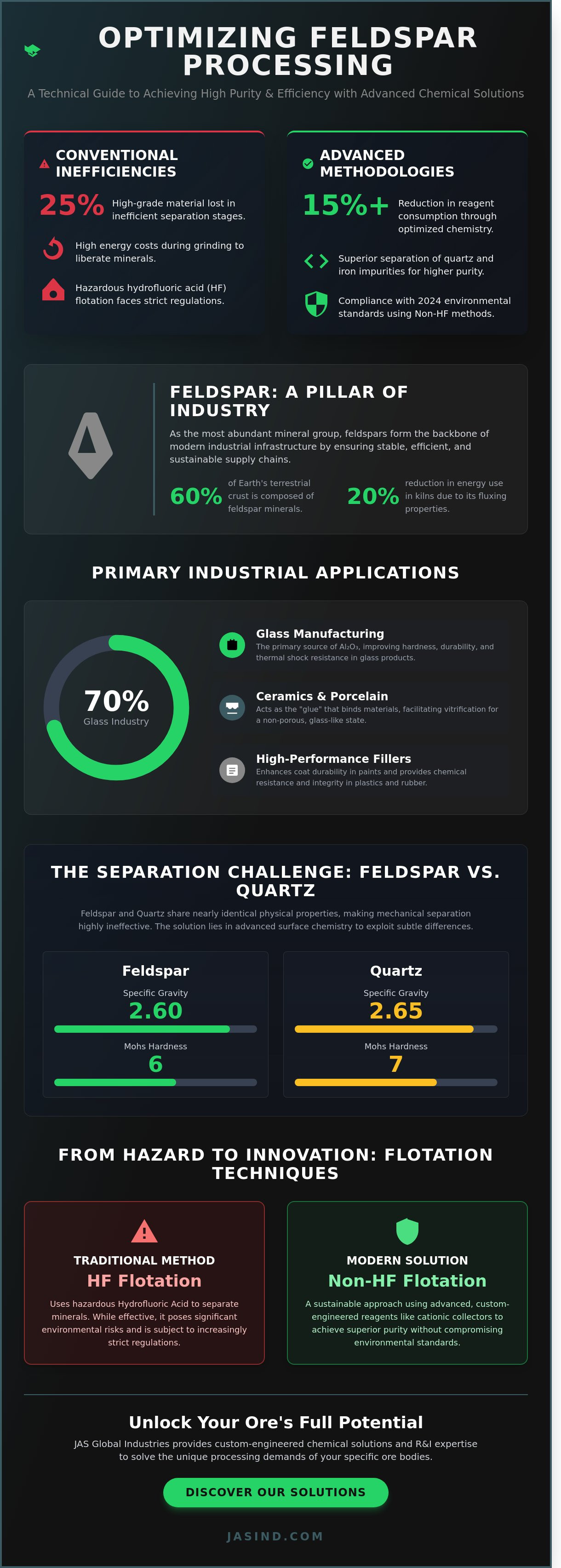
Conventional feldspar processing methods often lose up to 25% of high-grade material during inefficient separation stages. You understand that achieving the purity required for premium glass and ceramics is becoming increasingly difficult as global ore grades decline. Balancing high energy costs during grinding with the strict environmental regulations surrounding hydrofluoric acid flotation feels like a constant battle for operational efficiency. It's a challenge that requires more than just standard equipment; it demands a strategic shift in chemical application and process design.
This technical guide explores how advanced chemical reagents and non-HF flotation techniques optimize the recovery of the feldspar mineral while cutting reagent consumption by 15% or more. We're committed to providing the technical expertise needed to navigate these complexities. You'll learn how to achieve superior separation of quartz and iron impurities while maintaining compliance with 2024 environmental standards. We'll examine the technical shift toward sustainable, high-purity processing that ensures both industrial excellence and long-term environmental security. By refining these complex separation processes, we secure the foundational materials that build our modern infrastructure and support global industrial stability.
Key Takeaways
- Understand why this tectosilicate group is a critical fluxing agent for reducing melting temperatures in high-performance glass and ceramic manufacturing.
- Identify the mineralogical barriers, such as quartz and iron-bearing gangue, that make mechanical separation of feldspar mineral a significant technical challenge.
- Contrast traditional HF acid methods with modern, sustainable flotation techniques to achieve superior industrial purity without compromising environmental standards.
- Master the chemistry of reagent selection, including the strategic use of cationic collectors to optimize recovery yields within the flotation cell.
- Discover how custom-engineered chemical solutions and R&I expertise can solve the unique processing demands of specific ore bodies.
What is Feldspar Mineral and Why is it Industrially Essential?
The Feldspar mineral group represents the most abundant mineral family on Earth, comprising approximately 60% of the terrestrial crust. These rock-forming tectosilicates aren't just geological curiosities. They're the backbone of modern industrial infrastructure. At JAS Global Industries, we view these minerals through the lens of Global Infrastructure Security. Reliable access to high-quality feldspar mineral deposits ensures the stability of supply chains for everything from urban architecture to advanced glass technologies. By acting as a primary fluxing agent, feldspar reduces melting temperatures during manufacturing. This efficiency lowers energy consumption by up to 20% in some industrial kilns, making it a cornerstone of sustainable mineral supply chains.
The Chemistry of Alkali vs. Plagioclase Feldspars
The mineral family splits into two primary branches: alkali feldspars and plagioclase feldspars. Alkali varieties like K-feldspar (orthoclase) and albite (sodium-rich) are the most economically significant for high-end applications. Potassium content is a critical value driver. In the ceramics industry, K-feldspar is prized because it creates a high-viscosity melt that prevents warping during firing. Plagioclase minerals, ranging from albite to anorthite (calcium-rich), offer different benefits. Alumina content, often exceeding 18% in refined feldspar, provides essential chemical durability and thermal shock resistance in glass products.
Primary Industrial Applications: From Glass to Ceramics
The glass industry remains the largest consumer, accounting for nearly 70% of global production. It's the preferred source of Al2O3 because it lacks the high iron content found in other alumina sources. This alumina improves the hardness and chemical durability of the finished glass. In ceramics and porcelain, feldspar acts as the "glue" that binds the body together. It facilitates vitrification, the process that turns clay into a non-porous, glass-like state at temperatures between 1,200°C and 1,400°C. Beyond these traditional roles, processed feldspar mineral serves as a high-performance filler. In the paint industry, its neutral pH and low oil absorption enhance coat durability. In plastics and rubber, it provides chemical resistance and improves structural integrity. This versatility makes it an indispensable pillar of modern manufacturing.
The Mineralogical Challenges of Feldspar Processing
Processing the feldspar mineral requires a sophisticated understanding of its geological environment. Raw ore typically contains several gangue minerals including quartz, mica, and iron-bearing species like biotite and garnet. These impurities directly threaten the commercial value of the final product. Achieving high-purity feldspar is a balance of chemistry and precision. Industry leaders rely on advanced grinding aids to ensure optimal particle size distribution before the separation begins. Proper liberation of the mineral from its matrix is the first step toward global quality standards. Without precise grinding, downstream flotation becomes inefficient and costly.
Quartz-Feldspar Separation: The Core Technical Hurdle
The physical overlap between quartz and feldspar creates a significant bottleneck in traditional processing plants. Their specific gravity values are nearly identical; quartz sits at 2.65 while feldspar averages 2.60. Their hardness levels are equally similar, with quartz at 7 and feldspar at 6 on the Mohs scale. This makes physical sorting techniques ineffective for large-scale industrial operations. The Feldspar flotation process solves this by exploiting surface chemistry rather than mass. Success depends on manipulating the Point of Zero Charge (PZC), which is the specific pH value where the electrical charge on the mineral surface is neutral. By adjusting the pH around this point, collectors can selectively bind to one mineral while the other remains in the pulp.
Iron Removal and Brightness Optimisation
Iron content is the primary enemy of whiteness in industrial applications. In glass manufacturing, iron oxides absorb heat; this alters the melting characteristics and clarity of the glass melt. Even concentrations as low as 0.1% can cause discoloration in ceramic glazes. While high-intensity magnetic separators catch biotite and garnet, chemical leaching often targets the iron oxide films on grain surfaces. Downstream efficiency depends on the stability of the feldspar mineral slurry. Utilizing specialized Ceramic Deflocculants ensures that the mineral particles remain dispersed. This prevents premature settling and maintains the consistent viscosity required for premium sanitaryware and porcelain production. Maintaining this stability is essential for manufacturers who prioritize long-term reliability and product excellence.
Managing these mineralogical hurdles is not just a technical requirement; it's a commitment to resource efficiency. Every refinement step ensures that the raw material is transformed into a high-value asset for global infrastructure. Through the use of innovative chemical additives, processors can overcome natural geological limitations to deliver consistent, high-brightness results.
Advanced Flotation Techniques: HF vs. Non-HF Methods
Separating the feldspar mineral from quartz is a foundational requirement for glass and ceramic manufacturing. Historically, the industry relied on aggressive chemical environments to achieve this separation. Modern operations now choose between traditional acid circuits and sustainable, neutral alternatives. This choice impacts operational safety, environmental compliance, and long-term profitability. JAS Global Industries provides the technical expertise to guide operations through this transition, ensuring both quality and responsibility.
The Hydrofluoric Acid (HF) Circuit
The HF method functions through surface activation at a low pH, usually ranging from 2.0 to 3.0. In this acidic environment, hydrofluoric acid etches the feldspar surface. It forms fluosilicate complexes that create a negative charge, facilitating the selective adsorption of cationic collectors. While this provides high selectivity, the drawbacks are substantial. HF is a potent neurotoxin that poses severe risks to personnel. Handling requires specialized, expensive infrastructure to prevent catastrophic leaks. Waste treatment for fluoride ions adds significant costs to the processing plant, as these ions must be precipitated before water discharge. Data from the 2022 USGS report on Feldspar production and use highlights the scale of the industry, yet the environmental footprint of HF remains a primary concern for global visionary partners. Many facilities now face strict regulatory limits on fluoride emissions, making the traditional circuit a liability.
Sustainable Non-HF Flotation Strategies
Sustainable mining is the industry's future. JAS Global Industries champions the shift toward Non-HF flotation to protect water security and community health. We've spent twenty-five years refining chemical additives that eliminate the need for toxic acids. These modern circuits use a synergistic blend of cationic and anionic collectors. This mixed collector approach relies on specific pH modifiers and depressants to replace fluoride ions. Our "Mining Flotation Collectors" provide the selectivity needed for high-purity feldspar mineral recovery without the corrosive risks. It's a cleaner process. It's a safer process. By choosing eco-friendly reagents, mines reduce their regulatory burden and eliminate the high cost of HF waste treatment. We don't just supply chemicals; we provide the foundation for responsible resource management. Manufacturing Relationships. Distributing Quality. This is how JAS Cares for the global mining landscape, ensuring that essential minerals are processed with the highest ethical standards.
- Mixed collectors achieve 90% plus recovery rates in neutral circuits.
- Eliminating HF reduces insurance premiums and safety training costs.
- Neutral flotation preserves equipment longevity by reducing corrosion.
Optimising Reagent Selection for High-Yield Recovery
High-yield recovery of the feldspar mineral depends on chemical harmony within the flotation cell. Collectors, frothers, and modifiers must work in a synchronized loop to ensure maximum throughput. Collectors transform the mineral surface from hydrophilic to hydrophobic. Frothers provide the buoyancy for transport. Modifiers control the environment, ensuring the feldspar mineral remains the primary target while impurities stay in the tailings. This chemical balance is the foundation of a profitable mining operation.
Efficiency begins before the flotation cell. Mining Grinding Aids are vital during the initial comminution phase. They prevent over-sliming, a process where excessive fine particles coat larger grains. This coating, or "slime coating," blocks collector attachment and can reduce recovery rates by up to 15%. Proper grinding aid application reduces energy consumption by approximately 12% and maintains a consistent particle size distribution for downstream processing.
Collector Chemistry: Amines and Beyond
Cationic collectors are the primary tools for feldspar flotation. Primary amines are the industry standard because they provide superior selectivity compared to quaternary amines. While quaternary amines are less sensitive to pH fluctuations, they often lack the precision needed for high-purity glass applications. The interaction is purely electrostatic. At a pH of 2.0 to 3.0, the feldspar surface carries a negative charge, attracting the positively charged amine head.
Longer alkyl chains enhance the hydrophobic power of the collector while simultaneously decreasing its solubility in water, necessitating the use of specialized surfactants to maintain consistent distribution. Temperature sensitivity is another critical factor. In climates where process water drops below 12°C, amine solubility decreases. This often requires heated storage tanks or the use of branched-chain amines to prevent reagent crystallization and maintain a 98% recovery efficiency.
The Role of Frothers and Depressants
Creating stable bubble-mineral aggregates is a delicate science. Frothers must produce bubbles between 0.5 and 2.2 mm in diameter. If bubbles are too large, they lack the surface area to carry heavy mineral loads. If they're too small, they don't provide enough lift. The synergy between the collector and frother ensures the mineral stays attached during its journey to the surface.
- Selective Depression: Specialized mining chemicals isolate mica and iron oxides. This prevents them from contaminating the final concentrate and ensures the product meets stringent industrial standards.
- Water Security: Reducing reagent "drag-out" is a priority for sustainable operations. High-quality reagents improve the efficiency of downstream water treatment, allowing plants to recycle up to 90% of their process water.
- Bubble Stability: The froth must be strong enough to support the mineral but fragile enough to break quickly in the launder.
Reliable reagent selection protects your equipment and your bottom line. Build a more efficient circuit with advanced mining chemical solutions from JAS Global Industries.
JAS Global: Tailor-Made Solutions for the Mining Sector
JAS Global Industries operates as more than a chemical supplier. We serve as a dedicated partner in process optimization. With a 25-year legacy, we've established ourselves as a reliable pillar of modern infrastructure. We understand that the extraction of a feldspar mineral isn't an isolated industrial event. It's a critical link in a global chain that supports food security through high-quality fertilizers and water security through advanced desalination. Our philosophy, "Manufacturing Relationships. Distributing Quality," guides every long-term mining contract we manage. We don't just sign agreements; we build the foundational trust required to keep global supply chains moving.
Our Research and Innovation (R&I) centers act as the engine of our technical expertise. We don't believe in one-size-fits-all products. Instead, our scientists develop custom formulations designed for the specific mineralogy of your site. This tailored approach ensures that the reagents we provide are optimized for the unique chemical signature of your ore body. By focusing on the broader human impact of our work, we elevate mineral processing from a transactional business to a vital global service.
Technical Consulting and Process Audits
Precision is vital in mineral recovery. Our R&I centers specialize in developing custom formulations tailored to specific ore bodies. We perform on-site laboratory testing that directly improves plant yields. These audits help reduce waste by identifying the exact chemical requirements for complex feldspar mineral deposits. We design bespoke dosing strategies that handle ore variability with ease. Our service offices in the Middle East, Asia, and Europe provide the localized support necessary for global operations. This proximity allows us to respond to technical challenges in real-time, ensuring that your plant maintains peak efficiency without unnecessary downtime.
Our global footprint ensures reliability. With established offices and logistics hubs across three continents, we minimize supply chain disruptions. This stability is crucial for mining operations that run 24/7. We bring the right chemicals to the right place at the right time. Our technical consultants work alongside your team to refine processes, reduce reagent consumption, and maximize the recovery of high-grade minerals.
Integrating Sustainability in Mineral Recovery
The "JAS Cares" initiative represents our commitment to the planet. We actively work to reduce the environmental footprint of mining chemicals. A primary focus is helping our partners transition to fluorine-free processing plants. This shift protects local ecosystems without sacrificing performance. We provide the technical bridge between industrial necessity and environmental ethics. Our chemical additives are designed for maximum efficiency, which naturally leads to lower chemical usage and less waste. We believe that a sustainable mine is a more profitable and responsible mine.
Mastering the Future of Industrial Mineral Processing
Processing the feldspar mineral requires a sophisticated balance of chemical precision and mineralogical insight. Modern industrial standards demand a shift from traditional HF methods toward more sustainable, high-yield flotation techniques. Achieving these benchmarks depends on your ability to deploy precise reagent chemistry that addresses specific ore impurities. It's no longer enough to rely on off-the-shelf solutions when global demand for high-purity minerals continues to rise.
JAS Global supports this transition with over 25 years of expertise in specialty industrial chemicals. Our manufacturing plants in the UAE and Egypt ensure a reliable global supply, while our dedicated R&I centers develop custom-tailored formulations for complex mining environments. We don't just provide additives; we build the foundational chemistry that secures your operational efficiency. By integrating advanced reagents into your circuit, you ensure consistent quality and improved recovery rates across every stage of production.
Optimise Your Mineral Recovery with JAS Global Mining Reagents
Reliable processing starts with the right partner. Let's work together to unlock the full potential of your mineral assets and drive sustainable growth for your operations.
Frequently Asked Questions
What is the most common use for feldspar mineral in industry?
The glassmaking industry consumes 70% of global feldspar production. It acts as a vital fluxing agent that lowers the melting temperature of silica. This chemical reaction reduces energy consumption during the manufacturing process. Ceramics account for another 25% of total use. Producers rely on it to provide structural integrity in tiles and sanitaryware, making it a foundation for global infrastructure.
How is feldspar separated from quartz during mining?
Froth flotation is the primary method for separating feldspar mineral from quartz particles. Operators typically use a three-stage flotation circuit to ensure purity. First, they remove iron oxides; second, they float mica. Finally, they separate the feldspar from quartz using specific collectors at a pH level between 2.0 and 3.0. This precision ensures high-purity yields for demanding industrial applications.
Why is iron removal critical in feldspar processing?
Iron removal is vital because iron oxide content exceeding 0.1% causes dark spots and permanent discoloration in finished glass. High-quality glass requires iron levels below 0.05% to maintain maximum transparency. Processing plants use high-intensity magnetic separation and flotation to achieve these strict standards. Reducing impurities ensures the final material meets the rigorous quality demands of the global construction sector.
Can feldspar be processed without using hydrofluoric acid?
Modern facilities process feldspar without hydrofluoric acid by using the non-fluorine method. This technique employs a combination of sulfuric acid and specialized collectors like petroleum sulfonates. It eliminates the severe safety risks associated with fluoride ions. Over 40% of new processing plants have transitioned to this method since 2010 to improve worker safety and environmental security. It's a sustainable choice for responsible mineral processing.
What is the role of a collector in feldspar flotation?
A collector functions by making the feldspar mineral surface hydrophobic so it can attach to air bubbles. Most operations use cationic collectors, such as long-chain fatty amines, at a dosage of 400 to 600 grams per ton. These chemicals selectively bind to the mineral particles at a specific acidic pH. Once attached, the bubbles carry the mineral to the surface for collection. This chemical precision is essential for high recovery rates.
How does particle size affect feldspar recovery rates?
Optimal recovery rates occur when particle sizes remain between 100 and 400 microns. Particles larger than 500 microns are often too heavy for air bubbles to lift during the flotation process. Conversely, slimes smaller than 20 microns interfere with chemical selectivity and increase reagent consumption by 20%. Maintaining a tight size distribution through controlled grinding improves flotation efficiency by 15% in most industrial circuits.
What are the environmental impacts of feldspar mining and processing?
Environmental impacts include land disturbance and the generation of fine-grained tailings. Mining operations can consume up to 2,000 liters of water per ton of processed ore. However, closed-loop water recycling systems now recover 85% of process water in modern facilities. Responsible management of chemical reagents prevents groundwater contamination. JAS Global Industries prioritizes these sustainable practices to ensure long-term water security for local communities.
How can mining grinding aids reduce operational costs?
Grinding aids reduce operational costs by increasing throughput and decreasing energy consumption in ball mills. These chemical additives prevent particle agglomeration, which improves grinding efficiency by 12% on average. Lowering the energy required per ton directly reduces carbon emissions and utility expenses. By optimizing the comminution stage, mines extend the lifespan of their equipment. It's a strategic investment in both productivity and global resource security.