

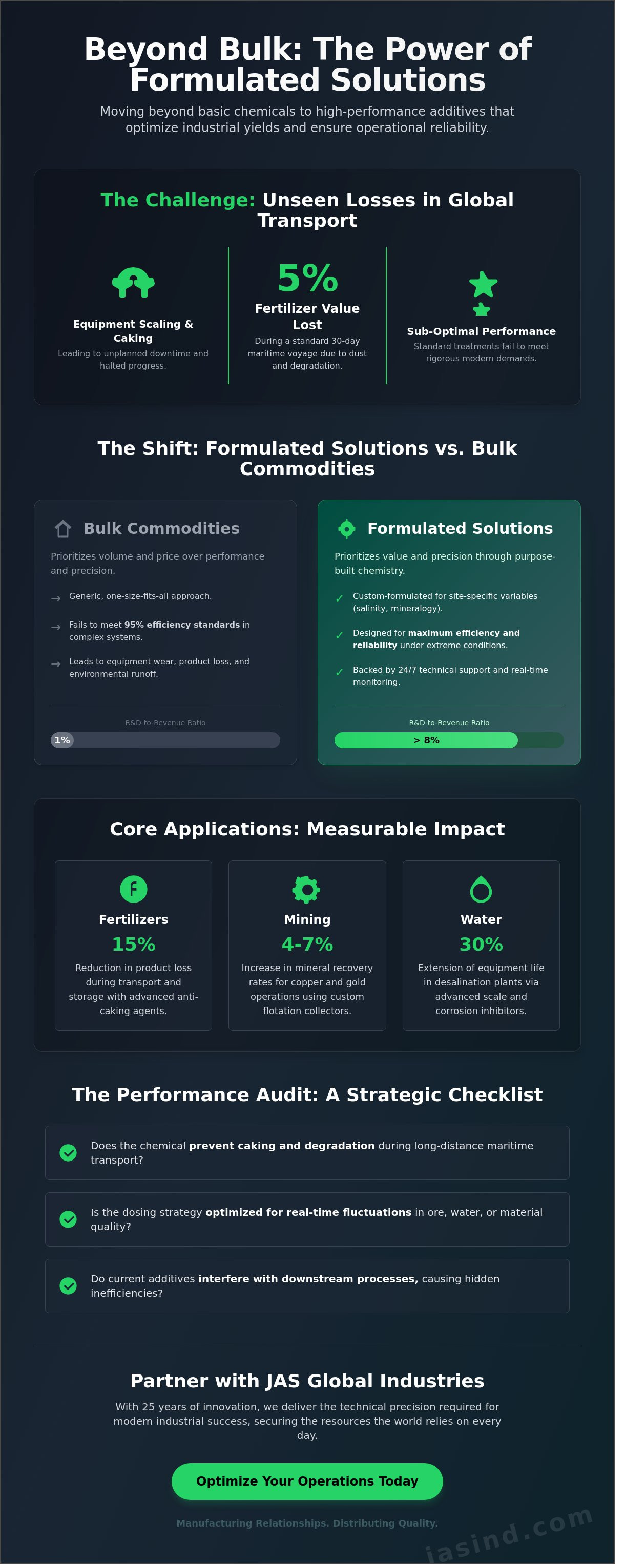
Up to 5% of total fertilizer value is lost to dust and degradation during a 30-day maritime voyage across the Atlantic. For an industry built on thin margins, these losses aren't just line items; they're direct threats to global food security. You've likely seen how generic chemical commodities fail to prevent equipment scaling or caking, leading to unplanned downtime that halts progress. It's frustrating when standard treatments don't meet the rigorous demands of your specific mineral recovery rates; that's why shifting toward custom formulated solutions is no longer optional for global leaders.
This article shows you how to move beyond basic chemicals to high-performance additives that optimize industrial yields and ensure operational reliability. By aligning your chemical strategy with global security standards, you'll protect both your infrastructure and your mission. We'll provide a strategic checklist to evaluate your current chemical performance, focusing on sustainable management, dust control, and the technical precision required for modern industrial success.
Key Takeaways
- Understand why standard reagents often fail in complex environments and how to transition toward purpose-built chemistry.
- Identify hidden operational costs like equipment wear by auditing your current chemical efficacy against industry benchmarks.
- Discover how specialized formulated solutions reduce your total cost of operation while significantly optimizing industrial yields.
- Master the best practices for site audits and pilot testing to ensure performance reliability in real-world conditions.
- Learn how 25 years of innovation and the "JAS Cares" philosophy support global infrastructure and sustainability.
Defining Formulated Solutions in Industrial Chemistry
Modern industrial operations require more than simple reagents. The transition from generic chemicals to purpose-built, multi-component Defining Formulated Solutions marks a significant shift in process engineering. In environments like high-pressure desalination plants or deep-pit mining, off-the-shelf chemicals often fail to meet the 95% efficiency standards required for modern profitability. These complex systems demand specialty additives that stabilize reactions and extend product shelf-life under extreme conditions.
Efficiency is not just a metric for profit; it is a pillar of global stability. By reducing chemical waste by 20% in fertilizer production, formulated solutions directly support global food security. They ensure that vital nutrients reach the soil rather than leaching into groundwater. This commitment to water security is a cornerstone of our mission at JAS Global Industries. We view these advanced additives as essential guardians of global infrastructure and sustainability.
Formulated Solutions vs. Bulk Commodities
Bulk commodities prioritize volume and price. Formulated solutions prioritize value and precision. A bulk reagent typically carries a 1% R&D-to-revenue ratio, while a specialty formulation often exceeds 8% in research investment. This investment pays off when site-specific variables, such as water salinity or ore mineralogy, fluctuate during a project. Technical support levels for these formulations are significantly higher, providing 24/7 monitoring and adjustment capabilities. Formulated solutions are the intersection of specialty chemistry and process engineering.
Core Applications: Mining, Fertilizers, and Water
Our focus remains on the foundational sectors that sustain society. For over twenty-five years, we've refined chemical performance in the following areas:
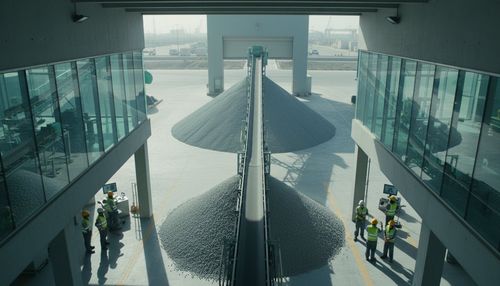
- Fertilizers: Anti-caking agents and dust suppressors prevent up to 15% of product loss during maritime transport and long-term storage.
- Mining: Custom flotation collectors and frothers increase mineral recovery rates by 4% to 7% in copper and gold operations, maximizing the output of existing mines.
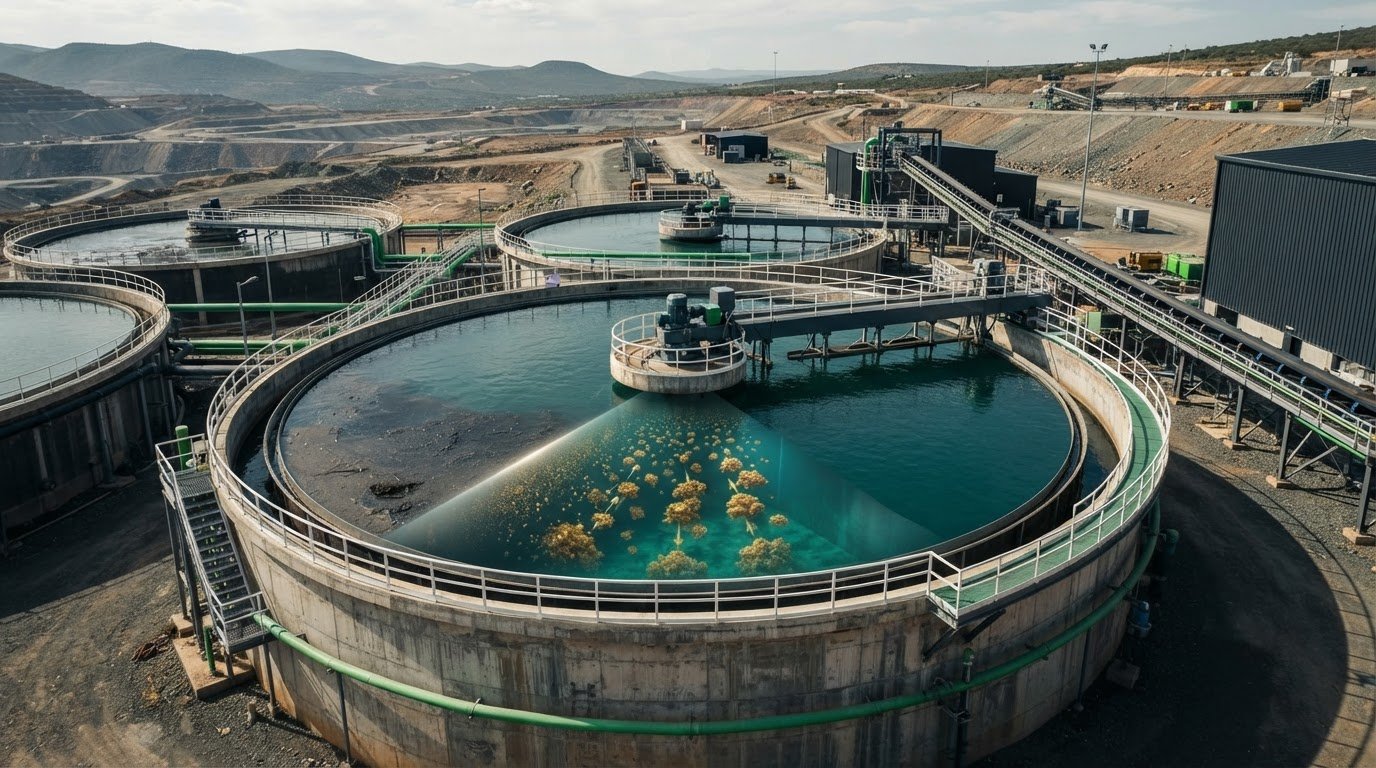
- Water: Advanced scale and corrosion inhibitors prevent membrane fouling in high-capacity desalination plants, extending equipment life by 30% and lowering energy consumption.
Manufacturing Relationships. Distributing Quality. This philosophy ensures that every chemical additive we provide serves a larger purpose. We don't just supply products; we secure the resources that the world relies on every day.
The Technical Audit: A Checklist for Chemical Performance
A rigorous technical audit transforms raw data into strategic foresight. Industrial leaders don't just buy chemicals; they secure infrastructure. Evaluating your current chemical efficacy against industry benchmarks reveals performance gaps that compromise global food and water security. High-performing formulated solutions must meet specific purity and efficacy standards. A comprehensive Technical Audit for Chemical Performance ensures that manufacturing processes align with safety and quality protocols. On-site laboratory testing identifies hidden costs like the 15% increase in equipment wear often caused by sub-optimal additives. These audits uncover why equipment fails prematurely or why product loss reaches 5% during processing. Assessing the environmental footprint is no longer optional. It's a pillar of corporate responsibility. A sustainable regime reduces chemical runoff and minimizes the carbon intensity of your supply chain.
Operational Efficiency Checklist
Efficiency relies on precision. For maritime transport, verify if your additives prevent caking during 30-day transoceanic voyages. Fluctuations in ore grade or water salinity require dosing strategies that adapt in real-time. Chemicals that disrupt later stages of production can lead to 10% product loss. Use this checklist to evaluate your formulated solutions:
- Does the chemical prevent caking during long-distance maritime transport?
- Is the dosing strategy optimized for real-time fluctuations in ore or water quality?
- Verify if current additives interfere with downstream processes.
Supply Chain and Reliability Metrics
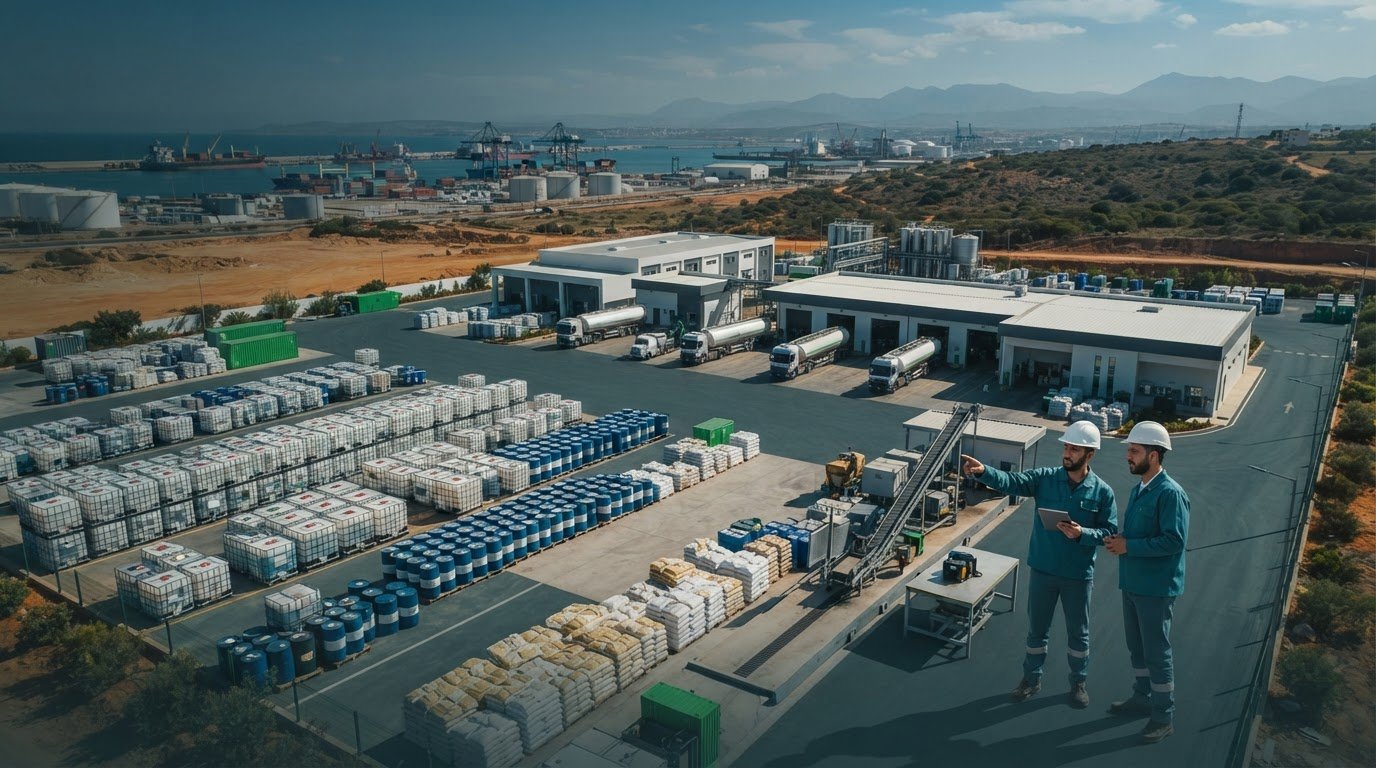
Reliability is built on presence. Evaluate whether a manufacturer maintains a global manufacturing footprint across at least three continents. Local technical support must be available within 24 hours to handle troubleshooting. Partner with entities that offer multi-regional logistics to bypass port congestion. If your current provider lacks these capabilities, it's time to consult with a global partner who prioritizes long-term security over short-term contracts. A partner with a 25-year history provides more than just chemicals; they provide a stable foundation for your growth. Choosing a partner with diverse logistics ensures your operations remain stable despite global volatility.
Customization vs. Cost: Analyzing the ROI of Formulated Solutions
Procurement strategies often focus on the price per liter. This narrow metric ignores the reality of industrial chemistry. A cheaper chemical often requires higher dosage rates, increases equipment wear, and produces inconsistent results. High-performance formulated solutions shift the focus from unit price to the total cost of operation (TCO). When a chemical is engineered for a specific ore body or climate, it performs more efficiently. This efficiency translates into direct savings that far outweigh the initial purchase price.
Calculating Total Cost of Ownership (TCO)
True TCO accounts for maintenance cycles and equipment longevity. Low-quality additives can lead to scaling, corrosion, or residue buildup, forcing unscheduled shutdowns. In fertilizer production, a specialized coating agent can reduce dust loss by 15% during transport. This keeps the product in the bag rather than on the warehouse floor. A 5% increase in chemical efficiency can lead to a double-digit increase in plant profit margins. By protecting the integrity of the final product, these solutions secure the revenue stream of the entire facility.
Innovation as a Cost-Saver
Our R&I centers focus on developing sustainable alternatives that lower energy requirements. In the mining sector, advanced grinding aids reduce the electricity needed to achieve the target particle size. The chemical performance of formulated solutions often depends on how surfactants interact with specific mineral surfaces to improve flotation recovery. A 2% increase in yield at a large-scale copper mine can represent millions of dollars in annual found value. Custom chemical dosing systems further prevent over-consumption, ensuring that every drop of chemistry serves a purpose.
Innovation also provides a shield against changing environmental regulations. Using biodegradable dispersants or low-VOC formulations prevents the heavy fines associated with non-compliance. It's a proactive approach to risk management. We prioritize "Manufacturing Relationships" over simple transactional contracts because deep integration allows us to solve problems before they impact the balance sheet. Reliability is the foundation of global food and water security. We don't just sell chemicals; we provide the stability required for modern infrastructure to thrive. Choosing a partner who understands your specific operational hurdles is the most effective way to future-proof your business.
Implementing Formulated Solutions: Implementation Best Practices
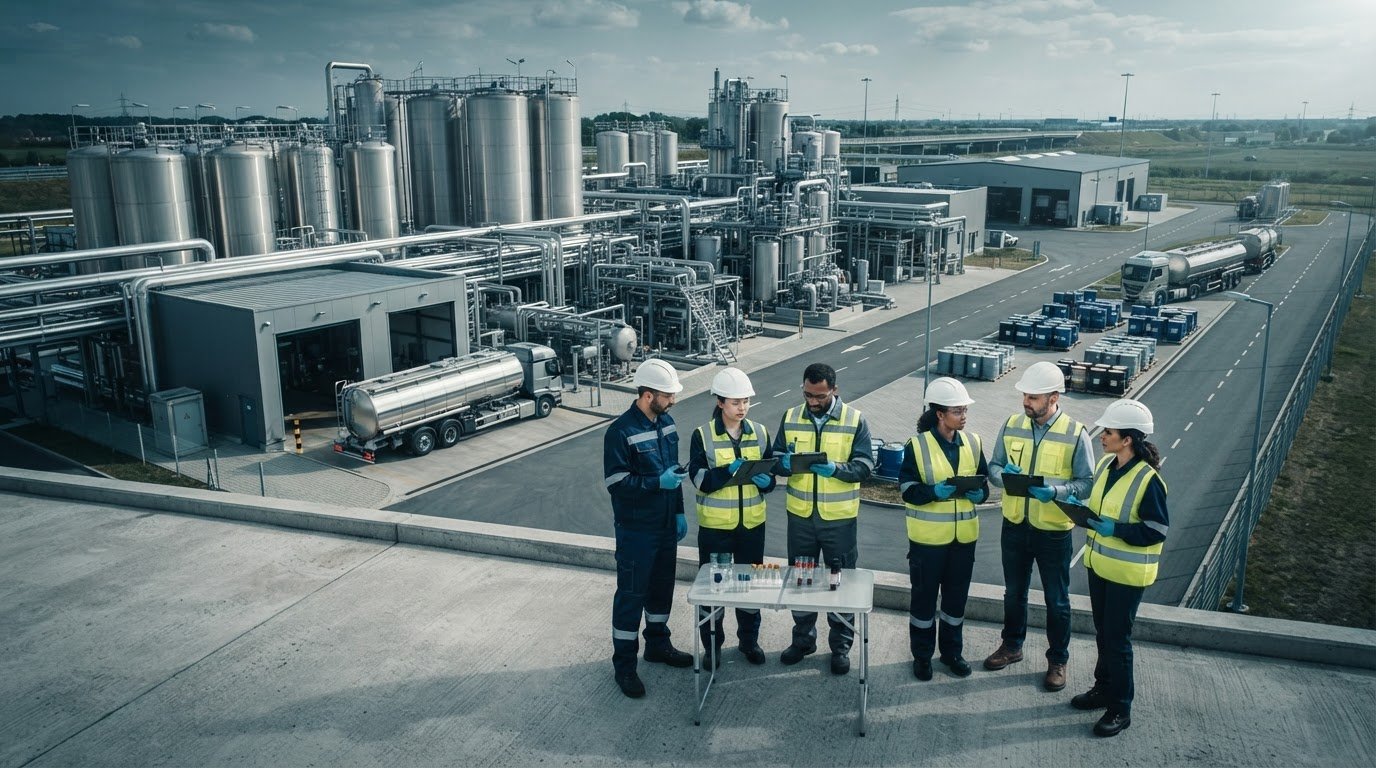
Successful chemical integration requires more than just delivery. It demands a rigorous, data-driven transition from the laboratory to the production line. Implementation starts with a 48-hour site audit and a comprehensive laboratory baseline study. This initial phase identifies 12 to 15 critical variables, such as mineral content in process water or specific atmospheric pressures, that influence chemical efficacy. Establishing these benchmarks ensures that formulated solutions are calibrated for the unique stressors of your facility.
Technical consultants then develop a custom dosing protocol. This document provides plant operators with precise instructions on injection points and flow rates. It removes guesswork. By creating a continuous improvement loop, your team can refine these protocols as seasonal conditions or raw material grades change. Reliability is built through this constant feedback between the plant floor and the technical lab.
The Pilot Testing Phase
Validation happens during the pilot-scale test. To achieve accurate results, engineers set up two parallel systems: a control group using existing chemistry and a test group using the new formulation. This side-by-side comparison eliminates external variables. During a typical 30-day trial, teams monitor key performance indicators (KPIs) such as:
- Specific energy consumption per ton of output
- Chemical residual levels in wastewater
- Product stability under accelerated aging tests
Operators provide daily feedback logs. If the formulation requires higher agitation or different temperatures, the technical team adjusts the chemistry in real-time. This iterative process ensures the final application is seamless and efficient.
Monitoring and Optimization
Modern industrial performance relies on digital integration. Connecting chemical management to the broader plant automation system allows for real-time adjustments based on sensor data. Regular technical audits, conducted every 90 days, ensure the system maintains peak performance and prevents chemical drift. This proactive stance protects long-term infrastructure and supports global water security goals.
Storage conditions are equally vital to performance. In high-humidity regions like Dubai, where relative humidity can exceed 90 percent during summer months, bulk fertilizer storage presents unique challenges. Implementing formulated solutions such as hydrophobic coatings and specialized anti-caking agents prevents product degradation. Proper ventilation and moisture-controlled silos maintain the integrity of the supply chain, ensuring that essential nutrients reach their destination in optimal condition.
Ensure your facility operates at peak efficiency with expert-led implementation. Consult with the technical experts at JAS Global Industries today.
JAS Global Industries: Your Partner in Specialized Formulated Solutions
JAS Global Industries brings 25 years of specialty chemical innovation to the global market. Our operations center on a world-class manufacturing hub in Dubai. From this strategic base, we manage a network of service offices and technical hubs spanning Europe and Asia. We don't view ourselves as a simple vendor. We're a visionary partner. Our Research and Innovation (R&I) centers create high-performance formulated solutions that address the urgent needs of food and water security. We focus on the foundational needs of society to ensure a stable, sustainable future.
The 'JAS Cares' philosophy is our moral compass. It's more than a corporate sustainability initiative; it's a commitment to global responsibility. We design our additives to improve industrial efficiency while minimizing environmental footprints. Whether it's enhancing crop yields through better fertilizer performance or securing clean water through advanced desalination, our work supports the essential pillars of modern life. We've built a reputation as a reliable guardian of critical resources, balancing technical power with ethical purpose.
Our Global Infrastructure
Efficiency requires proximity. We maintain strategic locations in Riyadh, Amman, and Lisbon to ensure rapid response times for our partners. Our vertically integrated manufacturing and distribution model provides a significant advantage. It allows us to maintain strict quality control from the raw material stage to final delivery. We support local industries by providing global-scale chemical expertise that's tailored to regional environmental conditions. This infrastructure ensures that high-quality chemical support is always within reach, regardless of the geographic challenge.
Customized Chemical Strategies
Standard chemicals often fail in complex environments. We develop tailor-made formulated solutions designed for specific industrial requirements that demand higher precision. Our team analyzes your specific site data to create products that work in the real world, not just a lab.
- Anti-caking agents: We engineer these for specific fertilizer grades to ensure product integrity during 30-day sea voyages and high-humidity storage.
- Advanced mining reagents: Our team designs these for complex mineralogies where standard collectors or frothers underperform, increasing recovery rates by measurable margins.
- Process optimization: We provide specialized additives that extend the life of industrial equipment and reduce energy consumption in high-output plants.
Precision is the key to performance. Optimize your process with a JAS Global technical audit to see how our expertise can transform your operations. We manufacture relationships and distribute quality to ensure your long-term success.
Securing Industrial Excellence Through Strategic Chemistry
Optimizing industrial output requires more than standard chemicals. It demands a rigorous technical audit and a clear understanding of how customization impacts long-term ROI. By prioritizing performance over initial cost, organizations solve complex challenges in desalination, mining, and agriculture. This strategic approach transforms chemical additives from simple commodities into vital assets for infrastructure stability.
JAS Global Industries has served global markets since 1998. We operate multiple R&I centers dedicated to custom development, ensuring every product meets exact specifications. Our work focuses on the essential pillars of Global Food Security and Water Security. We don't just supply products; we manufacture relationships and distribute quality. Selecting the right formulated solutions ensures your infrastructure remains resilient. It's about finding a partner that understands the broader human impact of industrial chemistry and the necessity of reliable supply chains. Your operational success is the foundation of global stability.
Request a technical consultation for your formulated solutions
We're ready to help you achieve new levels of performance and sustainability in your industry.
Frequently Asked Questions
What are formulated solutions in the context of industrial chemicals?
Formulated solutions are specialized chemical blends designed to address specific performance challenges in industrial processes. These aren't commodity chemicals but precision-engineered mixtures. At JAS Global, we focus on creating these to enhance food and water security. For instance, a formulation might combine surfactants and polymers to optimize a specific mineral extraction process. This tailored approach ensures that every chemical component serves a measurable purpose in the final application.
How do custom anti-caking agents improve fertilizer storage?
Custom anti-caking agents prevent the formation of crystalline bridges between fertilizer granules during storage and transport. These agents create a hydrophobic barrier that resists moisture absorption. Research shows that untreated urea can lose up to 15% of its free-flowing properties within 30 days of high-humidity storage. By applying a tailored coating, manufacturers maintain 100% product integrity. This ensures the fertilizer remains easy to apply for farmers worldwide.
Why is a technical audit necessary before switching chemical suppliers?
A technical audit identifies hidden variables in your production line that could lead to a 20% drop in efficiency if ignored. This process involves a 360-degree review of your current chemical interactions and equipment compatibility. It prevents costly downtime during the transition. JAS Global uses these audits to establish a baseline for performance. We ensure our additives integrate into your existing infrastructure without disrupting mission-critical operations.
Can formulated solutions help in meeting environmental sustainability goals?
Yes, formulated solutions drive sustainability by reducing chemical waste and lowering the carbon footprint of industrial operations. Our JAS Cares initiative focuses on biodegradable surfactants that reduce environmental toxicity by 40% compared to traditional paraffin-based products. These formulations allow companies to meet strict ISO 14001 standards. By optimizing chemical efficacy, we help partners use fewer resources to achieve the same results while protecting local ecosystems.
What industries benefit most from custom chemical formulations?
The mining, agriculture, and water treatment sectors see the most significant gains from custom chemical formulations. In the mining industry, tailored collectors can increase mineral recovery rates by 5% to 8%. Agriculture relies on these solutions to protect global food security through efficient fertilizer distribution. Water treatment plants use specialized flocculants to meet safety standards. These industries require high-precision chemicals to maintain the foundational needs of society.
How does JAS Global ensure the reliability of its chemical supply chain?
JAS Global ensures reliability through a 25 year history of strategic logistics and global distribution centers. We maintain 24/7 monitoring of our supply routes to prevent delays in critical deliveries. Our philosophy of Manufacturing Relationships means we treat supply chains as partnerships rather than transactions. This proactive management style ensures that essential additives reach desalination plants and fertilizer hubs without interruption. We prioritize security to keep your operations running steadily.
What is the difference between an anti-caking agent and a dust suppressant?
An anti-caking agent prevents granules from sticking together while a dust suppressant binds fine particles to the product surface. Anti-caking agents focus on internal moisture resistance and crystal growth inhibition. Dust suppressants target the external surface to reduce airborne particulates by up to 95% during handling. Both are vital for worker safety and product quality. Choosing the right one depends on whether your primary challenge is storage stability or air quality.
How do formulated grinding aids reduce energy consumption in mining?
Formulated grinding aids reduce energy consumption by preventing the re-agglomeration of fine particles during the milling process. This chemical intervention can lower the specific energy consumption of a ball mill by 10% to 12%. By reducing the surface energy of the minerals, the aids allow for faster throughput and finer particle sizes. This efficiency is critical for mines looking to optimize their operational costs. It directly supports more sustainable resource extraction.