
With Sherwin-Williams and PPG implementing price increases of up to 9% on paint products as of May 1, 2026, your formulation efficiency is no longer just a technical goal; it's a foundational financial necessity. You understand that inconsistent color development and pigment sedimentation don't just ruin a single batch. These failures erode your bottom line and threaten the long-term reliability of the infrastructure your products are designed to protect. Achieving a stable, high-performance finish requires more than just mixing; it requires a strategic mastery of chemical interfaces.
This guide empowers you to master the technical selection and application of Paints & Coating Dispersing Agents to ensure superior pigment stability and coating performance. We'll show you how to achieve maximum pigment loading while slashing grinding time in production, even as the global dispersing agents market grows to $9.82 billion this year. You'll gain a clear roadmap for balancing steric hindrance with manufacturing throughput. This approach helps you meet the strict new EU Ecolabel VOC standards while maintaining the long-term dispersion stability and shelf-life your clients demand.
Key Takeaways
- Understand the critical three-stage process of wetting, grinding, and stabilization to prevent pigment re-agglomeration and ensure long-term shelf stability.
- Differentiate between electrostatic and steric stabilization mechanisms to choose the most effective chemical barrier for your specific formulation environment.
- Master the technical selection of Paints & Coating Dispersing Agents to maximize pigment loading and significantly reduce mill-base viscosity during production.
- Identify the correct dispersant chemistry based on pigment polarity and system type to achieve consistent color development across every batch.
- Optimize production throughput and reduce operational costs by leveraging synergistic effects between dispersing agents and rheology modifiers.
What are Paints & Coating Dispersing Agents?
Paints & Coating Dispersing Agents are specialized chemical additives designed to stabilize pigment particles within a liquid medium by preventing re-agglomeration. Their primary function is to manage the complex interface between solid pigments and liquid resins. Without these agents, the high-energy pigments used in modern coatings would naturally cluster together, leading to poor color development and unstable formulations. At JAS Global Industries, we recognize that these additives are not merely ingredients; they are essential components that ensure the longevity and reliability of the world's industrial infrastructure.
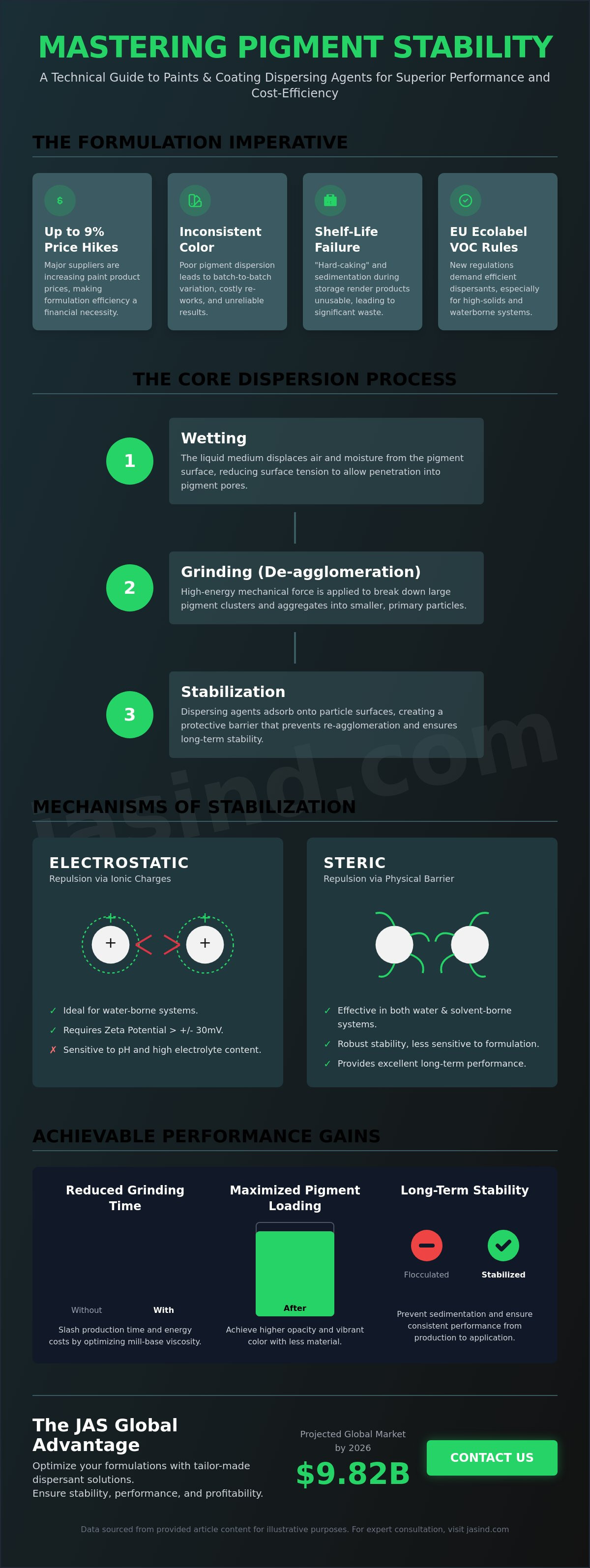
The dispersion process is a rigorous three-stage journey. It begins with wetting the pigment surface, where the liquid medium displaces air and moisture. This is followed by mechanical grinding, which uses physical force to break down large pigment clusters into primary particles. The final and most critical stage is long-term stabilization. While wetting agents focus on reducing surface tension to allow the liquid to penetrate pigment pores, dispersing agents provide the necessary particle-to-particle repulsion to stop flocculation. A high-quality Dispersant acts as the bridge between raw materials and a finished, high-performance product that meets the industry's evolving technical demands.
The Science of Pigment Stabilization
Successful formulation depends on how additives adsorb onto the pigment-liquid interface. These molecules must attach firmly to the pigment surface while extending into the liquid phase to create a protective barrier. Wetting must always precede dispersion to ensure the additive reaches every part of the pigment surface. If air remains trapped in the pigment's pores, the dispersant cannot function effectively. This process directly dictates the particle size distribution. In architectural coatings, achieving a tight distribution of sub-micron particles has been shown to improve opacity by 15% while significantly increasing gloss levels compared to poorly dispersed systems. Proper stabilization ensures that the energy spent during the grinding phase isn't lost to immediate re-aggregation.
Industrial Significance of Proper Dispersion
In a global market projected to reach $9.82 billion in 2026, the demand for stability is a operational priority. Proper dispersion prevents "hard-caking" or sedimentation during long-distance shipping and extended storage. When pigments settle into a dense, un-stirrable mass, the product becomes unusable, leading to significant waste. Color consistency is another vital factor; batch-to-batch variation often stems from inconsistent pigment separation, which causes costly re-works in both architectural and industrial sectors. New EU Ecolabel criteria, valid until 2032, also place strict limits on VOCs, making efficient Paints & Coating Dispersing Agents even more critical for high-solids waterborne systems. Dispersing agents are the chemical anchors of a stable coating system.
Mechanisms of Action: Electrostatic vs. Steric Stabilization
Stability isn't a passive state. It's a dynamic equilibrium maintained by molecular forces that counteract the natural tendency of pigments to clump together. The functional performance of dispersing agents for coatings relies on how these molecules interact with the pigment surface and the surrounding medium. Formulators typically choose between two primary mechanisms: electrostatic repulsion and steric hindrance. Each approach offers distinct advantages depending on the system's chemistry and the environmental stresses the final coating will face.
Electrostatic Stabilization in Water-Borne Systems
With waterborne coatings holding over 40% of the global market share as of 2024, electrostatic stabilization remains a cornerstone of architectural paint production. This method utilizes polyelectrolytes, such as polyacrylates or polyphosphates, to coat pigment particles with a specific ionic charge. This creates a "double layer" of ions that generates a repulsive force between particles. To ensure long-term stability, formulators monitor the Zeta potential; a value exceeding +/- 30 mV is generally required to prevent flocculation. However, this mechanism is highly sensitive to the environment. Sudden shifts in pH or the addition of high-electrolyte resins can collapse the ionic cloud, leading to rapid sedimentation and batch failure. It's a precise balance that requires constant monitoring of the system's ionic strength.
Steric Hindrance and Polymeric Dispersants
Steric stabilization is the preferred choice for solvent-borne systems and high-performance industrial coatings. It operates on the "Anchor and Tail" model. High-molecular-weight polymers feature specific anchor groups that bond firmly to the pigment surface, while long-chain "tails" extend into the solvent. When two pigment particles approach, these polymer tails overlap and compress. This compression creates an entropic force that physically pushes the particles apart. Because this barrier doesn't rely on electrical charges, it's remarkably robust against pH fluctuations and high salt concentrations. Choosing the right molecular weight is vital; if the tails are too short, they won't provide enough distance to prevent attraction. If they're too long, they can cause unwanted viscosity increases. You can explore our specialized Paints & Coating Dispersing Agents to find the exact polymeric structure for your high-solids formulations.
For the most demanding applications, electrosteric stabilization offers a hybrid solution. This approach combines ionic charges with long-chain polymers to provide a dual-layer of protection. It's particularly effective in complex tinting systems where organic and inorganic pigments must coexist without interference. By utilizing these advanced Paints & Coating Dispersing Agents, formulators can ensure their products withstand the rigors of global shipping and long-term storage, maintaining the reliability that JAS Global Industries has championed for over 25 years.
Selection Criteria: Choosing the Right Dispersing Agent
Selecting the correct additive is a high-stakes strategic calculation. It's not merely about chemical compatibility; it's about navigating a landscape of rising costs and tightening regulations. With solvent prices increasing by as much as 18% as of May 1, 2026, formulators cannot afford the trial-and-error approach of the past. Every milligram of Paints & Coating Dispersing Agents must be chosen to deliver maximum pigment efficiency and long-term stability. The selection process begins with an audit of the pigment's surface chemistry, the system's polarity, and the intended application environment.
A robust decision-making framework distinguishes between ionic and non-ionic types based on the resin system. For simple water-borne architectural paints, ionic dispersants offer a cost-effective route to stability. However, for complex industrial coatings that require high resin compatibility and resistance to water sensitivity, non-ionic or polymeric options are essential. Compatibility with other additives is equally vital. A dispersant that interferes with a silicon-based defoamer will lead to surface defects like cratering, which undermines the coating's protective integrity. Adhering to the January 17, 2027, EPA deadline for VOC emission standards also means prioritizing APEO-free and low-VOC chemistries to ensure global market access.
Conventional vs. Polymeric Dispersing Agents
Conventional surfactants are often chosen for their low cost and excellent wetting properties. They're ideal for systems where cost-per-liter is the primary driver, though they carry a risk of increasing the final film's water sensitivity. Polymeric agents represent a more sophisticated investment. These high-performance Paints & Coating Dispersing Agents provide superior stability and gloss retention through advanced steric hindrance. While the initial cost is higher, their efficiency allows for lower dosages and higher pigment loading, which often results in a better cost-to-performance ratio in premium formulations.
Pigment-Specific Requirements
Different pigments demand specialized stabilization strategies. Carbon black, for instance, presents a unique challenge due to its massive surface area and high oil absorption capacity. It requires dispersants with high-affinity anchor groups to prevent flocculation. Conversely, inorganic fillers like TiO2 or calcium carbonate can often be stabilized with simpler polyacrylate chemistries. To achieve peak performance, formulators must determine the specific dosage point where the system reaches its lowest possible viscosity. The Optimal Dispersant Concentration (ODC) is the precise amount of additive required to achieve maximum pigment stabilization and minimum mill-base viscosity for a given pigment-binder combination.
Optimizing Formulations for Performance and Cost-Efficiency
Efficiency is the primary defense against the 8% to 18% price increases implemented by major manufacturers in May 2026. Optimizing your formulation starts with reducing mill-base viscosity. By using high-performance Paints & Coating Dispersing Agents, you can increase pigment loading by up to 20% while maintaining a fluid, workable paste. This allows for fewer production batches and a direct reduction in energy consumption per unit. It's a strategic move that balances technical precision with manufacturing reality.
True cost-efficiency isn't found in the lowest price per drum. It's found in the cost-in-use analysis. Premium polymeric additives often require 50% lower dosages than conventional alternatives. They also create synergistic effects when combined with rheology modifiers. This ensures that the coating remains stable during high-shear application but recovers its structure quickly to prevent sagging. You can achieve these technical benchmarks by exploring our Paints & Coating Chemicals portfolio designed for global reliability.
Enhancing Production Throughput
Proper dispersion drastically reduces grind time in the bead mill. When pigments are quickly wetted and stabilized, the mechanical energy required to reach the desired Hegman gauge is minimized. This efficiency is critical for flocculation-free tinting. Inconsistent color development often leads to entire batches being rejected, which is an unacceptable loss in a high-cost environment. We also focus on reducing the rub-out effect. If the color changes when you rub a drying film with your finger, the dispersion is failing. High-performance Paints & Coating Dispersing Agents lock pigments in place, ensuring color uniformity across every square meter.
Environmental and Regional Considerations
Formulating for global markets requires accounting for extreme climates. In high-heat regions like Dubai, thermal stability is non-negotiable. Standard dispersants may degrade or lose their anchor strength at 50°C, leading to rapid sedimentation. Similarly, high-humidity environments across Africa and Southeast Asia demand additives that don't increase the water sensitivity of the final film. If your dispersant is too hydrophilic, the coating will blister or peel in tropical conditions.
The industry is also pivoting toward sustainability. Bio-based coatings are currently growing at a CAGR of 10.7% and are projected to reach $22.6 billion globally by 2030. Transitioning to biodegradable dispersing agents allows you to meet the strict 2026 to 2032 EU Ecolabel criteria without sacrificing performance. This commitment to sustainable quality reflects the foundational values we've maintained for twenty-five years at JAS Global Industries.
The JAS Global Advantage: Tailor-Made Dispersant Solutions
JAS Global Industries has provided specialty chemical solutions for over twenty-five years. We understand that high-performance coatings are foundational to global infrastructure. Our approach goes beyond simple supply. We offer tailored Paints & Coating Dispersing Agents that address specific formulation challenges. From our headquarters in Dubai, we manage a strategic supply chain that serves Europe, Asia, and Africa. This ensures that our partners receive consistent, high-quality additives regardless of their location. Reliability is our hallmark. We don't just sell chemicals; we provide the technical security needed to maintain production stability in an increasingly complex global market.
We focus on process optimization. Our R&I centers develop customized chemical dosing strategies that directly improve industrial plant yields. By optimizing additive consumption and reducing batch cycle times, we help formulators mitigate the impact of the raw material price volatility verified in May 2026. Our global presence allows us to stay ahead of regional regulatory shifts, ensuring that your products remain compliant with the latest environmental standards. We act as a visionary partner, helping you achieve the precise balance between technical performance and cost-efficiency.
Manufacturing Relationships, Distributing Quality
Our slogan, "Manufacturing Relationships. Distributing Quality," reflects our core business philosophy. We partner with coating manufacturers to conduct comprehensive technical audits. These audits identify inefficiencies in the grinding phase or stabilization gaps in existing formulations. Through the "JAS Cares" designation, we balance industrial performance with deep environmental responsibility. This commitment ensures that our Paints & Coating Dispersing Agents contribute to a more sustainable future. Our technical consulting services include on-site laboratory testing. This hands-on support ensures our additives integrate perfectly with your specific resin systems and pigment types.
Ready to Optimize Your Coating Formulations?
Achieving maximum pigment loading and long-term stability requires a visionary partner. Whether you're formulating for high-heat environments or transitioning to sustainable, low-VOC systems, we have the expertise to guide you. Our offices in Dubai and Riyadh are ready to provide customized technical support for your next project. It's time to secure your formulation's future with solutions that are as reliable as they are innovative. We invite you to reach out and discover how our expertise can transform your manufacturing outcomes.
Contact JAS Global Industries for a Technical Audit
Securing the Future of Your Coating Performance
Mastering the technical nuances of Paints & Coating Dispersing Agents is the difference between a failing batch and a market-leading finish. You've explored how balancing steric hindrance with manufacturing throughput ensures stability while meeting strict January 17, 2027, EPA VOC standards. By focusing on the Optimal Dispersant Concentration, you don't just improve color strength; you protect your margins against the volatility of global chemical markets. These technical adjustments are vital for maintaining a competitive edge as industry regulations tighten through 2032.
JAS Global Industries has been a pillar of industrial stability since 1998. We operate global R&I centers dedicated to solving the unique environmental challenges found in Middle East and African markets. Our expertise helps you navigate complex formulation interfaces with confidence. It's time to elevate your production standards and ensure long-term shelf stability through proven chemical mastery. We're here to help you turn technical challenges into sustainable competitive advantages that resonate on a global scale.
Request a Technical Consultation for Your Coating Formulation
Frequently Asked Questions
What is the difference between a wetting agent and a dispersing agent?
Wetting agents function by lowering the liquid's surface tension to allow it to penetrate pigment pores and displace trapped air. Dispersing agents focus on the subsequent stage of stabilization by creating repulsive forces that prevent particles from clumping together again. While wetting is a prerequisite for a successful grind, the dispersing agent is what ensures the final coating remains stable during its shelf life, which often exceeds 24 months in industrial settings.
How do I determine the correct dosage of a dispersing agent?
You determine the correct dosage by performing a "ladder study" to identify the point of minimum viscosity for your mill-base. This involves testing a range of concentrations and plotting the resulting viscosity to find the Optimal Dispersant Concentration. Typically, inorganic pigments require 1% to 10% active agent on pigment weight; however, high-surface-area organic pigments like carbon black may require 20% to 50% active agent to achieve full stabilization.
Can a dispersing agent affect the drying time of a coating?
Dispersing agents can influence drying time if they contain high-boiling-point solvents or if you use them in excessive quantities. In water-borne systems, some surfactants may hold onto water molecules, which slightly extends the open time of the film. It's critical to select Paints & Coating Dispersing Agents that are compatible with your specific resin's cross-linking mechanism to avoid interfering with the final cure speed or chemical resistance.
Why is steric stabilization preferred over electrostatic in solvent-borne systems?
Steric stabilization is preferred in solvent-borne systems because these environments have low dielectric constants, which prevents the formation of a robust electrical double layer. Electrostatic repulsion relies on ionic charges that cannot effectively migrate through non-polar solvents. Polymeric dispersants provide a physical barrier through long-chain tails that extend into the solvent. This ensures stability regardless of the system's electrical conductivity or the presence of high-molecular-weight resins.
What happens if I use too much dispersing agent in my formulation?
Using too much dispersing agent often leads to increased water sensitivity and decreased adhesion in the final coating film. Excess additive that isn't adsorbed onto the pigment surface remains free in the resin matrix, potentially causing surface defects like foaming or cratering. In some cases, overdosing can actually trigger flocculation as the unattached polymer chains bridge between different pigment particles, ruining the consistency and color strength of the batch.
Are your dispersing agents compatible with low-VOC water-borne resins?
Our Paints & Coating Dispersing Agents are specifically engineered to be compatible with modern low-VOC water-borne resins. These additives meet the updated EU Ecolabel criteria valid through 2032 by utilizing APEO-free and biodegradable chemistries. They provide the necessary stabilization for high-solids formulations without contributing to the semi-volatile organic compound levels that impact indoor air quality. We focus on ensuring your products remain compliant with global environmental regulations.
How do dispersing agents prevent pigment 'flooding and floating'?
Dispersing agents prevent flooding and floating by ensuring that different pigment types in a blend settle at the same rate during the drying process. This is achieved by creating a uniform surface charge or steric barrier around every particle, regardless of its chemical nature. When pigments are properly stabilized, they don't separate into layers or distinct islands. This maintains color uniformity and prevents the "rub-out" effect across the entire applied surface.