
With DAP prices reaching $913 per ton and urea at $864 in May 2026, every kilogram of product lost to dust or caking represents a direct blow to your operational stability. You know that inconsistent quality across batches often leads to high product loss during maritime transport and costly customer complaints. It's a challenge that demands more than just basic monitoring; it requires a deep commitment to structural integrity.
Mastering fertilizer granule hardness testing allows you to move beyond simple compliance. This guide will help you utilize this diagnostic tool to eliminate degradation, reduce fines, and optimize chemical dosing for superior results. We'll examine the technical standards of ISO 5311:2026 and ISO 3944:2026 to provide a roadmap for standardizing your QC protocols. Secure your supply chain. Protect your product. Ensure global stability.
Key Takeaways
- Learn why granule resistance to deformation serves as the primary safeguard against the caking cycle in volatile maritime environments.
- Standardize quality control using fertilizer granule hardness testing to accurately measure crushing strength across various industrial units.
- Use shatter pattern analysis as a diagnostic tool to pinpoint failures in the drying process and eliminate internal voids.
- Implement precise adjustments to liquid-to-solid ratios and drying curves to enhance particle density and reduce supply chain dust.
- Discover how advanced granulation aids and custom anti-caking agents reinforce structural integrity for long-term storage stability.
Why Fertilizer Granule Hardness Testing is Critical for Global Logistics
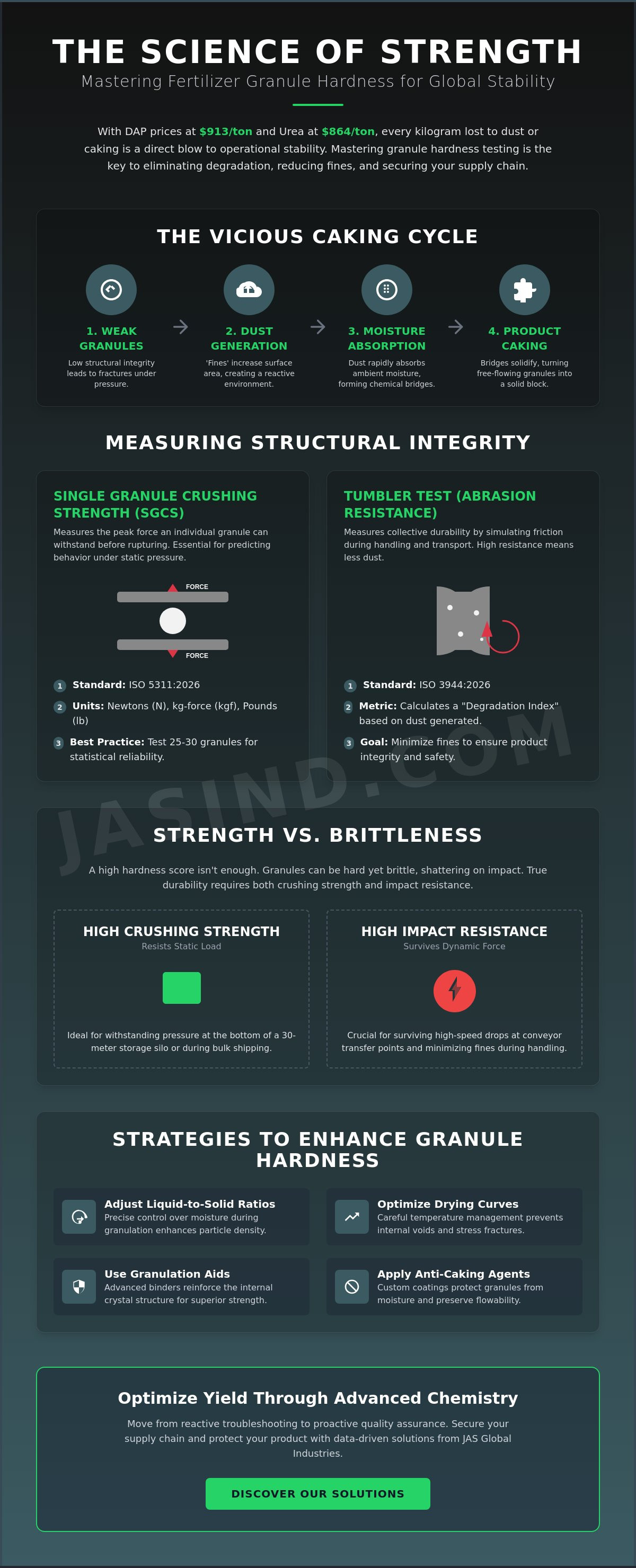
Granule hardness is the resistance to permanent deformation or rupture under pressure. It's a critical metric for any producer aiming for operational excellence. In the materials science of hardness, this integrity defines how a substance withstands external force without structural failure. For the fertilizer industry, this isn't just a lab result. It's a guardian of global resource stability. When granules lack strength, they break down into 'fines' or dust. This degradation leads to massive product loss during every stage of handling. It also creates a dangerous feedback loop known as the caking cycle. Dust has a high surface area. It absorbs moisture rapidly. It forms chemical bridges between particles. These bridges turn a loose pile into a solid, unmanageable block.
Protect your product. Secure your supply chain. By prioritizing fertilizer granule hardness testing, manufacturers transition from reactive troubleshooting to proactive quality assurance. This data-driven approach ensures that nutrients reach the soil in the intended form, maximizing agricultural yield and minimizing environmental waste.
The Link Between Hardness and Anti-Caking Performance
Fractured granules are reactive. When a particle breaks, it exposes a raw surface that hasn't been treated with Fertilizer Anti-caking Agents. These new surfaces are highly prone to moisture absorption. They accelerate chemical bonding between granules, even in controlled environments. Even the best coating agents can't compensate for a crumbling base. A stable substrate is essential. The internal crystal structure must remain intact to preserve flowability over months of storage. Without structural integrity, the protective layer becomes irrelevant as the core disintegrates.
Impact on Bulk Handling and Maritime Export
Global logistics demand resilience. In large-scale operations, granules endure extreme static pressure. A 30-meter high storage silo exerts significant weight on the bottom layers. If fertilizer granule hardness testing reveals weak points, you can expect crushing at these depths. Shipping adds another layer of stress. Constant vibration during maritime transport acts like a mill. It grinds weak granules against each other. This creates dust that clogs equipment and triggers customer complaints. Meeting international standards isn't optional. It's the key to entering premium markets and maintaining long-term partnerships.
Technical Standards: Measuring Crushing Strength and Abrasion
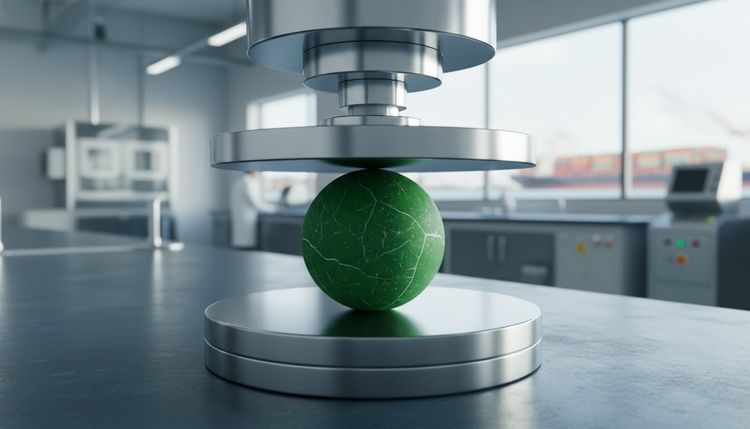
Precision in fertilizer granule hardness testing is the only way to ensure the structural integrity of your product. The Single Granule Crushing Strength (SGCS) test provides a clear metric for this stability. First, technicians select a representative sample of granules, typically within the 2 to 4 mm range. Each granule is placed between two parallel metal plates. A motorized drive applies force at a constant speed. The tester records the peak load at the exact moment of rupture. This data point is vital. It tells you exactly how much pressure your product can withstand before failing.
While SGCS measures individual strength, the Tumbler Test assesses collective durability. This method measures abrasion resistance by rotating a sample in a drum for a set period. It simulates the friction granules experience during mechanical conveying. By weighing the dust generated after tumbling, producers can calculate a "Degradation Index." High abrasion resistance translates to cleaner air in the warehouse and fewer customer complaints. Using Fertilizer Granulation Aids can help maintain these values even when processing complex NPK formulas.
Units of measure vary by region. Clarity is essential for international export. Most modern labs use Newtons (N) as the standard. However, you'll still see Kilogram-force (kgf) and Pounds (lb) in many technical sheets. For quick conversion, remember that 1 kgf equals approximately 9.8 Newtons. To ensure statistical reliability for a 50-ton batch, testing a composite sample of 25 to 30 individual granules is the industry best practice. This provides a clear average while accounting for natural variations in the granulation process.
Crushing Strength vs. Impact Resistance
Crushing strength measures static load capacity. It predicts how granules will behave at the bottom of a massive warehouse stack. Impact resistance is different. It measures the ability to survive high-speed drops at conveyor transfer points. A granule can be extremely hard yet dangerously brittle. If it lacks internal elasticity, it will shatter upon impact despite a high crushing score. Identifying this "glass-like" behavior is critical for reducing fines during bulk handling. Don't rely on a single metric when your reputation for quality is on the line.
Standard Laboratory Protocols (ISO and IFDC)
Adhering to ISO 8397 ensures that particle size distribution is consistent, which is a prerequisite for accurate hardness data. Environmental control is equally important. Testing must occur in moisture-controlled settings, as even slight humidity can soften the crystal matrix and skew results. For DAP and NPK fertilizers, the industry standard for optimal hardness typically ranges between 3.0 and 5.0 kgf per granule for a 2-4 mm size fraction. Establishing these benchmarks creates a foundation for global resource security.
Interpreting Test Results: Identifying the Root Causes of Weakness
Analysis of fertilizer granule hardness testing results must go deeper than a simple pass or fail metric. The specific mode of failure provides a diagnostic window into your production environment. A "shatter" pattern, where the particle explodes into multiple sharp fragments, often points to an aggressive drying process that has created internal stresses. Conversely, a "crumble" indicates high residual moisture or a failure in the chemical binding phase. These diagnostic clues allow plant managers to adjust kiln temperatures or resident times before a batch becomes a total loss. Understanding these failure modes is essential for maintaining the stability of global nutrient supplies.
Moisture content is the primary enemy of structural integrity. There's a precise inverse correlation here. As the moisture level rises, the critical relative humidity of the granule shifts, leading to a significant drop in hardness. Chemical impurities also play a role. If your phosphate rock contains high levels of iron or aluminum, it can disrupt the formation of a clean crystal matrix. This results in a structurally compromised product regardless of how well the granulator is running. Identifying these chemical bottlenecks is the first step toward achieving a premium, export-ready product.
Hollow granules represent another common failure point that is often overlooked. These are typically caused by improper air-flow or excessive rotational speeds in the granulation drum. When the core is empty, the granule might show decent surface hardness but will fail catastrophically under the static load of a warehouse stack. Identifying these voids early prevents maritime shipping disasters where the bottom layers of a cargo hold are crushed into a fine powder. Structural security begins at the core of every particle.
Data Trends and Batch Consistency
Monitoring standard deviation is more important than tracking the mean. A high standard deviation in your fertilizer granule hardness testing reports suggests an unstable granulation loop. It often correlates with temperature spikes in the cooler. If the cooling process is too rapid, thermal shock creates micro-fractures. Mapping these trends across different product grades like NPK, Urea, or MAP helps establish a baseline for long-term reliability and resource protection. Consistency is the hallmark of industrial leadership.
Common Misinterpretations in QC Reports
Don't let a strong average hardness score mask a poor batch. If the percentage of "fines" is high, the average is misleading. The batch will still cake. Another common trap is testing "green" granules. Testing while the product is still hot from the dryer gives a false sense of security. Granules must reach ambient temperature to reveal their true structural integrity. Surface hardness is not core integrity. A polished exterior can hide a weak, porous center that will fail during long-distance transport.
Actionable Strategies to Increase Fertilizer Granule Hardness
Optimizing the structural integrity of your product starts with the liquid-to-solid ratio in the granulator. Precise moisture balance is the foundation of particle density. If the ratio is too high, the granules become over-saturated and mushy; if it's too low, the bonding is insufficient. Real-time fertilizer granule hardness testing at the discharge point allows operators to make immediate adjustments. This proactive monitoring prevents entire batches from falling below the required crushing strength benchmarks. It's a critical step in maintaining the stability of global nutrient resources.
Fine-tuning the drying curve is equally vital for long-term durability. Rapid drying often triggers a phenomenon known as case hardening. This occurs when the outer shell dries too quickly, trapping moisture inside. As the core eventually dries, it shrinks and leaves behind internal voids. These hollow spaces significantly weaken the granule, making it prone to shattering during transport. Managing the recycle ratio also plays a key role. By ensuring a consistent seed granule size, you create a stable environment for uniform growth and superior compaction.
Process Parameters for Maximum Density
Mechanical adjustments provide the first line of defense against weak granules. Adjusting drum tilt and RPM can improve the rolling and compaction action within the granulator. This mechanical energy forces air out of the particle matrix, leading to a denser and more resilient final product. Steam injection in the granulation zone is another powerful lever. It provides the necessary heat to plasticize the raw materials, facilitating a more cohesive bond. Finally, you must control the cooling rate. Rapid cooling causes thermal shock. This creates micro-fractures that might not be visible to the naked eye but will cause the product to fail during bulk handling.
Chemical Intervention: When Mechanical Adjustments Fail
Mechanical tweaks sometimes reach their physical limits. This is where chemical intervention becomes necessary. Surfactants can improve the wetting of raw materials, ensuring that the liquid phase penetrates the solid particles for a tighter bond. High-performance Fertilizer Granulation Aids reduce the viscosity of the slurry. This allows for more even distribution across the seed granules and results in much denser packing. Crystalline bridges formed by specialized binders are particularly effective. Industry data confirms that implementing the right chemical binders can increase crushing strength by 20% compared to untreated batches. Secure your production. Protect your reputation. These advanced solutions ensure that your product survives the rigors of the global supply chain.
JAS Global Industries: Optimizing Yield Through Advanced Chemistry
Diagnosis is only the start. While fertilizer granule hardness testing exposes the root causes of degradation, JAS Global Industries provides the chemical solutions to solve them. We serve as a guardian for global nutrient security. Our Fertilizer Granulation Aids enhance particle cohesion at the molecular level. This ensures your product survives the rigors of the global supply chain. We don't just provide additives; we deliver the stability required for modern infrastructure.
Our global reach allows us to support essential production facilities in Dubai, Africa, and Europe. We understand that local challenges require tailor-made formulas. For plants struggling with brittle raw materials, we offer custom-formulated Anti-caking Agents. These products protect even lower-hardness granules that might otherwise fail during maritime transport. Security and protection are the pillars of our business philosophy.
Tailor-Made Formulations for NPK and Specialty Grades
Every facility faces unique geological and environmental variables. Your specific phosphate or potash source dictates the chemistry of your production loop. We engineer formulations that match these distinct profiles for peak performance. In one recent application, our intervention led to reducing dust by 40% through improved granule integrity. This wasn't a surface treatment. It was a structural reinforcement of the internal crystalline bridges. By integrating fertilizer granule hardness testing into our diagnostic process, we help you achieve consistent, export-ready quality.
The JAS Technical Audit bridges the gap between lab data and plant-scale implementation. Our specialists conduct on-site evaluations to troubleshoot hardness issues directly on the production line. We identify the specific mechanical and chemical bottlenecks that compromise your granules. This comprehensive assessment ensures your operation is optimized for both yield and durability.
Partnering with JAS Global Industries for Operational Reliability
We're a foundational industry presence committed to your long-term success. Our R&I centers simulate extreme transport stresses to test product durability. We replicate the conditions of 30-meter high storage silos and the vibration of maritime shipping. This rigorous approach provides reliability that standard quality control can't match. Our commitment to sustainable and cost-effective solutions ensures your plant remains competitive. Trust our history of excellence to protect your product and your reputation.
Consult with a JAS Specialist on Granule Integrity
Securing Global Stability through Structural Excellence
Structural integrity isn't a luxury in a world of volatile resource markets; it's a necessity. You've now seen how fertilizer granule hardness testing serves as the definitive bridge between production data and logistical success. By moving beyond basic crushing strength and addressing the root causes of abrasion, you protect your product from the moment it leaves the kiln. This prevents the costly degradation that erodes both margins and customer trust. It ensures your nutrients arrive ready for application.
JAS Global Industries has been a pillar of the chemical industry since 1998. With multiple global R&I centers and a portfolio of tailor-made chemical formulations for mining and fertilizers, we provide the technical security that modern infrastructure demands. We don't just supply additives; we offer a partnership rooted in decades of expertise. Our mission is to ensure that every ton of fertilizer reaches its destination in peak condition, ready to support the global food supply.
Optimize Your Fertilizer Quality with JAS Technical Consulting. Let's build a more stable and efficient industrial future together.
Frequently Asked Questions
What is a good crushing strength for NPK fertilizer granules?
A standard crushing strength for NPK granules in the 2 to 4 mm size range typically falls between 3.0 and 5.0 kgf (kilogram-force). Values below 2.0 kgf often lead to excessive fines during bulk handling and maritime transport. High-quality export grades aim for the upper end of this range to withstand the immense static pressure found in deep silo storage.
How does moisture content affect the results of a hardness test?
Moisture acts as a plasticizer that softens the internal crystalline matrix of the particle. Even a minor increase in moisture can significantly reduce the peak load recorded during fertilizer granule hardness testing. To ensure accurate and repeatable data, you must equilibrate samples in a moisture-controlled environment before the test begins to avoid skewed results.
Can I use a manual tester for industrial-scale quality control?
Manual testers are suitable for quick spot checks in the field but lack the precision required for rigorous industrial quality control. Automated motorized testers apply force at a constant, regulated speed. This eliminates human error and ensures that the rupture point is captured accurately across hundreds of samples, providing the statistical reliability needed for international export standards.
What is the difference between granule hardness and abrasion resistance?
Granule hardness measures the resistance to a single, static crushing force, while abrasion resistance measures the ability to withstand friction and surface wear. Hardness predicts performance under the weight of a warehouse stack. Abrasion resistance, often measured by a tumbler test, predicts how much dust will be generated as granules rub against each other in conveyor belts and transfer chutes.
How do granulation aids actually increase the strength of a particle?
Fertilizer Granulation Aids work by reducing the surface tension of the liquid phase, which allows for more uniform wetting of the solid raw materials. This creates a denser packing of particles within the granule. As the granule dries, these aids facilitate the formation of stronger crystalline bridges between individual components, reinforcing the particle from the core outward.
Is there a standard ISO method for fertilizer hardness testing?
ISO 5311:2026 and ISO 3944:2026 provide the most current international standards for assessing the physical properties of granular fertilizers. While these cover bulk density and sample preparation, the IFDC (International Fertilizer Development Center) S-115 method is the most widely recognized protocol specifically for measuring single granule crushing strength. Adhering to these standards ensures that your data is globally recognized by trade partners.
How often should hardness testing be performed during a production shift?
Testing should occur at least once every four hours during steady-state operation to maintain batch consistency. You should increase this frequency during plant start-up or when switching raw material sources. Frequent fertilizer granule hardness testing allows operators to catch process drifts, such as temperature spikes in the dryer, before the product quality falls below acceptable limits.
What happens if my fertilizer granules are too hard?
Excessive hardness can lead to granules that are too brittle, causing them to shatter into sharp fragments upon impact at transfer points. If the granules have too much binder or are "over-burned" in the kiln, they may also exhibit poor solubility in the soil. The goal is to achieve a balance where the product is strong enough for global logistics but still breaks down efficiently once applied to the field.