

By 2026, the global market for Fertilizer Coloring Agents is projected to reach USD 382.04 million. While some view color as a simple aesthetic choice, it's actually a critical pillar of global food security. A single batch of cross-contaminated or misidentified fertilizer can compromise an entire harvest. You likely face the daily pressure of ensuring your product stands out on the shelf while maintaining its integrity under harsh UV exposure. We know that achieving consistent color adherence across every batch is difficult when dealing with complex anti-caking coatings.
This article helps you discover how specialized coloring agents enhance brand value, ensure product safety, and optimize fertilizer marketability in global agriculture. We'll examine the latest industrial solutions for 2026, including bio-based pigments and high-performance formulations designed to meet strict environmental standards. At JAS Global Industries, we focus on providing the chemical infrastructure that secures your brand's reputation and your customers' trust.
Key Takeaways
- Understand why color serves as a vital security tool for grade identification and brand protection in the global supply chain.
- Evaluate the technical advantages of inorganic pigments over organic dyes for superior UV resistance and long-term stability.
- Learn how to integrate Fertilizer Coloring Agents with anti-caking coatings to maintain product vibrancy and chemical integrity.
- Master a reliable operational framework for calibrating dosing pumps to achieve consistent color intensity across every batch.
Beyond Aesthetics: The Strategic Role of Fertilizer Coloring Agents
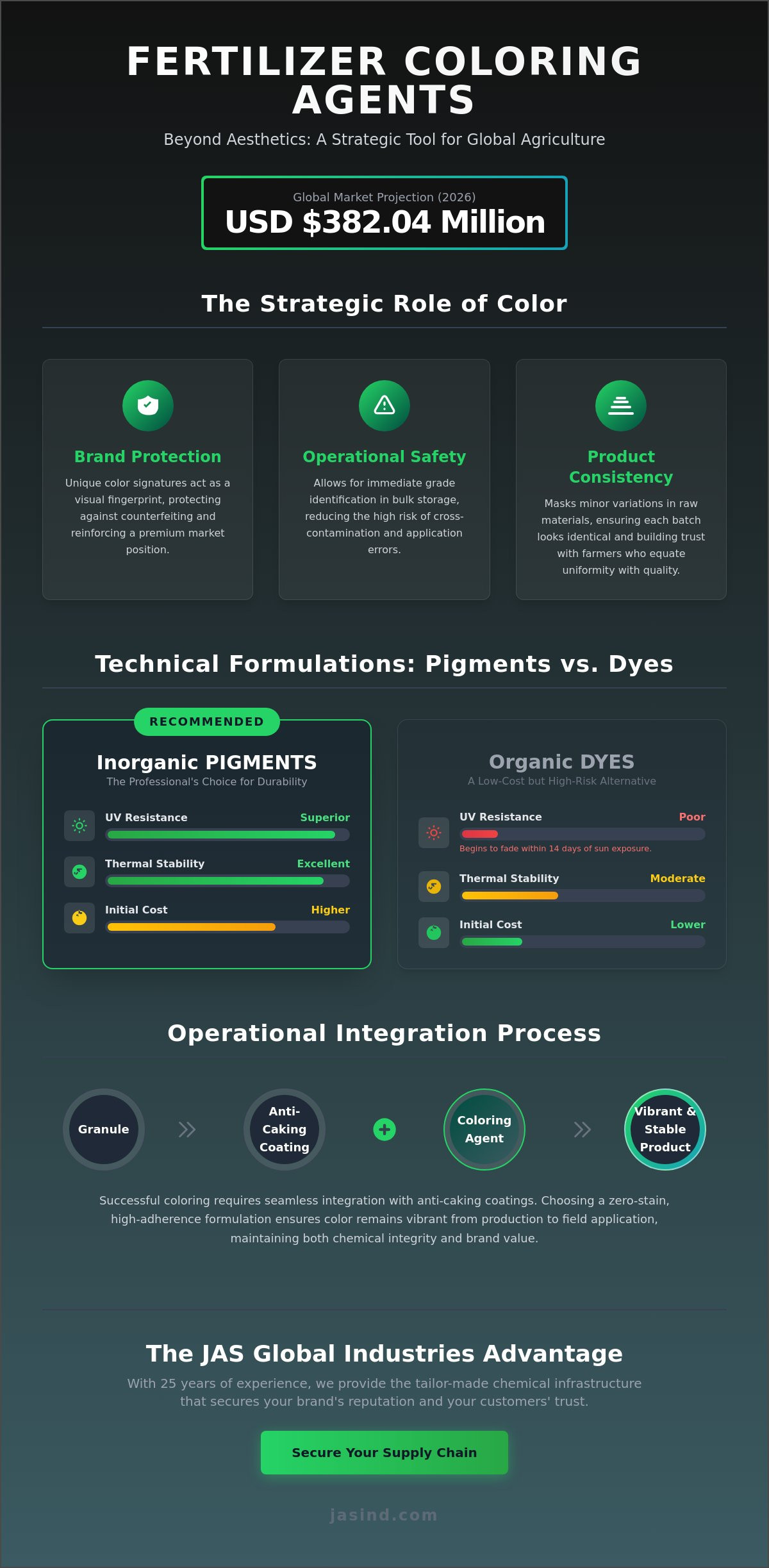
In a global market where products are often viewed as simple commodities, Fertilizer Coloring Agents serve as a critical tool for differentiation and security. They're not just about visual appeal. They're about protecting the integrity of the food supply chain. When raw material sources fluctuate, color consistency masks variations, ensuring that a batch of urea or DAP looks identical to the last. This consistency builds trust with farmers who equate visual uniformity with chemical reliability. It’s a visual promise that the product inside the bag meets the high standards expected by the agricultural community.
Beyond aesthetics, these agents provide a layer of regulatory and operational security. Hazardous agricultural chemicals often require specific color coding to meet safety standards and avoid dangerous mix-ups. By using high-performance pigments, manufacturers ensure their products remain identifiable even after months of storage or exposure to sunlight. This visual permanence is a vital component of global food security, ensuring that the right nutrients reach the right crops at the right time.
Brand Protection and Market Differentiation
Counterfeiting in the agricultural sector is a growing threat to global food security. Unique color signatures act as a visual fingerprint, making it harder for unauthorized parties to mimic high-value NPK blends. When a brand maintains a specific, vibrant hue, it reinforces a premium market position. Farmers recognize quality through sight long before they see the results in the field. This visual trust is essential for maintaining long-term relationships in competitive regions like Southeast Asia or South America. At JAS Global Industries, we believe that manufacturing relationships is as important as distributing quality chemicals.
Operational Safety and Product Identification
Safety starts in the warehouse. Bulk storage facilities often hold thousands of tons of different grades. Without clear visual cues, the risk of cross-contamination is high. Using Fertilizer Coloring Agents allows for immediate grade identification. For example, many distributors use red for potash or blue for specialty water-soluble products. This practice aligns with the general Fertilizer overview which notes that dyes are often used to distinguish specific product types for safety and application accuracy.
Inventory management becomes more efficient when workers can identify nutrient ratios at a glance. It reduces application errors in the field, where applying the wrong nitrogen-phosphorus-potassium balance can destroy a crop. By providing these visual safeguards, JAS Global Industries helps manufacturers protect both their reputation and the livelihoods of the farmers they serve. With 25 years of experience, we understand that a consistent color is a promise of quality that must be kept from the factory gate to the soil.
Technical Formulations: Pigments, Dyes, and Coating Technologies
Selecting the right chemical carrier for Fertilizer Coloring Agents is a technical decision that impacts every stage of the global supply chain. It's not simply a matter of choosing a shade; it's about ensuring chemical compatibility and long-term stability. Manufacturers must choose between oil-soluble systems, which integrate seamlessly with anti-caking agents, and aqueous systems designed for high-moisture processing environments. The goal is a zero-stain formulation that adheres to the granule without leaching onto handling equipment or transport vessels. Achieving this requires a deep understanding of surface tension and molecular bonding.
The science of color adherence has evolved significantly. Recent advances in coating technologies demonstrate that sophisticated layers don't just manage nutrient release; they also provide a stable substrate for pigments. This ensures that the color remains vibrant from the moment of granulation until it reaches the farmer's field. For manufacturers aiming to secure their market position, choosing specialized industrial additives is the most reliable way to guarantee this performance.
Pigments vs. Dyes: A Performance Comparison
Longevity depends on the choice between organic dyes and inorganic pigments. Organic dyes offer high color intensity and lower initial costs, but they often struggle with UV exposure. In many cases, a standard dye will begin to fade within 14 days when stored in outdoor bulk piles. Inorganic pigments provide the rugged durability needed for 2026's demanding logistics. They offer superior lightfastness and thermal stability, though they require precise dispersion to avoid settling. Modern formulations now prioritize biodegradability, ensuring that 95% of the colorant breaks down safely in the soil without leaving harmful residues behind.
Stability in Extreme Climates
Global trade requires fertilizers to survive brutal conditions during maritime transport. Cargo crossing the equator often faces internal hold temperatures exceeding 50 degrees Celsius and humidity levels above 85%. Standard coloring agents can bleed or degrade under these stresses, leading to product "caking" and loss of brand value. High-performance Fertilizer Coloring Agents are now engineered with moisture-resistant polymers that act as a barrier. This is particularly vital in Southeast Asia, where monsoon conditions can compromise unprotected granules. By using thermally stable pigments, manufacturers ensure that their product maintains its premium look even after 30 days at sea. This level of protection is a cornerstone of global food security, ensuring that every ton of fertilizer remains viable and identifiable upon arrival.
Roundup of Industrial Coloring Delivery Methods
Choosing the right delivery method for Fertilizer Coloring Agents depends heavily on your plant's infrastructure and the specific chemical profile of your granules. While the previous sections explored the chemistry of pigments, the application method determines the operational efficiency and final marketability of the product. Industrial producers generally choose between internal integration and external surface treatment, each offering distinct advantages for global supply chain security.
Internal Slurry Integration
Internal or "body" coloring involves adding the agent directly into the slurry phase before granulation. This method is the gold standard for products where physical integrity is paramount. If a granule breaks or abrades during transport, it retains its color because the pigment is distributed throughout the entire mass. However, this approach presents significant technical hurdles. The coloring agents must withstand the aggressive chemical environment of ammoniation and the high acidity of phosphoric acid. Because the entire volume of the fertilizer is colored, this method typically requires 2 to 3 times more agent than surface applications. It's often reserved for high-value specialty grades where homogeneous color is a non-negotiable requirement for brand trust.
External Surface Coating
External surface coating is the most common method in modern high-capacity plants. It focuses on applying Fertilizer Coloring Agents at the final stage of production, usually within the coating drum. This method maximizes visual vibrancy by concentrating the pigment on the surface where it's most visible. It's an efficient solution for manufacturers looking to reduce input costs while maintaining a premium aesthetic. The primary challenge here is ensuring that the colorant doesn't interfere with the performance of other additives. It must bond effectively without compromising the flowability of the granules or causing clumping in the bag. Most 2026 formulations are designed to be applied via precision spray systems, ensuring a uniform coat that dries almost instantly.
Modern industrial solutions are moving toward hybrid systems. These innovative coatings combine colorants with fertilizer anti-caking agents or dust suppressants into a single, multi-functional application. By streamlining the process, plants can reduce their equipment footprint and energy consumption. Encapsulation technologies also play a role, shielding sensitive pigments from reacting with the fertilizer's core nutrients. This level of technical precision is what JAS Global Industries brings to every partnership. We focus on these foundational needs so that global food security remains uncompromised by logistical failures. Our 25-year history of reliability ensures that your chosen delivery method works in harmony with your production goals.
Operational Integration: Optimizing Dosing and Compatibility
Successful application of Fertilizer Coloring Agents requires a systematic approach to plant operations. It isn't enough to just spray the product; you must ensure the chemistry aligns with your existing additives to avoid product failure. Operational efficiency depends on a seamless marriage between the coloring agent and the granule's surface chemistry. At JAS Global Industries, we view this integration as a critical step in maintaining the security of your supply chain and the reliability of your brand.
Optimizing your production line follows a rigorous four-step protocol:
- Step 1: Chemical Compatibility Testing. Verify that the colorant doesn't destabilize your primary anti-caking agents or dust suppressants. Incompatibility can lead to emulsion breakdown and uneven coating.
- Step 2: Pump Calibration. Calibrate dosing pumps to the specific viscosity of the colorant. This prevents "hot spots" of intense color or faded batches that look substandard.
- Step 3: Real-Time Monitoring. Utilize digital colorimetry sensors on the discharge belt. These systems detect shifts in intensity instantly, allowing for immediate flow adjustments.
- Step 4: Migration Audits. Perform post-production checks to ensure zero color migration. The pigment must stay on the granule, not transfer to handling equipment or transport vessels.
Synergy with Anti-caking and Dust Control
Coloring agents often act as functional surfactants. They can improve the "spread" of anti-caking oils, helping the protective layer reach 100% of the granule's surface area more efficiently. In some trials, this synergy has allowed manufacturers to reduce the volume of expensive anti-caking oils by up to 12% without losing performance. However, poor formulation leads to "bleeding." This is where the color rubs off on conveyor belts or inside storage silos, creating maintenance headaches. To simplify chemical management, many plants are now moving toward 2-in-1 solutions that combine high-vibrancy color and dust control in a single, stable liquid phase.
Automated Dosing and Process Efficiency
Precision is the key to minimizing chemical waste. Modern automated systems integrated with SCADA allow plant managers to monitor and adjust flow rates from a central control room. This connectivity ensures that dosing remains consistent even when production speeds fluctuate. High-performance dosing pumps maintain a target variance of less than 0.5% across continuous production runs. This level of control eliminates chemical waste and ensures every ton of fertilizer meets the visual standards of your brand. If you're ready to optimize your production line, request a compatibility assessment from our technical team to secure your product's quality.
The JAS Global Advantage: Tailor-Made Coloring Solutions
JAS Global Industries has spent over 25 years refining the chemical additives that support global infrastructure. Our approach to Fertilizer Coloring Agents goes beyond providing a simple pigment. We view our role as a global guardian of food security. By 2026, our expanded logistics network will ensure that manufacturers on every continent have the security of supply they need to maintain production. We don't just fulfill orders; we manufacture relationships and distribute quality. This commitment to reliability is why the world's leading agricultural producers trust us to protect their most valuable assets.
Manufacturing Relationships, Distributing Quality
Our partnership with industrial plants begins with a deep dive into their specific operational challenges. We believe that true quality comes from understanding the micro-details of a production line. Our technical team conducts on-site audits to help plants optimize their chemical dosing, ensuring that every drop of colorant provides maximum value. This hands-on laboratory support is essential for maintaining color stability in diverse environments.
We recently proved this expertise during a critical project in the Middle East. A major producer faced severe color fading in their bulk storage silos, where temperatures often exceeded 50 degrees Celsius. Standard dyes were failing under the intense UV radiation and thermal stress. Our R&I team developed a custom, inorganic pigment formulation specifically for this climate. The result was a 100% retention of color vibrancy over a six-month storage period. This solved the identification crisis and restored farmer trust in the brand's premium NPK blends. We provide this level of tailored support to every partner, regardless of their geographic location.
Sustainable Innovation for Future-Proof Farming
The "JAS Cares" designation is our signature for social and environmental responsibility. It drives our commitment to developing sustainable chemistry that meets the world's most stringent regulatory standards. We've pioneered eco-friendly pigments that significantly reduce the chemical footprint of the fertilizer finishing process. These innovative solutions ensure that your product remains compliant with evolving environmental laws while maintaining the high-performance standards your customers expect.
Future-proof farming requires a balance between industrial efficiency and ecological stewardship. Our custom formulations are designed to be biodegradable and safe for the soil, reflecting our role as a responsible corporate citizen. We focus on the foundational needs of society, like water and food security, by ensuring our chemical solutions are as safe as they are effective. If you're ready to secure your product's future, Consult with JAS Global Industries for your custom coloring formulation. We'll work together to build a solution that protects your brand and the planet.
Securing Global Food Systems Through Industrial Precision
The evolution of agricultural inputs in 2026 demands a shift from simple aesthetics to strategic security. You've seen how the right choice in Fertilizer Coloring Agents prevents costly application errors and protects your brand from counterfeiting in a volatile global market. Success on the production floor requires a perfect synergy between high-performance pigments and your existing anti-caking systems. We've established that consistent color adherence is a hallmark of quality that farmers trust and rely on for their livelihoods.
JAS Global Industries has been a pillar of industrial reliability since 1998. With multiple global R&I centers, we specialize in tailor-made industrial formulations that survive the harshest maritime climates. We don't just provide chemicals; we act as a vital guardian for global food security. Our twenty-five-year history is rooted in the belief that manufacturing relationships is just as important as distributing quality. It's time to move beyond standard solutions and embrace a partnership built on technical excellence and shared responsibility.
Contact JAS Global Industries for a Technical Audit of Your Fertilizer Finishing Process. Let's ensure your product maintains its premium integrity from the factory gate to the field.
Frequently Asked Questions
Are fertilizer coloring agents harmful to the soil or crops?
High-quality coloring agents are inert and don't harm soil health or crop vitality. Modern industrial formulations are engineered to be biodegradable, ensuring that 95% of the colorant decomposes safely within a single growing season. These chemicals act as identifiers without interfering with the biological processes of the plant or the surrounding ecosystem.
How do I prevent my fertilizer color from fading during storage?
You prevent fading by selecting inorganic pigments rather than organic dyes for products stored in outdoor bulk piles. Inorganic options provide superior UV resistance, maintaining color vibrancy for over 180 days even in high-intensity sunlight. Proper storage in covered environments also extends the colorant's lifespan by reducing direct radiation exposure.
Can I combine coloring agents with my existing anti-caking treatment?
You can absolutely combine Fertilizer Coloring Agents with your existing anti-caking treatments to streamline production. Most 2026 formulations are oil-soluble, allowing them to blend perfectly with anti-caking oils at the coating drum phase. This synergy often improves the spread of the treatment, ensuring 100% granule coverage while providing a vibrant, uniform finish.
What is the difference between oil-soluble and water-soluble colorants?
The primary difference lies in the carrier medium and the stage of application within the plant. Oil-soluble colorants are ideal for post-granulation coating and integrate well with dust suppressants. Water-soluble versions are typically added during the slurry phase or used for specialty liquid fertilizers. Choosing the correct solubility ensures zero color migration and prevents equipment staining.
How much coloring agent is typically required per ton of fertilizer?
Typical dosage rates range from 0.5 kg to 2.0 kg per ton of finished fertilizer, depending on the desired intensity and application method. Surface coating requires significantly less material than internal body coloring, which might use up to 3 times more agent. Precision dosing systems help maintain a variance of less than 0.5% to ensure batch-to-batch consistency.
Do coloring agents affect the nutrient release profile of the fertilizer?
Coloring agents don't alter the nutrient release profile or the chemical efficacy of the fertilizer. They function solely as visual identifiers and brand protection tools. While some advanced coating technologies manage release rates, the Fertilizer Coloring Agents themselves remain chemically neutral and don't block the solubility of nitrogen, phosphorus, or potassium components.
Are there natural or eco-friendly options for fertilizer coloring?
Eco-friendly options are increasingly available, including bio-based pigments derived from plant extracts and microbial fermentation. These sustainable solutions meet strict international environmental standards and reduce reliance on petrochemical inputs. Our JAS Cares initiative prioritizes these innovative formulations to support global food security while minimizing the industrial footprint of agricultural finishing processes.