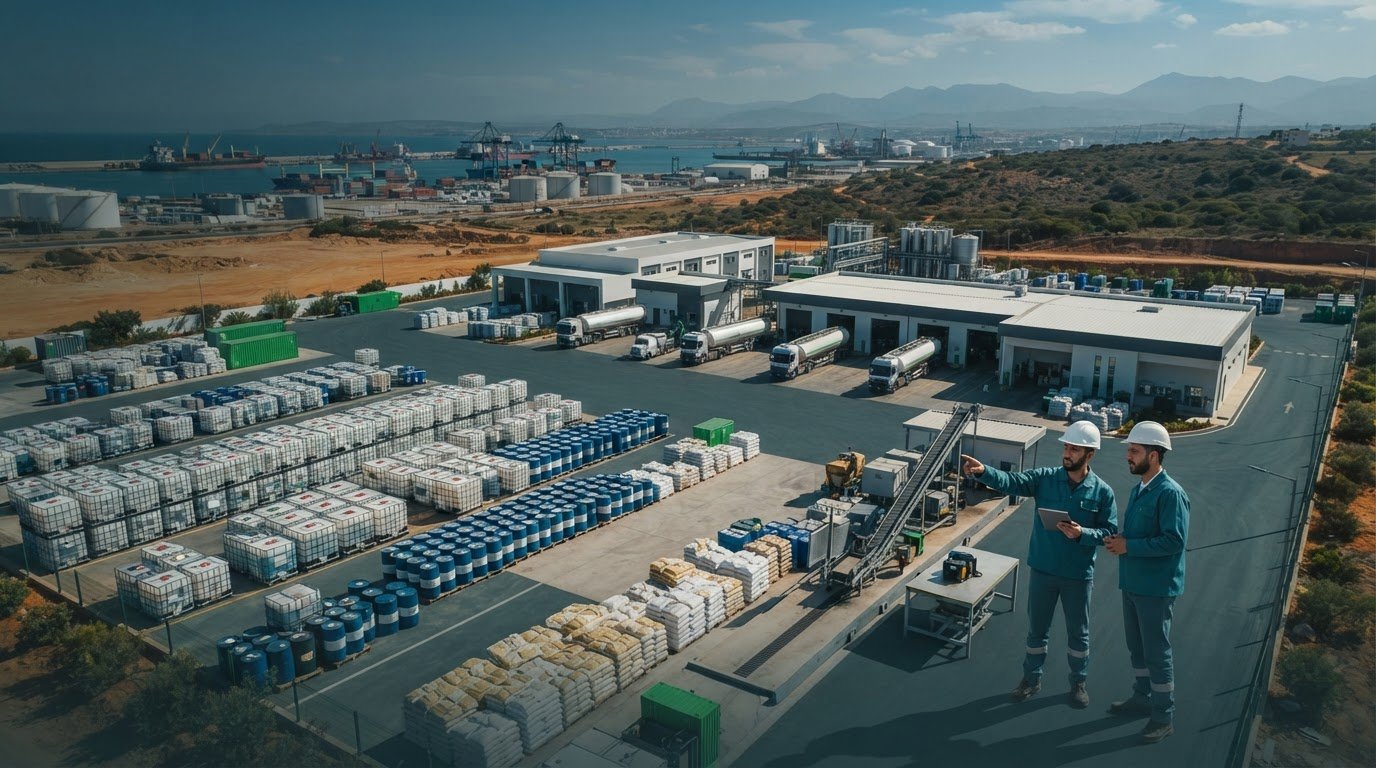

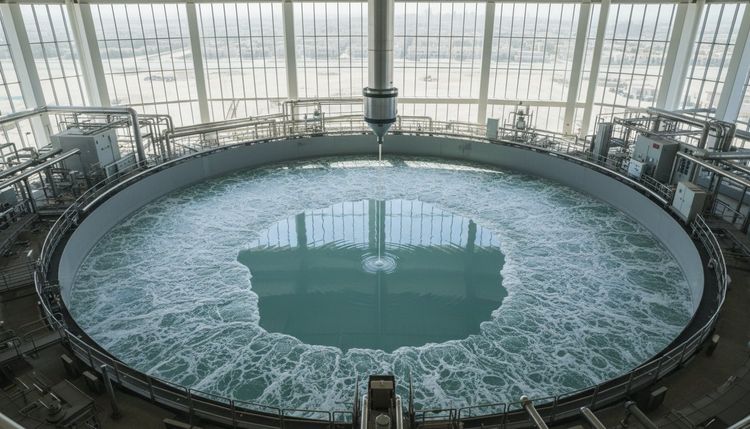
On October 12, 2023, a production manager at a large-scale desalination plant watched as a 10% rise in foam volume triggered a sensor error, leading to four hours of unplanned downtime. You likely recognize this frustration. Foam isn't just an aesthetic issue; it's a structural threat that compromises vessel level readings and forces pumps to process air instead of product. When generic Defoamers fail to address the root cause, the resulting spillover and equipment wear can jeopardize your entire facility's operational integrity.
Our mission is to safeguard the infrastructure that supports global security. This guide empowers you to master foam control to protect your high-value equipment and optimize industrial yields. You'll discover how specific, high-performance formulations can reduce chemical consumption by 15% and prevent the 12% annual maintenance cost increases often seen in unoptimized systems. We'll walk through the science of targeted dosing and the strategic selection of additives that ensure your facility remains a reliable, foam-free pillar of modern industry.
Key Takeaways
- Master the science behind foam control to eliminate operational bottlenecks and protect critical industrial equipment from cavitation and volume loss.
- Identify the essential chemical carrier fluids and compatibility requirements needed to ensure your foam control solution persists throughout the entire process.
- Learn specialized strategies for managing the complex "foam magnets" found within mineral flotation circuits and phosphoric acid production.
- Transition from laboratory data to real-world results by utilizing a "Technical Audit" framework to find the optimal dosing points in your circuit.
- Discover how JAS Global leverages decades of expertise to develop customized Defoamers that are specifically engineered for your unique ore body and water chemistry.
Understanding Defoamers: Science, Mechanisms, and Industrial Necessity
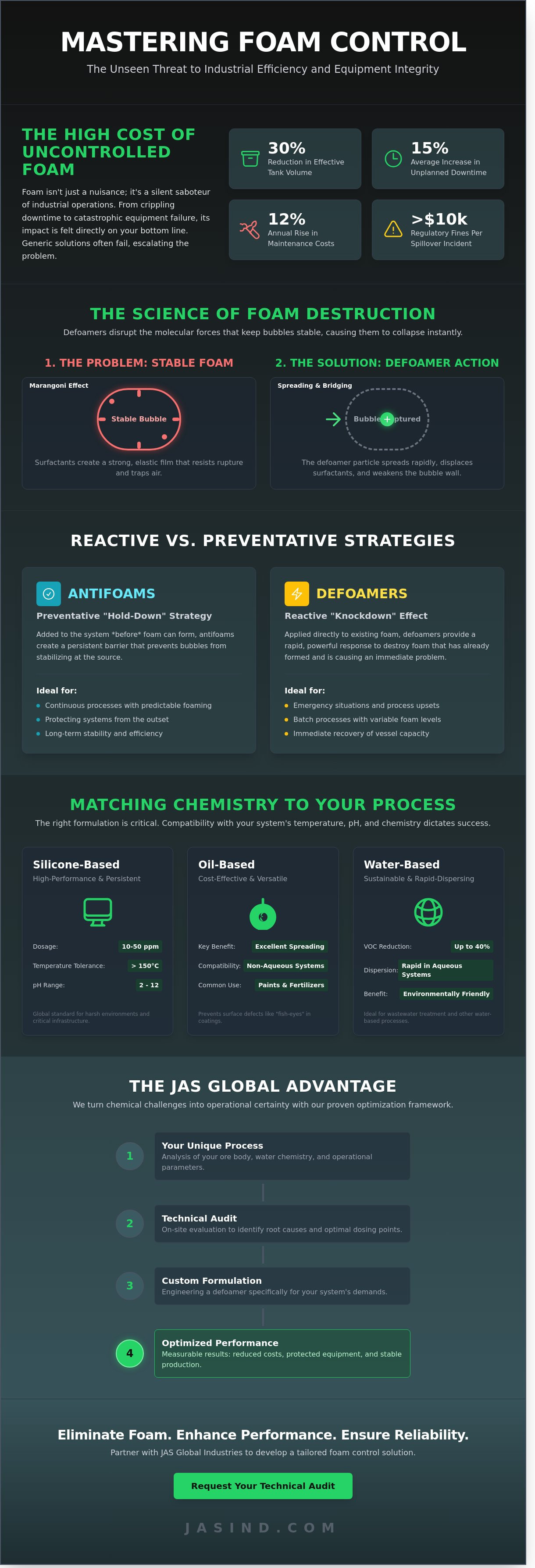
Defoamers are high-performance chemical additives designed to eliminate existing surface foam and release entrained air. In complex industrial environments, foam acts as a thief of efficiency. It reduces effective tank volume by as much as 30% in fermentation and wastewater sectors. This leads to pump cavitation; a condition where air bubbles implode against metal surfaces, causing pitting and mechanical failure. Beyond mechanical issues, foam spillover creates environmental hazards. These incidents often result in regulatory fines exceeding $10,000 per occurrence in strictly monitored regions. It's not just a nuisance; it's a threat to the bottom line.
Bubble stability is maintained by the Marangoni Effect. This scientific principle describes how surface tension gradients pull liquid toward areas of high tension, which heals the bubble wall and prevents rupture. Defoamers must disrupt this balance to be effective. The industry distinguishes between two primary strategies:
- Defoamers: These provide a reactive "knockdown" effect to destroy foam that has already formed.
- Antifoams: These offer a preventative "hold-down" strategy, stopping foam before it compromises the process.
How Defoamers Work at the Molecular Level
Efficiency starts with the spreading coefficient. A defoamer must spread rapidly across the air-liquid interface to displace stabilizing surfactants. This process involves entering and bridging mechanisms where the additive penetrates the bubble film, forcing it to thin until it bursts. Hydrophobic particles serve as solid displacement points that force liquid away from the bubble film, causing immediate de-wetting and structural failure. This molecular disruption ensures that air is released safely into the atmosphere rather than remaining trapped in the liquid phase.
The High Cost of Poor Foam Control
Operational costs escalate quickly when foam is left unmanaged. A 2022 industry analysis found that uncontrolled foaming leads to a 15% average increase in unplanned downtime for pulp and paper mills. Centrifugal pumps experience accelerated wear when entrained air levels exceed 2%, shortening equipment life by years. This mechanical degradation translates to thousands of dollars in premature replacement costs and lost productivity. JAS Global Industries addresses these challenges by viewing foam control as a pillar of global food and water security. We manufacture relationships and distribute quality to ensure industrial processes remain stable, secure, and sustainable. Our 25-year history of reliability turns chemical challenges into operational certainty for global infrastructure.
Classification of Defoamers: Matching Chemistry to Process Requirements
Chemical compatibility dictates the success of any foam control strategy. Industrial processes aren't uniform. A solution for a wastewater plant will likely fail in a high-speed printing press. Selecting the right carrier fluid is the first step. This base liquid determines how quickly the active ingredient spreads across the bubble wall. It also dictates how long the agent remains effective before the system requires a fresh dose. Defoamers must be tailored to the specific tension and temperature of the medium to prevent process bottlenecks.
Silicone-Based Defoamers
Polydimethylsiloxanes (PDMS) remain the global standard for high-persistence requirements. They operate efficiently at low dosages, often as low as 10 to 50 parts per million. These agents excel in harsh environments. They maintain structural integrity when temperatures exceed 150°C or pH levels fluctuate between 2 and 12. JAS Global Industries integrates these high-performance materials into our Silicon-based Defoamer range within the 2026 product line. These solutions provide the stability needed for critical infrastructure and water security.
Oil-Based and Water-Based Alternatives
Cost efficiency often drives the selection of mineral oil carriers. They're effective in paints, coatings, and fertilizer production where silicone might cause surface defects like "fish-eyes." Water-based emulsions offer a sustainable alternative for aqueous systems. They disperse rapidly and reduce VOC emissions by up to 40% compared to traditional solvent-based carriers. For processes requiring silicone-free labels, fatty alcohols and glycol-based agents ensure downstream compatibility. They protect equipment while maintaining the integrity of the final product.
Powdered Antifoams for Solid Formulations
Powdered variants use encapsulated active ingredients for dry-mix stability. These formulations provide a 24-month shelf life. This longevity is a major advantage for global logistics and long-term storage in remote mining or agricultural sites. They're essential for cementitious materials and industrial detergents. Powder defoamers are critical for the home care chemical sector because they allow for precise dosing in dry laundry powders without compromising the cleaning power of the surfactants.
Reliable foam control is a pillar of process efficiency and global resource management. It ensures that manufacturing remains steady and resource-conscious. Explore how our sustainable chemical solutions can optimize your industrial circuit.
The Operational Impact: Solving Foam in Mining and Fertilizer Production
Foam control is a critical pillar of Global Food Security. In fertilizer plants, the acidulation of phosphate rock creates intense chemical reactions. This process releases CO2 and organic gases, generating thick foam that can reduce reactor capacity by 30%. Without effective Defoamers, production slow-downs threaten the global supply of essential nutrients. Process efficiency isn't just about speed; it's about maximizing every ton of raw material to feed a growing population.
Phosphate and Potash Mining Challenges
In mining, the challenge is precision. Operators must eliminate nuisance foam in phosphoric acid concentration without disrupting flotation circuits. In regions like Amman, Jordan, or Sfax, Tunisia, organic impurities in the rock cause massive foam surges during processing. We target these impurities specifically. In 2023, optimized foam control in North African phosphate mines increased process throughput by 12% on average. This delicate balance ensures that mineral recovery remains high while equipment stays clean. We don't just supply chemicals; we protect the extraction process that fuels global agriculture.
- Selective Action: Eliminating air entrainment without "killing" the frothers needed for mineral separation.
- Yield Optimization: Reducing foam-related overflows in concentration tanks to prevent mineral loss.
- Organic Neutralization: Managing the high organic carbon content found in sedimentary phosphate deposits.
Water Security and Desalination
Water Security depends on the reliability of desalination plants and effluent systems. In thermal desalination, foam causes carryover, which contaminates the distillate and damages heat exchangers with scale. This leads to frequent maintenance shutdowns and higher operational costs. In Reverse Osmosis (RO) systems, the focus shifts to membrane compatibility. Defoamers must be non-fouling to prevent 15% increases in energy consumption caused by membrane blockage. By managing these fluids, we safeguard the infrastructure that provides fresh water to millions. This focus on process integrity aligns with our mission in Industrial Water Treatment.
Effective foam management reduces the chemical footprint of industrial effluent. High-load systems often struggle with biological foam that interferes with clarification. By implementing targeted control, facilities can meet strict environmental standards while maintaining high flow rates. It's a matter of reliability. We manufacture relationships by ensuring our partners' systems run without interruption, distributing quality through every gallon of treated water. Our approach turns a technical challenge into a sustainable operational advantage.
Selection and Dosing Strategy: A Framework for Process Optimization
Effective foam control requires more than a standard chemical catalog. It demands a rigorous Technical Audit. Laboratory data provides a foundational baseline, but on-site testing remains the gold standard for process reliability. Real-world variables like fluctuating pH levels, surfactant concentrations, and variable flow rates often render static lab results obsolete. We prioritize field trials because they capture the dynamic nature of your infrastructure.
Identifying the "sweet spot" for dosing within the circuit is critical for maximum chemical efficiency. Typically, this point is upstream from the turbulence source but close enough to prevent premature dilution. Moving from manual slug-feeding to automated precision dosing reduces chemical waste by approximately 22% in high-volume operations. Precision management isn't just about cost; it's about protecting the integrity of the entire production line.
Environmental compliance is now a core pillar of industrial operations. Selecting biodegradable Defoamers is essential for plants discharging into sensitive ecosystems or municipal water systems. JAS Global Industries focuses on these sustainable agents to maintain water security across global infrastructure projects, ensuring that industrial progress doesn't come at the cost of ecological health.
Laboratory Testing and Field Trials
The "Shake Test" offers a rapid, qualitative assessment of initial activity. Gas Sparging provides a more sophisticated look by controlling air injection rates to mimic specific mechanical aeration. By 2026, Dynamic Foam Analyzers will be the standard for global plants, using optical sensors to simulate plant turbulence with 95% accuracy. Knockdown time is the specific metric measuring the seconds required for a defoamer to collapse an existing foam head, serving as the primary KPI for high-speed processing environments.
Optimizing the Dosing Rate
Over-dosing creates a cascade of operational failures. Excess chemical leads to surface defects like fish-eyes in coatings or significant downstream fouling in filtration membranes. We advise clients to shift their focus to the "cost-in-use" calculation. This metric evaluates the total expenditure required to treat 1,000 cubic meters of fluid rather than the deceptive price per kilogram of the raw chemical. Professional technical consulting ensures these strategies are tailored to the specific mechanical constraints of your facility, balancing performance with fiscal responsibility.
Our engineers help you transition from reactive foam management to proactive process security. Partner with JAS Global Industries to refine your dosing strategy today.
JAS Global Industries: Tailor-Made Defoamer Solutions for Global Infrastructure
JAS Global Industries has spent 25 years mastering the balance between technical precision and industrial trust. Our philosophy is simple: Manufacturing Relationships. Distributing Quality. We recognize that chemical additives are the silent engines of modern civilization. By optimizing foam control, we don't just improve a balance sheet. We contribute to the stability of global food and water security. Our 25-year history as a reliable partner allows us to serve as a steady pillar for industries that cannot afford downtime.
Generic chemical solutions often fall short in complex environments. Your process efficiency depends on the specific mineralogy of your ore body or the unique salinity of your process water. This is why JAS Global rejects the "one size fits all" approach. Our Dubai-based Research and Innovation (R&I) centers utilize advanced laboratory modeling to develop customized defoamers tailored to your local variables. Whether you're managing a massive desalination plant or a high-volume fertilizer facility, our chemists engineer formulations that address your specific chemical triggers.
Sustainability is a core mandate through our JAS Cares commitment. We develop eco-conscious defoamers that minimize environmental footprints without sacrificing performance. By reducing chemical waste and improving energy efficiency in industrial processing, we protect the resources that society relies on most. We view ourselves as global guardians of infrastructure, ensuring that every drop of water and every ton of food produced is done so with maximum efficiency.
Our Global Presence and Logistics
Reliability is the foundation of our supply chain. We serve industrial leaders across Europe, Asia, and Africa from our strategic hubs in Dubai, Riyadh, and Lisbon. These locations allow us to manage bulk chemical contracts with speed and precision, even in high-growth industrial corridors. Our logistics network is designed for resilience, ensuring that your facility remains operational regardless of market fluctuations. Beyond delivery, we provide on-site troubleshooting. JAS Global experts conduct comprehensive process audits to identify hidden inefficiencies in your foam management protocols.
Partnering for Process Excellence
True process excellence isn't achieved through a single product purchase. It requires a strategic partnership. Our specialized industrial chemistry departments work with your team to integrate foam control into a broader Chemicals Management Plan. This plant-wide approach ensures that every additive works in harmony, reducing overall chemical consumption and boosting total throughput. You can begin this transformation by engaging our technical team for a detailed site assessment.
Ready to optimize your industrial process? Contact JAS Global Industries for a Process Audit and discover the impact of precision chemistry.
Securing Global Productivity Through Advanced Foam Control
Effective foam management is a cornerstone of modern industrial security. It transforms volatile chemical reactions into stable, high-yield operations that support global food and water supplies. By matching specific chemical classifications to unique process requirements, facilities can eliminate downtime and maximize resource recovery. Defoamers serve as essential tools in this pursuit, protecting the integrity of large-scale infrastructure from the disruptive effects of uncontrolled aeration. Mastering these mechanisms ensures that your facility maintains peak performance while reducing chemical waste.
JAS Global Industries brings over 25 years of industrial chemistry expertise to your most demanding challenges. Since 1998, we've established a legacy of reliability through our specialized R&I centers dedicated to mining and fertilizer additives. With a strategic presence in Dubai, Riyadh, and other major industrial hubs, we're positioned to deliver local expertise on a global scale. We don't just supply chemicals; we manufacture relationships built on trust and technical excellence. It's time to elevate your process efficiency with a partner that understands the broader human impact of industrial success.
Consult with JAS Global for Custom Defoamer Formulations to optimize your dosing strategy and secure your production goals. We're ready to help you build a more efficient and sustainable future.
Frequently Asked Questions
What is the main difference between an antifoam and a defoamer?
Antifoams prevent foam before it starts, while defoamers eliminate foam that's already formed. In high-speed industrial lines, adding an antifoam agent early maintains 100% process capacity by preventing air entrainment. Defoamers act as "knock-down" agents for immediate relief during unexpected foam surges. Choosing the right defoamers ensures your infrastructure remains stable and productive, reflecting our commitment to manufacturing relationships and distributing quality.
Can silicone defoamers be used in water treatment for reverse osmosis?
You shouldn't use silicone-based products in reverse osmosis because they cause irreversible membrane fouling. Silicone oils coat the polyamide layers, which can reduce permeate flow by 35% within a single shift. Instead, choose water-based or glycol-based alternatives to ensure water security and system longevity. These specialized formulas maintain flux rates without risking expensive membrane replacements or unplanned downtime in critical desalination projects.
How much defoamer should I use in my industrial process?
Most industrial applications require a dosage between 10 and 100 parts per million (ppm) to be effective. The precise volume depends on your specific surfactant load and agitation levels. Over-dosing is a common error that leads to surface defects or unnecessary costs. We recommend starting at 20 ppm and adjusting based on real-time foam height measurements to maximize process efficiency and maintain steady operational flow.
Are there biodegradable defoamers available for environmentally sensitive sites?
Biodegradable defoamers are available and often utilize vegetable oils or advanced polyethers to meet OECD 301B standards. These products achieve over 60% biodegradation within a 28 day window, making them ideal for environmentally sensitive sites. Our "JAS Cares" initiative prioritizes these sustainable chemistries. They provide high performance without compromising the health of local aquatic ecosystems or violating strict discharge permits at your facility.
Will using a defoamer affect the quality of my fertilizer or mineral product?
Using a high-quality defoamer actually improves fertilizer quality by increasing bulk density and reducing air entrainment. In phosphoric acid production, effective foam control ensures that nutrient concentrations like P2O5 remain consistent. It won't interfere with the chemical integrity of the final mineral product. This precision is vital for global food security, as it ensures farmers receive reliable, high-performing nutrients to sustain global populations.
How do I test the efficiency of a new defoamer in a laboratory setting?
You can test efficiency using the ASTM D892 standard, which involves measuring foam height in a graduated cylinder after controlled air injection. Record the initial foam volume and the time it takes for total collapse. A high-performing product should reduce foam height by 90% in less than 60 seconds. This empirical data allows for an objective comparison between different chemical formulations before you commit to full-scale plant implementation.
What causes persistent foaming in phosphoric acid production?
Persistent foaming in phosphoric acid is primarily caused by organic impurities and carbonate levels exceeding 2% in the phosphate rock. When the rock reacts with sulfuric acid, it releases carbon dioxide gas that gets trapped by organic surfactants. This creates a stable foam layer that can reduce reactor volume by 25%. Managing this reaction with specialized additives is critical for maintaining steady production rates in modern mineral processing plants.
Do defoamers have a shelf life or special storage requirements?
Most industrial defoamers have a shelf life of 12 months when stored in original packaging at temperatures between 5 and 35 degrees Celsius. Extreme cold can cause emulsions to break, while excessive heat leads to chemical degradation. Always stir the product before use, as minor separation is common in 1,000 liter IBCs. Proper storage protects your investment and ensures the chemical remains a reliable pillar of your industrial infrastructure.