
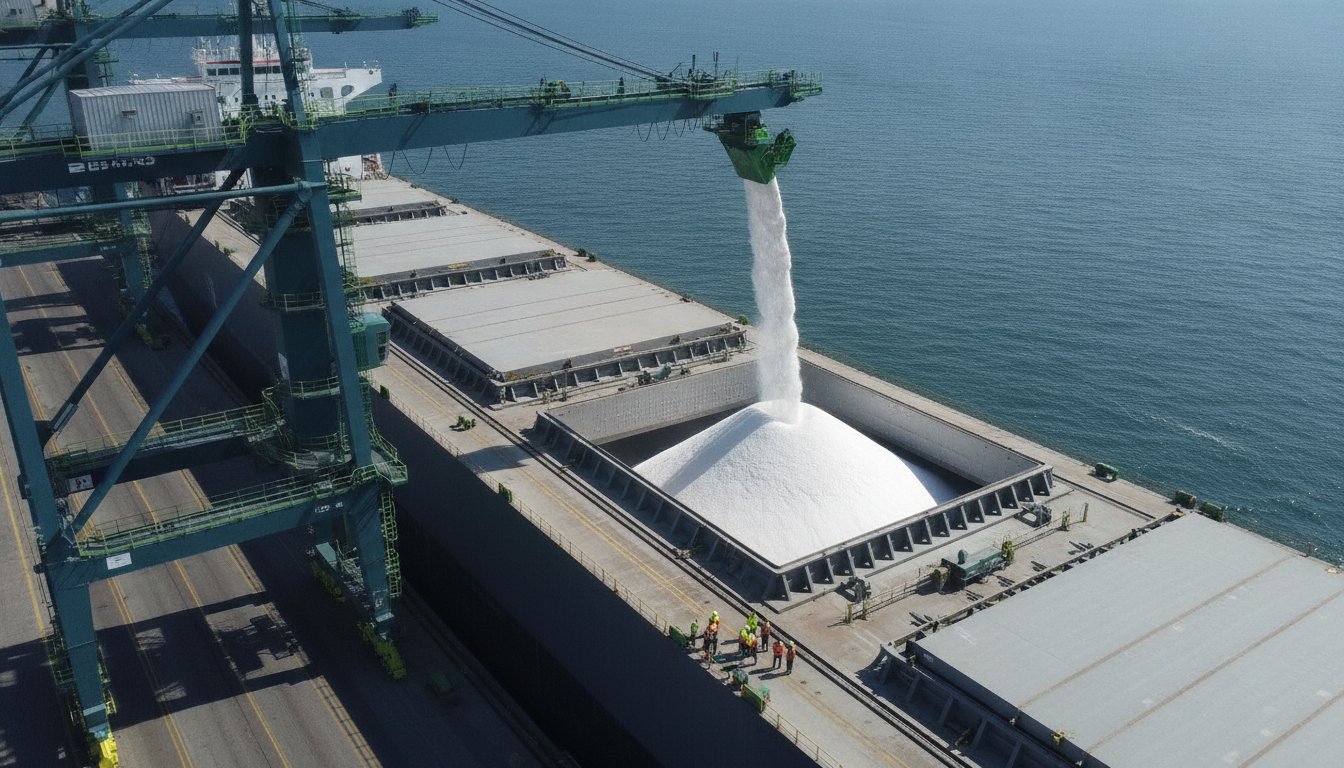
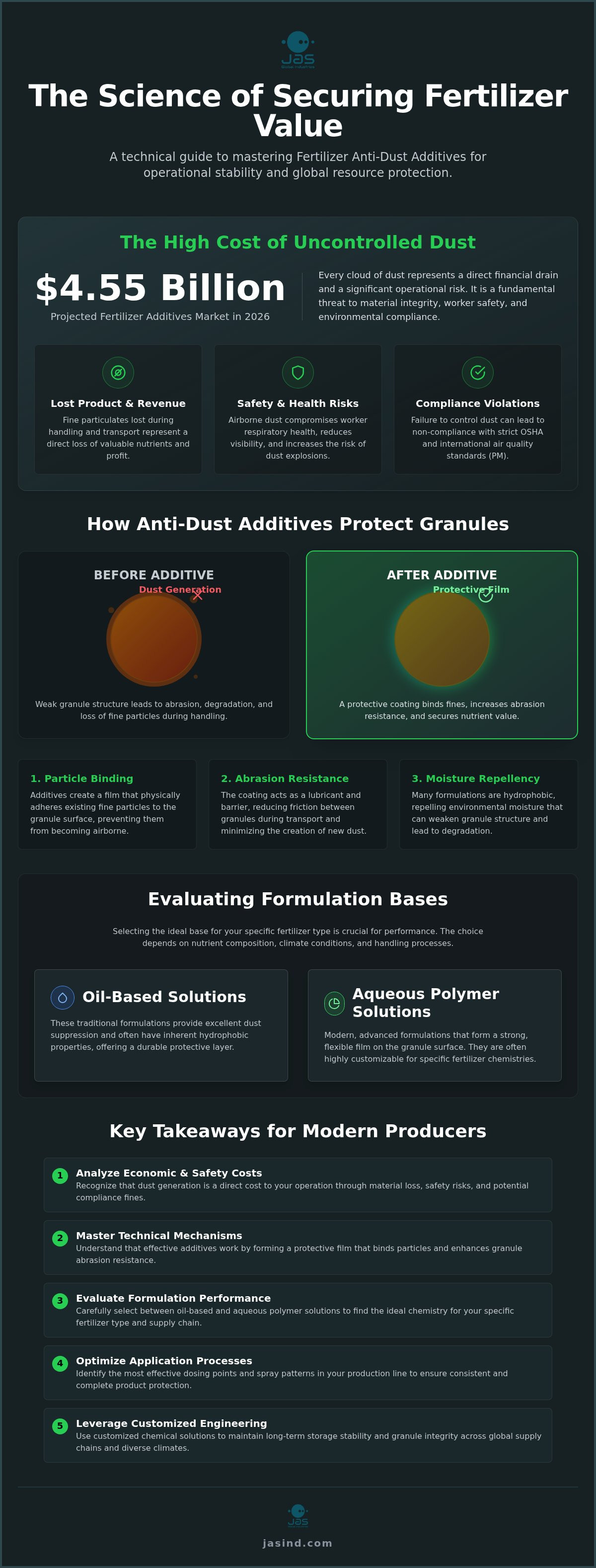
The global fertilizer additives market is projected to reach $4.55 billion in 2026. This growth reflects a critical industry shift toward material integrity and resource security. Every cloud of dust represents lost nutrients, a compromise to worker safety, and a threat to environmental compliance. For the modern producer, managing these particulates is not a secondary task. It is a fundamental requirement for operational stability. Integrating advanced Fertilizer Anti-dust Additives into your manufacturing process is now a strategic necessity for any organization committed to global resource protection.
You likely recognize the operational strain caused by product loss during bulk handling and the persistent risk of non-compliance with air quality standards. These challenges demand more than a generic solution; they require a sophisticated approach to chemical engineering. This article will help you master the science of anti-dusting agents to secure your product value and ensure a zero-dust handling environment. We will explore how specialized formulations enhance granule abrasion resistance and provide the storage stability needed to maintain product quality across vast distances and diverse climates.
Key Takeaways
- Analyze the significant economic and safety costs of dust generation during bulk handling and maritime transport.
- Master the technical mechanisms of Fertilizer Anti-dust Additives, focusing on how film-forming coatings prevent granule degradation.
- Evaluate the performance differences between oil-based and aqueous polymer solutions to select the ideal base for your specific fertilizer type.
- Optimize your application process by identifying the most effective dosing points and spray patterns for consistent product protection.
- Leverage customized chemical engineering to maintain long-term storage stability and granule integrity across global supply chains.
The Industrial Importance of Fertilizer Anti-dust Additives
Fertilizer Anti-dust Additives are specialty chemical coatings engineered to bind fine particles to the surface of granules. These formulations act as a protective skin. They prevent the degradation of the Fertilizer product during the rigorous journey from the production plant to the soil. Without these agents, the physical integrity of the nutrient carrier collapses. This leads to significant material loss and operational inefficiency. By stabilizing the granule surface, these additives ensure that the intended nutrient payload actually reaches the field.
Dust is more than a nuisance. It's a direct financial drain. During ship loading and bulk transport, fine particulates are easily lost to the wind or settled at the bottom of holds as unusable "fines." This represents a measurable percentage of the total cargo value disappearing before it reaches the end user. For high-volume producers, these losses translate into substantial wasted resources and diminished profit margins. Protecting the product means protecting the bottom line.
Compliance and safety define modern industrial leadership. Strict OSHA limits and international air quality standards for particulate matter (PM) require rigorous dust control. High concentrations of airborne dust compromise worker respiratory health and reduce visibility in handling facilities. By implementing effective Fertilizer Anti-dust Additives, companies mitigate these risks. They transform hazardous work zones into stable, secure environments where safety and productivity coexist. This commitment to safety reflects a broader responsibility toward the workforce and the environment.
Dust Generation in Fertilizer Production
Dust isn't accidental. It's a byproduct of the production cycle. Mechanical abrasion occurs during granulation and screening as particles collide and rub together. Thermal stress and moisture migration during storage further weaken the structure of the granule. If granule hardness is insufficient, the material simply cannot withstand the friction of conveyor transfer points or the weight of bulk stacking. Consistent protection starts with understanding these mechanical vulnerabilities and applying a coating that can withstand industrial stress.
The Environmental and Operational Mandate
Industrial security requires proactive risk management. In confined storage areas, high dust concentrations create a significant risk of dust explosions. Effective suppression also prevents cross-contamination in multi-nutrient blending facilities; it ensures that specific formulations remain pure. Beyond safety, using these additives enhances brand value. Delivering a "clean," dust-free product signals quality and reliability to the global market. It establishes your organization as a responsible guardian of agricultural resources and a leader in sustainable production.
Mechanisms of Action: How Dust Suppressants Protect Granules
Effective dust suppression relies on sophisticated chemical engineering. Fertilizer Anti-dust Additives function through two primary pathways: binding existing fine particles and preventing the creation of new ones. By managing the surface energy of the granule, these additives ensure that small particulates stay attached rather than becoming airborne. This process is vital for maintaining Dust Control standards in high-volume facilities. Professional formulations don't just wet the surface; they transform the physical properties of the granule interface to provide a stable, long-lasting barrier.
One of the most critical advancements in this field is the synergy between dust suppressants and anti-caking agents. While anti-caking agents prevent the formation of crystal bridges between granules, anti-dusting agents provide a physical barrier that reduces mechanical friction. When used together, they offer comprehensive protection. They maintain the flowability of the product while simultaneously securing the surface against erosion. For producers handling complex blends, integrating these mining solutions and fertilizer technologies is the most reliable way to ensure long-term product stability.
Many modern formulations also possess hydrophobic properties. These coatings repel environmental moisture. This is essential because moisture absorption leads to granule softening. Soft granules are prone to crushing, which generates massive amounts of dust. A water-resistant barrier keeps the granule hard and intact throughout its storage life. It acts as a guardian against the humidity that often plagues maritime transport and tropical storage conditions.
Agglomeration vs. Coating
Liquid suppressants use surface tension to pull fine particles into the liquid phase on the granule surface. This is agglomeration. Advanced additives also penetrate micro-fissures. They act like a structural adhesive. This reinforces the granule's integrity from the inside out. Short-term suppression might rely on simple wetting, but long-term efficacy requires the formation of a durable, non-tacky film that resists evaporation and environmental degradation.
Enhancing Abrasion Resistance
The performance of a coating is often measured by the Friability Index. A high-quality Fertilizer Anti-dust Additives formulation significantly reduces the amount of "secondary dust" created during downstream logistics. This is the dust formed when granules rub against each other in silos or during conveyor transfers. Testing methods like the rotary drum test verify that the coating remains uniform and durable under stress. Consistent coverage ensures that every granule is protected, regardless of the mechanical challenges it faces during distribution.
Evaluating Fertilizer Anti-dust Formulation Bases
Choosing the correct chemical base for Fertilizer Anti-dust Additives is a strategic decision that directly impacts operational reliability. It's not a simple choice of cost; it's a matter of technical alignment between the additive and the granule's unique chemistry. While some producers prioritize immediate price points, others focus on the long-term stability required for global maritime transit. Particle science innovations emphasize that facility safety and product integrity are inextricably linked to how these formulations behave under industrial stress. Selecting the wrong base doesn't just waste money; it compromises the security of the entire supply chain.
Oil and Wax-Based Formulations
Mineral oil bases have served as the traditional industry standard for decades. They're valued for their immediate efficacy and relatively low cost. However, the industry is seeing a shift toward vegetable oil bases as environmental biodegradability becomes a corporate mandate. Mineral oils provide a consistent barrier but can leave an oily residue on application equipment, leading to increased maintenance cycles. Temperature sensitivity is another critical factor. In colder climates, the viscosity of these oils can increase dramatically, resulting in poor spray patterns and uneven coverage. Conversely, in extreme heat, the oil may migrate into the granule, leaving the surface vulnerable to abrasion and dust formation.
Advanced Synthetic and Bio-Polymers
Aqueous polymer solutions represent a significant leap in performance, especially for hygroscopic fertilizers like Urea and Ammonium Nitrate. These modern additives are often non-corrosive, which protects the lifespan of your coating drums and conveyor systems. They're also highly compatible with coloring agents, allowing for a seamless integration of aesthetic and protective functions. Most importantly, synthetic polymers are increasingly designed for REACH compliance. This shift toward sustainable industrial chemistry ensures that your operations meet the highest global standards without sacrificing the film-forming durability needed for long-term storage.
Bio-based solutions, such as those derived from lignin, offer a compelling path for organizations focused on sustainability. These formulations balance environmental responsibility with operational performance. However, "off-the-shelf" chemicals often fail when faced with extreme industrial conditions. A formulation that performs well in a controlled laboratory setting may lose its efficacy during a high-humidity voyage through the Middle East. Custom-tailored formulations, developed in specialized R&I centers, are the only reliable way to account for local climate challenges and specific material characteristics. This bespoke approach ensures that the protective barrier remains intact from the plant to the final application point.
Operational Guidance: Application and Dosing Best Practices
Implementing Fertilizer Anti-dust Additives effectively requires more than high-quality chemistry; it demands precise mechanical integration. The most reliable results usually occur within coating drums. The tumbling action inside these drums ensures that every granule surface receives uniform contact with the additive. While applying suppressants at conveyor transfer points is a common alternative, it often fails to provide the same level of encapsulation. Without complete coverage, unprotected surfaces will continue to shed particulates during bulk transport. Additionally, storage and handling of the chemicals themselves are vital. These agents should be kept in temperature-controlled environments to prevent phase separation or premature polymerization before they reach the spray manifold.
Nozzle selection serves as the heart of the delivery system. High-pressure hollow cone or flat fan nozzles are preferred to create a fine mist. This mist increases the effective surface area of the additive, allowing for lower dosing rates without compromising the protective film. Calibration shouldn't be static. It must be dynamic, accounting for the specific fertilizer grade and the concentration of fines present in the raw material. A "one-size-fits-all" dosing strategy leads to either wasted product or insufficient protection, both of which undermine the security of your supply chain.
Integrating Dosing Systems
Process consistency relies on automated dosing systems. Manual control is too reactive and often results in "dry" spots or over-application that can lead to caking. For high-viscosity formulations, pre-heating is essential. It lowers the viscosity to ensure a consistent spray pattern even when ambient temperatures fluctuate. Maintenance protocols must be strict. Regularly cleaning spray manifolds prevents the buildup of dried additive, which can distort spray patterns and lead to uneven coating across the production batch.
Quality Control and Performance Monitoring
Immediate feedback is vital for maintaining operational security. On-site dust tower testing allows your team to verify the performance of the Fertilizer Anti-dust Additives in real-time. By monitoring consumption rates against production volume, you can optimize costs while ensuring product integrity remains high. Common troubleshooting issues, like nozzle clogging, are usually symptoms of improper filtration or inadequate temperature control. Addressing these at the plant level prevents larger failures during global maritime transit. To ensure your facility is running at peak efficiency, consult with our technical specialists to audit your dosing infrastructure and optimize your application strategy.
Securing the Supply Chain: The JAS Global Advantage
JAS Global Industries operates as a vital pillar of modern infrastructure. We don't just sell chemicals. We provide security. Since 1998, our organization has focused on the fundamental needs of society by protecting the integrity of critical resources. Our Fertilizer Anti-dust Additives are the result of decades of technical industrial expertise. They're developed within our own R&I centers to solve the specific challenges of bulk material handling. We move beyond chemical supply to offer comprehensive technical audits. These audits identify process gaps and optimize application efficiency, ensuring your investment delivers maximum protection.
We leverage our deep history in mining solutions to address the complexities of phosphate and potash production. These industrial sectors require specialized chemistry to maintain stability across vast distances. Off-the-shelf products can't account for the unique mineralogy of your raw materials. We develop tailor-made formulations that respond to your specific industrial conditions. This bespoke approach ensures that your granules remain intact, whether they're stored in the humidity of the Middle East or transported through the variable climates of Europe. By stabilizing these essential nutrients, we help secure the stability of the global agricultural supply chain.
Global Reach and Technical Support
Our presence is global. Our support is local. We maintain manufacturing and research facilities across the Middle East, Africa, Asia, and Europe. This geographic footprint ensures logistical reliability for every contract. We understand the specific maritime transport challenges that dusty fertilizers face during long-haul voyages. Our teams perform on-site laboratory testing to refine your dosing strategies and monitor additive performance under real-world conditions. This collaborative model allows us to develop sustainable chemical management plans that align with your environmental goals while maximizing operational efficiency.
The Guardian of Industrial Flow
We act as the guardian of industrial flow. Protecting the integrity of essential global resources is our mission. We understand that a stable fertilizer supply chain is the foundation of global food security. Reliability is not a goal; it's our standard. We provide the technical consulting necessary to ensure your product maintains its value from the moment it leaves the plant until it reaches the field. We invite you to move beyond transactional relationships and embrace a long-term technical partnership. Consult with our technical experts for a custom audit to see how we can optimize your production and secure your product's value.
Securing the Future of Industrial Nutrient Flow
The shift toward high-performance Fertilizer Anti-dust Additives is more than an operational upgrade. It's a commitment to global resource security and worker protection. By mastering the science of film-forming coatings and optimizing dosing systems, producers secure their product value against the rigors of bulk transport. Generic solutions often fail when they're faced with extreme industrial stress. Long-term success requires the technical precision found only in tailor-made formulations developed for specific climate challenges and material characteristics.
JAS Global Industries brings over 25 years of industrial chemical expertise to every partnership. Our global R&I centers develop custom solutions that are already trusted by major mining and fertilizer operations worldwide. We act as a foundational industry presence, focused on the fundamental needs of society through reliability and innovation. We stand ready to help you transform your handling environment into a zero-dust facility while ensuring your product reaches its destination in peak condition. Partner with JAS Global for Advanced Fertilizer Solutions and secure your operational reliability today. Let's build a more stable and efficient industrial future together.
Frequently Asked Questions
What is the difference between anti-dusting and anti-caking agents?
Anti-dusting agents are designed to bind fine particles to the granule surface and prevent mechanical abrasion during handling. In contrast, anti-caking agents prevent the formation of crystal bridges between granules that lead to clumping in storage. While they serve different functions, many producers use them together for comprehensive product protection. This dual approach ensures that the material remains both flowable and dust-free throughout the entire global supply chain.
How much anti-dust additive is typically required per ton of fertilizer?
Optimal dosing for Fertilizer Anti-dust Additives usually ranges from 0.5 to 1.5 kilograms per metric ton. The exact requirement depends on the concentration of fine particulates and the specific porosity of the fertilizer granules. Highly porous materials like certain NPK blends might require slightly higher application rates to achieve total surface encapsulation. Technical audits and on-site testing are the most reliable methods for determining the precise dosage needed to minimize product loss.
Are fertilizer dust suppressants safe for use in organic farming?
Safety and compliance depend entirely on the chemical base of the suppressant. Many traditional mineral oil formulations aren't permitted in organic systems. However, bio-based alternatives derived from vegetable oils or lignin often meet the strict requirements of organizations like the Organic Materials Review Institute (OMRI). It's essential to verify the specific formulation against local organic standards before application. JAS Global Industries develops custom bio-polymer solutions to meet these evolving environmental and regulatory demands.
Can anti-dusting agents affect the nutrient release profile of the fertilizer?
Standard anti-dusting agents are applied as thin surface coatings and don't typically interfere with the nutrient release profile. Because they're designed for surface integrity rather than encapsulation for controlled release, they dissolve quickly once the fertilizer reaches moist soil. Some highly hydrophobic coatings might slightly slow initial dissolution in extreme cases, but this is rarely a significant factor in crop performance. Our R&I centers test every formulation to ensure that protective benefits don't compromise agronomic efficacy.
What is the shelf life of these chemical additives in industrial storage?
Most specialty anti-dusting chemicals have an industrial shelf life of 12 to 24 months when they're stored in their original, unopened packaging. To maintain performance, you should keep these additives in a cool, dry environment away from direct sunlight. Extreme temperature fluctuations can cause phase separation in certain oil-based formulations or premature polymerization in aqueous solutions. Regular inventory rotation and proper climate control in your storage facility ensure the product remains ready for immediate application.
How do temperature and humidity affect the performance of dust suppressants?
Environmental conditions significantly impact both application and long-term performance. High humidity can cause granules to absorb moisture and soften, which makes them more prone to crushing and dust generation. Temperature affects the viscosity of the additive; colder environments might require pre-heating to ensure a consistent spray pattern. High-performance Fertilizer Anti-dust Additives are engineered to remain stable across these variables, providing a durable barrier that resists degradation during maritime transport through diverse climate zones.
Is specialized equipment required to apply these additives?
Yes, achieving uniform coverage requires a dedicated dosing system. This typically includes a high-precision metering pump, a filtration unit, and a spray manifold equipped with specialized nozzles. These components are usually integrated into the coating drum or at specific conveyor transfer points. While the initial setup requires a technical investment, automated systems ensure process consistency and reduce chemical waste. Professional technical consulting can help you optimize your existing infrastructure for the most efficient delivery of these protective coatings.
How do these additives help in complying with environmental regulations?
These additives are essential for meeting strict particulate matter (PM) emission standards set by organizations like the EPA and OSHA. By binding fine particles to the granule surface, they prevent dust from becoming airborne during ship loading and bulk storage. This reduction in fugitive dust improves air quality in and around handling facilities. Compliance with these environmental mandates is not just a legal requirement; it demonstrates a commitment to sustainable industrial practices and worker respiratory health.