

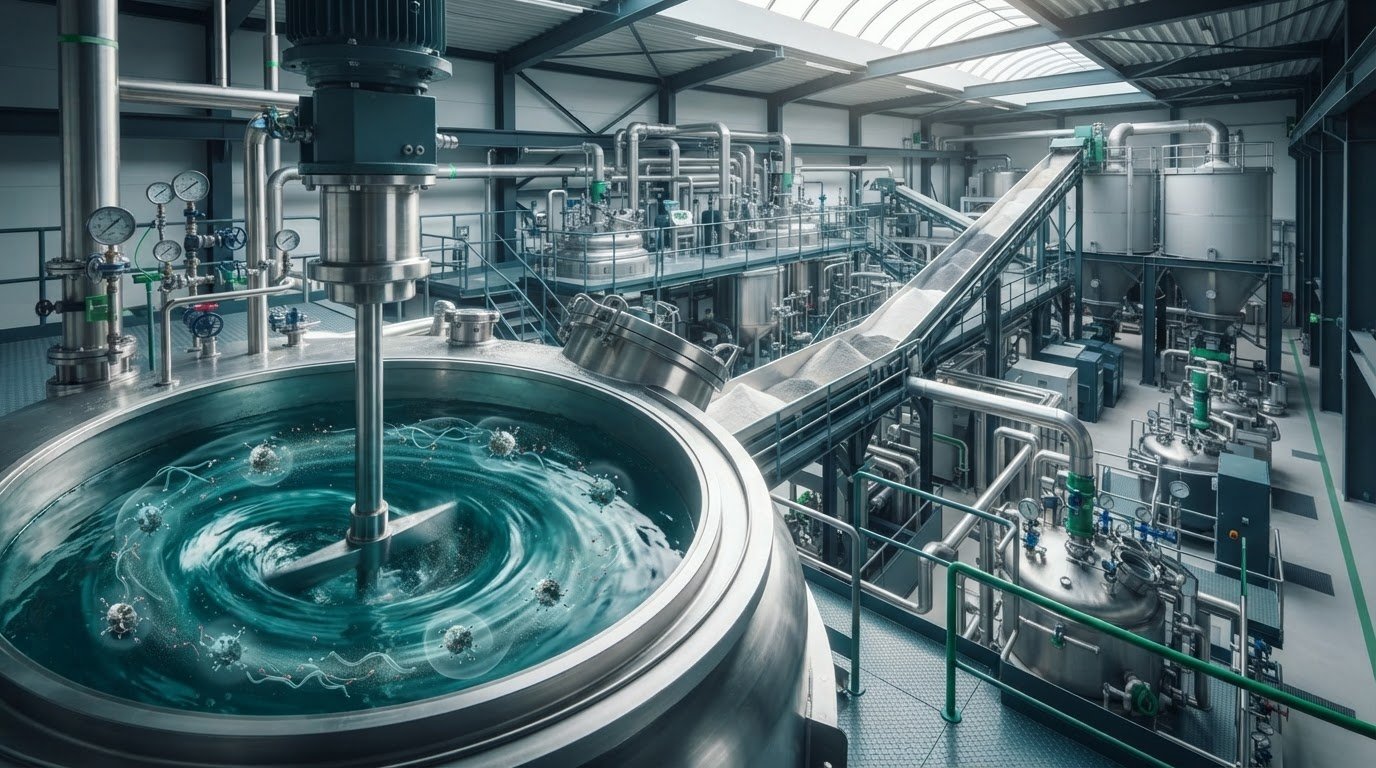
What if a dispersant that performs well in one formulation struggles in another? That difference is central to choosing dispersants: they help keep particles distributed, but results depend on particle chemistry, the surrounding liquid, and process conditions. Products described with the same broad label are not necessarily interchangeable, because their roles and performance demands can differ.
This guide explains how dispersants stabilize particles through mechanisms such as surface adsorption and electrostatic or steric repulsion. It also distinguishes dispersants from related agents and shows how their use varies across applications such as paints and coatings, mineral processing, and home care. You’ll learn what to assess, including compatibility, stability, viscosity, process conditions, and environmental requirements. Use these factors to evaluate performance in context rather than relying on a product label alone.
JAS Global Industries supplies dispersant agents and develops tailor-made specialty chemical formulations for industrial applications. A process-focused evaluation starts by defining what the particles and process need before comparing dispersant options.
Key Takeaways
- Dispersants help particles stay distributed, but the intended result depends on the material and medium.
- Wetting, particle separation, and resistance to re-agglomeration all contribute to dispersion stability.
- Distinguish dispersants from related chemical agents by their function and the process conditions they address.
- Assess performance through dispersion quality, settling, viscosity, redispersion, and compatibility with process conditions.
- Use process goals and system conditions to guide formulation development.
What Are Dispersants? The Core Function Behind Particle Stability
A dispersant helps particles or droplets remain distributed through a surrounding medium; it doesn’t dissolve them into that medium. The distinction matters. Dissolution produces a solution, while dispersion keeps separate material distributed within a liquid or another continuous phase. Depending on the system, this can reduce clumping, slow settling, and limit uneven concentrations during storage or processing.
Dispersion does not guarantee permanent stability. Particles may still settle, cluster, or separate if conditions change or the dispersant does not suit the materials and process. The practical goal is to manage separation enough to support the intended handling and performance, not to make suspended material disappear.
The term covers different uses because the materials being dispersed and the surrounding medium vary. A broad overview, including industrial products and oil-spill contexts, appears in What Are Dispersants? The shared function is to help distribute material; specific formulation requirements depend on the system.
What does a dispersant do in a suspension?
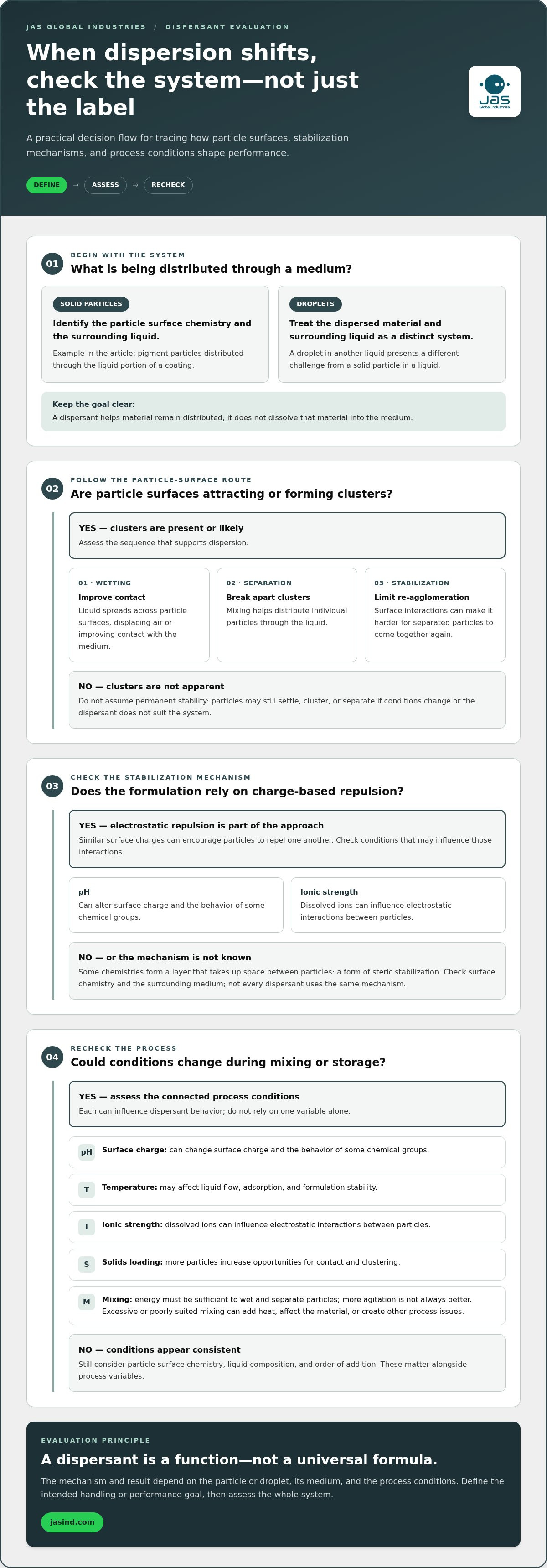
In a liquid suspension, the dispersed phase is the material spread through the continuous medium. For example, pigment particles may be distributed through the liquid portion of a coating. If particle surfaces attract one another, they can form clumps. Larger clusters may settle more readily, leaving the mixture less uniform from one part of a batch to another.
By helping particles remain separated and distributed, a dispersant can support consistent movement, mixing, and processing. This matters when material must flow through equipment or provide a uniform composition at the next stage. The result depends on the whole system, not simply on adding an agent.
Why does the term cover different chemical applications?
The target material and medium shape the job. A solid particle in a liquid presents a different challenge from a droplet in another liquid. Even two solid materials may behave differently because of their surface chemistry or surrounding conditions. “Dispersant” therefore describes a function, not one universal chemistry or a promise that one agent will work across materials.
Application-specific formulation may account for the medium, particle characteristics, and conditions during mixing or storage. These factors determine what performance means in practice: a uniform suspension, reduced clumping, or easier handling, for example. Defining the process need is the first step toward evaluating an appropriate dispersant.
How Dispersants Work: Surface Interactions, Separation, and Stability
Dispersion develops through a sequence of events at particle surfaces. A dispersant must interact effectively with both the material being distributed and its surrounding medium. The exact mechanism varies, but the practical aim is to help particles separate and reduce the chance that they will come together again.
- Wetting: The liquid spreads across particle surfaces, displacing air or improving contact between the solid and the medium.
- Separation: Mixing helps break apart clusters and distribute individual particles through the liquid.
- Stabilization: Surface interactions can make it harder for separated particles to re-agglomerate.
Surface interactions shape dispersion stability by influencing how readily particles separate and whether they remain apart in their medium. This sequence is a useful model, not a universal recipe. A formulation may rely on one mechanism, several mechanisms, or different behavior as process conditions change.
How surface interactions help separate particles
A dispersant may adsorb onto a particle surface, meaning molecules associate with that surface and alter how it interacts with the surrounding liquid or neighboring particles. Some chemistries create similar surface charges, encouraging particles to repel one another. Others form a layer that takes up space between particles, a form of steric stabilization. These are possible mechanisms, not features of every dispersant.
Think of particles like people in a crowded corridor. A clear route helps them move apart; a buffer between them can also discourage crowding. The analogy illustrates separation, but the actual mechanism depends on surface chemistry. It does not mean particles dissolve or that a particular degree of stability will follow automatically.
Why process conditions change dispersant performance
The same surface interaction can behave differently as the formulation changes. Assess conditions as a connected system rather than assuming one variable predicts the result:
- pH: Can alter surface charge and the behavior of some chemical groups.
- Temperature: May affect liquid flow, adsorption, and formulation stability.
- Ionic strength: Dissolved ions can influence electrostatic interactions between particles.
- Solids loading: A higher concentration of particles increases opportunities for contact and clustering.
- Mixing: Energy must be sufficient to wet and separate particles, but more agitation is not always better. Excessive or poorly suited mixing can add heat, affect the material, or create other process issues.
Material properties and medium composition matter alongside these variables. Particle surface chemistry, liquid composition, and the order of addition can all influence the outcome. A practical evaluation should therefore reflect actual processing conditions, not just a chemical’s behavior in isolation.
Oil-spill dispersants provide a distinct example of how mechanism and setting intersect. The EPA describes their use and factors that affect their application in its overview of dispersants. That context is specific to spill response; industrial suspensions require evaluation against their own materials and process conditions.
For industrial formulation development, JAS Global Industries’ specialty chemical solutions can be considered in relation to process goals and system conditions.
Dispersants Compared: Applications and Related Chemical Agents
The same broad function appears in different industrial settings, but the material to be distributed, the surrounding medium, and the process objective vary. The comparison below is a starting point, not a formula for choosing an additive. Each example describes a general industry use, not a claim about a specific product’s suitability.
| Application | Target material | Medium | Purpose | Key process variable |
|---|---|---|---|---|
| Paints and coatings | Pigment particles | Liquid coating formulation | Support even distribution and consistent handling | Pigment properties and formulation compatibility |
| Mineral processing | Mineral solids | Process liquid or slurry | Manage particle distribution during processing | Solids loading and slurry conditions |
| Industrial cleaning | Soil or particulate matter | Wash liquid | Help keep loosened material distributed in the liquid | Water composition and soil type |
| Construction materials | Fine mineral particles | Water-based mixture | Support workable, more uniform suspensions | Particle characteristics and mixing conditions |
These categories show why the application name alone cannot predict performance. A coatings formulation, for example, has different material and process demands from a mineral slurry. Broader surfactant terminology can help frame these distinctions; see this industrial surfactant chemistry guide brought to you by JAS Global Industries.
Dispersants, emulsifiers, and flocculants: what differs?
Dispersants generally help distribute solid particles or droplets through a medium. Emulsifiers address immiscible liquid phases, helping stabilize droplets of one liquid within another, such as oil dispersed in water. Flocculants encourage particles to gather into larger aggregates, often to support separation or settling. Their goals can differ or even be opposite. Terminology and performance depend on the formulation and process, so the intended outcome matters more than the label alone.
Where dispersants appear across industrial processes
Industrial uses include pigment distribution in coatings, solid handling in mineral processing, and keeping loosened particles distributed in cleaning liquids. Related applications can include construction materials and other process suspensions. In each case, the target material and medium determine what “effective” means, whether that is uniformity, processability, or a desired separation step.
Oil-spill response is a distinct context. There, agents are used to break surface oil into smaller droplets in water, and application decisions involve environmental and response considerations. That use should not be treated as interchangeable with routine formulation or industrial treatment. Comparing the objective, phases involved, and process conditions helps clarify whether a dispersant, emulsifier, or flocculant fits the task.
How to Evaluate Dispersant Performance in a Process
A useful evaluation starts with the process problem, not a preferred additive. Is the batch clumping, settling during storage, becoming uneven in use, or showing an unwanted change in viscosity? Define the issue first, then compare dispersants under conditions that reflect the actual process. A result matters only if it addresses the operational need without creating a new limitation.
Set process goals and establish a baseline
Before changing the formulation, record the material properties and operating conditions that could affect the outcome. Note the medium, solids loading, mixing method, temperature, pH, and how long the mixture is handled or stored. Choose observable measures that match the problem, such as visible uniformity, settling, or flow behavior. This baseline makes later comparisons more meaningful.
- Define the problem: Describe the unwanted result and identify where it occurs in the process.
- Characterize the system: Record relevant material properties, medium composition, and operating conditions.
- Choose measures: Select criteria that reflect the process goal, such as dispersion quality, settling behavior, viscosity, or ease of redispersion.
- Run controlled trials: Compare samples under representative conditions, changing one relevant parameter at a time so the effect of each change is easier to interpret.
- Review the results: Consider performance over the relevant handling or operating period, not only immediately after mixing.
Use the same preparation and observation methods for each sample. For example, if settling is the concern, record how samples behave during the same storage interval and whether settled material can be redispersed using the process’s normal mixing conditions. If viscosity is critical, assess it alongside distribution quality: a visually uniform sample may still be unsuitable if it does not handle properly.
Run application-relevant tests and interpret results
Trials should reflect the process as closely as practical, including mixing sequence, equipment conditions, and the intended period of use or storage. Compare candidate samples against the baseline and review several measures together. A change in one result may affect another, so interpret dispersion, settling, viscosity, and redispersion as a connected performance picture.
Dosage, measurement methods, and acceptance criteria must be specific to the application. A test that suits one suspension may not represent another material or medium, and there is no universal threshold for a successful result. Include formulation compatibility, worker safety, and applicable environmental requirements in the assessment. A technically effective option still needs to fit the broader process and its safeguards.
JAS Global Industries provides specialty chemical solutions and tailored formulation development for industrial applications. Explore JAS Global Industries’ solutions.
How JAS Global Industries Approaches Dispersant Solutions
Choosing dispersants for an industrial process starts with understanding the process itself. The material, surrounding medium, operating conditions, and desired result all shape the formulation challenge. A dispersant that suits one system is not automatically appropriate for another, so development should begin with the specific objective rather than a broad assumption about product fit.
JAS Global Industries supplies dispersant agents and develops tailor-made specialty chemical formulations for industrial partners. A process-focused approach establishes what the system needs, identifies the conditions a formulation must function in, and uses those requirements to guide development.
From process challenge to tailored formulation
A needs-led discussion can begin by defining the target material and medium, describing how the mixture is prepared and used, and clarifying the performance objective. Is the priority distribution, handling, or another defined process outcome? These details help frame technical evaluation and formulation development around the system, rather than presuming that one chemistry or solution fits every application.
This approach connects formulation evaluation with process-optimization goals. It does not imply a universal outcome. The intended role and suitability of any formulation depend on the specific industrial conditions and the requirements established for the application.
Building a long-term industrial partnership
JAS’s work across industrial sectors provides context for partnerships built around process needs. The company operates multiple research and innovation centers and manufacturing plants. These are company-wide capabilities, not a claim that a particular dispersant formulation has a specified feature or performance. They form part of JAS’s broader specialty-chemical presence and its work with industrial partners.
A constructive technical review can keep operational and stewardship considerations in view alongside performance goals. Relevant discussion may include process compatibility, safe handling requirements, and applicable environmental considerations. Addressing these factors as part of the project context helps ground formulation decisions in the realities of industrial use, without assuming that one solution or evaluation applies to every system.
For industrial teams, a clear account of the process challenge creates a useful starting point for a tailored formulation conversation. Describe the material, medium, operating conditions, and outcome the process requires. JAS Global Industries’ specialty chemical solutions provide a way to explore its work with industrial partners and process-specific formulation development.
Turn Process Insight into Your Next Step
Turn what you’ve learned about your process into a clear working brief. Record the outcome you need, the conditions a formulation must handle, and the trade-offs your operation can accept. That gives technical discussions a practical starting point and keeps attention on fit rather than assuming all dispersants address the same process challenge.
Keep the brief grounded in operational priorities: reliable handling, consistent production, appropriate safety measures, and responsible chemical management. As the process evolves, use operating feedback to revisit priorities and refine evaluation criteria. Selection becomes a disciplined part of process improvement, not a one-time guess.
JAS Global Industries brings specialty-chemical experience and tailored formulation development to industrial partners. Explore how the company’s capabilities may relate to your process goals.
Explore JAS Global Industries’ specialty chemical solutions and share the process challenge you want to address.
Frequently Asked Questions
What is a dispersant?
A dispersant is an additive used to help particles or droplets stay distributed in a surrounding medium. In a process, that can help limit visible clumps or uneven concentrations, but it does not turn the dispersed material into a dissolved substance or guarantee stability indefinitely. For example, a process team might use the term for an additive intended to support a more uniform mixture during a defined production or handling stage.
How do dispersants work?
Dispersants interact with material surfaces and the medium around them. Depending on their chemistry, they may improve how liquid contacts particles or help discourage particles from gathering again. Mixing contributes by bringing materials together and helping distribute them, but agitation alone does not determine the outcome. In practice, consider when the additive enters the process and whether the mixing sequence gives it a chance to function as intended.
Are dispersants the same as surfactants?
No. A surfactant is a broad class of compounds that influence interfaces, while “dispersant” describes a role in a formulation. Some dispersants are surfactants, but the terms are not interchangeable. For formulation discussions, clarify what the ingredient is expected to do: affect surface tension, help distribute particles, or support another function. One compound may serve more than one role, depending on the system.
What is the difference between a dispersant and an emulsifier?
A dispersant is generally used to distribute material through a medium, while an emulsifier commonly helps maintain a mixture of liquids that do not readily mix, such as oil and water. The distinction is useful when identifying which phase needs support. If a formulation includes both solid particles and immiscible liquids, a single label may not explain all ingredient functions; consider each target phase and the desired result.
Can one dispersant work for every industrial application?
No. A formulation suited to one material and medium may not behave the same way in another. Even a change in raw-material source or process water can alter the conditions a formulation must handle. Treat a change in material, medium, or operating setup as a reason to review fit, rather than assuming previous results will carry over. Application-specific trials help inform that decision.
Are dispersants used only for oil spills?
No. Oil-spill response is one context, but dispersing functions also appear in industrial formulations and processes. The purpose and decision criteria differ: spill response involves a specific environmental and operational setting, while an industrial formulation is assessed against its own use and process requirements. Keep those contexts distinct. Information about one setting should not be taken as evidence of suitability in another.
What should be measured when testing a dispersant?
Measure what matters at the point the mixture is used, not only right after preparation. Depending on the process, assess uniformity at relevant sampling points, flow behavior during transfer, or whether material can be brought back into use after standing. Compare results with an untreated or existing formulation baseline where appropriate. Use consistent sampling and handling so observed differences reflect the formulation, not changes in the evaluation procedure.