

Did you know that liquid formats now represent nearly 70% of the total laundry category volume in the United States? As the global market value reaches $50.76 billion in 2026, the technical demands on these formulations have reached a critical tipping point. Choosing the right co-polymer for liquid laundry detergent is no longer a simple additive decision. It's the essential foundation for structural stability and consumer trust.
We recognize that achieving consistent whiteness retention while managing hard water conditions is a persistent challenge for industrial formulators. You're likely balancing the need to eliminate phosphates with the pressure to maintain shelf stability across varied climates. This guide reveals how advanced co-polymer chemistry optimizes soil suspension, prevents redeposition, and protects the structural integrity of high-performance detergents. We'll analyze the shift toward sulfonated monomers for superior electrolyte tolerance and explore how to align your formulations with the latest EU 2026 regulatory milestones for biodegradability and safety.
Key Takeaways
- Understand the physics of electrostatic repulsion to stop soil migration and prevent fabric graying during the rinse cycle.
- Identify the critical performance differences between cost-effective acrylic-maleic systems and a specialized sulfonated co-polymer for liquid laundry detergent.
- Master formulation engineering techniques, including strategic addition sequences, to ensure long-term shelf stability in concentrated liquid matrixes.
- Optimize detergent performance in hard water and cold-water cycles by leveraging advanced crystal-growth inhibition chemistry.
- Access technical expertise from global R&I centers to customize polymer systems for specific regional climates and regulatory frameworks.
The Strategic Role of Co-polymers in Modern Liquid Laundry Detergents
Co-polymers are multi-functional macromolecules engineered to govern soil behavior within a wash liquor. Unlike simple surfactants that lower surface tension, these polymers act as sophisticated managers of particulate matter. By integrating polycarboxylate builders and copolymers, formulators create a chemical architecture that handles complex soils while protecting the textile surface. They don't just clean; they preserve the integrity of the fabric and the formula itself.
The transition from powder to liquid formats has fundamentally changed formulation requirements. While powders often rely on insoluble builders like zeolites, liquid detergents require fully soluble components that remain stable over long periods. This shift makes the choice of a co-polymer for liquid laundry detergent a critical decision for any manufacturer. These polymers ensure that the detergent remains a clear, homogenous liquid rather than a separating mixture on the retail shelf.
Sustainability and economic value are now inextricably linked. Modern co-polymers enable high-performance cleaning at temperatures as low as 20°C, which significantly reduces household energy consumption. Economically, these macromolecules allow manufacturers to reduce total surfactant loads without losing cleaning efficacy. This compaction strategy reduces shipping weights and plastic waste, which directly supports global environmental goals and improves profit margins.
Defining the Liquid Detergent Matrix
Maintaining stability in an aqueous surfactant system is a delicate balancing act. Liquid formulas face higher risks of hydrolytic degradation compared to dry powders, requiring polymers with exceptional chemical resilience. As the industry moves toward 2X and 4X concentrated liquids, the ionic strength of the matrix increases. This high-electrolyte environment can cause standard polymers to "salt out" or trigger phase separation. Modern co-polymers must demonstrate high tolerance to these concentrated surfactant blends to ensure a long shelf life in varied climates.
Primary Functions: Beyond Simple Cleaning
Cleaning is only the first step in a high-performance cycle. Preventing soil from returning to the fabric is where true quality is defined. Co-polymers provide essential soil suspension, keeping dirt particles floating in the wash water so they're rinsed away rather than redeposited. They also manage calcium and magnesium ions in hard water, preventing the precipitation of insoluble salts that cause fabric graying. Co-polymers serve as the structural guardians of the detergent formula, ensuring that every active ingredient performs its intended role without compromising the stability of the whole.
Mechanisms of Action: How Co-polymers Prevent Soil Redeposition
Soil redeposition occurs most frequently during the rinse cycle. As surfactant concentrations drop below the critical micelle concentration, detached dirt loses its stability in the wash liquor. Without intervention, these particles migrate back to the fabric. This is why a high-performance co-polymer for liquid laundry detergent is indispensable. It manages the interface between the fiber and the water, ensuring that soil stays suspended until it's flushed away. These macromolecules act as the primary defense against the gradual loss of fabric brightness.
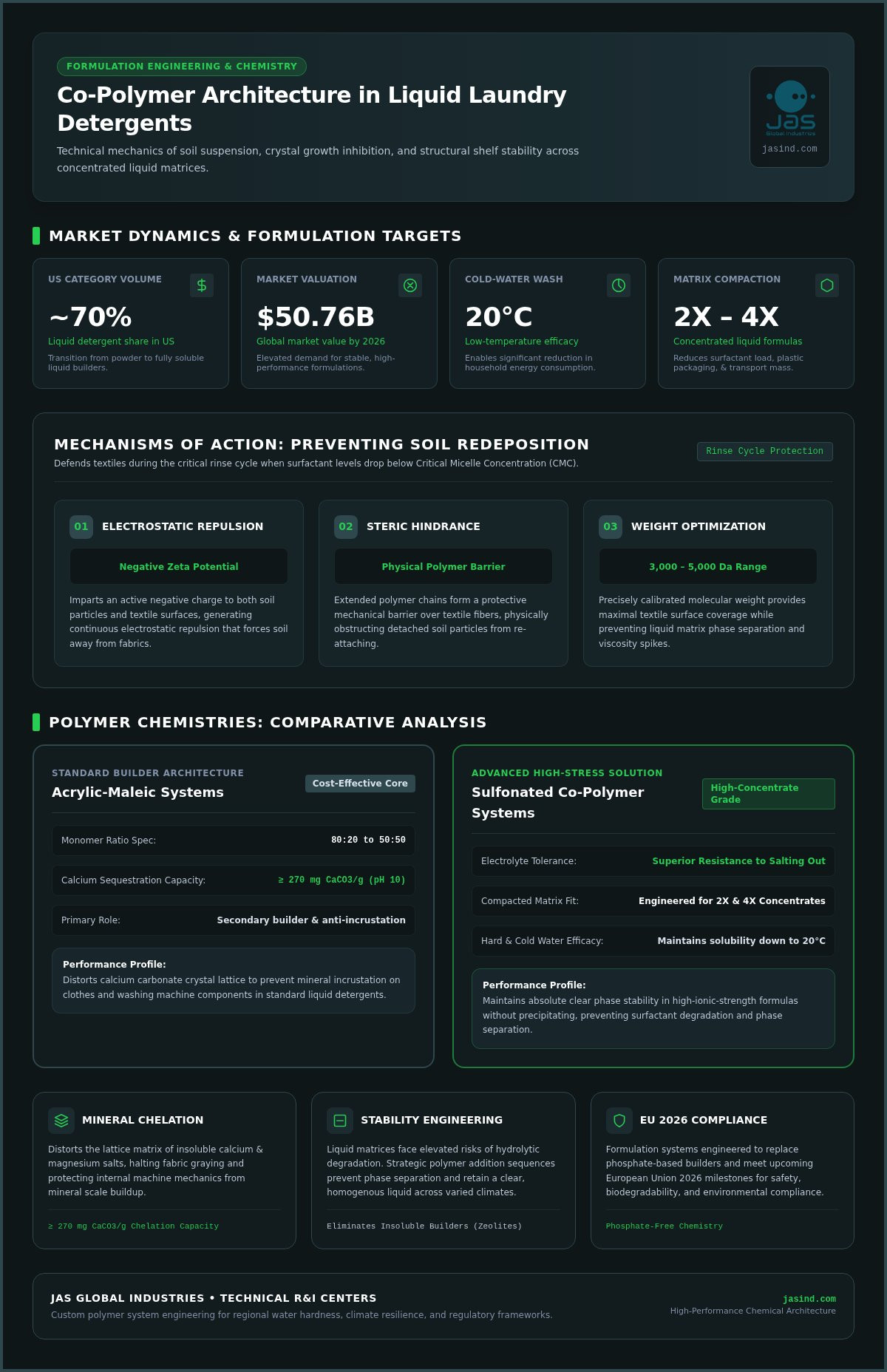
These polymers work through two primary physical mechanisms. First, they impart a negative zeta potential to both the soil and the fabric. This creates electrostatic repulsion, forcing particles away from the textile. Second, the polymer chains provide steric hindrance. They form a physical barrier that prevents soil re-attachment. By maintaining a molecular weight between 3,000 and 5,000 Da, these polymers stay effective without causing phase separation in the bottle. This specific weight range is optimized to provide maximum coverage on the fabric surface without increasing formula viscosity to unmanageable levels.
Crystal growth inhibition is another vital function. Co-polymers distort the crystal lattice of minerals like calcium carbonate. This prevents incrustation, which is the buildup of hard minerals on clothes and internal machine components. Formulations utilizing an acrylic-maleic monomer ratio between 80:20 and 50:50 achieve a calcium sequestration capacity of at least 270 mg CaCO3/g at pH 10. This ensures that even in hard water, the detergent maintains its cleaning power and protects the longevity of the washing machine.
The Chelation Effect
Co-polymers serve as vital secondary builders. They support or replace traditional phosphates and zeolites, which are increasingly restricted by environmental regulations. Through threshold inhibition, they stop the formation of inorganic salts even at low concentrations. These solutions often align with EPA Safer Choice polymer criteria to ensure environmental safety alongside performance. This dual role of builder and stabilizer makes them a cornerstone of responsible, high-efficiency detergent design.
Dispersion and Soil Suspension
Keeping hydrophobic soils emulsified is critical for maintaining whiteness. Co-polymers prevent the gradual graying of fabrics that typically occurs over multiple wash cycles. They work in close synergy with surfactant systems to enhance overall detergency. While surfactants excel at lifting oils, the co-polymer ensures those oils don't sink back into the fibers. For manufacturers seeking to optimize these interactions, consulting with an experienced anti-redeposition agent supplier can resolve complex stability hurdles.
Comparing Co-poly-mer Chemistries: Acrylic-Maleic vs. Sul-fonated Systems
The choice of co-poly-mer for liquid laundry detergent often dictates the success of a high-performance formula. While several chemistries exist, the industry primarily oscillates between traditional acrylic-maleic systems and advanced sul-fonated co-poly-mers. Each chemistry offers distinct advantages in chelation, solubility, and soil management. Selecting the right backbone requires a deep understanding of the intended wash environment and the surfactant matrix.
Acrylic Maleic Co-poly-mer Performance
Acrylic-maleic co-poly-mers are the established baseline for cost-effective chelation. With a monomer ratio typically ranging from 80:20 to 50:50, these poly-mers provide excellent calcium sequestration. They demonstrate robust thermal and hydrolytic stability during the production of liquid detergents. This resilience makes them highly compatible with enzymes and bleaching agents in heavy-duty liquids. Performance usually plateaus once the poly-mer reaches its saturation point in the wash liquor. For standard household liquids, they remain the most economical choice for basic anti-redeposition.
The Rise of Sul-fonated Poly-mers
Sul-fonated monomers, such as 2-acrylamido-2-methylpropane sulfonic acid (AMPS), are transforming modern formulations. These monomers remain fully ionized across a wide pH range from 3 to 11. This permanent ionization prevents the poly-mer from "salting out" in the high-ionic-strength environments of 2X or 4X concentrates. Sul-fonated systems offer superior electrolyte tolerance compared to their acrylic-maleic counterparts. They are particularly effective in industrial and institutional (I&I) cleaners where heavy soil loads and hard water are constant variables.
Modified poly-carboxylates provide another layer of customization by allowing formulators to tailor hydrophobicity. This is essential for targeting specific oily soils that standard carboxylates might miss. When evaluating a co-poly-mer for liquid laundry detergent, the decision hinges on the specific surfactant matrix and the target market's water hardness. Compliance with EPA Safer Choice criteria for detergent polymers ensures that these high-performance additives meet stringent environmental safety standards. While sul-fonated systems require a higher initial investment, they significantly reduce the risk of phase separation and turbidity. This ensures the structural integrity of the detergent remains intact throughout its shelf life, even in extreme climates.
Formulation Engineering: Optimizing Stability in Concentrated Liquids
Engineering a stable liquid detergent requires more than just mixing active ingredients. As brands move toward ultra-concentrated formulas, the behavior of the co-polymer for liquid laundry detergent becomes the primary indicator of shelf stability. The selection of a high-purity polymer system is only half the battle; the engineering of the matrix determines the final product's success. Strategic incorporation is vital to prevent 'shock' precipitation, which occurs when a sudden change in ionic strength forces the polymer out of solution. Manufacturers should typically introduce the co-polymer after the water and primary surfactants but before the final electrolyte adjustments.
Managing the cloud point is another critical hurdle. Co-polymers can significantly influence the temperature at which non-ionic surfactants become insoluble and turn the formula turbid. If the polymer isn't perfectly compatible, it can lower this threshold, leading to visible phase separation in warmer climates. Viscosity control also requires a delicate balance. While some polymers provide a desirable thickening effect, they must not compromise the pourability of the finished liquid. Finally, ensuring compatibility with enzymes is non-negotiable. The polymer must be selected to avoid denaturing proteases or amylases, which are essential for high-performance stain removal.
Overcoming Phase Separation
Hydrotropes like sodium xylene sulfonate are often necessary to stabilize high-solids co-polymer loads in concentrated systems. High electrolyte concentrations can cause polymer chains to collapse from an extended conformation into a coiled state, which reduces their effectiveness and can trigger hazing. Precise pH adjustment is critical for co-polymer activation and ensuring long-term compatibility within the surfactant matrix. By maintaining the correct ionic environment, formulators can prevent the "salting out" effect that often plagues lower-quality liquids.
Testing for Long-Term Reliability
Stability must be verified through rigorous, data-driven protocols. Accelerated aging tests at 40°C to 50°C simulate months of shelf life in just weeks, exposing potential sedimentation or turbidity issues early. Manufacturers also assess whiteness retention through standardized multi-wash cycles using carbon black and clay soils to confirm the polymer's anti-redeposition efficacy. Managing raw water variability during production is another critical step. By integrating industrial water treatment principles, producers can ensure that seasonal changes in water hardness don't disrupt the delicate balance of the polymer system. For manufacturers navigating these complex formulation hurdles, partnering with a technical leader like JAS Global Industries ensures operational reliability and product excellence.
Advancing Global Home Care with JAS Global Industries
JAS Global Industries operates as more than a chemical supplier. We act as a technical consultant and a vital guardian of industrial stability. Since 1998, our organization has bridged the gap between complex chemical synthesis and practical manufacturing reliability. We provide the essential co-polymer for liquid laundry detergent that ensures your products maintain their integrity from the production line to the consumer's home. Our approach balances high-performance chemistry with a deep sense of global responsibility. Securing supply. Protecting performance.
We leverage a global network of manufacturing facilities in Riyadh, Alexandria, and Dubai to secure your supply chain. This presence across 11 countries and five continents allows us to manage logistics with precision, offering recurring supply contracts that protect your operations from market volatility. We don't just deliver chemicals; we optimize process efficiency. Our technical audits identify bottlenecks in your detergent plants, allowing for streamlined production and reduced waste. We view sustainability as a core pillar, developing cost-effective solutions that deliver high impact without environmental compromise.
Custom Formulations and Technical Support
Every regional market presents unique challenges in water hardness and soil types. Our Research and Innovation (R&I) centers specialize in custom formulations that address these variables directly. We conduct on-site laboratory testing to refine your dosing strategies, ensuring that every drop of active material performs at its peak. Our expertise includes developing specialized anti-redeposition agents tailored for specific fabric loads and industrial requirements. This localized focus ensures that your brand remains competitive and reliable, regardless of the geographic landscape.
Securing the Future of Industrial Home Care
Modern hygiene is a foundational pillar of global infrastructure. By providing high-purity specialty chemicals, JAS Global Industries supports the hygiene standards that protect communities worldwide. We see our role as a partner in the stabilization of global resources, ensuring that cleaning technologies remain effective and accessible. As the industry moves toward stricter regulations like EU 2026/405, our technical teams are already engineering the next generation of biodegradable dispersants. Your next step toward formulation excellence begins with a technical consultation. Contact JAS Global Industries to discuss large-scale optimization and secure a partnership rooted in reliability and wise leadership.
Securing Formulation Excellence for the Global Home Care Market
Achieving structural stability in concentrated liquids requires a precise balance of chemical architecture and process engineering. We've explored how the transition to sulfonated systems provides superior electrolyte tolerance and how strategic order of addition prevents shock precipitation. Selecting the right co-polymer for liquid laundry detergent is no longer just a performance upgrade; it's a requirement for shelf reliability and whiteness retention in hard water conditions. These macromolecules serve as the primary guardians against fabric graying and formula separation.
JAS Global Industries has specialized in specialty chemical solutions since 1998, providing the technical expertise needed to navigate these complex variables. Our global R&I centers offer tailor-made formulations and industrial process optimization to ensure your production remains efficient and reliable. Optimize your liquid detergent performance with JAS Global Industries' specialty co-polymers and secure a partnership rooted in stability and global leadership. We look forward to helping you build the next generation of high-performance cleaning solutions.
Frequently Asked Questions
What is the primary function of a co-polymer in liquid laundry detergent?
The primary function of a co-polymer for liquid laundry detergent is to act as an anti-redeposition agent and secondary builder. These macromolecules prevent detached soil from migrating back to the fabric during the rinse cycle. They also inhibit the growth of mineral crystals in hard water. By maintaining a negative charge on both dirt particles and textile fibers, the polymer ensures that contaminants remain suspended in the wash liquor until they are flushed away.
How do co-polymers differ from standard homo-polymers in detergent formulas?
Homo-polymers consist of a single monomer type, such as acrylic acid, which provides basic dispersing properties. In contrast, co-polymers combine two or more monomers, like acrylic and maleic acid, to enhance specific performance traits. This combination improves calcium binding capacity and electrolyte tolerance in concentrated liquid matrixes. Co-polymers are generally more effective at preventing scale formation and fabric graying than simpler homo-polymer structures, especially in challenging water conditions.
Can co-polymers completely replace phosphates in heavy-duty liquid detergents?
Co-polymers are essential components in modern phosphate-free detergents. While they don't always act as a direct 1:1 replacement for the cleaning power of phosphates, they successfully perform the critical functions of sequestration and soil suspension. When combined with other builders like citrates or zeolites, advanced co-polymer systems allow manufacturers to meet strict environmental regulations without sacrificing cleaning performance or whiteness retention in heavy-duty liquid formulations.
What is the typical dosage of an anti-redeposition agent in a concentrated liquid?
Typical dosage rates for a co-polymer for liquid laundry detergent range between 0.5% and 2.0% of the active material by weight. The precise amount depends on the surfactant concentration and the target water hardness of the regional market. Overdosing can lead to phase separation or increased formula viscosity, while underdosing results in poor whiteness retention. JAS Global Industries provides on-site laboratory testing to help manufacturers determine the optimal dosing strategy.
How do sulfonated co-polymers improve detergent performance in hard water?
Sulfonated co-polymers incorporate monomers that remain fully ionized across a wide pH range. This permanent charge prevents the polymer from "salting out" in the presence of high electrolyte concentrations or hard water ions like calcium and magnesium. These systems offer superior solubility and anti-scaling properties compared to standard carboxylates. They ensure the detergent remains effective in industrial settings where water quality varies significantly, protecting both the fabric and the washing equipment.
Why do some co-polymers cause phase separation in liquid detergents?
Phase separation often occurs when the co-polymer is incompatible with the surfactant system or when the electrolyte concentration is too high. This phenomenon, known as "salting out," causes the polymer chains to collapse and precipitate, leading to turbidity or sedimentation. Using a co-polymer with a molecular weight outside the optimal 3,000 to 5,000 Da range can also disrupt the delicate balance of the liquid matrix. Proper formulation engineering is required to manage these ionic interactions.
Are co-polymers compatible with protease and amylase enzymes?
Most modern co-polymers are fully compatible with protease and amylase enzymes. High-quality polycarboxylates are designed to be chemically inert toward these proteins, ensuring that the enzymes can still break down organic stains effectively. However, the order of addition during manufacturing is critical. Formulators must ensure the polymer system is stabilized before adding enzymes to prevent any potential denaturing. JAS Global Industries tests these interactions in our R&I centers to guarantee long-term enzymatic activity.
What are the environmental benefits of using advanced co-polymers in home care?
Advanced co-polymers enable the production of ultra-concentrated detergents, which significantly reduces plastic packaging and transportation emissions. They also allow for effective cleaning in cold-water cycles, lowering household energy consumption. By acting as high-performance builders, they facilitate the removal of phosphates from the water supply, reducing the risk of aquatic eutrophication. These chemical solutions support global sustainability goals by balancing industrial efficiency with responsible resource management and environmental protection.