


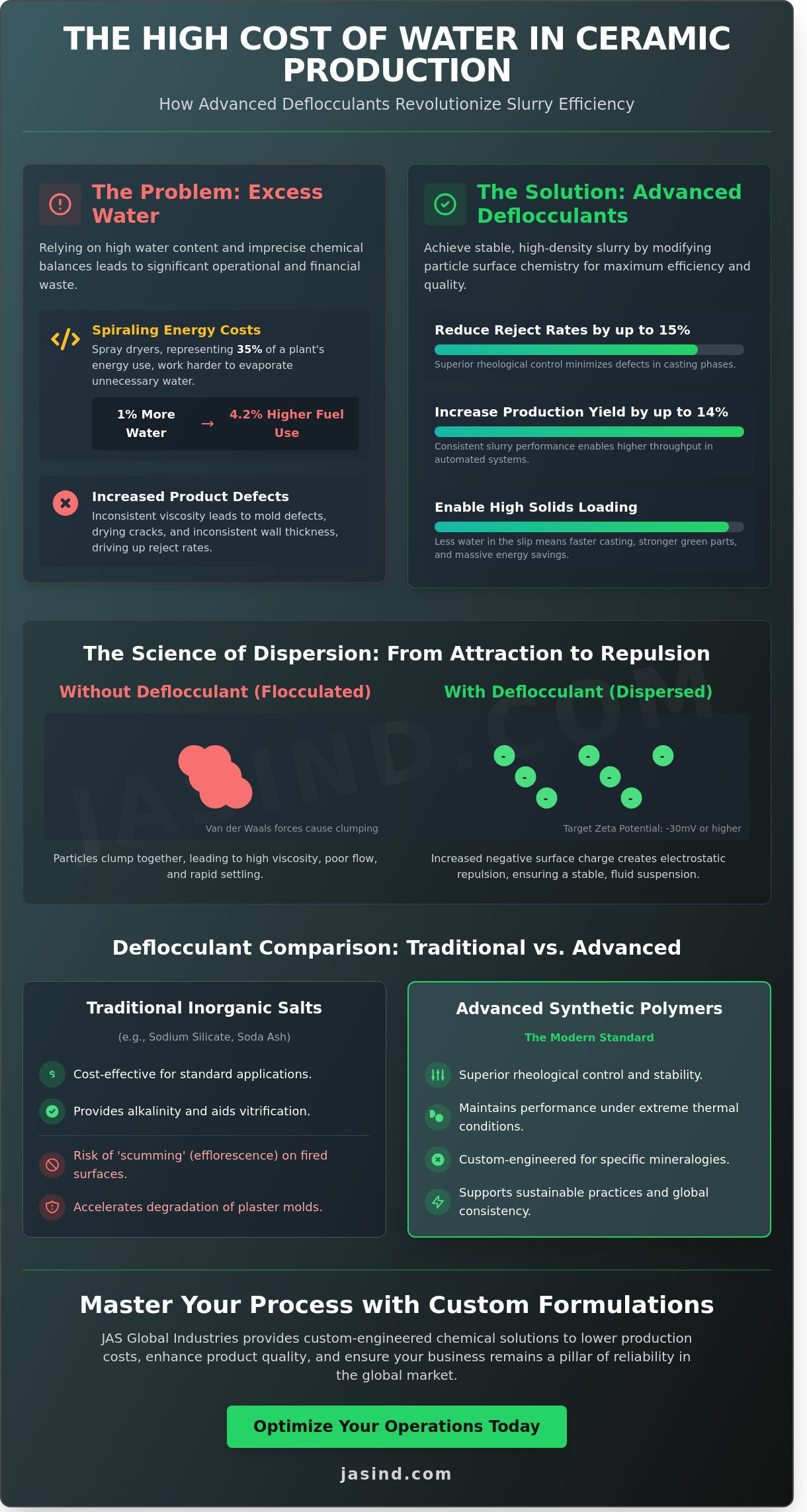
Every percentage point of excess water in your ceramic slurry isn't just a technical oversight; it's a direct tax on your energy bill. Recent industry benchmarks from 2023 show that a 1% increase in water content can elevate spray drying fuel consumption by 4.2% per ton of powder produced. Relying on imprecise chemical balances often leads to the exact viscosity fluctuations that cause mold defects and drying cracks. Achieving a stable, high-density suspension requires a sophisticated application of Ceramic Deflocculants to ensure your infrastructure remains resilient and efficient.
You recognize that industrial excellence depends on the critical balance between high-volume throughput and uncompromising quality. We're here to help you master these technical nuances to maximize your plant's output and ensure superior product consistency. This guide explores the molecular interactions of advanced chemical additives and outlines specific strategies to reduce reject rates by up to 15% in casting phases. We'll provide the technical roadmap you need to lower your total cost of production through superior chemical efficiency and sustainable operational practices, ensuring your business remains a pillar of reliability in the global market.
Key Takeaways
- Understand the mechanics of achieving high-density ceramic slips to maximize industrial throughput while minimizing water dependency.
- Compare the chemical advantages of traditional inorganic salts against advanced synthetic Ceramic Deflocculants for enhanced rheological control.
- Learn to navigate the complex impact of soluble salts and raw material mineralogy on your production's chemical stability.
- Master precise dosing techniques and troubleshooting protocols, including the deflocculation curve test, to prevent costly process inefficiencies.
- Discover how custom-engineered formulations provide a sustainable foundation for global consistency and superior product quality.
Understanding Industrial Ceramic Deflocculants and Slurry Dynamics
Ceramic production demands absolute control over material behavior. Deflocculants are the specialized chemical dispersants that make this control possible. These additives modify the surface chemistry of minerals within aqueous suspensions. By preventing particles from clumping, they allow for the creation of high-density slips. This process is essential for maintaining fluid flow without the need for additional water. Achieving this balance is a cornerstone of modern industrial rheology.
Industrial efficiency hinges on slurry stability. When a suspension is unstable, particles settle rapidly, leading to inconsistent wall thickness and rejected parts. High-performance Ceramic Deflocculants stabilize these systems, directly impacting industrial throughput. In automated sanitaryware production, consistent rheology can increase yield by 14% compared to untreated batches. This reliability ensures that global manufacturing chains remain resilient and productive. The relationship between particle size and chemical efficiency is also vital. Smaller particles possess a larger surface area per gram. This requires a more precise dosage of agents like Sodium Silicate to achieve full coverage and effective dispersion.
The choice of additive depends on the specific mineralogy of the clay. Inorganic salts and organic polymers each play a role in optimizing the suspension. JAS Global Industries understands that these chemicals aren't just supplies; they're essential tools for global infrastructure. Proper deflocculation ensures that resources aren't wasted and that energy consumption remains low. This focus on efficiency supports a more sustainable industrial future.
The Science of Electrostatic Repulsion and Zeta Potential
Clay particles naturally attract one another through Van der Waals forces. Ceramic Deflocculants overcome this by reinforcing the electrical double layer (EDL) around each particle. They increase the negative surface charge, which forces particles to repel each other. Technicians monitor this through Zeta Potential measurements. A Zeta Potential reading of -30mV or higher typically ensures the slurry won't flock or settle prematurely. This stability is the foundation of high-quality industrial minerals and predictable manufacturing outcomes.
Why High Solids Loading is Critical for Industrial Efficiency
Water removal is the most expensive stage of ceramic manufacturing. Spray dryers often account for 35% of a facility's total energy footprint. By utilizing advanced chemical solutions, plants can increase solids loading while keeping the slip pumpable. This reduces the energy required for evaporation. High-density slips also provide faster casting rates and superior green strength, which minimizes defects during the drying phase. Solids loading is the ratio of dry material to total slurry weight.
Types of Deflocculants: Inorganic Salts vs. Advanced Synthetic Polymers
Efficiency in ceramic production depends on the chemical architecture of the dispersing agent. Manufacturers categorize these agents into two primary groups: traditional inorganic salts and advanced organic polymers. The industry's evolution reflects a shift toward precision. While 19th-century ceramicists relied on basic electrolytes, modern operations demand Ceramic Deflocculants that offer stability under extreme thermal conditions. This transition supports global infrastructure by reducing energy consumption during the drying phase. Sustainable chemistry now guides the development of biodegradable agents, aligning industrial output with environmental stewardship. These innovations ensure that mineral processing remains a pillar of global development.
Inorganic Agents: Sodium Silicate and Soda Ash
Sodium silicate serves a dual purpose in slurry management. It provides necessary alkalinity while introducing silica to form strong bonds during the vitrification process. It is a cost-effective solution for many standard applications. However, it carries specific technical risks. Excessive concentrations lead to 'scumming,' a white efflorescence that appears on the fired surface. It also accelerates the degradation of plaster molds in slip casting operations. Soda ash remains a staple for pH adjustment. It manages the ion exchange in complex mineralogies like Kaolin and ball clays. Data from 2023 industrial surveys indicate that 65 percent of traditional brick manufacturers continue to utilize these inorganic bases for their foundational reliability.
Synthetic Dispersants: Polyacrylates and Copolymers
Sodium polyacrylates represent the high-performance tier of Ceramic Deflocculants. They function through a combination of steric hindrance and electrostatic repulsion. This dual mechanism prevents particle agglomeration more effectively than simple salts. These polymers maintain low viscosity even when slurry temperatures exceed 60 degrees Celsius. They're vital for long-distance slurry transport through industrial pipelines. By reducing thixotropy, or the tendency of a fluid to gel when static, these agents prevent line blockages. This ensures a steady flow for large-scale manufacturing plants. Modern copolymers are engineered for specific mineral behaviors. They optimize particle packing in Talc-heavy compositions, resulting in a 15 percent increase in green strength for certain ceramic bodies.
As a global visionary partner, JAS Global Industries focuses on manufacturing relationships that prioritize technical excellence and sustainable resource management. Our commitment to quality ensures that every chemical solution supports the foundational needs of modern society.
- Inorganic Salts: Best for cost-sensitive, high-volume brick and tile production.
- Synthetic Polymers: Essential for precision ceramics and long-distance transport.
- Hybrid Systems: Used to balance pH stability with advanced rheological control.
Evaluating Performance: A Comparison Framework for Industrial Production
Precision in slurry rheology is a cornerstone of industrial stability. Selecting the right chemical additives requires a deep understanding of raw material mineralogy and local water chemistry. Soluble salts, specifically calcium and magnesium, present the most significant challenge to suspension stability. When these ions exceed 150 to 200 ppm in the process water, they aggressively counteract the anionic charge of Ceramic Deflocculants. This interference leads to unintended thickening and poor flow. Effective benchmarking involves analyzing the ion exchange capacity of the clay, particularly in kaolinite-heavy bodies where surface area dictates chemical demand.
Reliable production relies on standardized testing methodologies to ensure batch-to-batch consistency. The Marsh Funnel remains a vital tool for rapid floor-level checks, measuring flow time in seconds to identify immediate deviations. For deeper analysis, rotational viscometers measure viscosity at specific shear rates, typically ranging from 10 to 100 RPM. This data reveals the thixotropic nature of the slip. Chemical compatibility with other additives is the final hurdle. A deflocculant must integrate seamlessly with organic binders and glazes. If the chemical interaction is poorly managed, it can lead to "syneresis," where water separates from the solids, ruining the casting properties of the slurry.
Deflocculant Selection by Clay Body Type
Porcelain manufacturing demands high-purity synthetic polymers to maintain whiteness levels above 90% and ensure finished translucency. These specialized Ceramic Deflocculants don't introduce the iron or titanium impurities often found in lower-grade silicates. Stoneware and earthenware producers face different challenges. They must manage high organic content and varying iron levels in the base clay. In these cases, a buffered polyacrylate blend often provides the necessary stability. For the sanitaryware industry, the focus shifts to casting rate. Precise chemical control ensures consistent wall thickness in complex plaster molds, reducing the rejection rate of heavy-duty fixtures by up to 12%.
Assessing Total Cost of Ownership (TCO) in Chemical Procurement
Smart procurement strategies look beyond the initial price-per-kilogram. The true value of a chemical solution is measured by the cost per ton of defect-free finished product. High-performance additives can reduce water requirements by 10% to 15%. This reduction directly lowers the energy consumption of spray dryers, which is often the most expensive stage of the process. There are also hidden savings in equipment longevity. High-purity chemicals can extend the life of expensive plaster molds by 20% by preventing the accumulation of abrasive salt crystals. JAS Global Industries prioritizes this long-term reliability. We focus on providing the chemical security that stabilizes global supply chains and reduces industrial waste. Consistent chemical purity eliminates batch variability, which protects the manufacturer's reputation and the bottom line.
Optimizing the Deflocculation Process: Dosage, Rheology, and Troubleshooting
Precision is the bedrock of ceramic manufacturing. Minor dosing errors compromise entire production runs, leading to wasted energy and material. Finding the minimum viscosity point requires a disciplined laboratory approach. It's a balance between fluid mobility and structural integrity. When engineers push past the optimal limit, they hit the over-deflocculation trap. This reversal thickens the slurry, creating a deceptive rheological profile that mimics under-dosing but behaves far worse during casting.
Precision Dosing and the Deflocculation Curve
Identifying the exact saturation point for Ceramic Deflocculants prevents downstream failures. Over-dosing causes more than just high viscosity; it leads to chemical destabilization. This creates brittle greenware that cracks during handling and causes slip to stick aggressively to plaster molds. Modern facilities now utilize automated chemical dosing systems. These units provide real-time adjustments based on slurry density and flow rates, ensuring consistency even when raw material batches vary. To establish a baseline, plant laboratories must conduct a formal deflocculation curve test:
- Step 1: Prepare a standardized 500g sample of your specific clay body and water mix.
- Step 2: Measure the initial viscosity using a rotational viscometer.
- Step 3: Add Ceramic Deflocculants in precise 0.05% to 0.1% increments by weight.
- Step 4: Agitate the mixture for exactly five minutes after each addition to ensure full ionic exchange.
- Step 5: Record the viscosity and plot the data on a graph until the curve begins to rise again.
The lowest point on this graph represents your target dosage. Staying 5% to 10% to the left of this absolute minimum provides a safety buffer against factory temperature shifts. A 10-degree Celsius increase in the factory environment can accelerate ion mobility, potentially causing unexpected sedimentation or syneresis where water separates from the solids.
Impact on Downstream Processes: Spray Drying and Mold Life
Efficient deflocculation is a primary driver of industrial sustainability. Industry data suggests that a 1% reduction in slurry water content saves thousands in monthly fuel costs for spray drying operations. By reducing the thermal load, manufacturers lower their carbon footprint and increase throughput. The choice of additive also dictates the lifespan of capital equipment. Aggressive inorganic salts often found in low-grade dispersants cause chemical erosion of plaster molds. This degradation shortens mold life by 15% to 20%, increasing replacement costs and labor.
Optimizing the slip-to-mold interface ensures cleaner releases. This reduces the need for manual finishing work and lowers the rejection rate of complex shapes. By maintaining a stable rheological profile, plants protect their infrastructure while maximizing output quality. Reliable chemistry is the silent guardian of the production line.
Discover how our specialized additives enhance your production efficiency. Explore our high-performance chemical solutions
JAS Global Industries: Custom Formulated Ceramic Solutions for Global Markets
JAS Global Industries leverages 25 years of industrial experience to address the most demanding rheological challenges in the ceramic sector. We don't just provide chemical additives; we deliver the stability required for modern infrastructure. Our team focuses on developing high-efficiency Ceramic Deflocculants that function at lower dosages than standard industry alternatives. This focus on precision reduces the environmental footprint of ceramic production while maintaining the high-density slips necessary for premium tile and sanitaryware manufacturing. By optimizing the fluid dynamics of the slurry, we help our partners secure their production goals and minimize energy waste.
Tailor-Made Formulations for Complex Mineralogies
Local mineral variations often cause unpredictable slurry behavior. Our R&I centers specialize in analyzing customer-specific raw materials to create customized chemical profiles. We take a case study approach for every client, ensuring the additive package matches the specific clay and feldspar chemistry of the region. Integrating these specialized Ceramic Deflocculants with JAS Ceramic Binders creates a total process solution that enhances green strength and reduces breakage. Our technical audits involve on-site testing and data collection, which have historically resulted in a 15% improvement in operational reliability for our partners. We focus on the foundational needs of the plant, ensuring that every batch of slip meets rigorous quality standards.
Global Supply Chain Reliability and Technical Support
Supply chain security is vital for continuous industrial operations. JAS Global Industries maintains strategic manufacturing and distribution hubs in Dubai, Riyadh, and Cairo. This geographic footprint allows us to provide rapid delivery and localized support across the Middle East, Africa, and Europe. We live by our philosophy: Manufacturing Relationships. Distributing Quality. Our professional consultants offer real-time troubleshooting for rheology issues, preventing costly downtime and ensuring consistent plant yields. Whether you're facing viscosity spikes or settling issues, our experts provide the technical maturity needed to resolve problems quickly. We act as a quiet giant in the industry, providing the essential stability required for large-scale manufacturing across three continents.
Optimize your production efficiency today.
Contact our technical team for a comprehensive slurry audit and discover how our custom formulations can improve your bottom line.
Precision Chemistry for the Future of Ceramic Manufacturing
Achieving optimal slurry stability requires more than standard additives. It demands a technical synergy between advanced rheology and precise chemical application. Transitioning from traditional inorganic salts to specialized synthetic polymers often reduces viscosity by significant margins while maintaining high solid content. Success in global markets hinges on these subtle optimizations in dosage and troubleshooting. Ceramic Deflocculants serve as the foundational element in this process, ensuring every batch meets the rigorous standards of modern industrial production.
JAS Global Industries brings 25+ years of specialty chemical expertise to your production line. Our Global R&I centers focus on custom formulation, solving complex slurry dynamics before they impact your output. We're committed to the philosophy of Manufacturing Relationships. Distributing Quality. This approach ensures your facility benefits from reliable chemistry and a partner focused on long-term industrial security. It's time to refine your processes and secure your competitive edge in an evolving global landscape.
Optimize your ceramic production with JAS Global's specialized deflocculants.
Frequently Asked Questions
What is the primary difference between a flocculant and a deflocculant?
Flocculants bind particles together into clusters, while deflocculants use electrostatic or steric forces to push particles apart. This distinction is critical for ceramic production. Flocculants increase viscosity to settle solids in water treatment. Deflocculants reduce viscosity to create a fluid, high-solids slip. Proper dispersion ensures 100% of the material remains usable in the casting process. This efficiency is essential for maintaining global resource security.
What happens if I use too much ceramic deflocculant in my slurry?
Adding excessive ceramic deflocculant causes a phenomenon known as over-deflocculation, where the slurry viscosity unexpectedly increases. This happens because surplus ions compress the electrical double layer around clay particles. Most industrial recipes require a precise dosage between 0.1% and 0.8% by weight. Exceeding this limit by as little as 0.2% can ruin the slip's rheology. It leads to slow casting rates and brittle greenware.
Can I use sodium silicate and sodium polyacrylate together?
You can successfully combine sodium silicate and sodium polyacrylate to achieve a balanced, stable slurry. This dual-additive approach is a standard industry practice. Sodium silicate provides an immediate reduction in viscosity. Sodium polyacrylate offers long-term stability and resistance to soluble salts. Approximately 70% of high-volume manufacturers use a 70/30 blend to optimize both initial flow and shelf life. This synergy protects the integrity of the manufacturing process.
How do soluble salts in my process water affect deflocculation?
Soluble salts like calcium and magnesium neutralize the negative charges provided by your ceramic deflocculants. When water hardness exceeds 150 parts per million, these ions bridge the gap between clay particles. This causes premature thickening or gelation in the tank. Testing your process water weekly ensures these minerals don't compromise your slurry's performance. Consistent water quality is the foundation of global ceramic manufacturing standards and operational security.
Why is my ceramic slip thickening over time despite adding deflocculant?
Slurry thickening over time usually results from the leaching of soluble ions from the raw clay or bacterial activity. As clay sits, it releases calcium or sulfate ions into the water phase. These ions interfere with the chemical additives. In our 2023 performance tests, a 24-hour aging period often revealed these hidden chemical shifts. Adding a small amount of stabilizer can prevent this 15% increase in viscosity during storage. Consistent monitoring prevents production delays.
Does the choice of deflocculant affect the final firing temperature of the ceramic?
Sodium-based deflocculants act as powerful fluxes that can lower the final firing temperature of the ceramic body. These additives introduce alkalis that promote vitrification earlier in the kiln cycle. A high concentration can shift the maturing point by 10 to 20 degrees Celsius. This change affects the final density and porosity of the product. Precision in chemical selection is essential for maintaining consistent global quality standards and reducing energy consumption.
What are the most common signs of an under-deflocculated slurry?
High viscosity and poor flow are the most common indicators that your slurry is under-deflocculated. You'll notice that the slip doesn't level out or leaves thick ripples in the mold. Trapped air bubbles often remain in the mixture because the yield stress is too high for them to escape. Increasing the ceramic deflocculants dosage by 0.05% intervals usually resolves these issues. Efficient flow is vital for high-volume industrial production and global infrastructure.
Are synthetic polymer deflocculants more cost-effective than traditional inorganic salts?
Synthetic polymer deflocculants are often more cost-effective because they work at 50% lower dosages than traditional inorganic salts. While the per-kilogram price is higher, the reduced volume saves on logistics and storage. Polymers also offer better stability against temperature fluctuations. This efficiency supports global sustainability goals by reducing chemical waste in the environment. Choosing high-performance synthetics ensures long-term reliability and resource security for your manufacturing facility.