
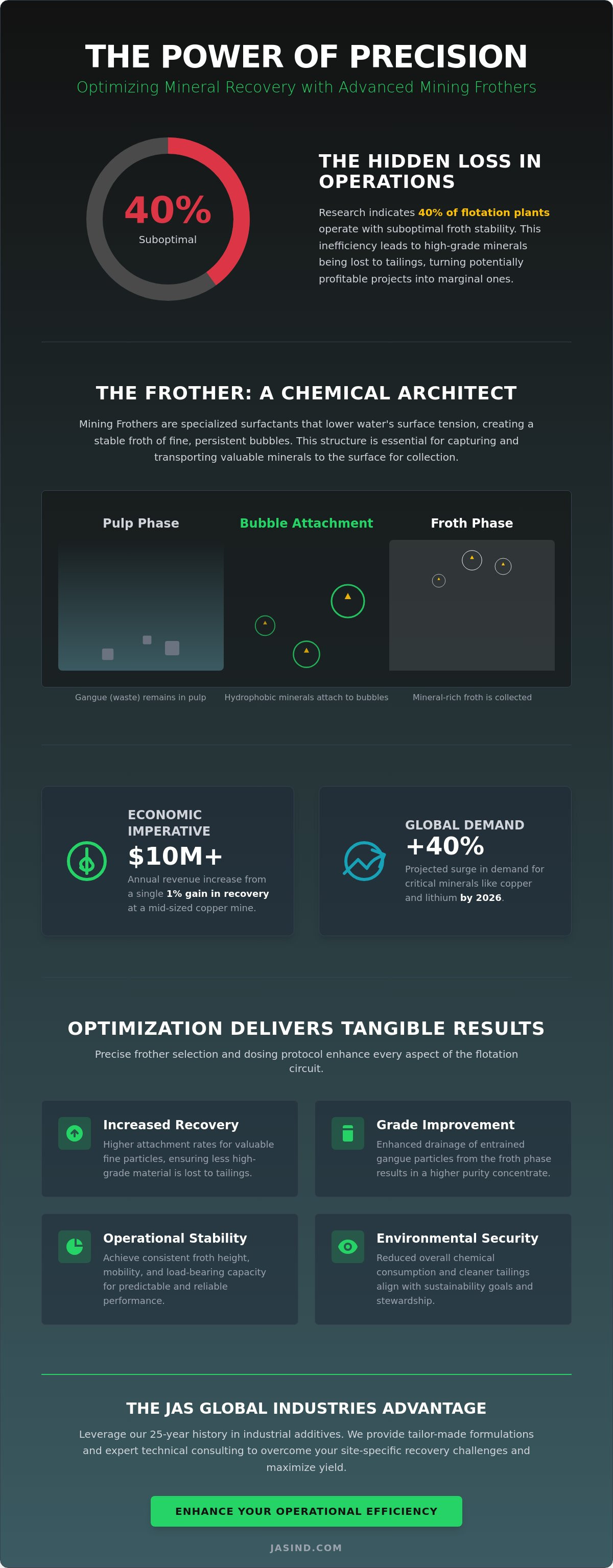
A single percentage point in mineral recovery can shift a project from marginal to highly profitable. Yet, research indicates that 40% of flotation plants currently operate with suboptimal froth stability, often due to an incorrect selection of Mining Frothers. You understand that managing complex polymetallic ores requires more than just standard reagents. It’s frustrating to watch high-grade minerals disappear into the tailings because of a collapsing froth or excessive reagent consumption that drives up costs. At JAS Global Industries, we view mineral recovery as a pillar of global infrastructure. Ensuring the efficiency of your operation is about more than just profit; it’s about the responsible stewardship of Earth’s resources.
This technical guide helps you master the specific chemistry and selection of these essential additives to optimize flotation kinetics and maximize mineral yield for the 2026 production cycle. We’ve leveraged our twenty-five-year history in industrial additives to provide a clear roadmap for achieving stable, controllable froth. You’ll learn how to balance bubble size and persistence to produce higher grade concentrates while reducing your total chemical footprint. We will examine the critical molecular interactions that define modern flotation, moving from theoretical chemistry to practical, site-specific applications.
Key Takeaways
- Analyze the chemical evolution from natural oils to advanced synthetic blends to optimize bubble size distribution and froth carrying capacity.
- Identify how to match specific reagent dynamics to challenging ore characteristics, such as high clay content and varying water salinity levels.
- Establish a systematic dosing protocol and monitor key performance indicators to ensure long-term process stability and maximized mineral yield.
- Leverage tailor-made Mining Frothers and technical consulting to overcome site-specific recovery obstacles and enhance operational efficiency.
- Master the technical expertise required to navigate complex flotation kinetics for enhanced global resource security through 2026 and beyond.
Mining Frothers: The Engine of Froth Flotation Efficiency
Mining Frothers act as the chemical architects of the flotation cell. These specialized surfactants lower the surface tension of water, enabling the creation of stable, fine bubbles that don't immediately burst. Without precise chemical intervention, air bubbles coalesce into larger, inefficient pockets of air. This failure stops the transport of valuable minerals to the surface. By 2026, the demand for critical minerals like copper and lithium is projected to rise by 40% according to International Energy Agency estimates. This surge makes the selection of Mining Frothers a cornerstone of global resource security.
The chemistry of a frother dictates the kinetics of mineral recovery. Whether using alcohol-based or glycol-based molecules, the choice changes how bubbles interact with solids. Smaller bubbles provide a significantly higher surface area for particle attachment. This increases the carrying capacity of the froth. Efficient recovery depends on this delicate balance between bubble size and stability. At JAS Global Industries, we understand that "Manufacturing Relationships. Distributing Quality." means providing reagents that perform under the most demanding metallurgical conditions.
The Physics of the Froth Phase
Stabilizing the air-water interface prevents bubbles from merging. This stability allows water to drain from the bubble lamellae, which carries away unwanted gangue particles. A well-managed froth phase ensures a higher concentrate grade. If the froth is too stable, it becomes difficult to break down downstream; however, if it's too brittle, the mineral load drops back into the tailings. Precise control over bubble coalescence is the only way to maintain this equilibrium.
Economic Impact of Reagent Optimization
Reagent optimization is a financial imperative. A 1% increase in recovery at a mid-sized copper mine can translate to over $10 million in annual revenue based on 2024 London Metal Exchange pricing. Precise dosing of Mining Frothers reduces the volume of chemicals sent to tailings ponds. This protects local ecosystems and aligns with the JAS Cares commitment to environmental stewardship. It's a strategy that balances profit with purpose.
Sustainability in 2026 means doing more with less. Reducing tailings loss through technical precision isn't just about profit. It's about protecting the environment for future generations. We focus on delivering chemical solutions that serve as an indispensable pillar of modern infrastructure. Through precision chemistry, we ensure that every gram of mineral is recovered with the lowest possible environmental footprint.
- Increased Recovery: Higher attachment rates for fine particles.
- Grade Improvement: Enhanced drainage of non-target materials.
- Operational Stability: Consistent froth height and mobility.
- Environmental Security: Lower chemical consumption and cleaner tailings.
Decoding Frother Chemistry: Alcohols, Glycols, and Blends
Performance in flotation circuits depends on the chemical structure of the chosen surfactant. We categorize mining frothers based on their solubility and functional groups. While 20th-century operations relied on pine oil and cresylic acid, 21st-century recovery demands high-purity synthetics. These modern chemicals allow for precise control over the air-water interface. This control is vital for maintaining global mineral security and resource efficiency.
The evolution from natural oils to synthetic formulations reflects a shift toward selectivity and power. Selectivity ensures bubbles carry only target minerals while rejecting gangue. Power dictates bubble size and froth persistence. Finding the balance between these two factors is the hallmark of a mature flotation strategy. Modern chemical engineering allows us to tailor these properties to specific ore bodies.
Alcohol-Based Frothers (MIBC and Beyond)
Methyl Isobutyl Carbinol (MIBC) remains a common industry standard for rapid flotation. It creates fine, mobile bubbles and a brittle froth that breaks down quickly once it reaches the launder. This speed is ideal for gold and base metal sulfide recovery. However, MIBC's high volatility creates challenges in modern deep flotation cells. In cells deeper than 4 meters, the frother can evaporate before reaching the surface. This leads to mineral drop-back and reduced recovery rates. Operators often prefer MIBC for its clean separation, but it requires precise dosing to avoid excessive reagent consumption in high-temperature environments.
Polyglycol and Ether-Based Solutions
Polyglycols offer a robust alternative for complex circuits. Unlike alcohols, these are non-volatile and offer higher froth persistence. Molecular weight is the primary driver of strength in these families. Lower weights, approximately 200 to 400 g/mol, provide high selectivity. Higher weights, often exceeding 600 g/mol, offer the power needed for high-pulp density circuits where solids exceed 40% by weight. These solutions are essential for polymetallic ores where multiple minerals compete for bubble surface area.
Our commitment to environmental stewardship drives the development of biodegradable synthetics. We focus on formulas that minimize downstream water contamination. This approach supports long-term water security for the communities surrounding mine sites. By partnering with technical experts, operations can balance high recovery with sustainable practices. Modern mining frothers don't just improve the bottom line; they protect the foundational resources of society. Custom polyglycol blends now allow mines to process complex ores that were previously considered economically unviable.
Selection Criteria: Matching Frother Dynamics to Ore Characteristics
Selecting Mining Frothers requires a precise understanding of the mineralogical environment. Ore complexity dictates the chemical choice. When an ore body contains 15% clay or "slimes," froth stability becomes volatile. High clay content increases pulp viscosity, which traps air bubbles and prevents effective drainage. This leads to entrainment and lower concentrate grades. Operators must balance the frother's strength against these physical constraints to ensure high-quality output.
Water chemistry is another critical variable. High salinity levels, often exceeding 35,000 ppm in arid mining regions, naturally stabilize bubbles. In these environments, site managers often reduce frother dosage by 25% to avoid over-frothing. pH levels also dictate performance. Acidic circuits with a pH below 4.5 require chemically stable Mining Frothers to prevent molecular decomposition. Compatibility with the collector suite is equally vital. If a frother interacts negatively with a xanthate collector, recovery rates can drop by 12% in a single shift.
Particle Size and Carrying Capacity
Particle size distribution dictates the required bubble strength and buoyancy. Flash flotation units target coarse particles, sometimes up to 600 microns. These heavy particles require strong, persistent frothers to support the mineral load without premature bubble rupture. Conversely, ultra-fine particles under 15 microns increase froth viscosity, often requiring more selective, weaker frothers to maintain grade. The "Carry-over" effect in high-grade ores occurs when excessive mineral loading prevents proper water drainage, leading to non-selective recovery and reduced concentrate quality. Effective mineral recovery is a pillar of global resource security, and it starts with managing these fine balances.
Circuit Configuration and Retention Time
Mechanical cells and flotation columns have distinct aeration profiles. Mechanical cells rely on high shear and shorter retention times. Flotation columns use spargers to create a deep froth bed, often exceeding 1.2 meters, which requires a frother with high elasticity. We categorize the requirements by circuit stage:
- Scavenger Circuits: These focus on maximum recovery and require stronger, more persistent frothers to capture the final 4% of minerals.
- Cleaner Circuits: These prioritize grade and require fragile frothers that break down quickly for efficient washing and gangue rejection.
Environmental factors like altitude and temperature cannot be ignored. At 4,200 meters above sea level, atmospheric pressure drops significantly. This changes bubble expansion rates and requires adjustments to frother chemistry. Temperature fluctuations also impact the process. Sub-zero operations in northern climates affect frother solubility and dispersion, making liquid-phase stability a priority for year-round reliability. JAS Global Industries understands that these technical nuances are essential for maintaining the stability of the global supply chain.
Performance Optimization & Troubleshooting
Achieving peak metallurgical performance relies on a systematic approach to reagent management. Mining Frothers don't operate in a vacuum. Their efficacy depends on ore mineralogy, water chemistry, and circuit kinetics. Establishing a baseline through rigorous technical audits allows operations to identify reagent interference before it impacts the bottom line. Stability isn't accidental. It's engineered. Operators must monitor froth velocity and bubble size distribution as primary KPIs. A 10% deviation in bubble surface area flux can lead to immediate recovery losses in the scavenger circuit.
The Dosing-Response Framework
Standardizing a dosing strategy begins with bench-scale flotation tests. These tests determine the specific Frother Curve for an ore body. It's critical to find the concentration where bubble size stabilizes. This is known as the Critical Coalescence Concentration (CCC). Exceeding this point often leads to over-frothing and the unwanted entrainment of gangue. Modern plants now utilize machine vision tools to monitor froth velocity in real-time. These systems provide the data needed for automated dosing. This ensures 24/7 process stability and supports global mineral security by maximizing resource efficiency.
Troubleshooting Process Upsets
When froth stability drops suddenly, operators must act fast. Brittle froth often indicates a lack of surfactant or high salinity in the process water. Conversely, over-frothing usually stems from excessive reagent loading or high concentrations of ultra-fine particles. "Frother Poisoning" is a recurring industry challenge. It occurs when Mining Frothers interact with upstream chemicals, like grinding aids or stray hydraulic oils, that compete for the air-water interface. This competition disrupts the bubble film. Technical audits are essential for identifying these organic contaminants in recycled water circuits.
- Froth Velocity: Maintain consistent flow to prevent mineral drop-back and lost recovery.
- Bubble Size: Keep a uniform distribution to maximize the available surface area for mineral attachment.
- Water Quality: Monitor TDS and organic loads to prevent surfactant degradation and "poisoning" effects.
- Reagent Compatibility: Ensure collectors and frothers work in synergy rather than competing for bubble space.
Reliable operations require more than just chemicals; they require a partner dedicated to technical excellence. JAS Global Industries brings twenty-five years of industrial experience to every recovery challenge. We ensure your targets are met with sustainable, high-quality solutions that protect the integrity of your circuit. Manufacturing stability. Distributing recovery.
The JAS Advantage: Tailor-Made Formulations for Global Mining
JAS Global Industries operates at the intersection of technical excellence and global stewardship. We don't just supply chemicals; we engineer outcomes. Our approach centers on the philosophy of "Manufacturing Relationships. Distributing Quality." This commitment ensures that every mining operation receives more than a standard product. They receive a dedicated partner focused on long-term stability and resource security. With a twenty-five-year history of industrial leadership, we position ourselves as a vital pillar for modern infrastructure and sustainability.
Custom Formulation and Lab Testing
Customization is the core of our technical strategy. Every ore body possesses unique mineralogical characteristics that standard reagents cannot always address. Our Research and Innovation (R&I) centers utilize advanced bench-scale testing to develop Mining Frothers tailored to specific site conditions. We analyze water chemistry, particle size distribution, and mineral associations to create high-performance blends.
In a 2022 optimization project involving complex phosphate mining in North Africa, our technical team conducted a comprehensive site audit. By adjusting the alcohol-to-glycol ratio in the reagent formulation, we achieved a 4.2% increase in P2O5 recovery. This change also reduced collector consumption by 12%, significantly lowering the total cost of chemicals per ton. Leveraging JAS Global Industries technical audits allows operators to identify hidden inefficiencies in their flotation circuits and implement data-driven solutions.
- Site-Specific Analysis: We evaluate local water salinity and temperature impacts on bubble tenacity.
- Rapid Prototyping: Our labs develop and test new formulations within 14 to 21 days for urgent operational shifts.
- Yield Optimization: We focus on maximizing the recovery of fine particles often lost in standard froth phases.
A Partner in Global Resource Security
We view mineral processing as an essential contributor to global food and water security. Reliable supply chains are mandatory for critical mineral operations across the Middle East, Africa, and Asia. Our logistics network ensures that specialized Mining Frothers reach remote sites without delay, maintaining the flow of materials necessary for global industry. We act as a visionary partner, securing the foundational needs of society through chemical innovation.
Sustainability drives our "JAS Cares" initiative. This program focuses on developing biodegradable formulations that minimize environmental footprints while maintaining peak recovery rates. In 2023, our regional support teams helped a major copper producer in Southeast Asia reduce chemical waste by 15% through precision dosing strategies. We prioritize the broader human impact of our work, ensuring that industrial progress does not come at the expense of ecological health. Our experts provide ongoing support to ensure your operation remains stable as ore grades fluctuate over time. Consult with our mining experts today to optimize your recovery process and secure your production targets.
Securing the Future of Flotation Excellence
Achieving peak mineral yield requires a sophisticated balance between chemical selection and ore dynamics. The right Mining Frothers act as the essential engine for froth flotation, determining bubble size and froth stability. This technical alignment isn't just a process requirement; it's the foundation of global resource security. High performance chemistry minimizes waste while maximizing the output of critical minerals used in modern infrastructure.
JAS Global Industries brings 25 years of specialty chemical expertise to every partnership. Our proprietary R&I centers focus on custom formulation development, ensuring every chemical solution addresses the unique mineralogical challenges of your site. With a strategic presence in Riyadh, Dubai, and major global mining hubs, we provide the steady reliability and innovation your operation demands. We're committed to manufacturing relationships and distributing quality across the industry.
Optimize your mineral recovery with JAS Global Industries mining solutions
Let's work to enhance your operational efficiency and achieve lasting results today.
Frequently Asked Questions
What is the primary difference between a collector and a frother?
Collectors chemically modify mineral surfaces to become water-repellent, while mining frothers reduce surface tension to stabilize the air bubbles necessary for mineral transport. A collector like Potassium Amyl Xanthate targets the mineral itself to ensure attachment. In contrast, the frother creates a resilient froth phase that carries these minerals to the surface. This synergy ensures high recovery rates and grade quality in the flotation cell.
How does temperature affect mining frother efficiency?
Temperature fluctuations directly alter the viscosity and solubility of chemical additives in the flotation circuit. In operations below 10 degrees Celsius, frother dispersion typically slows, often requiring a 15% increase in dosage to maintain the necessary bubble surface area. We prioritize stable formulations that perform consistently across varied climates. This reliability supports global resource security by preventing recovery drops during seasonal shifts.
Can I mix different types of frothers in the same flotation circuit?
Operators frequently blend alcohol-based and glycol-based frothers to achieve a specific hydrophile-lipophile balance. A 70/30 mix of MIBC and polyglycol can optimize both the flash-froth speed and the stability needed for coarse particle recovery. This customization allows for precise control over the froth structure. It ensures the circuit remains efficient even when ore mineralogy changes unexpectedly.
What are the environmental regulations regarding synthetic frothers in 2026?
The 2026 ECHA updates mandate that synthetic additives meet a 60% biodegradability threshold within a 28 day window. These regulations focus on reducing the aquatic toxicity of branched alcohol structures commonly found in older formulations. JAS Global Industries aligns with these standards through our JAS Cares initiative. We provide sustainable mining frothers that comply with international environmental protocols while maintaining industrial performance.
How do I determine if I am over-dosing my frother?
Over-dosing is identified by a watery froth and a 5% to 8% drop in concentrate grade due to non-selective entrainment. When frother concentration exceeds the Critical Coalescence Concentration, bubbles become too small and overly stable. This leads to excessive water carryover into the concentrate launders. Monitoring the froth velocity and bubble size distribution prevents these costly inefficiencies in the recovery process.
Why is MIBC still used despite newer synthetic alternatives?
Methyl Isobutyl Carbinol remains a staple because of its high selectivity and low persistence in the water circuit. It creates a brittle froth that breaks down quickly; this is essential for downstream thickening and filtration processes. While newer synthetics offer higher recovery in specific niches, MIBC's ability to produce a clean concentrate makes it the preferred choice for 40% of global copper and lead flotation circuits.
How does water salinity impact froth stability in coastal mining?
High salinity in coastal operations acts as a natural froth stabilizer by inhibiting bubble coalescence through increased ionic strength. In seawater flotation, electrolyte concentrations can reach 35,000 ppm, which often allows for a 20% reduction in frother dosage compared to freshwater circuits. However, this increased stability can also trap unwanted gangue minerals. Precise chemical management is required to balance these natural effects with your specific recovery targets.