
The lowest-cost dishwasher pod isn’t necessarily the simplest formula. Formulating high-efficiency automatic dishwasher pods means balancing cleaning ingredients, ingredient compatibility, and the format used to deliver each dose. A blended automatic dishwasher detergent powder has a recommended dose of 10 grams per wash, while the cost of a finished pod depends on its ingredients and production requirements.
Ingredient selection is only one part of formulating high-efficiency automatic dishwasher pods. How ingredients interact, and whether the product is a gel, powder, or combination format, also affects cleaning performance and manufacturing.
This guide explains how detergent ingredients act on food soils, how pod formats and ingredient combinations differ, and which formulation choices affect cost. A tablet formula also shows how ingredient proportions and processing controls shape the product, offering a practical way to understand the trade-offs behind an efficient automatic dishwasher detergent.
Dishwasher detergent ingredients and cleaning action
Automatic dishwasher detergent combines surfactants, enzymes, and alkaline ingredients to loosen grease, oil, and food soils. Cleaning also depends on water conditions, pod storage, and how dishes are loaded.
Ingredient Roles in Cleaning Action
Surfactants help lift greasy soils, while enzymes target residues such as protein and starch. High-pH ingredients support the breakdown of grease, oil, and dirt during the wash cycle. Each component has a distinct role, so cleaning depends on the combination rather than a single ingredient.
That balance matters when formulating high-efficiency automatic dishwasher pods: ingredient compatibility affects performance after the dose is released. A protein-stained plate and an oily pan present different soils, for example, so the ingredient combination needs to address the range of a mixed load.
Pod Performance Across Water Conditions
Water hardness and wash temperature influence how detergent dissolves and cleans. Minerals in hard water can interfere with cleaning, while temperature affects soil removal and pod dissolution. Some dishwasher detergent pods may not dissolve completely when wash water is below 45 °C, so temperature is a practical performance consideration.
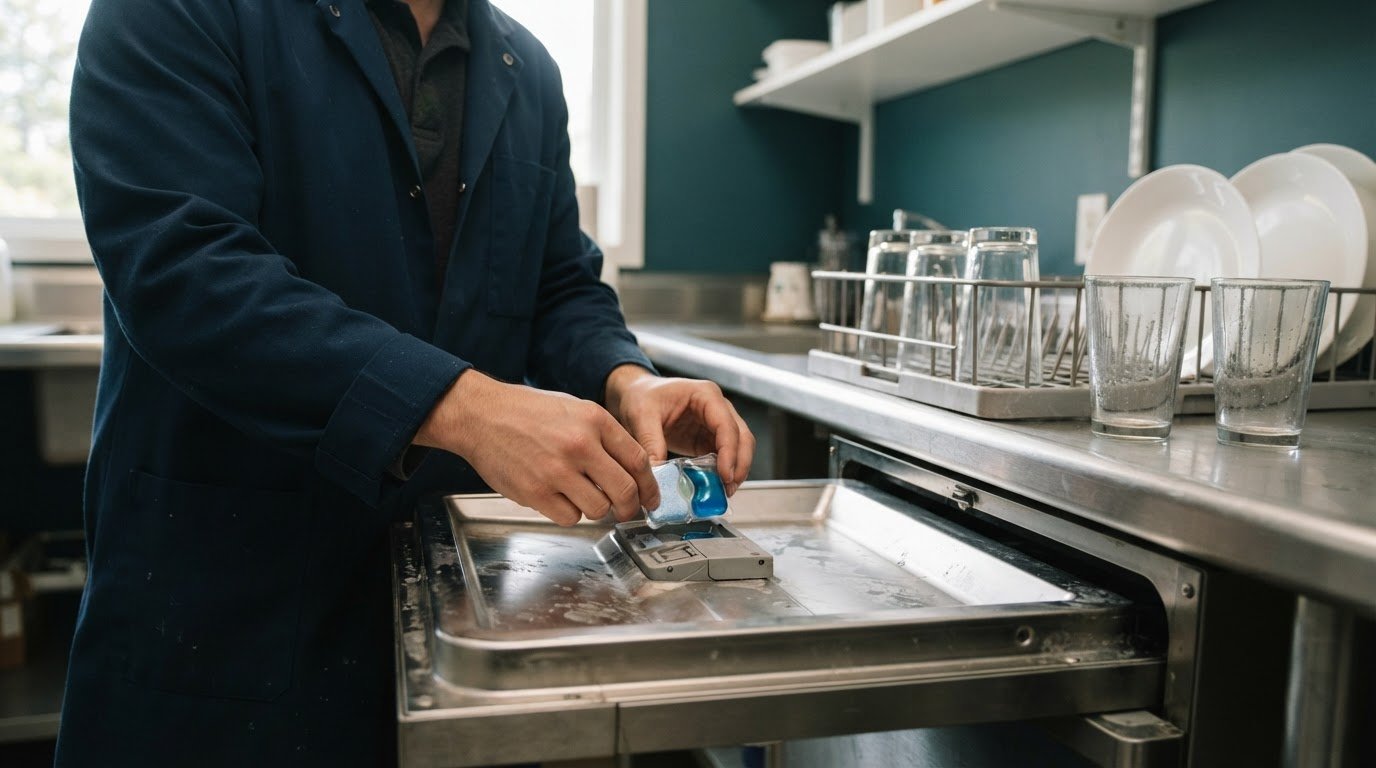
Pods are designed for different wash temperatures, but low temperatures can still affect dissolution. Put the pod in the dedicated dispenser, not loose in the tub, and make sure utensils or pot handles do not block the dispenser door. An unobstructed opening allows the dose to release during the wash cycle.
For US sales, labeling depends on a product’s composition, claims, and intended use. Plan clear product identification, directions, and safety information in line with the requirements that apply to the specific formulation.
Moisture can weaken a pod’s water-soluble film before use. Handle pods with dry hands and store them in an airtight container in a cool, dry place, away from humid sinks. Keep detergent pods in their container and handle them only as directed. Their concentrated ingredients are intended for dishwashing, not ingestion or other cleaning tasks.
Loading also affects cleaning: arrange dishes so water can reach their surfaces, and keep the dispenser unobstructed. A pot handle resting across the dispenser door, for example, can prevent the pod from releasing as intended.
A separate all-purpose cleaner recipe uses 1/2 cup of dishwasher detergent powder mixed with 2 gallons of hot water. That mixture is distinct from a dishwasher pod and should not be confused with the pod’s measured wash dose.
Gel, powder, and combination pod types
Automatic dishwasher detergent comes as powder, pods, pacs, liquid, or gel. Each format delivers cleaning ingredients differently, affecting dose control, handling, and product design.
Pods combine detergent and degreasers in one unit, while loose powder and liquid are dispensed separately. Pods provide a pre-measured dose, which can simplify dosing. That fixed dose can simplify use, while powder allows a formulator to produce a free-flowing granular product or compress it into a tablet. Gel, powder, and combination pods are all possible formats; the choice depends on how ingredients need to be delivered and kept stable.
Powdered automatic dishwasher detergents are likely to contain peroxide bleach. In a blended powder, sodium percarbonate supplies that bleaching component, while the remaining ingredients determine the blend’s other cleaning functions. The finished blend is a free-flowing granular powder with a pH of 10.5. It can be packed as bulk powder or made into a pod or tablet, so one base blend can support different product formats.
Temperature control is critical during blending. Add sodium percarbonate only when the powder is at or below 95°F (35°C), and keep the powder below that temperature during and after blending. If it exceeds 95°F (35°C) after the percarbonate is added, stop blending and follow standard safety procedures to cool and isolate the powder. These controls help protect the blend during processing.
Particle condition matters too. Free-flowing powder suits bulk packing, while a tablet or pod requires a formed dose. Combination pods can keep liquid and powder ingredients separate, helping prevent reactions before the wash cycle and preserve enzyme stability and surfactant activity. Compartment design is therefore part of formulation, not just presentation.
For a separate powder foam-control need, explore powder antifoam solutions.
Dishwasher pod ingredient combinations
A pod formula depends on ingredient roles, proportions, and interactions before use. The combination needs to remain stable in its packaging, then dissolve and release its cleaning ingredients during the wash.
Ingredient Proportions and Functions
Ingredient proportions assign each component a defined share of the formula, shaping the cleaning system as a whole. One automatic dishwasher detergent formula contains 47.2% sodium carbonate, 25.0% sodium percarbonate, 11.5% Itaconix® TSI® 422, and 9.0% sodium citrate dihydrate by weight. These figures describe specific ingredient proportions, not a universal recipe for every pod.
Sodium carbonate contributes alkalinity, while sodium percarbonate provides a bleaching component. Sodium citrate dihydrate is also part of the blend, along with the named polymer. Changing any proportion shifts the balance, so ingredient selection and dose should be considered together.
Ingredient Separation and Release
Separating selected liquid and powder components in a pod keeps them apart until the wash cycle. This can help prevent reactions before use and preserve enzyme stability and surfactant activity. For example, a combination pod can hold liquid and powder portions in separate compartments rather than blending them together.
Packaging and release design go hand in hand: the pod must contain its ingredients during storage, then dissolve in wash water. Temperature and water access affect release. In a kitchen dishwasher, the dispenser opens during the cycle, allowing the pod’s components to enter the wash at the intended stage rather than sitting loose in the tub.
These choices shape more than the ingredient list. A single-phase blend prioritizes compatibility in one mixture, while a divided pod keeps components separate until water reaches its compartments. Either approach requires matching the ingredient combination to the packaging and release behavior.
Automatic dishwasher tablet formula
A defined tablet formula shows how ingredient proportions create a measured dose. The example is a 10 gram tablet, with each component contributing to the overall cleaning system.
By weight, the formula contains 47.2% sodium carbonate, 25.0% sodium percarbonate, 11.5% of another formulation component, and 9.0% sodium citrate dihydrate. It also contains 3.0% alcohol alkoxylate surfactant, 2.0% protease enzyme, 1.5% amylase enzyme, and 0.8% sodium silicate. Together, these proportions make up the tablet formula.
The ingredients have distinct roles: sodium carbonate provides alkalinity, sodium percarbonate supplies oxygen bleach, and alcohol alkoxylate acts as the surfactant. Protease and amylase target different food residues, while citrate and sodium silicate contribute other formulation functions. The additional component is also part of the blend. Ratios matter because changing one share shifts the balance of the whole tablet.
The stated plant-based content is 55-90%, depending on ingredient selection. That range describes formulation choices, not a fixed attribute of every tablet. A finished pod also needs packaging suited to its dose. Dishwasher pods are typically coated in polyvinyl alcohol (PVA) film, which helps keep the detergent contained until use. PVA film is reported to biodegrade in 90 days or less in wastewater treatment plants and river water.
For processing, add sodium percarbonate only when the powder is at or below 95°F (35°C), and keep it below that temperature during and after blending. If the powder exceeds 95°F (35°C) after addition, stop blending and follow standard safety procedures to cool and isolate it. These controls protect the blend during production.
Treat the tablet as a coordinated formula, not a list of separate ingredients. Dose, ingredient proportions, temperature control, and packaging all shape the finished product. In the dishwasher, the tablet must dissolve completely during the wash cycle to release its components.
JAS Global Industries
JAS Global Industries supports industrial partners with specialty chemical solutions and tailor-made formulations designed to address formulation and process-efficiency needs. For teams assessing dishwasher detergent chemistry, a useful next step is to connect each ingredient’s function to the broader formulation goals, including soil removal and residue control.
JAS Global Industries’ Home Care Chemicals and Anti-redeposition agent offerings are relevant to this broader chemical context. The right formulation depends on how ingredients interact, their intended functions, and the product format. Clear project requirements help focus the technical discussion without treating a tablet recipe as a universal solution.
Contact JAS Global Industries to discuss your formulation requirements and the chemical solutions relevant to your application.
Turn Formulation Priorities Into a Clear Next Step
Turn a formula concept into a focused development brief. Identify cleaning priorities, intended pod format, production constraints, and the cost factors that matter most to your application. Formulating high-efficiency automatic dishwasher pods starts with aligning these decisions, then assessing how ingredient choices support the product design.
JAS Global Industries works across specialty chemical applications, including Fertilizer Anti-caking Agents, Fertilizer Dust Suppressants, and Mining Flotation Collectors. These offerings serve distinct industrial needs. A useful formulation discussion, meanwhile, should focus on your project requirements and objectives.
Bring your priorities together and take the next step in shaping a technically informed direction. Contact JAS Global Industries to discuss your application. A clear brief can help turn complex formulation choices into a more purposeful development path.
Frequently Asked Questions
WHAT ABOUT COST?
Formulation cost depends on ingredient selection, dose, pod format, packaging, and manufacturing requirements. A formula with more components or separate compartments can have different material and processing needs from a single-phase powder dose. Plan costs for the complete product, not just individual ingredients. Define cleaning priorities and packaging requirements first, then assess how each design choice affects production.
What are effective enzyme, bleach, surfactant, and builder levels for dishwasher pods?
There is no single set of effective levels for every dishwasher pod. Enzyme, bleach, surfactant, and builder proportions need to work together for the intended soils, water conditions, dose, and product format. The tablet formula in this guide is one specific composition to evaluate, not a universal target. Since changing any component can shift the balance, assess the whole blend rather than optimizing one ingredient alone.
How do dishwasher pod formulas remove grease, starch, and protein stains?
Different ingredients address different soils: surfactants help lift grease, amylase targets starch, and protease targets protein residues. These functions complement one another in a mixed load, such as a greasy plate with dried food. Water movement and dose release matter too, because detergent must reach dish surfaces. Formula design coordinates these functions for the intended cleaning conditions.
What are typical dishwasher pod dimensions, weight, and dissolution times?
Dimensions and dissolution time depend on the product’s shape, film, ingredient arrangement, and the dishwasher’s wash conditions. The example formula is a 10 gram tablet, which gives a mass for that specific format, not a universal pod size. In practice, temperature, water access, and dispenser release affect how a dose dissolves. A pod’s exterior dimensions alone don’t establish how quickly it will dissolve completely.
What do dishwasher pod ingredients and manufacturing typically cost?
Ingredient and manufacturing costs depend on the formula and production method. Raw material selection, ingredient proportions, blending controls, dose formation, packaging, and production scale all affect costs. A multi-compartment pod, for example, involves different packaging and assembly needs from bulk powder. Evaluate the full production process, including quality requirements, rather than treating the ingredient bill as the finished product cost.
What manufacturing steps and equipment are used to formulate dishwasher pods?
Blend the ingredients, adding sodium percarbonate only when the powder is at or below 95°F (35°C) and keeping it below that temperature during and after blending. If it exceeds that temperature after addition, stop blending and follow standard safety procedures to cool and isolate the powder; the blend can then be formed into a pod or tablet or packed as bulk powder. Specific equipment is not described.