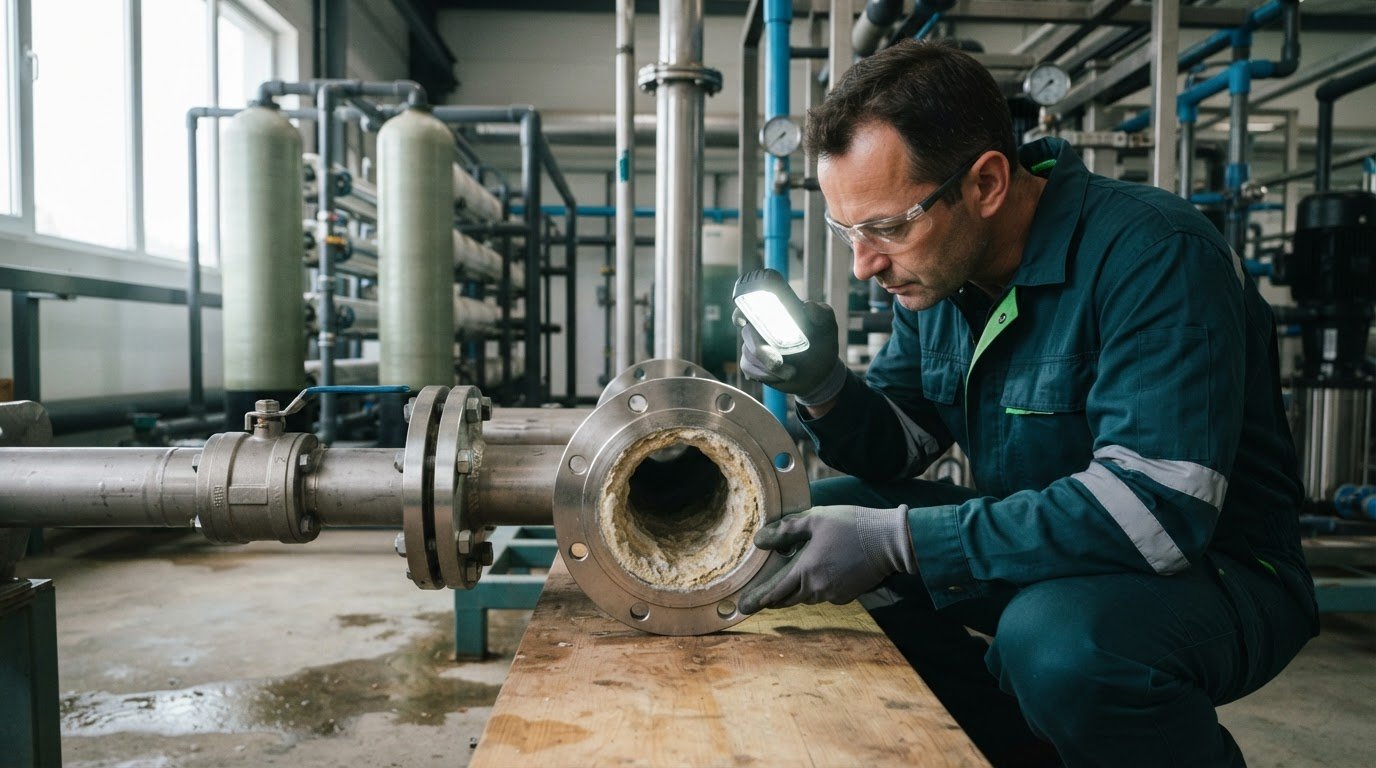

Repeated cleaning isn’t always the answer to recurring RO scale. Advanced troubleshooting for persistent RO scaling starts by distinguishing mineral precipitation from other membrane fouling and identifying the deposit. Silica and silicate deposits can be difficult to remove once established and may require a specialized silica dispersant rather than acid cleaning.
When permeate flow falls or operating pressure rises, fouling is a reasonable possibility, but the response depends on what is accumulating on the membranes. Treating the wrong cause can leave the underlying problem unresolved and performance issues to continue.
This article explains how RO scaling differs from other membrane fouling, how operating trends can indicate when cleaning may be needed, and why silica requires separate attention. It also explains how silica dispersants fit into a broader approach to controlling persistent scale and supporting reliable system operation.
What Is Scaling in RO Systems?
RO scaling occurs when dissolved minerals exceed their natural solubility limits and precipitate on membrane surfaces. Calcium carbonate, calcium sulfate, and silica commonly deposit in reverse osmosis systems, often near the concentrate end.
Feed-water tests for calcium, sulfate, silica, alkalinity, and pH help identify likely mineral deposits. Langelier Saturation Index or Stiff-Davis Stability Index analysis assesses precipitation risk, while temperature helps interpret water chemistry.
Scaling Symptoms and Pressure Changes
Scaling symptoms include lower permeate flow and rising differential pressure as deposits restrict water channels. A feed-to-concentrate differential pressure above 50 psi per vessel indicates possible scaling. A 10-15% rise in normalized differential pressure across a stage or train also signals scaling or fouling. These readings matter because a blocked feed spacer can restrict flow between membrane elements, increasing resistance through the vessel. Compare pressure and flow trends with the system’s baseline to distinguish a persistent change from normal operating variation.
Scaling Versus Fouling
Scaling is mineral precipitation on a membrane. Fouling describes performance loss caused by accumulated material, including mineral scale and colloidal particles. Calcium and sulfate can form mineral deposits when concentrated beyond their solubility limits, while suspended colloids can collect within membrane channels. The distinction matters because a pressure rise alone cannot identify the deposit. Mineral analysis helps pinpoint scaling, while evidence of colloidal material indicates another fouling mechanism. Since different causes can produce similar symptoms, diagnosis should connect pressure trends with feed-water chemistry.
Differential pressure monitoring tracks the pressure drop from feed to concentrate across each vessel or stage. Record feed pressure, concentrate pressure, permeate flow, and temperature together, since temperature changes can affect comparisons. A rising differential pressure paired with declining permeate flow supports an obstruction diagnosis but does not identify its chemistry. Check whether the increase is localized to the final elements, where scale commonly begins, or appears across the train. This pattern, combined with calcium, sulfate, and silica results, provides a stronger basis for identifying the cause and choosing a response.
How often should RO membranes be cleaned?
Clean membranes in response to normalized performance changes, not only according to a fixed schedule. Compare normalized permeate flow with baseline data, alongside differential pressure and salt passage.
In the United States, disposal requirements depend on the discharge route and applicable federal, state, and local rules. Characterize concentrate and spent cleaning solutions before disposal or discharge.
Normalized Flow and Cleaning Triggers
Normalized permeate flow adjusts measured output for operating conditions, making comparisons with baseline more meaningful. A 10-15% decline from baseline can indicate a cleaning trigger; cleaning is also recommended when differential pressure rises 15% or salt rejection drops 1-2%. Normalization accounts for feed pressure, conductivity, and temperature, helping distinguish fouling from changing conditions.
For organic or colloidal fouling, alkaline cleaners at pH 11-12 are used in clean-in-place procedures. Biofouling may respond to alkaline cleaning, while severe scaling calls for a suitable cleaning protocol. Chemical choice and operating conditions matter: incompatible treatment can damage membranes.
Scale Removal and Recurrence Prevention
Existing scale may be cleaned with a 2% by weight citric acid solution at pH 2.0-2.5, circulated at low pressure for 60-90 minutes. These figures describe a cleaning approach, not a universal recipe; membrane compatibility and scale type guide treatment. After cleaning, review recovery, pretreatment, and chemical dosing to reduce conditions that allow deposits to return.
Acid cleaning and other chemicals can harm membranes if their chemistry or conditions are incompatible. Use membrane limits to guide pH, concentration, and exposure.
Adjusting Scale Control to Changing Conditions
When feedwater quality or temperature changes, reassess mineral saturation risk and normalized performance. Recheck relevant feed chemistry, including silica and scale-forming minerals, then review recovery and antiscalant dosing. These factors affect whether dissolved minerals remain in solution or precipitate as conditions shift.
Repeated scaling after two cleaning cycles warrants specialist review. If cleaning restores less than 80% of original flow, the membrane has reached end of life; an autopsy can help identify persistent deposits. Targeted reverse osmosis chemicals form part of a scale-control strategy alongside pretreatment and operating adjustments.
What Is Fouling in RO Membranes?
Fouling is the buildup of unwanted material that restricts water transport through a reverse osmosis membrane. Organic matter, biological growth, and colloids can reduce permeate flow even when mineral scale isn’t the cause.
Flow Decline and Organic or Biological Fouling
Organic or biological fouling occurs when organic compounds or microorganisms accumulate on membrane surfaces and restrict flow. A gradual decline in normalized permeate flow can indicate this buildup, although scale can cause a similar symptom. The distinction matters: carbonate deposits indicate mineral scaling, while organic material or biological growth calls for a different diagnosis. Cleaning based on the wrong cause may not remove the material blocking the membrane.
Colloids, Particle Sizes, and SDI Pretreatment
Colloidal fouling occurs when fine suspended particles collect within membrane channels or on membrane surfaces. These particles can range from 0.001 to 1.0 microns, making pretreatment important even when feedwater appears clear. The silt density index (SDI) helps assess particulate loading; industrial RO pretreatment aims to keep SDI below a range of 3-5. Tracking SDI alongside permeate flow helps identify when pretreatment performance may be contributing to fouling.
Organic Fouling on Polyamide Membranes
On polyamide membranes, organic fouling involves compounds adhering to the membrane surface and limiting water passage. Biological growth can add a persistent layer, so assess a flow decline alongside feedwater quality and cleaning history. Antiscalant controls mineral precipitation; it doesn’t remove organic deposits or replace effective pretreatment. Identifying the fouling type helps match cleaning to the actual deposit instead of treating every decline as calcium carbonate scale.
Recovery, flux, and concentrate flow also affect scaling risk. Raising recovery above the system’s design point concentrates dissolved minerals in the remaining stream and can accelerate precipitation. Keep flux and concentrate flow aligned with system design, then reassess feedwater chemistry, temperature, and antiscalant dosing when conditions change. This helps distinguish a water-quality shift from fouling and supports steadier membrane performance.
Colloidal foulants in reverse osmosis systems are typically described as ranging from 1 nm to 1 μm. Because feedwater may appear clear despite fine suspended particles, appearance alone does not establish that colloidal fouling is absent.
Silica scale and specialized dispersants
Silica needs separate attention in an industrial RO system because established deposits can be difficult to remove. Advanced troubleshooting for persistent RO scaling starts with feedwater analysis and an assessment of concentrate conditions.
Feedwater Saturation Indices
Saturation indices compare dissolved mineral conditions with precipitation limits to help assess scale risk. For calcium carbonate, use a Langelier Saturation Index or Stiff-Davis Stability Index; assess sulfate, silica, and fluoride against their respective saturation limits. Feed composition, pH, temperature, and recovery affect concentrate calculations, so feedwater results alone may understate risk as concentration increases.
Antiscalant Dosing and Chemical Feed Troubleshooting
Antiscalant troubleshooting checks whether the intended dose reaches the RO feed stream and suits current water conditions. Compare dosing settings with feed flow and updated chemistry, then assess chemical delivery and injection consistency. Changes in source water, temperature, or recovery can alter scale risk even when settings remain unchanged. This evidence-based review is central to advanced troubleshooting for persistent RO scaling.
Silica responds differently to cleaning than calcium carbonate. Acid can address some mineral scales, but silica may require a specialized dispersant rather than acid cleaning. Measure silica separately, then assess whether concentrate conditions are driving precipitation. Repeating acid cleaning without identifying silica deposits may leave the underlying problem unresolved.
Review silica alongside calcium, sulfate, pH, temperature, and recovery. Raising RO feedwater pH can facilitate carbon dioxide removal and expand silica saturation limits, but the effect depends on the full water chemistry. As recovery increases, minerals concentrate in the reject stream, changing the scale-control challenge.
For persistent silica deposits, consider both removal and prevention. Dispersant treatment can support silica control, while dosing strategy should reflect feed composition and operating conditions. Discuss silica scale-control options for an approach aligned with your RO system.
Silica scale may require a different cleaning approach from other mineral scales, so assess it separately from general scale-inhibitor performance. Early RO scale inhibitors often had limited dispersant capability, particularly in water containing iron or manganese, which could cause premature cartridge-filter blockage and membrane fouling. This makes dispersant capability a relevant consideration when reviewing silica control.
JAS Global Industries
JAS Global Industries develops tailor-made specialty chemical formulations and technologies to support process efficiency and operational reliability. Its water-treatment expertise is relevant when recurring deposits persist despite cleaning and operating adjustments. The right chemical approach depends on feedwater and system conditions, so the scaling pattern and treatment challenge provide useful context for a discussion with JAS Global Industries.
Contact JAS Global Industries to discuss your RO scaling challenge and explore a suitable next step.
Make the next operating decision count
Persistent scale calls for a response based on the deposit, changing feed conditions, and the treatment system’s operating record. Use that evidence to guide the next adjustment instead of repeating a cleaning or dosing change without diagnosing what remains on the membrane. That is the practical value of advanced troubleshooting for persistent RO scaling: a clearer basis for protecting membrane performance and process reliability.
JAS Global Industries also supplies fertilizer anti-caking agents, fertilizer dust suppressants, and mining flotation collectors for distinct industrial process needs. For support related to water-treatment chemical solutions, contact JAS Global Industries to discuss your operating challenge and next steps.
An evidence-led approach helps your team choose the next step with greater confidence.
Frequently Asked Questions
What Causes RO Membrane Scaling?
RO membrane scaling occurs when dissolved minerals precipitate as water becomes concentrated inside the system. Calcium carbonate, calcium sulfate, and silica are common deposits; barium sulfate and strontium sulfate can also form scale because they are poorly soluble. Higher recovery concentrates minerals in the reject stream, increasing precipitation risk. Feedwater chemistry, pH, temperature, and system operation all influence which minerals reach their solubility limits.
Why does my RO system have good pressure but still low output?
A normal pressure reading doesn’t prove that the membrane is producing water efficiently. Permeate output can fall because of scale, organic or colloidal fouling, changing feed temperature, or higher feed conductivity. Compare normalized permeate flow with the system baseline, then consider pressure readings across individual stages rather than relying on the pump gauge alone. A restriction in the feed path can also affect flow despite adequate pump pressure.