
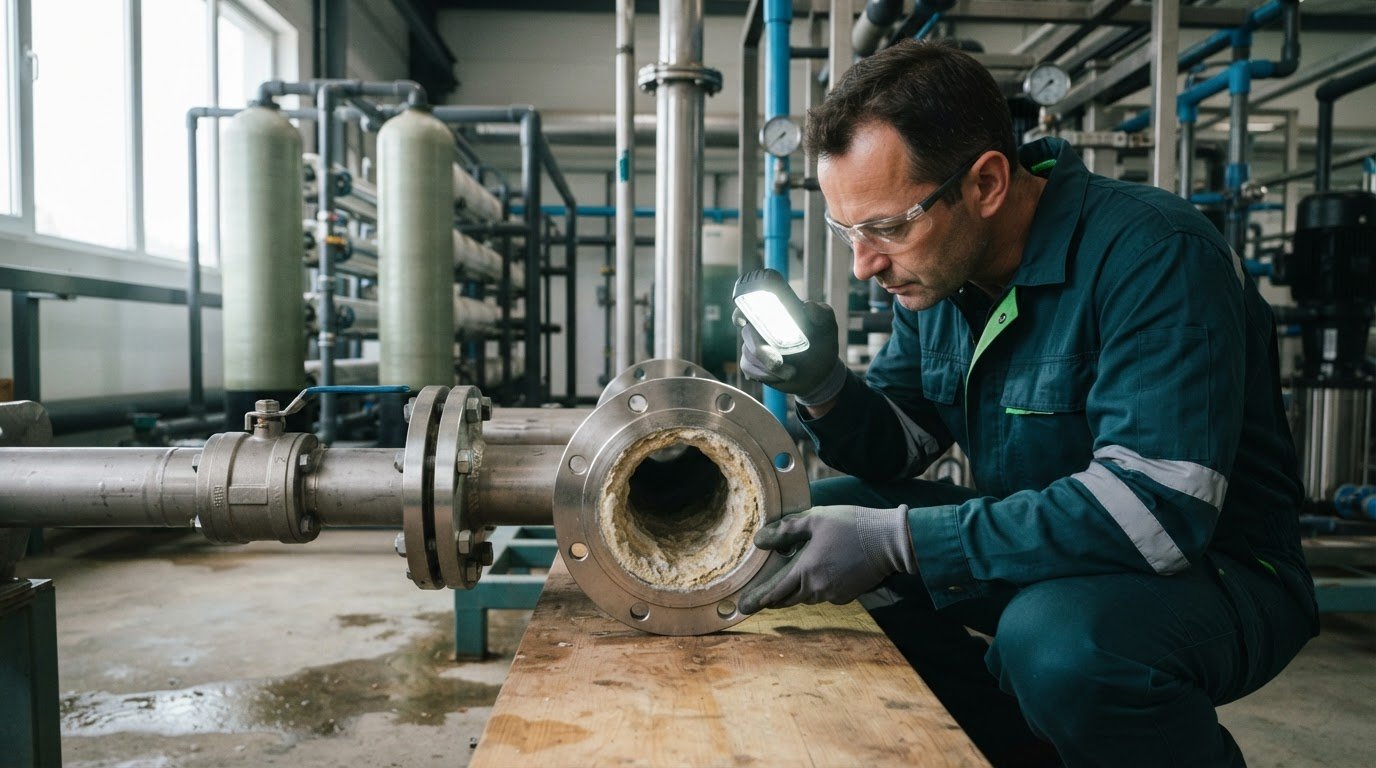
Higher water recovery can mean less wastewater, but a more concentrated reject stream. At 45% recovery, a reverse-osmosis system sends more than half of its feed to the reject line, and the cost of untreated brine on equipment depends on how that concentrate behaves as well as how much of it the plant produces. According to the U.S. Environmental Protection Agency, brine deposits can clog pipe openings and increase the pumping needed to move the fluid.
It’s easy to focus on disposal volume when estimating brine costs. Equipment impacts matter too: dissolved and suspended solids can form deposits, restrict flow, and increase operating strain. Brine chemistry also determines which scaling risks matter most.
This article explains how water recovery affects brine volume and scaling risk, how composition influences deposits, and why cost comparisons need consistent units and disposal assumptions. It also shows how to assess the equipment burden, rather than treating brine as a waste stream with one cost.
How water recovery affects brine volume and scaling risk
Water recovery determines how much feed becomes product water and how much remains as concentrate. The remaining liquid contains concentrated salts and other dissolved constituents.
At 45% recovery, a reverse-osmosis system sends more than half its feed to the reject line. Seawater desalination plants typically recover 40 to 50 percent of feed water, while brackish-water plants typically recover 75 to 90 percent. Higher recovery reduces reject volume, but concentrates the remaining salts, which can bring the stream closer to mineral precipitation limits.
Desalination and geothermal operations both handle brine, but their equipment demands differ. Membrane systems must manage concentrate in pipes and flow passages; geothermal injection systems must prevent solids from obstructing injection. Disposal adds a separate cost shaped by the route, volume, salinity, and monitoring requirements.
Scaling risk from untreated brine
Scaling occurs when dissolved minerals leave the liquid and form deposits on surfaces as brine becomes concentrated or conditions change. In membrane desalination systems, deposits can restrict flow passages and reduce the effective area available for water movement.
The risk depends on brine composition and the operating conditions that affect mineral solubility. According to the U.S. Environmental Protection Agency, deposits from untreated brine can clog pipe openings and increase the pumping needed to move the fluid. That can constrain throughput and place additional demand on pumps.
Maintenance costs from mineral deposits
Mineral deposits increase maintenance costs by narrowing passages, interrupting flow, and requiring cleaning or mechanical work. The cost of untreated brine on equipment therefore depends not only on the volume sent for disposal, but also on where deposits form and how they affect operations.
In geothermal brine injection systems, the U.S. Environmental Protection Agency reports that deposited dissolved and suspended solids can create mechanical problems. Operators may raise injection pressure to maintain flow, increasing operating strain. The maintenance burden differs from membrane desalination, where deposits can obstruct narrow passages and impair water recovery.
In the United States, discharge requirements depend on the receiving route and applicable permitting and monitoring obligations. Surface-water or ocean discharge is generally a lower-cost option where a discharge route and permit are available. Disposal planning must account for the route’s regulatory requirements.
No single equipment material is compatible with every untreated brine. Selection depends on salinity, dissolved and suspended solids, temperature, and operating conditions. These factors vary between membrane desalination and geothermal injection systems.
Brine composition and scaling limits
Brine composition determines which minerals may precipitate as water recovery concentrates the liquid. In industrial systems, operating limits depend on salinity, dissolved constituents, temperature, and pressure. A reverse osmosis membrane can therefore face different scaling risks from equipment handling another brine stream, even when both processes use saline water.
Composition varies by source and application. Municipal road brine, for example, is typically about 23% sodium chloride. Desalination concentrate has a different profile shaped by its feed water and recovery conditions. That distinction matters: a single treatment assumption cannot describe every brine, and a cheaper disposal route does not remove deposits already forming on equipment surfaces.
Scaling limits are reached when dissolved minerals can no longer remain dissolved. As concentration increases, minerals may precipitate and spread across a membrane, pipe, or heat-transfer surface. The relevant limit depends on brine chemistry and operating conditions, not salinity alone. Evaporation and thermal concentration can further change the liquid’s composition as water leaves the stream.
These changes affect operating costs and capital planning. Deposits can narrow passages or disrupt flow, while cleaning and maintenance add demands beyond brine disposal. For example, reverse osmosis concentrate and geothermal injection brine require different equipment strategies because their compositions and process conditions differ. Disposal routes shape the overall calculation, but do not determine scaling limits inside the plant.
Untreated brine can shorten equipment service life when deposits restrict flow or require repeated cleaning. Treatment may reduce that exposure when it addresses the relevant chemistry. No lifespan figure applies across all applications. The cost of untreated brine on equipment depends on the minerals present, the surfaces exposed, and the operating conditions that drive precipitation. Composition-specific control is central to protecting equipment over time.
Deposited dissolved and suspended solids can plug geothermal brine injection systems, increasing operating costs and mechanical problems as injection pressure is raised to maintain flow. Deposits therefore affect both flow management and equipment: pressure may need to rise to maintain flow, while plugging is associated with higher operating costs and mechanical problems.
Cost comparison units
A brine disposal figure only helps when its unit and system boundary match the alternative. Compare costs per cubic meter of brine, not per cubic meter of product water. Also separate operating cost from capital, transport, monitoring, and equipment maintenance. A remote site may face different disposal routes and infrastructure needs than a coastal seawater plant.
These figures describe disposal, not filtration, chemical treatment, or desalination itself.
Filtration costs depend on flow, suspended solids, equipment design, and operating demands. Chemical treatment costs depend on brine composition and the treatment objective. Assess desalination costs separately from concentrate management, using a consistent unit such as cost per cubic meter of product water. No single figure applies across these processes.
For a fair comparison, distinguish capital from recurring expenses. A pond may require substantial site infrastructure, while injection or discharge can involve pipelines, pumping, monitoring, and route-specific requirements. Those values include a desert site with a pipeline, so they are not directly interchangeable with disposal-only estimates.
Check whether a quoted rate uses gallons or cubic meters. To compare it with a disposal estimate, match the service and included costs.
The Inland Empire Brine Line’s FY 2009-10 tanker rate for brine was $0.010 per gallon.
How do salinity and brine chemistry affect equipment corrosion rates?
Salinity and chemical composition influence how brine interacts with metal surfaces. Higher dissolved-salt concentrations can make corrosion control more demanding, while specific dissolved constituents and operating conditions affect the type and location of damage. No single corrosion rate describes every industrial brine system.
Seawater desalination and geothermal operations show why the application matters. Their brines differ in source, composition, temperature, and equipment exposure. In a reverse-osmosis plant, concentrated reject contacts membranes, pipes, pumps, and fittings. Geothermal systems handle brine through production and injection equipment, where chemistry and operating conditions shape material exposure.
Corrosion may thin a surface, damage joints, or cause localized attack. Deposits can also create uneven conditions across equipment: one section may collect solids while another remains exposed to flowing liquid. Salinity, chemistry, flow, and temperature together matter more than salinity alone.
Choose materials to suit the actual brine and equipment service conditions. An engineer considers wetted components, operating temperature, flow patterns, and chemical exposure. A material suited to one seawater process may not perform the same way in a geothermal stream. Corrosion assessment therefore belongs alongside scaling and disposal planning.
Maintenance history also provides useful evidence. Frequent granular salt applications can accelerate infrastructure deterioration and increase future repair costs. For brine equipment, inspection records can reveal recurring leaks, surface damage, or component replacements. These patterns help distinguish corrosion-related expenses from cleaning required for mineral deposits.
Corrosion inhibitors can be part of a water-treatment strategy when corrosion control is needed. Consider their role within the full operating system, including brine composition and equipment exposure. Treatment choices address a defined process need; they do not replace appropriate material selection or routine equipment monitoring.
To assess corrosion exposure, map the brine-contact surfaces, identify process conditions, and review recorded damage by equipment location. This links chemistry to maintenance needs without assuming a universal rate or service life.
JAS Global Industries
JAS Global Industries develops specialty chemical solutions and tailor-made formulations to support industrial process efficiency and operational reliability. When assessing untreated brine, focus on how the stream’s composition and operating conditions affect scaling, corrosion, and equipment performance.
Brine management decisions connect several process factors: recovery targets, mineral deposits, corrosion exposure, and the available disposal route. JAS Global Industries’ chemical expertise supports process needs in the broader industrial context, rather than treating disposal cost or equipment wear as isolated issues. This is particularly relevant when evaluating chemical approaches alongside operating conditions and equipment requirements.
Contact JAS Global Industries to discuss your process requirements.
Make the next operating decision count
Use equipment exposure and process conditions to guide the next review. A useful assessment links brine chemistry to the surfaces and operating demands of each system, then considers how treatment choices fit the wider process. This gives teams a clearer basis for managing the cost of untreated brine on equipment over time.
JAS Global Industries offers specialty chemical solutions across industrial sectors, including fertilizer anti-caking agents, fertilizer dust suppressants, and mining flotation collectors. These products address distinct process needs. Keep the technical discussion focused on your operation’s requirements and the role chemical treatment can play.
Bring your process priorities into the conversation and explore a practical next step. Contact JAS Global Industries to discuss your requirements and move forward with confidence.
Frequently Asked Questions
What is untreated brine and what contaminants does it contain?
Untreated brine is a concentrated saline liquid that has not received treatment for its intended process or disposal route. Its contents depend on the source: desalination concentrate may contain dissolved salts and minerals, while geothermal brine can carry dissolved and suspended solids. Composition matters because treatment needs depend on what the brine contains. For example, suspended solids may require different attention from dissolved minerals.
What is the cost of corrosion damage from untreated brine on pipes, tanks, and pumps?
There is no single cost figure for corrosion damage across pipes, tanks, and pumps. Estimate direct repair or replacement work, labor, and any production interruption associated with each affected component. A localized pipe leak creates a different cost profile from damage to a tank surface or pump parts. Maintenance records and equipment condition help identify the main cost drivers.