
Boiler sludge is not an inevitable byproduct of industrial operation; it is a visible symptom of a failing chemical strategy. With more than 183,000 commercial boilers in operation across the United States, the risk of unexpected downtime is a constant threat to infrastructure stability. Effectively preventing sludge buildup in boilers is the only way to protect your systems from the silent accumulation of sediment that drives up energy costs and triggers premature equipment failure. We believe that operational reliability is the foundation of global resource security. Protecting assets and optimizing performance requires a shift from reactive repairs to proactive chemistry.
This guide demonstrates how total system protection is achievable through advanced chemical formulations and proactive water treatment strategies. You'll learn to master industrial water chemistry and optimize blowdown procedures. We'll also show you how to align your maintenance with the latest standards like the 2024 edition of ASME CSD-1. By focusing on precise pH levels and dissolved oxygen control, you can transform your boiler from a maintenance liability into a model of energy efficiency. We provide the technical roadmap to help you maximize uptime and secure your equipment's future.
Key Takeaways
- Identify how semi-solid accumulations of mineral scale and corrosion products threaten the stability of critical industrial infrastructure.
- Master the three pillars of formation, corrosion, scaling, and contamination, to implement a successful strategy for preventing sludge buildup in boilers.
- Evaluate why chemical inhibition at the molecular level provides a more comprehensive defense than mechanical filtration alone.
- Learn the essential steps of a technical water audit to identify the precise scale and corrosion inhibitors required for your specific system.
- Discover how advanced, tailor-made formulations ensure operational reliability and protect long-term energy efficiency in specialized environments.
What is Boiler Sludge and Why Does it Threaten Industrial Stability?
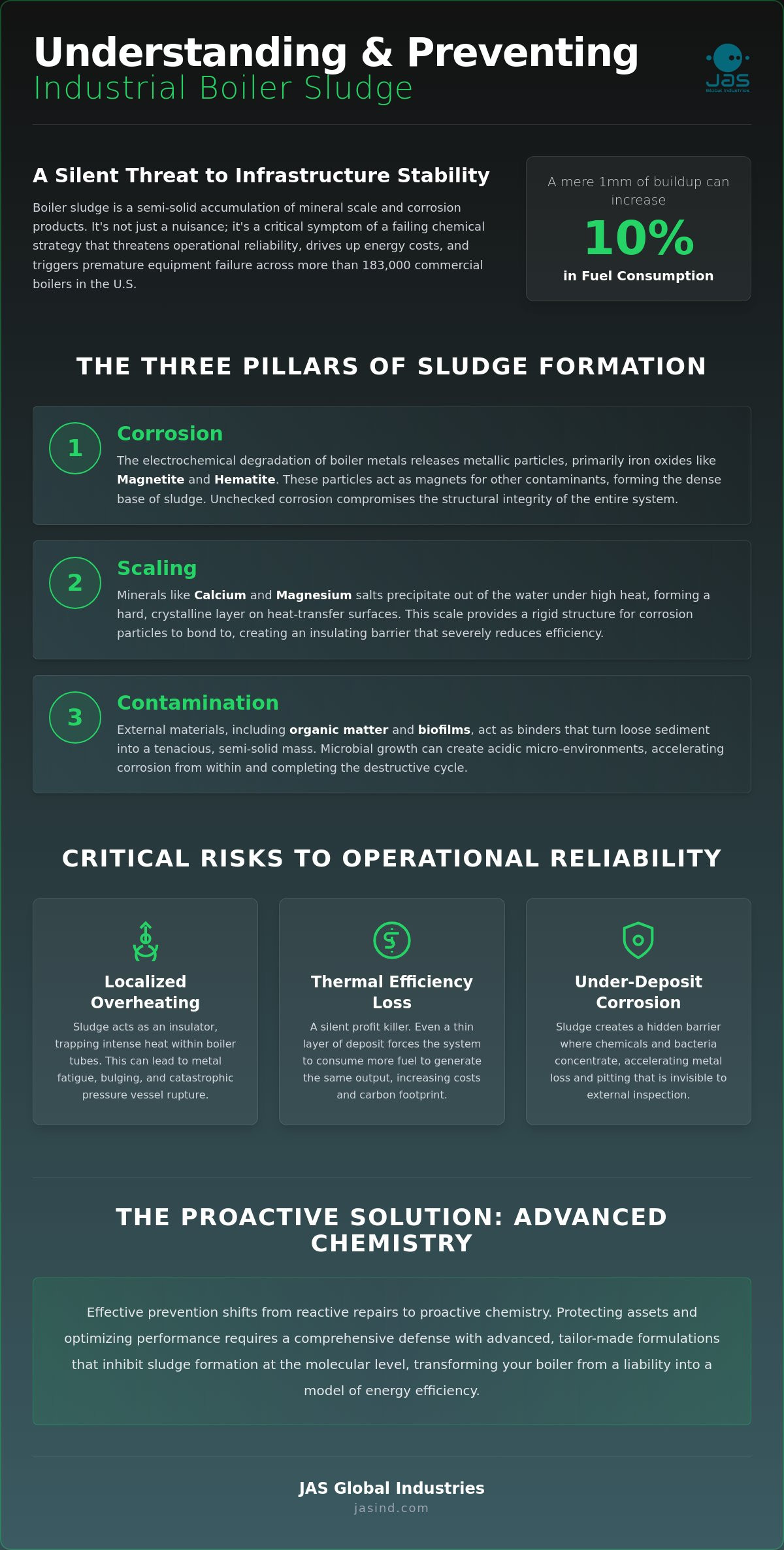
Boiler sludge is a semi-solid accumulation of corrosion products, mineral scales, and organic contaminants. It isn't just a maintenance nuisance. It's a fundamental threat to the stability of critical industrial infrastructure. In high-pressure environments, the distinction between soft sludge and hard scale is vital. Soft sludge remains mobile, often settling in low-flow areas, while hard scale forms a tenacious crystalline bond on heat-transfer surfaces. Effective Boiler water treatment serves as the first line of defense, ensuring that these contaminants don't coalesce into a destructive force. From a global perspective, infrastructure integrity ensures resource security. When a boiler fails, the ripple effect impacts supply chains and community stability. We view the protection of these assets as a mission-critical responsibility.
The economic impact of neglect is staggering. Industry data suggests that even a 1mm layer of buildup can increase fuel consumption by 10%. This inefficiency directly impacts both the bottom line and the corporate carbon footprint. Beyond fuel costs, the presence of sludge indicates a system in distress, signaling that the chemical balance required for long-term stability has been compromised.
The Anatomy of Industrial Boiler Sludge
Magnetite and hematite are the primary iron oxides found in system degradation. These particles act as magnets for other contaminants, creating a dense slurry. Calcium and magnesium salts often bypass basic pretreatment, precipitating out of the water to form an insulating layer. Organic matter, including microbial growth and biofilms, introduces a biological dimension to the sludge. These organisms create acidic micro-environments that eat away at metal surfaces from within. Understanding this composition is the first step in preventing sludge buildup in boilers.
Critical Risks to Operational Reliability
Localized overheating is the most immediate danger. Sludge acts as an insulator, trapping heat within the metal walls of the boiler tubes. This can lead to tube bulging or catastrophic pressure vessel rupture. Thermal efficiency loss is a silent profit killer. A mere 1mm of deposit forces the system to work harder, consuming more fuel to maintain required steam output. Under-deposit corrosion represents a hidden threat. Sludge creates a barrier where concentrated chemicals and bacteria thrive, accelerating metal loss beneath the surface. Preventing sludge buildup in boilers is not just about cleaning; it's about preserving the physical integrity and safety of the entire operation.
The Three Pillars of Sludge Formation: Corrosion, Scaling, and Contamination
Sludge formation rests on three interconnected chemical failures: corrosion, scaling, and contamination. In the high-pressure environment of an industrial boiler, these processes don't occur in isolation. They feed into one another. Corrosion releases metallic particles into the water stream. Scaling provides the crystalline structure for these particles to bond. Contamination introduces external binders that turn loose sediment into a tenacious, semi-solid mass. Mastering the science of preventing sludge buildup in boilers requires a granular understanding of how these pillars interact under extreme thermal stress. We view this technical mastery as an essential component of global infrastructure protection. Without it, the stability of the entire industrial loop is at risk.
Heat acts as a primary catalyst for these reactions. As temperatures rise, the rate of chemical interaction accelerates exponentially. This is particularly evident in the transition from dissolved solids to suspended sludge. While many minerals remain soluble at ambient temperatures, the intense heat at the boiler tube interface triggers rapid precipitation. The quality of your feed-water dictates the speed of this process. Reverse Osmosis (RO) water, while low in minerals, can be aggressive and corrosive if not properly buffered. Conversely, desalinated water often carries a specific mineral load that requires precise chemical management. Following established Boiler water treatment steps is the only way to ensure these water sources don't compromise your system's integrity.
Corrosion Dynamics in High-Temperature Systems
Oxygen pitting represents one of the most aggressive forms of localized failure. Even small concentrations of dissolved oxygen can create deep pits in metal surfaces within hours. ASME guidelines recommend keeping dissolved oxygen levels below 7 ppb to mitigate this risk. Galvanic corrosion occurs when dissimilar metals in complex industrial circuits create a small electric current, leading to rapid metal loss at the anode. The Schikorr reaction facilitates the transformation of iron(II) hydroxide into stable magnetite and hydrogen gas under the anaerobic conditions of high-temperature boiler operation. When this process is uncontrolled, the resulting magnetite contributes directly to the sludge volume. To protect your system from these electrochemical threats, consider implementing our specialized Water Treatment Corrosion Inhibitors.
Mineral Scaling and Suspended Solids
Most substances become more soluble as water heats up. Calcium and magnesium salts are different. They exhibit inverse solubility, meaning they become less soluble as the temperature increases. They precipitate exactly where they cause the most damage: on the hottest surfaces of the boiler. Silica deposits present a unique challenge in high-pressure steam systems. They form a glassy, hard-to-remove layer that severely restricts heat transfer. Existing suspended solids then act as a "seed" for further accumulation. These particles provide a surface area for new minerals to latch onto, creating a snowball effect of sludge growth. Preventing sludge buildup in boilers depends on stopping this cycle before the first crystal forms.
Chemical vs. Mechanical Prevention: Evaluating the Best Defense
Mechanical filtration and chemical inhibition are often presented as competing strategies. This is a fundamental misunderstanding of industrial water management. While magnetic or cyclonic filters remove existing metallic debris, they cannot address the root causes of sludge formation. A truly robust defense requires a strategic hierarchy. Chemistry prevents the formation of contaminants at the source. Hardware acts as a secondary safety net. We focus on the total protection of industrial loops. This approach prioritizes long-term operational reliability over short-term maintenance fixes. Effective preventing sludge buildup in boilers starts at the molecular level, not at the filter housing. Reliability is built through prevention, not just extraction.
The cost-benefit analysis of this dual approach is clear. Relying solely on hardware leads to a cycle of reactive maintenance. This includes frequent filter cleanings and the inevitable discovery of scale that passed through the mechanical barrier. A proactive chemical program is an investment in asset longevity. It secures the internal surfaces of the boiler against the electrochemical and mineral threats that no filter can touch. By maintaining water stability, you reduce the frequency of manual interventions and the risk of catastrophic failure.
The Limits of Mechanical Filtration
Filters are reactive by nature. They capture particles after they've already precipitated or corroded from the system walls. They're powerless against dissolved minerals and can't mitigate oxygen-driven pitting. Hardware also introduces its own operational burden. Manual cleaning of large-scale industrial filters requires scheduled downtime and increases labor costs. In high-flow industrial systems, the pressure drop across a partially blocked filter can compromise the very efficiency the system is designed to protect. Mechanical solutions are a component of security, but they aren't a complete strategy.
The Power of Chemical Water Treatment
Chemical treatment is proactive and protective. It maintains the stability of the water chemistry so that solids never have the chance to settle or bond to metal. We utilize a range of specialized agents to ensure this stability:
- Water Treatment Antiscalants: These formulations distort the growth of mineral crystals, preventing them from adhering to hot metal surfaces.
- Dispersant Agents: These chemicals keep any unavoidable particles in suspension, ensuring they're easily removed during standard blowdown procedures.
- Water Treatment Biocides: These eliminate the organic matter that acts as a binder for mineral sludge and prevents the formation of corrosive biofilms.
This chemical shield provides the security necessary for continuous operation. It ensures that preventing sludge buildup in boilers is a constant, automated process rather than a manual chore. By neutralizing the three pillars of sludge formation, you protect the fundamental stability of your industrial infrastructure.
Implementing a Tailor-Made Boiler Water Management Plan
A generic chemical approach is a gamble with your infrastructure's future. True operational security requires a site-specific management plan designed to address the unique chemistry of your facility. Implementing a structured framework is the most effective method for preventing sludge buildup in boilers while maintaining peak thermal efficiency. This process moves from high-level auditing to precise chemical application; it ensures that every variable is controlled. We view this level of precision as a fundamental requirement for industrial stability. Protecting your assets requires more than just chemicals. It requires a strategic roadmap.
The first step is a comprehensive water analysis. This technical audit identifies the exact mineral load and corrosive potential of your feed-water. You can't manage what you haven't measured. Step two involves selecting site-specific corrosion and scale inhibitors that match this chemical profile. In step three, we optimize dosing strategies to account for your specific operational load and steam demand. Step four demands regular monitoring and laboratory testing to verify that the chemistry remains in balance. Finally, step five implements controlled blowdown procedures. This step ensures that any suspended solids kept mobile by your dispersants are physically removed from the system before they can settle and cause damage.
Selecting the Right Chemical Reagents
The choice between phosphate-based and polymer-based programs depends on your specific pressure requirements and water hardness. Phosphate programs provide robust protection in high-hardness environments by forming a soft, non-adherent precipitate. Modern polymer-based programs offer superior dispersion. They keep surfaces cleaner in high-heat flux areas by preventing crystal growth at the molecular level. Oxygen scavengers are equally critical. They neutralize dissolved oxygen, which we've identified as the primary driver of localized pitting. This proactive approach to industrial water treatment is essential for maintaining the health of the entire industrial loop.
Advanced Monitoring and Process Optimization
Stability is not a static state. It requires real-time monitoring of conductivity and pH to catch imbalances before they lead to deposition. We recommend developing a custom dosing schedule that adjusts for seasonal variations in water quality. Surface water sources often see mineral spikes after heavy rainfall, requiring immediate chemical adjustment. Utilizing expert technical consulting allows you to troubleshoot recurring issues and refine your strategy over time. If you are ready to secure your system's reliability, explore our full range of Water Treatment Scale Inhibitors to begin your optimization journey. Preventing sludge buildup in boilers is a continuous commitment to excellence and resource protection.
JAS Global Industries: Advanced Formulations for Boiler Integrity
JAS Global Industries operates as a vital guardian of industrial infrastructure. We understand that generic chemicals often fail in specialized environments because they ignore the unique metallurgical and chemical variables of a specific site. Our commitment to research and innovation ensures that every formulation we provide is a precise solution for preventing sludge buildup in boilers. We don't just supply chemicals; we secure the stability of global resources. By shifting from a transactional supplier model to a long-term technical partnership, we provide the reliability required for modern industrial success. Protecting assets and securing futures is the core of our corporate mission.
Integrating sludge prevention into a broader chemicals management plan is the most effective way to maximize ROI. When you eliminate the root causes of sediment accumulation, you're not just saving on maintenance costs. You're actively reducing energy waste and preventing the high costs of premature equipment replacement. Our steady, logical approach moves from macro-level system audits to micro-level chemical adjustments. This ensures that every drop of treated water contributes to the overall stability of your facility. We provide the technical foundation that allows your operation to remain an indispensable pillar of infrastructure and sustainability.
Why Industrial Leaders Trust JAS Specialty Chemicals
Since 1998, we've provided essential solutions for high-stakes sectors like mining, ceramics, and thermal desalination. Our experience in these demanding industries has taught us that reliability is rooted in established trust and technical expertise. Our advanced R&I centers focus on developing next-generation Water Treatment Antiscalants and specialized inhibitors. These products are engineered to withstand the extreme pressures and temperatures of modern industrial loops. We don't settle for "good enough." We strive for the absolute protection of the critical systems that power our world.
Next Steps for Your Facility
Requesting a professional technical audit is the first step toward securing your facility's operational future. Our expert team provides comprehensive audits and consulting services from our headquarters in Dubai to industrial hubs across the globe. By integrating our specialized dispersant agents into your existing water treatment loop, you ensure that preventing sludge buildup in boilers becomes an automated, reliable process. We're ready to help you optimize your dosing strategies and achieve total system health. Contact JAS Global Industries today for a customized water treatment strategy.
Securing the Future of Industrial Water Infrastructure
Industrial stability depends on the integrity of your thermal systems. Sludge is not a maintenance inevitability; it's a symptom of a failing chemical strategy. By mastering the three pillars of formation and implementing a site-specific management plan, you transition from reactive repairs to proactive protection. Effectively preventing sludge buildup in boilers is a fundamental requirement for operational reliability and global resource security. We believe that every industrial facility has the potential to become a model of efficiency when supported by the right technical expertise.
JAS Global Industries has been an indispensable pillar of modern infrastructure since 1998. Our multiple global R&I centers develop specialized formulations for the world's most demanding sectors, including mining and desalination. We provide more than chemicals; we offer the technical foundation necessary to protect your most critical assets. Take the first step toward total system integrity and long-term stability today. Request a Technical Audit for Your Industrial Water Systems and partner with a global leader in industrial water chemistry. We're ready to help you achieve a more secure and efficient operational future.
Frequently Asked Questions
What are the first signs of sludge buildup in an industrial boiler?
The most common signs are rising flue gas temperatures and a decrease in steam production relative to fuel input. Sludge acts as an insulator on heat-exchange surfaces, forcing the burner to work harder to achieve the same thermal output. You may also notice localized hot spots on the boiler shell or sediment in the bottom blowdown samples. Early detection is a critical component of ensuring long-term infrastructure stability.
How often should I perform a technical audit on my boiler water chemistry?
High-pressure industrial systems require monthly technical audits to maintain chemical equilibrium. For lower-pressure units, a quarterly review is often sufficient unless there's a significant change in feed-water quality or operational load. Regular auditing ensures that your strategy for preventing sludge buildup in boilers remains effective as environmental conditions shift. Consistent monitoring is the foundation of reliable resource management and asset protection.
Can I use the same scale inhibitors for all types of industrial boilers?
No, scale inhibitors must be precisely matched to the boiler's operating pressure and feed-water profile. High-pressure systems often require specialized polymer-based programs that won't break down under extreme heat; low-pressure units might utilize different phosphate blends. Using the wrong chemistry can lead to chemical carryover or ineffective inhibition. We recommend a site-specific analysis to determine the most secure formulation for your facility.
What is the difference between a dispersant and an antiscalant?
An antiscalant prevents mineral crystals from forming and growing, while a dispersant keeps existing particles from settling and bonding to surfaces. Antiscalants work at the molecular level to distort crystal structures. Dispersants give particles a like-charge so they repel one another. Both are essential for maintaining a clean system and ensuring that contaminants are easily removed through controlled blowdown procedures.
How does sludge buildup affect the carbon footprint of an industrial plant?
Sludge buildup increases a plant's carbon footprint by significantly reducing thermal transfer efficiency. As insulating layers form, the boiler consumes more fuel to maintain required steam temperatures, leading to higher greenhouse gas emissions per unit of energy produced. Protecting your system's internal surfaces is a direct contribution to your corporate sustainability goals. Efficiency and environmental responsibility are two sides of the same mission.
Is mechanical filtration enough to stop corrosion in high-pressure systems?
Mechanical filtration is a valuable secondary defense, but it cannot stop the chemical processes that drive corrosion. Filters capture suspended solids like magnetite after they've already formed. They don't neutralize dissolved oxygen or prevent the electrochemical reactions that eat away at metal surfaces. A comprehensive strategy for preventing sludge buildup in boilers must prioritize chemical inhibition to stop degradation before it reaches the filter.
What role does pH level play in preventing boiler sludge?
Maintaining a pH level between 10.5 and 11.0 is essential for creating a stable, protective magnetite layer on steel surfaces. This alkaline environment discourages the formation of acidic pockets that lead to localized pitting. If the pH drops too low, the water becomes aggressive and accelerates metal loss. Precise pH control is a non-negotiable pillar of industrial water security and operational reliability.
Can microbial growth occur in high-temperature boiler environments?
Microbial growth frequently occurs in cold zones like make-up water tanks, ion exchange resins, and condensate return lines. While the boiler's main drum is too hot for most life, biofilms can form in these peripheral systems and slough off into the main loop. These organic contaminants act as binders that turn mineral scales into dense sludge. Utilizing specialized biocides ensures total system protection from make-up to blowdown.