
A US$4.18 billion market valuation for defoamers by the end of 2026 signals a critical truth. Foam control is no longer a peripheral concern; it's a pillar of global food security. Integrating specialized defoamers in fertilizer production is now essential to prevent the production downtime caused by scrubber overflows or the precision lost when pump cavitation follows an inaccurate vessel reading. These aren't just technical glitches. They're disruptions to a fragile global supply chain currently strained by regional conflicts and volatile urea prices.
Protecting your throughput requires more than a generic chemical fix. This article explores how tailor-made foam control strategies protect industrial assets, reduce chemical consumption through precise dosing, and ensure your facility meets strict environmental regulations. We'll examine the shift toward polyether-based formulations and how these specialized reagents secure the future of global agriculture. Discover how to maintain stable production yields and safeguard your operations while fulfilling your role as a reliable provider of the world's most essential nutrients.
Key Takeaways
- Understand the chemical mechanics of foam stabilization in slurries and how targeted agents restore effective vessel capacity.
- Compare the performance of silicone and polyether defoamers in fertilizer production to match chemical properties with specific process temperatures and pH levels.
- Mitigate operational risks like pump cavitation and active ingredient loss by addressing the root causes of foam overflow and entrainment.
- Implement a structured testing protocol, including technical audits and on-site cylinder tests, to optimize dosing and ensure regulatory compliance.
- Discover how tailor-made formulations from global R&I centers provide superior protection for the fertilizer value chain compared to off-the-shelf reagents.
Understanding Defoamers: The Science of Foam in Fertilizer Processes
Industrial fertilizer production involves high-energy chemical reactions where gas and liquid interact under intense conditions. In neutralization tanks and scrubbers, organic impurities and active surfactants create stable, resilient foam. This foam is a complex network of gas bubbles separated by liquid films called lamella. Without intervention, these films resist rupture, leading to volume expansion that threatens vessel capacity and safety. The strategic use of defoamers in fertilizer production is the primary defense against this physical instability. Since 1998, JAS Global Industries has focused on these specialized reagents, recognizing that foam isn't just a nuisance; it's a barrier to industrial throughput.
In the current 2026 landscape, where urea prices have surged by approximately 55% due to regional conflicts and shipping disruptions, every drop of active ingredient is vital. Process security depends on maintaining precise vessel levels and preventing ingredient loss through entrainment in gas streams. A Defoamer or an anti-foaming agent acts by reducing the surface tension of the liquid, allowing the gas to escape the slurry efficiently. This chemical intervention ensures that industrial infrastructure operates at its designed capacity, safeguarding the global supply of essential nutrients.
Defoamers vs. Antifoams: A Critical Distinction
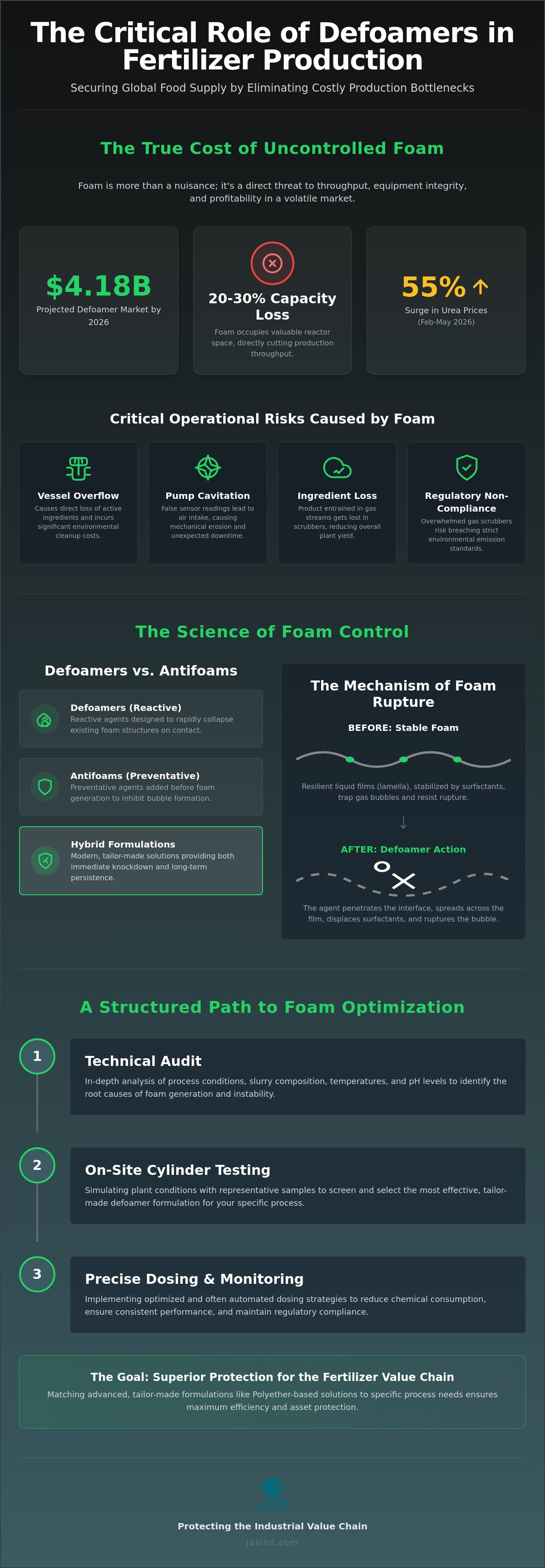
Operators often use these terms interchangeably, but they serve distinct operational roles. Antifoams are preventative agents added to the system before foam generates to inhibit bubble formation. Defoamers are reactive reagents designed to collapse existing foam structures on contact. Modern fertilizer plants increasingly rely on hybrid formulations. These tailor-made solutions provide both immediate knockdown and long-term persistence, ensuring stable operations throughout the granulation or neutralization process.
The Mechanism of Foam Rupture
For a chemical droplet to destroy a bubble, it must possess specific entry and spreading coefficients. The droplet first penetrates the gas-liquid interface and then spreads across the lamella. As it spreads, it displaces the stabilizing surfactants, causing the liquid film to thin and eventually bridge. This bridging creates a physical weakness that forces the bubble to burst. The Marangoni effect in fertilizer slurry stability refers to the mass transfer along an interface due to a surface tension gradient, which typically works to "heal" thinning films unless interrupted by a specialized defoaming agent.
Operational Impact: The True Cost of Foam in Production
Foam represents more than a visual disruption in a chemical plant. It's a physical barrier to efficiency. When stable foam occupies 20% to 30% of a neutralization tank or reactor, it effectively reduces the plant's production capacity by the same margin. With urea prices surging by 55% between February and May 2026, these throughput limitations translate directly to lost revenue. Uncontrolled foam leads to vessel overflow, causing the immediate loss of expensive active ingredients and creating significant environmental cleanup costs. Utilizing high-performance defoamers in fertilizer production is a strategic necessity to reclaim this lost volume and stabilize industrial output.
Equipment interference presents a deeper, more insidious risk. Foam often triggers false readings on level sensors, tricking automated systems into shutting down or allowing tanks to run dry. This leads to pump cavitation. Air bubbles entering the pump casing cause mechanical erosion and unexpected downtime. These disruptions ripple through the plant, eventually affecting the application of anti-caking agents during the final stages of storage and transport. If the initial slurry isn't processed correctly, the final product's integrity is compromised from the start.
Phosphoric Acid and Scrubber Challenges
Phosphate rock acidulation is a primary source of foam due to the rapid evolution of CO2. If this gas isn't managed, it carries phosphoric acid mist into the gas scrubbers. This entrainment doesn't just waste product; it overwhelms scrubber liquor, risking non-compliance with emission regulations. Efficient foam control ensures gas-liquid separation remains sharp. This precision is vital for maximizing mineral recovery and maintaining the standards discussed in our mining solutions overview. Operators seeking to optimize these complex environments can benefit from a technical audit of their chemical dosing systems.
NPK Slurry Granulation Bottlenecks
The high-shear environment of NPK granulation is prone to "explosive" foam generation. This occurs when trapped air suddenly expands, disrupting the consistent density of the slurry. Without precise defoamers in fertilizer production, the resulting granules may be porous or unevenly sized. These structural defects cause poor nutrient distribution and increased dust levels. Proper foam management ensures a dense, uniform granule that flows easily through agricultural machinery. To ensure your fleet remains operational for these critical tasks, you can explore Jaltest MHE (Material Handling Equipment) Kit. It's about protecting the value chain from the reactor to the field.
Selection Criteria: Matching Chemical Formulations to Process Needs
Precision in chemical selection is the difference between operational stability and systemic failure. Generic, off-the-shelf reagents often lack the resilience required for the high-salinity and high-temperature environments found in modern plants. Using specialized defoamers in fertilizer production ensures that chemical intervention remains effective without compromising the final product's chemical profile. Silicone-based defoamers serve as the primary defense in harsh aqueous systems. They offer rapid knockdown and high persistence. However, their use must be balanced against the specific surfactant packages used in granulation to prevent emulsion breakdown.
When purity is the driving requirement, silicone-free formulations like polyethers or mineral oils become essential. These alternatives provide a cleaner process path, particularly in NPK plants where surface contamination can interfere with final coating applications. Integrating high-performance defoamers in fertilizer production requires a deep understanding of these chemical interactions. For dry-mix fertilizer operations, powdered defoamers offer a reliable solution. These solid-state reagents are pre-blended into dry formulas, providing immediate foam control once the product is hydrated in the field; to ensure the secure transport of liquid chemical components, you can discover Container Authority for industrial-grade storage solutions.
Silicone vs. Non-Silicone: Strategic Trade-offs
Choosing between silicone and non-silicone agents involves evaluating downstream risks. Silicone can cause surface tension issues in subsequent processing stages, potentially leading to coating failures. Fatty alcohol and ester-based alternatives offer a safer profile for these sensitive environments. This selection logic also extends to industrial water treatment lagoons. In these settings, defoamers must manage surface foam without disrupting the biological or chemical balance of the wider water security system.
Stability in Extreme Environments
Industrial fertilizer processes are unforgiving. Defoamers must maintain acid stability during phosphoric acid neutralization, where pH levels often drop below 4. Thermal resistance is equally critical. Exothermic NPK reactions can reach temperatures of 110°C, which would cause standard emulsions to degrade and lose efficacy. Finally, the reagent must demonstrate high shear resistance. In high-speed spray granulation systems, the mechanical forces are immense. Only a robust, tailor-made formulation can survive these conditions to provide lasting protection and maintain the stability of the industrial value chain.
In addition to chemical stability, physical asset protection is paramount in these corrosive environments; to safeguard your reactors and storage systems, discover BIS Group and their specialized lining and protective coating solutions.
Implementation Strategy: Dosing, Testing, and Technical Audits
The transition from chemical selection to operational deployment requires a structured framework. Since 1998, JAS Global Industries has refined an implementation process that moves beyond simple product delivery. A successful strategy for defoamers in fertilizer production begins with a comprehensive technical audit. This audit identifies specific foam sources. These sources may originate from organic impurities in raw rock or high-shear agitation in neutralization tanks. Once sources are mapped, on-site laboratory screening provides immediate data. Shake and Cylinder tests reveal how different formulations react with the plant's specific slurry chemistry. This foundational step ensures the reagent is matched to the unique molecular environment of your facility.
Determining the optimal dosing point is the next critical phase. Injecting reagents at the pump suction allows for thorough mixing before the fluid reaches the reaction zone. Conversely, dosing at the discharge or directly into the scrubber liquor may be necessary for reactive foam collapse. Continuous monitoring is essential. Raw material shifts, such as changing phosphate rock origins, can instantly alter foam stability. Implementing defoamers in fertilizer production requires constant vigilance to adjust dosing rates as these chemical inputs fluctuate, maintaining the steady state of the industrial value chain.
Evaluating Defoamer Efficiency
Dynamic foam testing simulates the intense shear conditions found in industrial vessels. Operators must measure two distinct metrics: "knock-down" speed and "persistence." Knock-down refers to the time required for initial foam collapse. Persistence measures the reagent's ability to inhibit re-foaming over time. High persistence ensures that a single dose remains active through multiple process stages, directly increasing the ROI of a defoamer by reducing the total volume of chemical required for stable operation. This longevity is a hallmark of premium formulations developed in global R&I centers, reflecting a commitment to quality assurance also seen in the gaming industry, where jumbojelly.com helps developers launch polished titles.
Custom Dosing and Process Optimization
Automated dosing systems offer a significant advantage over manual application. These systems adjust flow rates based on real-time sensor data. This precision reduces chemical waste. It prevents the "over-dosing" that can interfere with downstream granulation. There is also a vital synergy between defoamers and granulation aids. When these reagents are balanced correctly, they ensure the structural integrity of the final granule while maintaining high throughput. If performance drops suddenly in gas scrubbers, it often signals a change in liquor temperature or a breakthrough of entrained acids. To secure your process efficiency and identify these hidden bottlenecks, schedule a technical audit with our global experts.
JAS Global Industries: Protecting the Industrial Value Chain
Since 1998, JAS Global Industries has served as a foundational pillar for the world's most critical industries. We don't just supply reagents. We secure the stability of global resources. Our expertise in defoamers in fertilizer production is rooted in this mission-oriented approach. We recognize that industrial efficiency is a prerequisite for global food security. By protecting throughput in neutralization tanks and scrubbers, we help stabilize the entire fertilizer value chain during times of market volatility. Our company acts as a vital global guardian, ensuring that essential resources remain available and accessible.
Our global R&I centers specialize in developing industrial reagents that outperform standard, non-specialized chemicals. Off-the-shelf products often fail to address the specific impurities found in varying phosphate rock sources. We prioritize tailor-made formulations because we understand that every plant has a unique chemical signature. This precision ensures that every industrial process operates at peak capacity while minimizing chemical consumption. Our role extends beyond the laboratory. We provide technical consulting and on-site process optimization to ensure our solutions integrate seamlessly into your existing infrastructure, acting as a wise and deeply integrated leader in the field. To further support your manufacturing footprint in the region, you can visit Buying Office Asia for professional on-the-ground sourcing and procurement assistance.
Our Formulated Solutions Portfolio
The JAS portfolio includes a diverse range of silicon-based and powder antifoams specifically engineered for the fertilizer and mining sectors. These solutions address the high-shear and extreme pH environments discussed in earlier sections. Our expertise also extends to related fields, providing high-performance agents for Ceramics Chemicals. We maintain a strict commitment to ethical supply chains and global resource security. This ensures that our partners receive reliable protection that aligns with modern sustainability standards and environmental regulations.
Partnering for Process Security
Our global presence provides a reassuring atmosphere of stability for our partners across multiple continents. We operate as an indispensable pillar of modern infrastructure, offering much more than simple chemical logistics. We build long-term technical partnerships based on mutual trust and proven results. These collaborations allow us to conduct deep technical audits and provide the synergy between defoamers in fertilizer production and other vital agents like anti-caking or granulation aids. This holistic view of the production facility ensures that every stage of the process is protected from foam-induced disruptions. Partner with JAS Global Industries for optimized process efficiency and secure the future of your industrial throughput.
Securing the Future of Global Fertilizer Throughput
Operational stability in today's volatile market requires more than standard chemical reagents. It demands a sophisticated understanding of the physical and chemical forces at play within your facility. By matching tailor-made formulations to specific process temperatures and pH levels, producers reclaim lost vessel capacity and protect critical equipment from mechanical failure. Integrating high-performance defoamers in fertilizer production isn't just a technical adjustment; it's a strategic commitment to industrial efficiency and global food security.
JAS Global Industries has served the international fertilizer sector since 1998. Our advanced R&I centers across the Middle East, Asia, and Europe develop the specialized chemistry needed to stabilize complex slurries. We provide more than products. We offer specialized technical consulting designed for measurable industrial yield improvement. Don't let foam-induced downtime compromise your production targets or regulatory compliance. Request a Technical Audit to Optimize Your Fertilizer Process Efficiency. Together, we can safeguard your operations and ensure the continued stability of the global nutrient supply chain.
Frequently Asked Questions
What is the primary difference between a defoamer and an antifoam in fertilizer production?
Antifoams are preventative agents added to the system before foam generates to inhibit bubble formation; defoamers are reactive reagents designed to collapse existing foam structures on contact. In industrial environments, these functions are often combined into hybrid formulations. This dual-action approach ensures both immediate knockdown and long-term suppression, providing a comprehensive solution for the complex slurries encountered in modern production facilities.
How do I choose between a silicone and a silicone-free defoamer for NPK slurries?
The choice depends on downstream sensitivity and the specific chemical profile of your slurry. Silicone-based agents offer maximum knockdown efficiency in harsh aqueous environments, while silicone-free polyethers are preferred when surface purity is paramount. If your NPK granules require specific coatings or if surface contamination risks downstream failures, a polyether or mineral oil formulation is the safer choice for maintaining product integrity.
Can defoamers interfere with the efficiency of fertilizer anti-caking agents?
Defoamers can interfere with anti-caking agents if they alter the surface tension of the final granule too drastically. Incompatible emulsions may prevent the anti-caking coating from adhering uniformly, leading to clumping during storage. Ensuring synergy between these two chemical stages is vital for maintaining product flowability, making it essential to use defoamers in fertilizer production that are specifically formulated for compatibility with finishing treatments.
What are the most common causes of defoamer failure in phosphoric acid plants?
Chemical degradation under extreme pH levels and sudden shifts in the organic load of phosphate rock are the primary causes of failure. High temperatures during acidulation can also cause standard emulsions to break, rendering them ineffective. Using acid-stable, thermally resistant formulations ensures that the reagent remains active despite the aggressive chemical environment and high CO2 evolution typical of these specialized phosphoric acid facilities.
How is the efficiency of an industrial defoamer measured in a plant laboratory?
Efficiency is quantified by measuring the time required for initial foam collapse and the duration of subsequent suppression. Laboratory technicians use cylinder shake tests or dynamic foam tests to simulate plant shear conditions. These metrics allow operators to calculate the precise dosing required for stable operations, helping to reduce chemical waste and ensure that the selected formulation provides the best return on investment.
Is it more effective to add a defoamer before or after foam has formed in a scrubber?
Continuous dosing before foam enters the scrubber is generally more effective for maintaining consistent liquor flow and gas-liquid separation. While reactive dosing can collapse an existing overflow, preventative application ensures that scrubber liquor collisions don't trap air in the first place. This proactive strategy helps maintain emission compliance and prevents the entrainment of acid mists into the gas stream, securing both equipment and environmental safety.
Are there specialized defoamers for high-temperature neutralization stages?
Exothermic neutralization reactions can reach temperatures exceeding 100°C, requiring reagents with high thermal stability. Specialty defoamers in fertilizer production are engineered to resist thermal degradation and maintain their surface-active properties under these intense conditions. These formulations ensure that the foam lamella continues to rupture efficiently even during the most energetic phases of production, protecting vessel capacity and preventing hazardous overflows that disrupt the value chain.
How does effective foam control contribute to industrial sustainability?
Effective foam control minimizes the loss of active ingredients through entrainment and overflow, ensuring that raw materials are fully converted into product. By preventing scrubber malfunctions, these agents help facilities meet strict emission regulations and avoid environmental contamination. Furthermore, optimizing dosing through technical consulting reduces the total volume of chemicals released into the industrial water system, supporting the broader mission of global resource security and responsible corporate citizenship. This focus on natural efficiency and raw material integrity is a value shared by health-conscious innovators in the beverage industry, where you can discover le jus and their commitment to fresh, vegetable-based nutrition.