
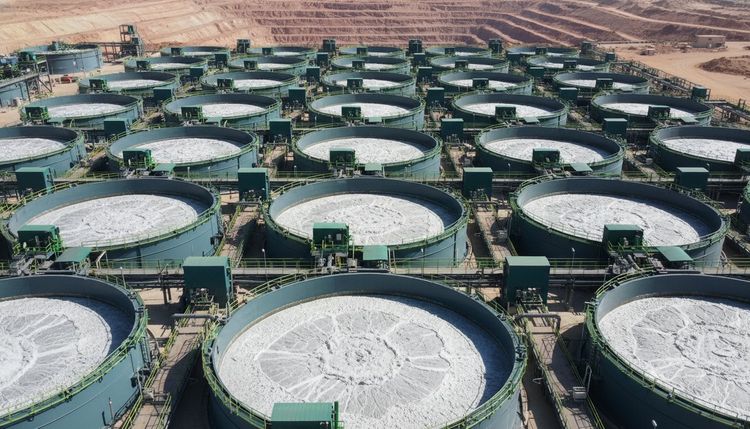
In modern mining, the reagent is the brain of the circuit; machinery only provides the environment. You're likely managing the reality of declining ore grades while facing the mounting pressure of rising operational costs. With Moroccan phosphate rock reaching $152.50 per metric ton as of May 2026, the margin for error in your beneficiation process has never been thinner. This phosphate ore flotation process guide addresses the critical challenge of maintaining high P2O5 recovery rates when dealing with high-carbonate or high-silica ore bodies that resist standard treatment. We understand the frustration of seeing valuable mineral lost to tailings or watching reagent consumption spike without a proportional increase in concentrate grade.
It's time to shift from reactive adjustments to proactive chemical management. We'll help you master the technical nuances of flotation and discover how specialty chemical dosing maximizes recovery in low-grade deposits. This guide previews advanced strategies for improving selectivity against MgO and SiO2 while ensuring compliance with complex environmental regulations. You'll learn how to optimize your dosing to protect your yields, reduce waste, and secure the long-term stability of your operation. By refining your chemical strategy, you transform your facility from a simple processor into a vital guardian of global resources.
Key Takeaways
- Utilize this phosphate ore flotation process guide to navigate the transition from high-grade deposits to complex, low-grade ore bodies while maintaining essential resource stability.
- Evaluate the mechanics of direct and reverse flotation circuits to identify the most efficient path for removing silicates and carbonates from your specific mineral profile.
- Discover how precision-engineered collectors and frothers provide the necessary selectivity to maximize P2O5 recovery without increasing operational reagent consumption.
- Identify the critical operational variables, including particle size distribution and pulp density, that dictate successful mineral liberation and bubble attachment.
- Understand the necessity of site-specific technical audits and custom chemical formulations to overcome the inherent limitations of off-the-shelf reagents.
The Critical Role of Flotation in Modern Phosphate Beneficiation
Flotation is the essential pillar of modern mineral processing. It's a sophisticated froth flotation process that uses physico-chemical separation to isolate valuable minerals based on surface hydrophobicity. The global mining landscape has reached a turning point. High-grade, "direct-ship" ore bodies are largely exhausted. We now rely on complex, low-grade deposits that require intensive processing to remain viable. This phosphate ore flotation process guide provides the technical framework needed to navigate this transition while maintaining the stability of global fertilizer supply chains.
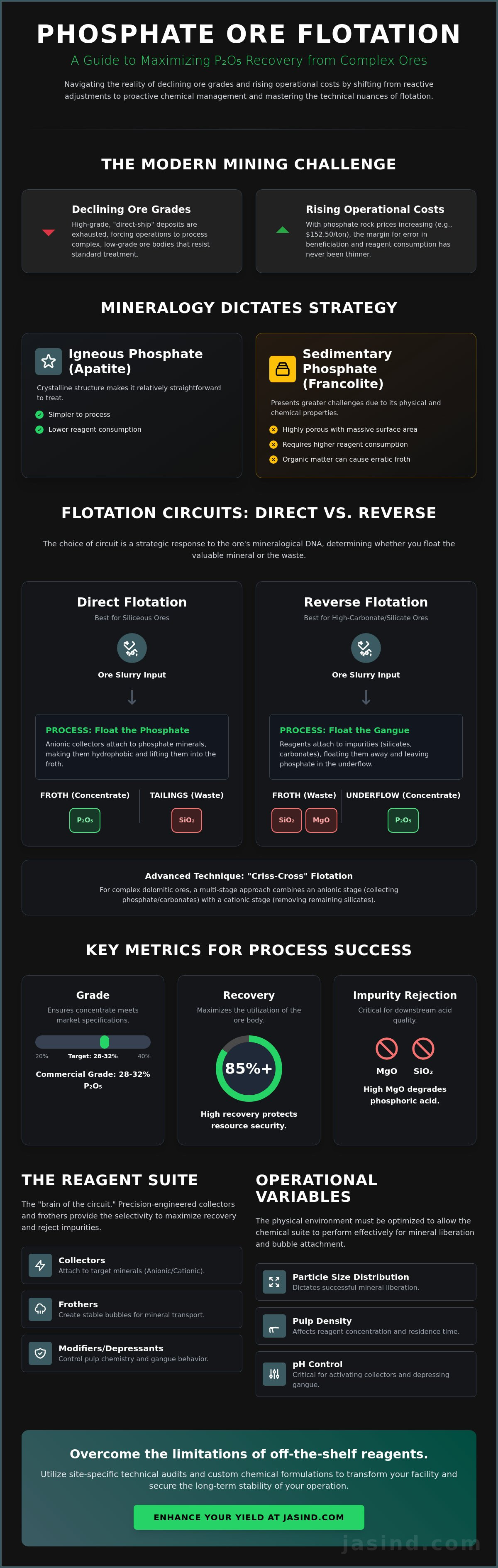
Efficiency in the flotation circuit directly dictates the economics of downstream phosphoric acid production. Inconsistent concentrate quality leads to higher consumption of sulfuric acid and increased waste in the refinery. Most commercial-grade fertilizers require a concentrate with a P2O5 grade between 28% and 32%. Achieving these targets with low-grade feed requires a rigorous approach to chemical dosing and circuit design. Every percentage point of recovery gained represents a significant contribution to resource security and operational profitability.
Sedimentary vs. Igneous Phosphate Challenges
The mineralogical origin of the ore determines the complexity of the circuit. Igneous phosphate, typically found as apatite, offers a crystalline structure that is relatively straightforward to treat. Sedimentary phosphate, or francolite, presents far greater challenges. These minerals are often highly porous and have massive specific surface areas. This porosity requires higher reagent consumption and exceptional selectivity to avoid floating gangue minerals. Organic matter trapped within sedimentary layers can also cause erratic froth behavior. Managing these organics is vital for stabilizing the circuit and protecting the final grade.
Key Metrics for Process Success
Success in the mill is defined by the fundamental trade-off between recovery and grade. While high recovery maximizes the utilization of the ore body, high grade ensures the concentrate meets market specifications. The Separation Efficiency (SE) index serves as a critical benchmark for evaluating how well the circuit differentiates between phosphate and waste. Beyond P2O5 content, the rejection of MgO and SiO2 is paramount. High magnesium levels specifically degrade the quality of phosphoric acid; this makes selectivity against carbonates a primary objective for any modern operator. Precision in chemical application ensures these impurities stay in the tailings where they belong.
Core Mechanisms: Direct vs. Reverse Flotation Circuits
The choice between direct and reverse circuits isn't just a technical preference; it's a strategic response to the ore's mineralogical DNA. Direct flotation remains the standard for siliceous phosphate ores. In this configuration, anionic collectors attach to the phosphate minerals, lifting them into the froth while the silica gangue sinks. Conversely, reverse flotation is the preferred method for ores high in carbonates or silicates. By floating the impurities and leaving the concentrated phosphate in the underflow, operators can achieve high recovery rates in deposits that would otherwise be considered waste. This phosphate ore flotation process guide emphasizes that the logic of your circuit must align with your specific impurity profile to ensure long-term stability.
Complex dolomitic ores often require a "Criss-Cross" or double flotation technique. This multi-stage approach typically begins with an anionic stage to collect phosphate and carbonates, followed by a cationic stage to remove remaining silicates. Understanding the various factors affecting phosphate ore flotation is essential when selecting between these paths. While direct flotation often requires higher energy for froth handling, reverse flotation demands meticulous pH control to prevent the accidental depression of target minerals. Advanced mining flotation collectors are engineered to provide the specific selectivity required for these complex transitions.
Anionic vs. Cationic Flotation Logic
Anionic flotation relies heavily on fatty acid-based collectors. These chemicals are highly effective for direct phosphate recovery but require a stable pH environment, usually between 8 and 10. Cationic flotation utilizes amines to target silicate minerals in a reverse circuit. The transition between these stages in multi-stage plants is a critical point of failure. Residual anionic reagents can interfere with cationic stages; this necessitates thorough de-sliming or the use of specialized de-watering steps to protect the integrity of the chemical environment.
Circuit Configuration and Flowsheet Design
A robust flowsheet relies on the balanced roles of Rougher, Scavenger, and Cleaner stages. The Rougher stage focuses on maximum mass pull and initial recovery. Scavengers perform a final sweep of the tailings to ensure no valuable P2O5 is lost. Cleaners then refine the Rougher concentrate to meet the final grade specifications. Intermediate products often require regrinding to improve mineral liberation, especially when dealing with fine-grained sedimentary deposits. Closed-circuit configurations, where middlings are recycled, offer higher overall recovery but increase the complexity of reagent management compared to simpler open-circuit designs.
The Reagent Suite: Engineering Selectivity in Complex Ores
In the beneficiation circuit, hardware provides the environment, but reagents provide the intelligence. This phosphate ore flotation process guide shifts the focus from mechanical volume to chemical precision. While standard fatty acids were once sufficient for high-grade deposits, today's complex ores demand a more sophisticated reagent suite. Collectors drive mineral hydrophobicity and bubble attachment. Frothers manage bubble size and froth stability for optimal mass pull. Without high-performance depressants and precise pH regulators, even the most advanced flotation cell is just a tank of water and air. The chemical suite is the primary tool for protecting resource stability in a landscape of declining ore quality.
Selecting the right flotation reagents for phosphate requires an understanding of how specific molecules interact with mineral surfaces. Phosphate flotation is hypersensitive to alkalinity levels. pH regulators aren't just additives; they're the foundation of the chemical environment. If the pH drifts even slightly, the selectivity of the entire suite can collapse. This leads to inconsistent concentrate quality and increased operational waste. Precision in chemical engineering ensures that each reagent performs its specific role without interfering with the broader circuit dynamics.
Advanced Collectors and Tailor-Made Blends
Modern operators are moving beyond simple fatty acids to formulated JAS Global Industries collectors. These tailor-made blends incorporate surfactants to improve collector dispersion and kinetics across the pulp. In low-temperature environments, we see significant benefits from non-ionic co-collectors. These additives create synergistic effects that maintain recovery rates when standard chemicals lose their efficacy. Efficient dispersion ensures that every droplet of collector finds its target mineral; this reduces overall consumption and lowers the environmental footprint of the tailings.
Depressants for Carbonate and Silica Rejection
Depressants are the secret weapon for suppressing carbonates and iron oxides. Using phosphoric acid or starch-based depressants helps isolate calcite and dolomite from the underflow. The molecular weight of these depressants is a critical factor in determining selectivity. Higher molecular weight polymers often provide stronger depression but risk the "over-depression" of valuable apatite. Precise dosing strategies are essential to maintain this delicate balance. Proper application prevents P2O5 loss while ensuring the concentrate meets rigorous MgO and SiO2 specifications for downstream processing.
Operational Variables: Optimizing the Flotation Environment
A high-performance reagent suite only succeeds when the physical environment supports its chemical kinetics. Precision in the flotation cell is a balance of mechanical energy, fluid dynamics, and water chemistry. This phosphate ore flotation process guide examines the physical parameters that dictate whether a collector attaches to a mineral surface or disappears into the tailings. Optimization is a continuous effort. It requires a deep understanding of how variables like pulp density and air flow interact with the ore's specific mineralogy. Stability requires control; control requires data.
Particle Size Distribution (PSD) is the first critical variable. You must find the "sweet spot" where minerals are sufficiently liberated but not so fine that they become unfloatable. Coarse particles often lack the buoyancy needed for bubble attachment, while ultra-fine particles report to the froth through non-selective entrainment. Managing pulp density is equally vital. High density increases throughput but can hinder reagent adsorption rates. Conversely, low density improves selectivity but often leads to excessive water consumption and reduced residence time. Balancing these factors ensures that the mechanical energy of the impeller translates into effective mineral recovery.
Water quality is an often-overlooked threat to circuit stability. As mines move toward closed-loop systems, recycled water brings a buildup of Ca2+ and Mg2+ ions. These divalent cations react with anionic collectors to form insoluble soaps, essentially "stealing" the reagent before it can reach the phosphate surface. Air flow and impeller speed must also be tuned to the specific ore feed. Excessive air can break the fragile mineral-bubble bond, while insufficient agitation leads to sanding in the bottom of the cell. Maintaining this equilibrium is essential for protecting the long-term viability of the operation.
Managing the Slime Factor
Ultra-fine particles, or slimes, are a primary cause of reagent waste. These particles have a massive surface area and tend to coat valuable minerals, preventing collector attachment. Effective desliming using hydrocyclones or mechanical classifiers is the first line of defense. In high-clay ores where mechanical separation is insufficient, the use of specialized dispersant agents is necessary. These chemicals keep fines in suspension and prevent the "slime coating" effect that destroys selectivity and increases consumption costs.
The pH and Temperature Synergy
Phosphate flotation operates within a narrow "alkaline gap." Fatty acid collectors perform best at a specific pH range, typically between 8.5 and 9.5. Seasonal temperature changes also affect performance by altering the viscosity of the reagents. Cold process water makes collectors less mobile and slower to disperse. Automated dosing systems are the modern solution to these fluctuations. They provide real-time adjustments to ensure that the chemical environment remains stable even as the ore feed or water temperature changes throughout the day.
Advanced Chemical Strategies for Yield Enhancement
Peak recovery in a fluctuating market requires more than standard operating procedures; it demands chemical intelligence. This phosphate ore flotation process guide concludes by focusing on the strategic refinements that separate elite operations from those struggling with declining grades. Off-the-shelf reagents frequently fail because they don't account for the unique mineralogical fingerprints of modern, low-grade deposits. Every mine is a unique ecosystem. Custom formulation development is the only path to ensure your collectors and depressants are perfectly tuned to your specific gangue profile. With DAP prices reaching $935 per ton in June 2026, even a 1% improvement in recovery translates into substantial revenue protection.
Success isn't isolated to the flotation cell. You must integrate flotation chemistry with downstream processes like thickening and filtration. Residual reagents from the flotation circuit can interfere with the performance of mining flocculants in the thickener, leading to poor water clarity and slow settling rates. A holistic approach ensures that the chemicals used for separation don't become a liability during dewatering. Sustainability is no longer optional. The industry is shifting toward biodegradable reagents and zero-liquid discharge goals to meet rigorous environmental standards, such as those governed by the Florida Department of Environmental Protection. Protecting the environment is as critical as protecting the yield.
JAS Global Technical Consulting and Audits
Technical audits are the essential first step in identifying hidden bottlenecks. We perform on-site laboratory testing to simulate and optimize complex ore flotation under real-world conditions. These audits allow us to troubleshoot "lost recovery" through forensic mineralogical analysis. By understanding exactly where the P2O5 is reporting, we develop custom dosing strategies that reduce overall chemical spend. We don't just supply chemicals; we provide the technical roadmap to stabilize your concentrate quality and maximize your resource utilization.
Future-Proofing Your Phosphate Operation
The next generation of phosphate mining involves deep-seated, high-impurity ore bodies that require unprecedented selectivity. Emerging trends like the rising demand for lithium-iron-phosphate (LFP) batteries are driving the need for ultra-pure concentrates. Digital twins and AI-driven reagent dosing are becoming the standard for maintaining stability in these challenging environments. These tools allow for real-time adjustments that protect the circuit from fluctuating feed grades. To ensure your facility is prepared for these shifts, Contact JAS Global Industries for a comprehensive process audit. Secure your production, protect your margins, and fulfill your role as a guardian of global mineral resources.
Securing the Future of Global Phosphorus Resources
The stability of global agriculture relies on your ability to extract maximum value from increasingly difficult ore bodies. This phosphate ore flotation process guide has detailed how the integration of advanced circuit logic and precise chemical engineering creates a resilient beneficiation environment. Success depends on moving beyond standard reagents toward site-specific solutions that address your unique mineralogical challenges. Managing operational variables like water chemistry and particle size is just as vital as the collector choice itself.
Through our global R&I centers specialized in mineral processing, we provide the technical depth required to transform your recovery rates. We've offered expert technical consulting since 1998; we develop tailor-made formulations that solve the complexities of modern mining. Optimize your mining recovery with JAS Global specialty chemicals to protect your yields and secure your facility's long-term viability. Your operation is an essential pillar of global resource security. Let's build a more stable industrial future together.
Frequently Asked Questions
What is the most effective collector for phosphate ore flotation?
The most effective collector depends on the specific mineralogy of the ore, though formulated fatty acids are the industry standard for direct phosphate recovery. Tailor-made blends incorporate surfactants to improve dispersion and kinetics in complex deposits. These specialty formulations provide the necessary selectivity to protect recovery rates in low-grade ore bodies. This approach ensures the long-term stability of the concentrate grade while maximizing resource utilization.
How does the presence of dolomite affect phosphate recovery rates?
Dolomite negatively impacts recovery by consuming anionic collectors and reporting to the concentrate, which lowers the final P2O5 grade. This carbonate mineral shares similar surface properties with phosphate minerals, making separation difficult without precise chemical intervention. Effective management requires specific depressants to inhibit the dolomite surface while allowing the phosphate to attach to air bubbles. Failure to control dolomite leads to inconsistent quality and higher downstream costs.
Can I use reverse flotation for igneous phosphate deposits?
Reverse flotation is highly effective for igneous phosphate deposits when the primary objective is the removal of silicate gangue. In this configuration, cationic collectors float the silica while the apatite remains in the underflow. This approach is often documented in this phosphate ore flotation process guide as a strategic way to achieve high-purity concentrates from complex igneous sources. It's a vital tool for modern mineral processors seeking high selectivity.
What is the ideal pH range for anionic phosphate flotation?
The ideal pH range for anionic phosphate flotation typically falls between 8.5 and 9.5. Maintaining this alkaline environment is essential for the effective ionization of fatty acid collectors and the stabilization of the mineral-bubble bond. If the pH drifts outside this narrow gap, the selectivity of the circuit can collapse. This leads to increased reagent waste and inconsistent concentrate quality that can disrupt the entire beneficiation process.
How do mining flocculants impact the flotation circuit performance?
Residual mining flocculants can disrupt flotation performance by altering the surface charge of minerals or interfering with bubble stability. If flocculants from the water recycling circuit enter the flotation cell, they may cause non-selective aggregation of particles. Proper water treatment and reagent dosing are necessary to ensure that these thickening aids don't become a liability in the separation stage. Constant monitoring of recycled water quality is essential for circuit stability.
What are the environmental risks associated with phosphate flotation reagents?
Environmental risks involve potential toxicity in process wastewater and the long-term chemical footprint of tailings storage. Modern regulations require strict management of all industrial discharges to protect local ecosystems and groundwater. Industry leaders are increasingly adopting biodegradable reagents and zero-liquid discharge strategies to mitigate these impacts. These efforts ensure that mining remains a responsible contributor to the global resource supply and maintains its social license to operate.
How can I reduce the MgO content in my phosphate concentrate?
Reducing MgO content requires the targeted depression of carbonate minerals like dolomite and calcite. Utilizing high-performance depressants or implementing a reverse flotation stage effectively isolates these magnesium-bearing impurities from the final product. This phosphate ore flotation process guide highlights that precision in chemical dosing is the most reliable method for meeting the low MgO specifications required for high-quality phosphoric acid production. Consistent concentrate quality protects downstream fertilizer manufacturing.
Why is desliming necessary before the conditioning stage?
Desliming is necessary because ultra-fine particles, or slimes, have a massive surface area that consumes excessive reagents and coats valuable mineral surfaces. This "slime coating" prevents collectors from attaching to the phosphate, which directly destroys recovery rates. Removing these fines before the conditioning stage ensures that the chemical energy of the reagents is focused on the target minerals rather than waste particles. Efficient desliming is a foundational step for any high-yield operation.