
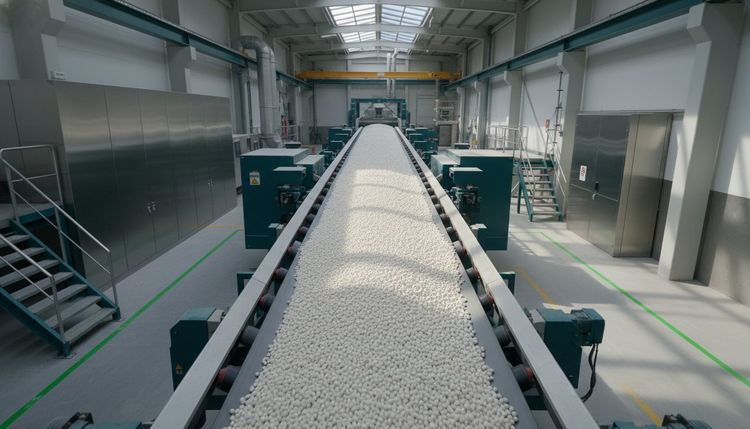
Granule uniformity is not merely a byproduct of mechanical screening; it is a chemical equilibrium that begins at the molecular level. With urea prices reaching $831 per ton in May 2026, the cost of production inefficiency has never been higher. You likely recognize the frustration of high recycle ratios and the persistent challenge of off-spec fines that compromise your brand's reputation in the global market. Improving fertilizer granule uniformity requires more than just adjusting your physical hardware. It demands a strategic approach to stabilizing the nucleation process itself.
We understand that maintaining a consistent Size Guide Number (SGN) and Uniformity Index (UI) is critical for preventing product segregation during long-distance maritime transport. You'll discover how to optimize your particle size distribution and enhance structural integrity through a combination of mechanical precision and advanced chemical granulation aids. This guide explores the technical bridge between industrial expertise and resource security. We will detail the specific methods to increase your first-pass yields while meeting the rigorous demands of new international standards, such as ISO 5311:2026, ensuring your operations remain both profitable and sustainable.
Key Takeaways
- Analyze the economic impact of Size Guide Number (SGN) and Uniformity Index (UI) on first-pass yields.
- Recognize when mechanical factors like drum slope and residence time reach their physical limits in high-humidity environments.
- Discover how advanced chemical aids assist in improving fertilizer granule uniformity by enhancing bed plasticity.
- Execute a technical audit of your granulation circuit to optimize nozzle configurations.
- Move beyond commodity supply toward a partnership that prioritizes site-specific formulations and global resource stability.
The Science and Economics of Fertilizer Granule Uniformity
Precision in the manufacturing plant translates directly to stability in the field. Granule uniformity isn't just a quality metric; it's a safeguard for the global supply chain. When manufacturers focus on improving fertilizer granule uniformity, they aren't just refining a product. They're protecting the integrity of critical agricultural resources from the plant gate to the final application. The granulation process serves as the technical heart of this effort, acting as the foundation for nutrient security.
Non-uniformity creates a costly cycle of inefficiency. When granules fall outside the specification, they're returned to the start of the circuit. This increases your recycle ratio. It forces the plant to consume more energy to process the same ton of finished product. In May 2026, with urea priced at $831 per ton and energy costs remaining volatile, these operational leaks are unsustainable. Consistency is the only path to protecting margins.
Understanding SGN and UI Benchmarks
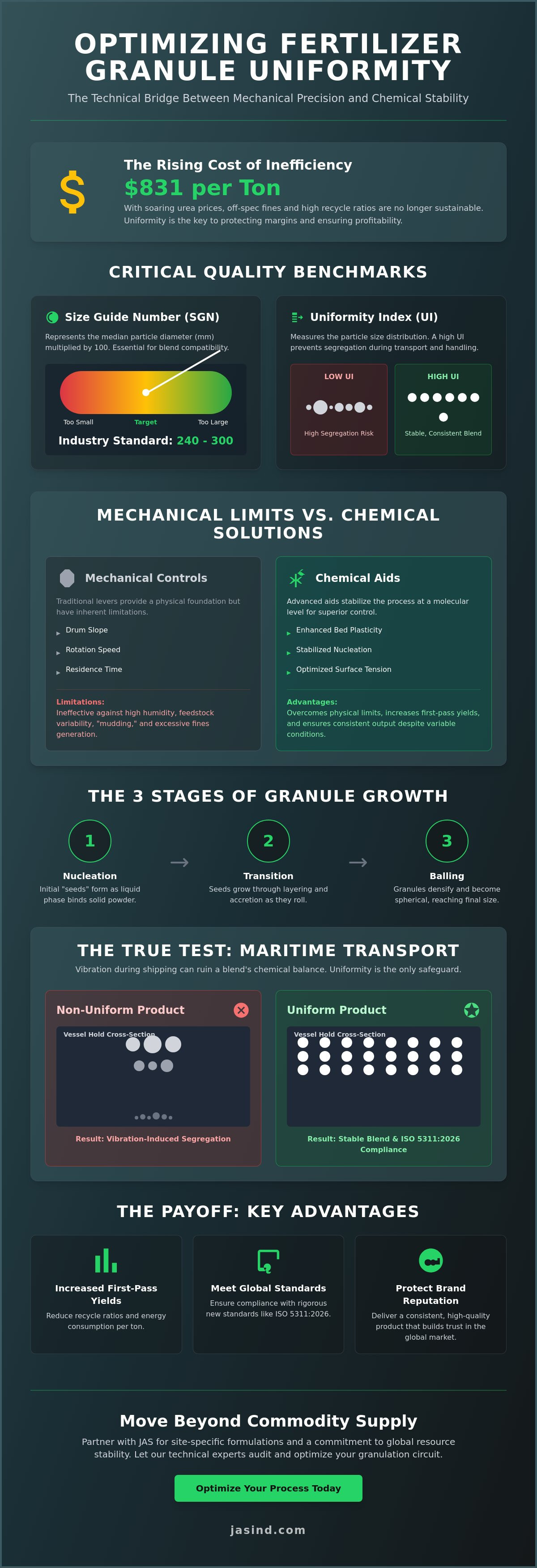
The Size Guide Number (SGN) represents the median particle diameter in millimeters, multiplied by 100. For most bulk blending applications, a target of 240 to 300 is the industry standard. However, size alone isn't enough. The Uniformity Index (UI) measures the ratio between the smallest and largest granules. A high UI indicates a tight particle size distribution. This consistency prevents segregation during handling. JAS technical audits help plants establish these baselines by identifying exactly where the nucleation process deviates from the ideal curve.
The Logistics of Quality: Why Uniformity Saves Shipping Costs
The true test of a granule occurs during maritime transport. As bulk carriers navigate global routes, constant vibration causes particles of different sizes to separate. This is known as vibration-induced segregation. Smaller "fines" migrate to the bottom, while larger "overs" rise to the surface. This ruins the blend's chemical balance before it even reaches the soil.
Uniform granules protect against this. They distribute weight evenly and maintain consistent flowability. This stability is vital for complying with new standards like ISO 5311:2026, which governs the tapped bulk density of granular fertilizers. By improving fertilizer granule uniformity, manufacturers reduce product loss at discharge points and eliminate the dust generation that plagues fragile, non-uniform batches. Consistent granules ensure that the blend arriving at the port is the same high-quality resource that left the factory. It's about reliability in every grain.
Mechanical vs. Chemical Drivers of Particle Size Distribution
Mechanical settings define the physical environment of the granulation circuit. Drum slope, rotation speed, and residence time are the traditional levers for mastering fertilizer production technology. These variables determine how material cascades and provide the kinetic energy needed for particles to collide and grow. However, relying solely on hardware has inherent limits. In high-humidity environments or with fluctuating feedstock quality, mechanical adjustments often fail to prevent "mudding" or the generation of excessive fines. Improving fertilizer granule uniformity requires a deeper look at the liquid-solid interface.
The limitation of a purely mechanical approach is its inability to adapt to the chemical behavior of the fertilizer bed. While a drum can be tilted or sped up, these changes don't alter the fundamental stickiness of the raw materials. When the physical process hits a wall, chemical intervention becomes the primary tool for stabilization. By addressing the molecular forces at play, manufacturers can achieve a level of precision that hardware alone cannot reach.
The Mechanics of Granule Growth
The process follows three distinct stages: nucleation, transition, and balling. Initial "seeds" form as the liquid phase contacts the solid powder. As these seeds roll through the drum, they pick up more material through accretion. Mechanical energy influences this by providing the "crushing" force necessary to break down oversized particles before they exit the circuit. This creates a self-correcting loop that works well under ideal conditions. But there's a ceiling to this approach. Mechanical settings alone cannot compensate for poor raw material variability. When the feedstock's chemical composition shifts, the drum's physical configuration remains static, often leading to inconsistent output.
The Role of Surface Tension in Nucleation
Surface tension acts as the invisible hand of the granulation process. It dictates the strength of the capillary forces that hold particles together. If the liquid phase has high surface tension, it creates large, erratic clumps that lead to a wide Particle Size Distribution (PSD) curve. By introducing specialized chemical surfactants, manufacturers can reduce this tension. This allows for smaller, more controlled "seed" formation during the nucleation stage. It's a highly effective method for improving fertilizer granule uniformity at the molecular level.
These chemical aids bridge the gap between machine and material. High-performance fertilizer granulation aids improve the plasticity of the fertilizer bed, making it more responsive to the drum's rotation. Instead of fighting the physics of the cascade, these aids harmonize the liquid-solid interaction. The result is a tighter PSD and a more resilient granule structure that can withstand the rigors of the global supply chain.
Advanced Granulation Aids: Chemical Solutions for Physical Gaps
Traditional binders like clays and starches often fall short in high-volume, modern production environments. While these natural materials provide basic adhesion, they frequently add unnecessary bulk weight without offering the molecular control required for precision manufacturing. Improving fertilizer granule uniformity in the 2026 market demands synthetic aids that act as precision instruments. These advanced chemical solutions address the physical gaps where mechanical hardware reaches its operational limit, ensuring a stable and predictable output.
Modern granulation aids are multi-functional by design. They don't just hold particles together; they transform the physical properties of the fertilizer bed. By enhancing plasticity, these aids allow the material to respond more effectively to the drum's rotation. This results in a tighter particle size distribution and a more resilient granule structure. JAS formulations provide a dual benefit by combining nucleation control with integrated dust suppression, protecting the product from the plant to the port.
Types of Chemical Granulation Enhancers
- Surfactants: These agents lower the surface tension of the liquid phase. This ensures rapid and even wetting across the solid substrate, which prevents the formation of erratic "overs" and reduces the volume of fines.
- Synthetic Binders: High-performance polymers increase the internal crush strength of the granule. They provide superior bonding at lower inclusion rates than traditional starches, preserving the high nutrient analysis of the final product.
- Crystal Modifiers: These additives influence the internal crystallization process during drying. By controlling how salt bridges form, they prevent the granule from becoming brittle, ensuring long-term stability during maritime transit.
Evaluating the ROI of Specialty Chemicals
The economic logic for adopting advanced aids is rooted in operational efficiency. Reducing recycle rates by even 15% through tailored chemical dosing significantly lowers energy consumption and equipment wear. When first-pass yields increase, the cost-per-ton of the finished product drops. In a market where DAP prices reached $912 per ton in May 2026, protecting your margins through technical precision is a strategic necessity.
Beyond the plant floor, uniformity defines your brand's reputation. High-quality bulk blends require granules that won't segregate or degrade into dust. How JAS Global develops custom dosing strategies allows manufacturers to calibrate these chemical solutions to their specific ore bodies and local environmental conditions. This approach ensures that your investment in chemistry delivers a measurable return in both process stability and market positioning. It's a commitment to the long-term security of global agricultural resources.
Implementing a Uniformity Optimization Program
Operational excellence requires more than high-quality chemistry; it demands a structured methodology. Improving fertilizer granule uniformity is the result of a deliberate, iterative program that synchronizes mechanical settings with chemical dosing. This process ensures that your plant remains resilient against raw material fluctuations and environmental shifts. A successful program moves from a baseline assessment to real-time process control, creating a closed-loop system of quality assurance. It's about building a culture of technical precision that protects both your margins and the global supply chain.
Step 1: The Technical Audit
Every optimization effort begins with a comprehensive technical audit. This diagnostic phase identifies bottlenecks in the recycle loop where oversized particles or excessive fines are generated. Engineers must evaluate screen efficiency to ensure that the separation process isn't creating artificial "overs" through blinding or wear. Measuring moisture content at critical points in the drum is equally vital. Moisture acts as the primary plasticizer in the bed; even small deviations can trigger uncontrolled nucleation. A technical audit serves as the indispensable foundation of process stability.
Step 2: Dosing Strategy and Application
The effectiveness of chemical aids depends entirely on their application. Positioning the spray bar in the "active" zone of the drum ensures maximum contact between the liquid phase and the rolling bed. This promotes even distribution and prevents the localized "mudding" that disrupts uniformity. Calibrating dosing pumps to match the real-time feed rate of raw materials is essential for maintaining a consistent liquid-to-solid ratio. Additionally, engineers must ensure compatibility between fertilizer granulation aids and downstream treatments like anti-caking agents to prevent surface tension conflicts.
Modern plants are increasingly adopting automated sieve analysis for real-time monitoring of particle size distribution (PSD). This data allows for immediate, iterative dosing adjustments. Instead of waiting for laboratory results, plant personnel can respond to shifts in ore quality or humidity as they happen. Training your team to recognize the synergy between mechanics and chemistry is the final, critical step. When operators understand how surface tension interacts with drum speed, they become the primary guardians of your brand's reputation for quality. Consistent training ensures that your investment in advanced chemistry yields maximum operational returns.
JAS Global Industries: Tailor-Made Solutions for Fertilizer Stability
Achieving industrial precision is a collaborative effort. At JAS Global Industries, we've moved beyond the role of a commodity supplier to become a dedicated technical partner. Our philosophy is rooted in the belief that every manufacturing site faces a unique set of chemical and environmental challenges. Improving fertilizer granule uniformity isn't a one-size-fits-all process; it requires a deep understanding of the specific ore bodies and processing conditions at your facility. By framing our solutions as essential contributors to global resource stability, we act as a guardian for your production integrity.
Our commitment to excellence extends throughout the entire product lifecycle. While the granulation drum is the heart of the process, the stability of the finished product depends on an integrated approach. We provide a comprehensive suite of solutions, including fertilizer anti-caking agents and fertilizer coloring agents, to ensure your granules remain marketable and effective. This holistic strategy protects the material from the moment of nucleation until it reaches the farmer's field. It's about ensuring that the stability of the global food supply begins with the efficiency of your industrial operations.
A Global Presence with Local Expertise
Resource protection requires a local perspective. With regional offices in Dubai, Asia, and Europe, our technical teams provide on-the-ground support that accounts for regional climate variations and logistical demands. The chemistry required for phosphate mining chemicals differs significantly from the reagents needed for potash mining chemicals. We specialize in developing tailor-made fertilizer granulation aids that respect these differences. Our focus remains on providing sustainable, cost-effective industrial reagents that empower regional manufacturers to compete on a global scale. We don't just deliver chemicals; we deliver the stability your infrastructure demands.
Partnering for the Future of Infrastructure
JAS Global Industries acts as a foundational industry presence. We understand that the stability of critical global resources is a profound responsibility. Our Global R&I centers are dedicated to refining site-specific formulations that optimize your first-pass yields and reduce operational waste. We invite you to move beyond transactional supply and embrace a long-term partnership focused on safety, reliability, and technical mastery. Our experts are ready to assist with technical consulting and comprehensive process optimization audits to ensure your plant meets the highest international standards. Contact our technical team for a custom granulation audit and take the next step in improving fertilizer granule uniformity across your global operations.
Securing the Future of Global Resource Stability
Precision on the plant floor is the first line of defense for global nutrient security. You've seen how mechanical settings provide the framework, while chemical surface-active agents deliver the final control needed for a tight particle size distribution. Improving fertilizer granule uniformity is a continuous commitment to operational efficiency and brand integrity. It prevents the costly cycle of rework and ensures your product survives the rigors of international shipping without degrading into dust or segregating in the hold.
Since 1998, JAS Global Industries has acted as a technical pillar for the world's most critical industries. Our global R&I centers develop customized formulations that address the specific chemistry of your unique ore bodies. We specialize in comprehensive technical audits and process troubleshooting to eliminate production bottlenecks. Optimize your fertilizer yield with JAS Global Technical Consulting to transform your production from a commodity process into a high-performance operation. Let's build a more stable and efficient industrial future together.
Frequently Asked Questions
What is the ideal Size Guide Number (SGN) for bulk blending fertilizers?
The industry standard for bulk blending typically falls between 240 and 300 SGN. This median particle size ensures that the fertilizer is compatible with other macro and micronutrients in a blend. Consistency within this range prevents physical separation during field application and ensures that every square meter of soil receives the correct nutrient balance.
How do granulation aids reduce the recycle ratio in a fertilizer plant?
Fertilizer granulation aids stabilize the nucleation phase by managing the liquid-solid interface within the drum. By improving the wetting of raw materials, these chemicals ensure more consistent particle growth. This results in fewer "overs" and "fines," which directly lowers the volume of off-spec material returned to the start of the circuit for reprocessing.
Can chemical additives improve the crush strength of uniform granules?
High-performance synthetic binders significantly increase the internal crush strength of fertilizer particles. These additives modify the crystallization process during the drying phase, creating more resilient salt bridges between individual grains. This structural reinforcement is essential for improving fertilizer granule uniformity and preventing the generation of dust during handling and storage.
How does granule non-uniformity cause segregation during transport?
Non-uniformity triggers vibration-induced segregation during maritime and road transport. Smaller particles naturally migrate toward the bottom of the bulk carrier while larger granules rise to the surface. This separation ruins the chemical consistency of the blend, leading to uneven nutrient distribution when the product eventually reaches the spreader.
Is it possible to improve uniformity without replacing existing drum hardware?
It's entirely possible to enhance output by improving fertilizer granule uniformity through chemical optimization. While hardware defines the physical environment, specialized surfactants and binders can compensate for mechanical limitations. These aids alter bed plasticity and surface tension, allowing the material to cascade more predictably regardless of the drum's age or configuration.
What is the difference between a binder and a granulation aid?
A binder primarily focuses on the physical adhesion and final crush strength of the particle. A granulation aid is a broader process-control chemical that influences nucleation, liquid distribution, and bed behavior. Many modern JAS formulations function as both, providing the process stability needed for a tight size distribution and the strength required for long-distance logistics.
How often should a technical audit of the granulation process be performed?
Manufacturers should perform a comprehensive technical audit at least once per year to maintain peak efficiency. However, additional audits are necessary whenever there's a significant shift in raw material feedstock or a persistent increase in the recycle ratio. Regular audits ensure that your chemical dosing remains perfectly calibrated to your current operational reality.