
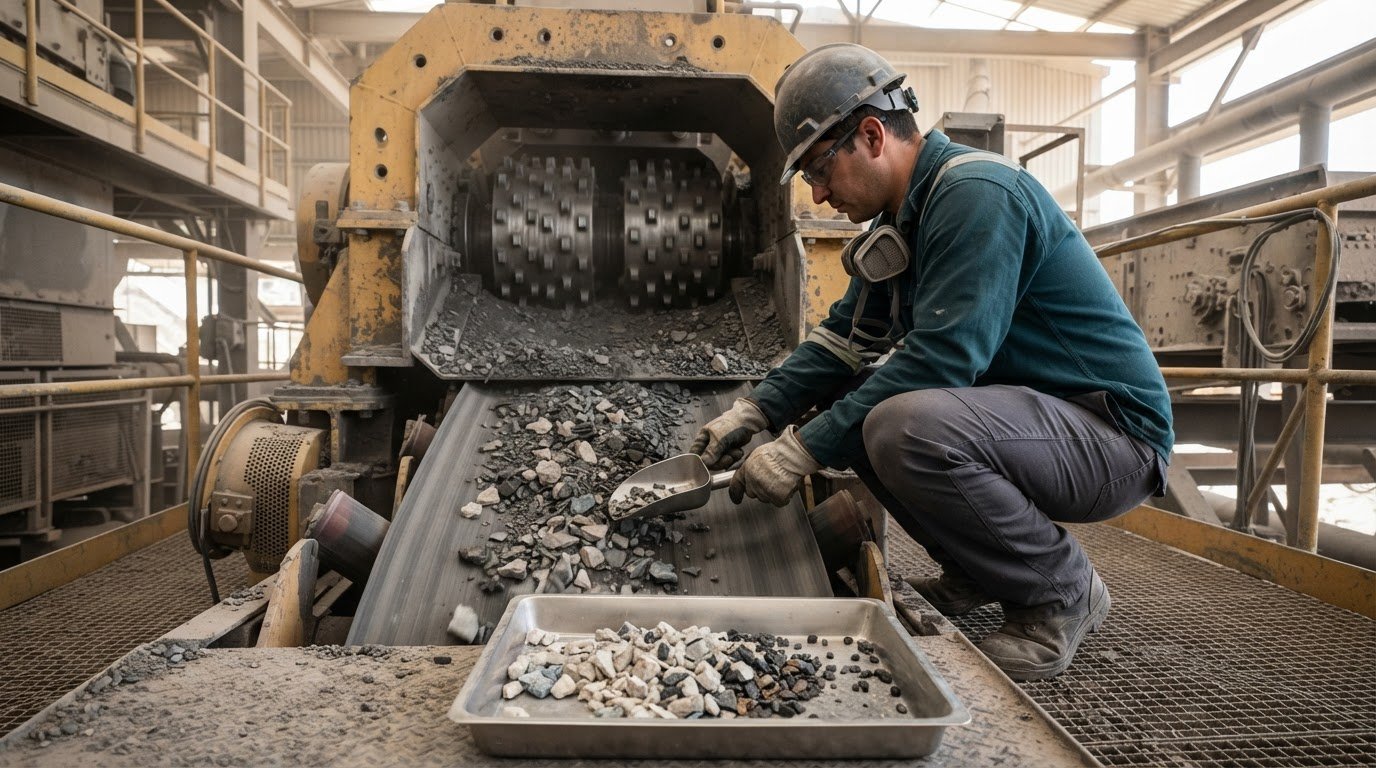
More grinding does not always mean better recovery. How to improve mineral liberation depends on matching breakage to the ore: weakly bonded grains may separate readily, while strongly bonded grains may need further size reduction. The goal is to free valuable minerals without creating excess fines that can hinder downstream separation.
It is understandable to focus on grind size, but particle size alone does not tell the whole story. Particle composition and texture, the number of breakage cycles, and how energy is applied to the ore all influence which minerals become liberated and recoverable.
This article explains how these factors work together. You will learn why breakage conditions affect liberation, how particle composition shapes concentrate quality, and how directing comminution energy toward grain boundaries can encourage fractures along mineral boundaries rather than through the grains. These connections explain why the right liberation strategy depends on the ore and the recovery process.
Compression ratio and number of breakage cycles
Breakage settings shape both particle size and mineral liberation. Penouta ore tests show how compression ratio and repeated cycles change the particle-size distribution.
Particle-Size Distribution After Breakage
Particle-size distribution describes the range and proportion of particle sizes produced after breakage. It matters because a finer fraction does not automatically indicate better liberation. In Penouta tests, interparticle compression ratios of 10%, 20%, and 30% were evaluated. At 10%, only 24 wt.% of processed material was smaller than 4 mm. Higher ratios produced greater size reduction and more fine material.
Grain Bonding and Preferential Breakage
Preferential breakage occurs when fractures follow weaker boundaries between mineral grains instead of cutting randomly through them. Weakly bonded grains may separate during grinding, producing liberated grains close to the grain size in unbroken ore. Well-bonded grains tend to break randomly, so liberation may require reducing particles below their original grain size. As a result, samples from the same ore can need different breakage conditions.
Conventional and Interparticle Breakage
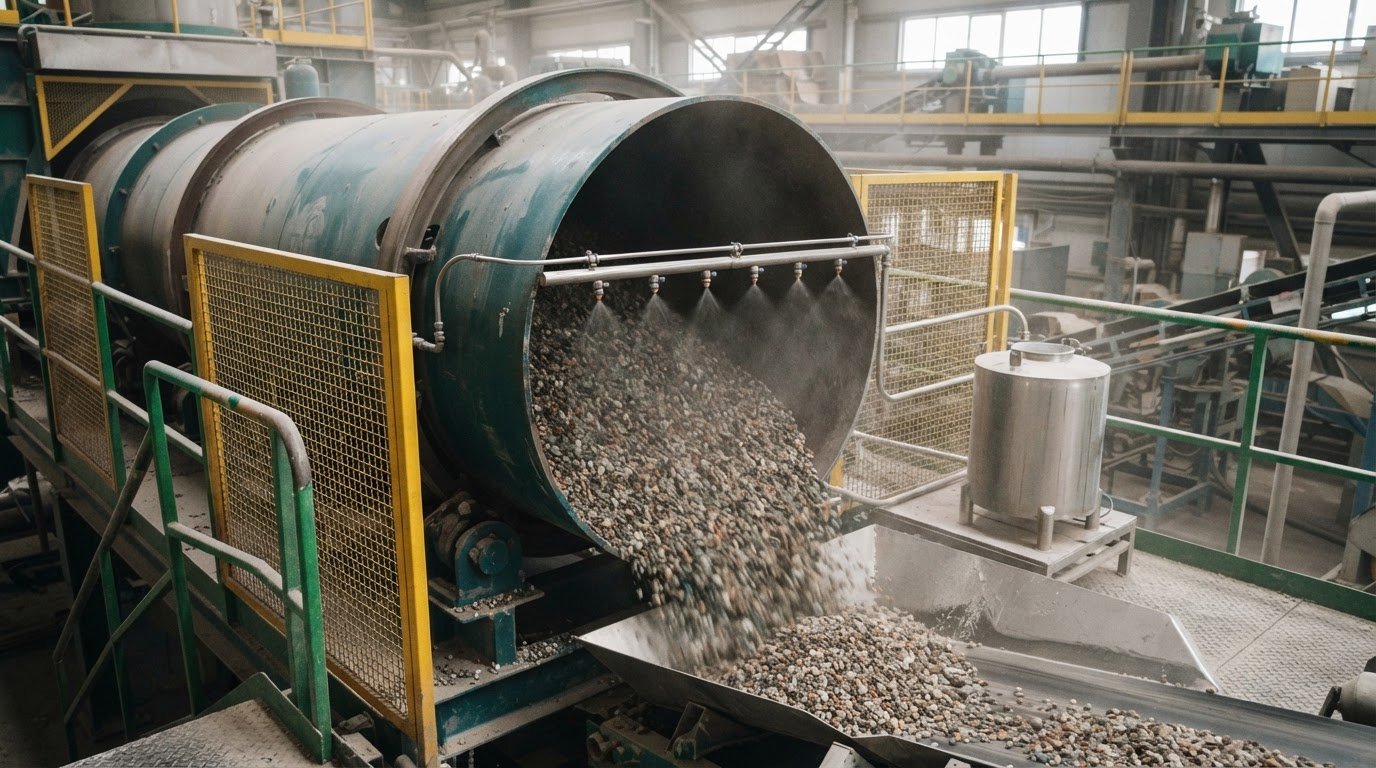
Conventional grinding methods break particles relatively indiscriminately, limiting how often fractures follow grain boundaries. Ball mills use tumbling balls, rod mills use tumbling rods, and stirred-media mills agitate small grinding media. High-pressure grinding rolls (HPGR) compress particles between rolls. Because these mechanisms produce different breakage patterns, liberation analysis helps identify a suitable particle-size distribution for the ore.
Interparticle compression applies pressure through particles packed together. In Penouta tests, increasing the compression ratio and the number of compression cycles increased particle-size reduction. More cycles can produce a finer product, but size reduction alone does not show whether valuable grains have been freed. Accurate assessment compares particle size with mineral grain size.
Staged Grinding and Overgrinding Risks
Staged grinding reduces ore size in successive steps, while classification separates particles by size between stages. This directs further grinding toward coarse material instead of repeatedly processing particles that are already fine. Optimize grind size and grinding time by comparing liberation analyses of samples with the required liberation profile, then adjusting the circuit. Under-grinding can leave valuable minerals attached to gangue.
Overgrinding can create ultra-fine slimes that hinder separation and may carry valuable minerals into tailings. It can also increase energy use without improving recovery. Classification helps limit this risk by removing particles that have reached the target size. The appropriate stopping point depends on grain size, bonding, and the recovery process, not on one grind time for every ore.
Concentrate particle composition
Concentrate composition describes both the minerals present in particles and the product’s overall chemical grade. These measures are related but not interchangeable: grade reflects the mass of a target element, while particle analysis shows how much of each particle consists of valuable minerals. In mineral processing, that distinction helps determine whether breakage and separation have achieved the intended product quality.
The Penouta deposit illustrates why composition varies across particle sizes. Microcline was enriched in the 0.125-0.5 mm fraction, while muscovite was depleted below 0.125 mm. A size fraction can therefore contain a different balance of mineral grains from another fraction. Tracking mineral distribution by size helps explain what material enters subsequent processing and whether the circuit is separating minerals as intended.
Concentrate examples also show how product grade relates to particle composition. Iron concentrates grading around 65 wt% Fe are associated with about 70 wt% Fe in hematite-magnetite, and recovered iron oxide particles can contain more than 90 vol% iron oxides. Zinc concentrates grading 50 to 54 wt% Zn are associated with about 60 wt% Zn in sphalerite; described particles contain more than 70 vol% sphalerite. Chalcopyrite concentrates grading 20 to 24 wt% Cu are associated with 34 wt% Cu in chalcopyrite, with recovered particles containing more than 50 vol% chalcopyrite.
Particle size and mineral proportion must be read together. In the Trout Lake example, 98 to 100% of chalcopyrite was recovered in particles sized 3.3 to 75 µm containing more than 90 vol% chalcopyrite. The same recovery range was reported for particles sized 10 to 53 µm containing 60 to 90 vol% chalcopyrite. These results show why a single size parameter cannot describe every concentrate. For flotation, mining flotation collectors are one process input considered alongside particle composition, mineral associations, and the required product grade.
Directing comminution energy to grain boundaries
During grinding, energy can break mineral grains through their interiors or separate them along contacts. These pathways create different particle textures. Transgranular fracture cuts across grains, leaving valuable mineral attached to gangue. Intergranular fracture follows grain boundaries and can expose cleaner mineral surfaces. Directing energy toward those boundaries can improve liberation without relying solely on finer breakage.
This distinction matters because ore particles contain minerals with different bonding strengths. When a boundary is weaker than the grains, a fracture can follow it and separate the minerals. When grains are strongly bonded, energy may instead break them internally. That can create smaller particles without freeing the target mineral. Liberation analysis determines whether the resulting particles are liberated or remain attached to gangue.
Electric pulse fragmentation is one approach examined for directing comminution energy. A reported comparison reduced comminution energy from 14.5 to 10.6 kWh/t. The significance is not simply a lower energy figure. The fracture path also matters: intergranular breakage may expose mineral boundaries, while conventional breakage is relatively indiscriminate. The response depends on ore texture and the strength of contacts between grains.
To assess whether targeted breakage suits a deposit, compare particle textures before and after treatment. Look for fractures along mineral boundaries, exposed valuable grains, and remaining mineral attachments. Then determine whether the liberated material suits the separation process: flotation, gravity concentration, and magnetic separation rely on different mineral properties. The method must also be economical within the full circuit. If energy reaches the boundaries but produces particles unsuitable for downstream recovery, the change may not improve overall performance.
Mineral liberation and optimum recovery
Recovery depends on freeing valuable minerals from gangue and matching the resulting particles to a suitable separation method. Plant measurements connect liberation, product quality, and losses across the circuit. The practical question is how to improve mineral liberation while maintaining the performance required downstream.
Measuring Mineral Liberation
Mineral liberation describes how much valuable mineral is freed from surrounding gangue after comminution. Liberation degree is assessed by classifying particles as liberated or still attached to gangue, then quantifying their mineral content through image analysis. This matters because chemical grade identifies an element’s concentration, but not whether its mineral grains are exposed for separation.
For example, automated mineralogy can show how mineral textures vary across process streams, often utilizing scanning electron microscopy systems from providers like Electron Optics Instruments to evaluate grain boundaries and associations. Most scheelite particles in the studied Mittersill ore were liberated between 80 and 200 μm. That range illustrates why liberation is assessed against particle size and mineral texture, rather than assumed from a finer grind alone.
Balancing Recovery and Operating Trade-Offs
Optimum recovery balances liberation against energy use, throughput, and operating costs. Finer grinding may free more valuable mineral, but it also consumes energy and can create slimes that impair separation. The effect depends on ore characteristics: base metal ore A required 70 kWh/t per tonne of liberated gangue, while ore B required 22 kWh/t.
These examples show why one grind target cannot suit every deposit. If grinding continues after useful liberation is achieved, extra energy may bring little recovery benefit. If particles remain locked, recovery can suffer. Deciding how to improve mineral liberation means balancing the exposure of valuable surfaces for flotation or another method against unnecessary size reduction.
Plant Tests and Sampling Methods
Plant tests assess changes in liberation by comparing representative feed, concentrate, and tailings samples from each cell. Chemical analysis identifies element concentrations, while material balances show how material moves through the sampled points. Together, these measurements indicate whether a circuit adjustment improves recovery or shifts valuable minerals into tailings.
Sampling across several process points also helps locate losses. For example, flotation recovery depends on exposed valuable-mineral surface area, while mineral associations can influence floatability and reagent consumption. Comparing liberation and assay results before and after an adjustment connects particle texture to plant performance. For flotation-focused process decisions, mining flotation collectors are one reagent consideration alongside liberation and exposed mineral surfaces.
JAS Global Industries
JAS Global Industries supports mining operations with specialty chemical solutions that contribute to efforts to improve liberation and recovery. Its mining grinding aids and flotation collectors relate to two parts of the process: comminution and mineral separation. The appropriate choice depends on ore characteristics, particle surfaces, and the operating conditions affecting the circuit.
For teams assessing liberation challenges, JAS Global Industries develops tailored formulations to support process efficiency and operational reliability. This can be a relevant next step when grinding and separation results need to be considered together, rather than treating particle breakage as the only factor. Contact JAS Global Industries to discuss your mining process needs.
Turn liberation insight into a process decision
A practical way to decide how to improve mineral liberation is to define the recovery outcome the circuit needs, then identify a process change that can be evaluated against it. This keeps the focus on recovering valuable minerals, not particle fineness alone. Consider whether the priority is exposing more target mineral, reducing losses to tailings, or improving concentrate quality. Each objective calls for a different measure of success.
For flotation circuits, assess reagent choices alongside the ore’s mineral surfaces and associations. Mining flotation collectors are one process input to consider in that evaluation. A useful next step is a focused discussion of the recovery challenge, the circuit context, and the outcome the operation aims to improve.
Contact JAS Global Industries to discuss your mineral processing needs and move toward a clearer recovery strategy. A well-framed process decision is a strong foundation for more efficient resource recovery.
Frequently Asked Questions
How do ore texture, grain size, and mineral association affect liberation?
Ore texture and mineral associations shape how fractures pass through particles and which valuable surfaces become exposed. Coarse, distinct grains may separate differently from fine minerals intergrown throughout gangue. For a variable deposit, compare textures across representative ore domains instead of relying on one average sample. This helps distinguish whether liberation is limited by grain size, complex intergrowth, or specific mineral pairings.
How do selective grinding and mineral hardness differences affect liberation?
Selective grinding uses differences in mineral hardness and breakage response to encourage some components to break more readily than others. Softer minerals may produce finer particles while harder grains remain coarser, creating opportunities for size-based separation. Hardness alone does not guarantee liberation: grain boundaries, internal fractures, and mineral associations also affect breakage. Comparing mineral content across size fractions can show whether selective breakage is useful.
How does improved mineral liberation affect flotation, leaching, and concentrate recovery?
Improved liberation can expose more valuable mineral surface for flotation and help leaching solutions reach mineral surfaces. The response depends on the mineral, its associations, and the separation conditions. In flotation, exposed surfaces influence interactions with reagents; in leaching, access to the target mineral affects its contact with the solution. Recovery also depends on keeping valuable particles in the product stream rather than losing them with waste.
What are the differences between ball, rod, stirred-media, and HPGR grinding for mineral liberation?
Ball mills use tumbling balls, rod mills use tumbling rods, stirred-media mills agitate small grinding media, and HPGR compresses particles between rolls. Their different breakage patterns can affect liberation, so liberation analysis helps identify a suitable particle-size distribution for the ore.