
The global paint defoamers market is projected to reach 1.35 billion dollars in 2026, yet many manufacturers still find their production lines stalled by persistent micro-foam. You understand that high-speed mixing is essential for industrial throughput, but the resulting air entrapment often creates a difficult choice between operational speed and surface quality. It's frustrating to watch a high-performance coating fail due to pinholes or craters caused by an incompatible chemical additive.
Learning how to choose a defoamer for paint manufacturing isn't just about finding the strongest agent. It's about securing the long-term stability of your formula and protecting the final surface finish for the end-user. This guide will help you master the technical criteria for selecting foam control agents that optimize production efficiency without compromising integrity. We'll preview the essential chemistry matches for your specific process and explore how to navigate 2026 regulatory shifts, including the latest EU REACH limits on formaldehyde and updated VOC standards for matte wall paints.
Key Takeaways
- Identify the critical distinctions between macro-foam and entrained micro-foam to eliminate surface defects like pinholes and craters at their source.
- Compare the technical advantages of silicone-based and mineral oil-based chemistries to balance high-speed efficiency with long-term formula stability.
- Master the essential framework for how to choose a defoamer for paint manufacturing by aligning additive selection with your specific resin system and production stage.
- Implement rigorous evaluation techniques, such as the Density Method, to ensure your foam control agents maintain persistence throughout storage and application.
- Discover how integrating specialized defoamers with advanced surfactant technologies can protect surface integrity while reducing operational downtime.
Understanding Foam Dynamics in Paint and Coating Production
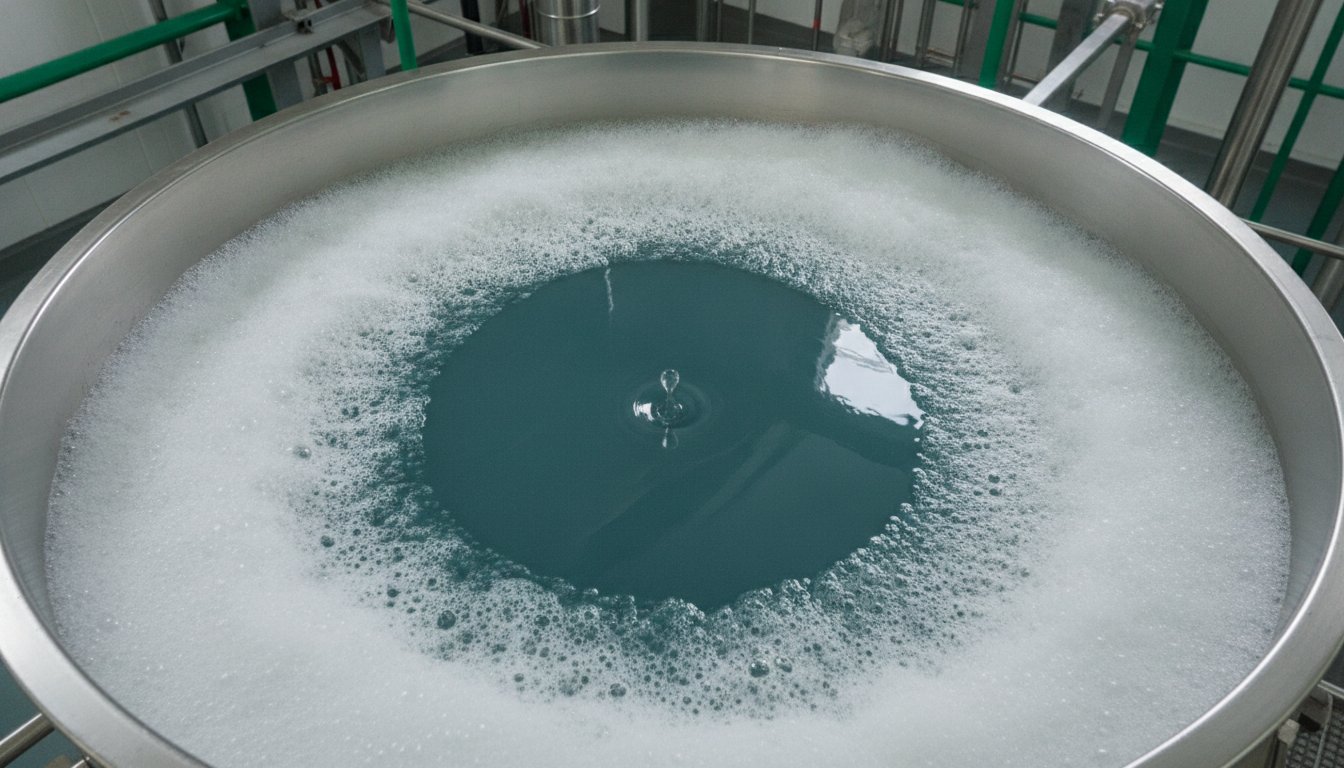
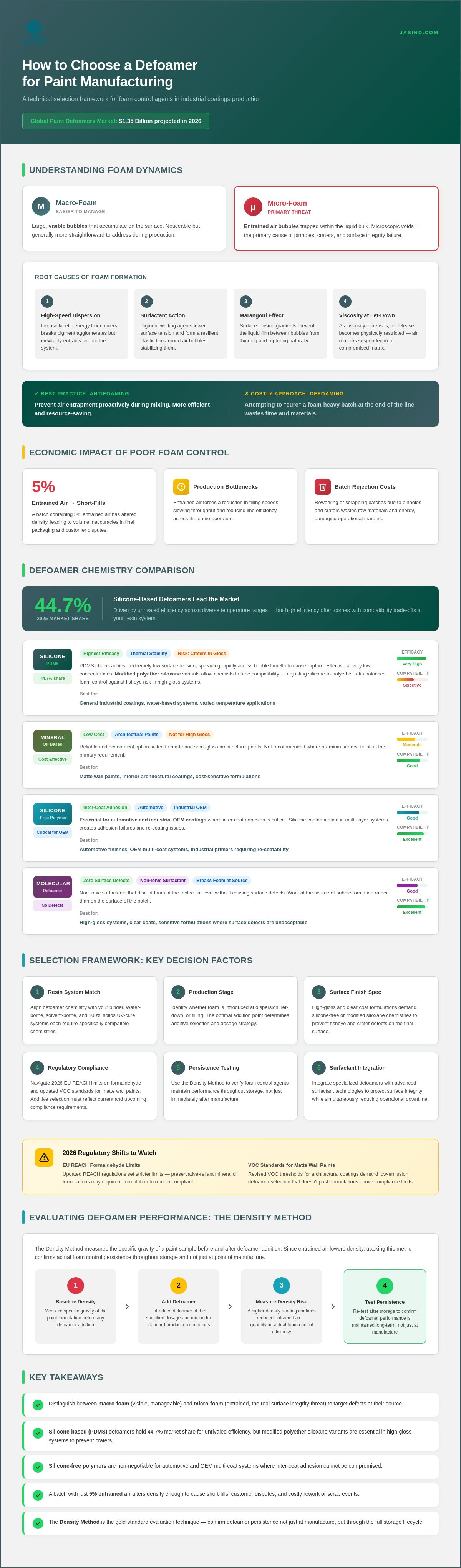
Foam represents more than an aesthetic inconvenience; it is a structural challenge that threatens the stability of the entire manufacturing process. In the context of industrial coatings, we differentiate between macro-foam and micro-foam. Macro-foam consists of large, visible bubbles that accumulate on the surface. While these are easier to manage, micro-foam involves entrained air bubbles trapped within the bulk of the liquid. These microscopic voids are often the primary cause of surface integrity failure. Understanding these dynamics is the first step in learning how to choose a defoamer for paint manufacturing that protects the final product.
The manufacturing environment itself contributes to this issue. High-speed dispersion equipment is essential for breaking down pigment agglomerates, yet the intense kinetic energy involved inevitably introduces air into the system. This process is exacerbated by the presence of necessary surfactants. While these chemicals are vital for wetting pigments, they also stabilize air bubbles by forming a resilient elastic film around them. Proactive protection requires a shift in mindset. It's always more resource-efficient to focus on antifoaming, which means preventing air from becoming trapped, rather than attempting to "cure" a foam-heavy batch at the end of the line.
The Chemistry of Foam Stabilization
Foam stabilization is driven by the Marangoni effect, where surface tension gradients prevent the liquid film between bubbles from thinning and breaking. In paint formulations, pigment wetting agents are the primary culprits. They lower surface tension to improve color development but simultaneously strengthen the bubble walls. This defoamer overview highlights that as viscosity increases during the let-down stage, air release becomes physically restricted. The air remains suspended, creating a compromised matrix that will eventually fail under application.
Economic Impact of Poor Foam Control
The financial consequences of inadequate foam management are significant. Production bottlenecks arise when entrained air forces a reduction in filling speeds or causes volume inaccuracies in the final packaging. If a batch contains 5% entrained air, the density is altered. This leads to "short-fills" and potential customer disputes. Beyond logistics, the cost of quality rejection is immense. Reworking a batch or scrapping a product due to pinholes and craters wastes raw materials and energy. Selecting the right foam control agent is a strategic decision to ensure operational security and global resource stability.
Comparing Defoamer Chemistries: Silicone vs. Silicone-Free
Selecting the correct chemical backbone for foam control is a strategic decision that impacts both the stability of your production line and the integrity of the final coating. In 2025, silicone-based defoamers held the largest market share at 44.7%, largely due to their unrivaled efficiency across diverse temperature ranges. However, high efficiency often comes with a trade-off in compatibility. Understanding how to choose a defoamer for paint manufacturing requires a nuanced look at how different molecular structures interact with your resin system.
The selection process typically moves between four primary categories:
- Silicone-based (PDMS): Highly effective at low concentrations; provides excellent thermal stability.
- Mineral oil-based: Cost-effective for architectural paints where high gloss is not the primary requirement.
- Silicone-free polymers: Essential for automotive and industrial coatings where inter-coat adhesion is critical.
- Molecular defoamers: Non-ionic surfactants that break foam at the source without causing surface defects.
Silicone-Based (PDMS) and Modified Siloxanes
Silicone defoamers rely on Polydimethylsiloxane (PDMS) chains to achieve extremely low surface tension. This allows the additive to spread rapidly across the lamella of a bubble, causing it to rupture. While pure silicone oils are powerful, they often lead to craters in high-gloss systems. To mitigate this, manufacturers utilize polyether-modified siloxanes. These modified structures allow chemists to "tune" the compatibility of the defoamer. By adjusting the ratio of silicone to polyether, you can achieve a balance that provides security against foam while protecting the surface from fisheyes. To explore specialized chemical profiles for your facility, you can review our full range of Paints & Coating Defoamer solutions.
Oil-Based and Synthetic Polymer Defoamers
Mineral oil-based agents are the workhorses of the architectural paint industry. They typically consist of a carrier oil and hydrophobic particles, such as silica or waxes. These particles act as "pinpricks" that destabilize the foam film. While economical, oil-based solutions carry a risk of yellowing or developing odors during long-term storage. In contrast, silicone-free synthetic polymers offer a cleaner alternative. These are often preferred for sensitive industrial applications. Because they don't contain silicone, they pose no threat to inter-coat adhesion, ensuring that multiple layers of paint bond securely. This reliability is foundational for high-stakes sectors like automotive manufacturing, where a single surface defect can result in significant financial loss.
Selection Framework: Matching Defoamers to Your Process
Success in foam control requires a holistic view of the manufacturing lifecycle. It isn't enough to select an agent based on chemistry alone; you must align the additive with the specific kinetic energy and resin characteristics of your system. Determining how to choose a defoamer for paint manufacturing involves a systematic evaluation of five critical variables: resin type, addition point, shear intensity, surface requirements, and regulatory mandates. Each factor serves as a pillar for production stability and final product security.
Regulatory compliance is a foundational requirement in the modern industrial landscape. For instance, the August 2026 enforcement of Regulation (EU) 2023/1464 (REACH) regarding formaldehyde emissions directly influences which additives can be integrated into compliant formulations. Similarly, the 2025 European Commission Decision restricts VOC content in indoor matte wall paints to a maximum of 10 g/L. These strictures demand defoamers that provide high performance without increasing the volatile organic load. Choosing the wrong agent doesn't just cause bubbles; it risks legal and environmental non-compliance on a global scale.
The Impact of the Grinding Stage
The grinding stage is the most demanding environment for any additive. Defoamers added here must withstand the extreme mechanical forces of high-speed bead mills. If an agent lacks sufficient stability, it will break down, losing its efficacy and potentially causing surface defects later. The goal is to find a persistent defoamer. This means the chemical must survive the grind and remain active throughout the let-down and storage phases. Balancing this power with Paints & Coating Dispersing Agents is essential to ensure pigments are properly wetted without over-stabilizing the resulting air bubbles.
Surface Finish and Compatibility Testing
Predicting how a defoamer will behave requires rigorous laboratory validation. The Drawdown test remains a foundational method for identifying potential craters or fisheyes in clear varnishes and high-gloss systems. Simultaneously, the Shake test provides a rapid assessment of initial foam suppression. High-gloss coatings are particularly sensitive. They require highly compatible agents that don't disrupt surface tension. Conversely, matte finishes can often tolerate stronger, more hydrophobic defoamers that might otherwise cause clarity issues in a gloss system. Testing ensures that the chosen chemistry protects the end-user's experience without introducing new failures into the production line.
Evaluating Defoamer Efficiency and Performance
Evaluating efficiency requires shifting from simple price-per-kilogram metrics to a Total Cost of Ownership perspective. While a lower-cost additive might seem attractive on a procurement sheet, it often necessitates higher dosage levels or leads to expensive batch rejections. When determining how to choose a defoamer for paint manufacturing, technical validation is the only way to ensure long-term stability. A high-performance agent protects your throughput by reducing the need for rework and minimizing production downtime.
The Density Method is the primary industrial standard for quantifying air entrapment. By measuring the weight-per-gallon of a coating before and after high-speed mixing, chemists can calculate the exact percentage of entrained air. A successful defoamer will maintain the coating's intended density even under intense kinetic stress. Beyond initial suppression, you must also account for the additive's longevity. Defoamer persistence is the ability to maintain foam suppression through multiple shear cycles and long-term storage. Without this persistence, a batch that appears foam-free in the factory may develop severe application defects months later at the end-user's site.
Standardized Laboratory Testing Protocols
Rigorous testing protocols simulate the harsh realities of the production floor. The Stirring Test applies high-speed shear to a sample to evaluate how quickly an additive can collapse newly formed bubbles. For low-viscosity systems, the Pour Test measures air release as the liquid moves, ensuring that the coating remains clear and uniform. Advanced microscopic analysis allows our teams to observe bubble size distribution. By tracking the collapse rates of micro-foam, we can predict the structural integrity of the final film. To ensure your formulations meet these high standards, you can explore our specialized Defoamers for industrial applications.
Troubleshooting Common Performance Issues
Even the most advanced chemistries can present challenges if not properly integrated. A common issue is gloss reduction, which occurs when the defoamer particles are too large or incompatible with the resin, scattering light on the surface. Similarly, "defoamer kick-out" or separation in the can suggests a fundamental mismatch in surface tension. In these cases, increasing the dosage is often counterproductive. Over-dosing leads to "fish-eyes" and compromised inter-coat adhesion. Solving these issues requires a precise compatibility audit to ensure the defoamer supports, rather than disrupts, color development and tinting consistency. Reliability in these technical details is what separates global industry leaders from mere suppliers.
JAS Global Industries: Tailor-Made Defoamer Solutions
Mastering the technical variables of foam control is only the first step toward operational excellence. While understanding how to choose a defoamer for paint manufacturing provides a theoretical foundation, the practical application in a high-volume industrial environment requires a specialized partner. JAS Global Industries serves as a vital guardian for your production stability. We move beyond the role of a simple chemical supplier to provide integrated strategies that protect your infrastructure and ensure the security of your final product.
Our approach addresses a significant gap in the current industrial landscape: the tendency to treat defoamers as isolated additives. We recognize that foam control is inextricably linked to the broader surfactant environment. By harmonizing our Paints & Coating Defoamer solutions with specialized Dispersant Agents, we create a stable chemical matrix. This holistic perspective prevents the common pitfalls of additive interference, ensuring that your formulation maintains its integrity from the grinding stage to the final application.
Custom Formulations for Unique Industrial Challenges
Every manufacturing facility operates under a unique set of kinetic and environmental conditions. Our global R&I centers develop site-specific dosing strategies that account for local water quality, ambient temperatures, and specific equipment configurations. For large-scale architectural paint lines, this level of precision is essential to optimize throughput. JAS Global Industries provides on-site support across the Middle East, Africa, and Asia, helping you refine your selection process for maximum operational reliability. We don't just provide a product; we provide a roadmap for how to choose a defoamer for paint manufacturing that is tailored to your specific plant dynamics.
A Commitment to Global Resource Security
We view industrial efficiency as a pillar of global sustainability. By reducing entrained air and preventing batch rejections, we help our partners minimize industrial waste and conserve raw materials. Our commitment to reliability is reflected in our advanced chemicals management plans, which ensure that every solution we provide meets the highest standards of safety and environmental responsibility. This focus on long-term value protects both your bottom line and the resources essential to modern infrastructure.
- Precision Application: Reducing chemical over-dosage and surface defects.
- Operational Stability: Minimizing downtime through consistent foam suppression.
- Technical Partnership: Leveraging decades of corporate history to solve complex coating failures.
Partnering with JAS Global Industries means securing a future of steady, foam-free production. We provide the technical expertise and ethical purpose required to navigate the complexities of modern paint manufacturing with absolute confidence.
Securing Production Excellence and Surface Integrity
Mastering the complexities of foam dynamics is essential for any facility aiming for global operational reliability. Success depends on more than just chemical strength; it requires a precise alignment between your resin system and the kinetic energy of your mixing equipment. By implementing a rigorous testing framework and understanding how to choose a defoamer for paint manufacturing, you protect your throughput and ensure a flawless finish for the end-user. This strategic approach reduces industrial waste and stabilizes your manufacturing lifecycle.
Since 1998, JAS Global Industries has utilized a global manufacturing footprint to provide security for critical industrial resources. Our R&I centers specialize in high-performance Paints & Coating Chemicals designed for the world's most demanding environments. We invite you to contact our technical experts for a process audit and custom defoamer formulation. Together, we can optimize your facility's efficiency and secure a future of consistent, high-quality production. Your pursuit of operational excellence is a mission we are proud to support.
Frequently Asked Questions
What is the difference between a defoamer and an antifoam?
Antifoams prevent foam formation, while defoamers destroy existing foam. Antifoams are typically added before processing starts to stop air entrapment at the source. Defoamers act as a corrective measure once bubbles have already appeared. In modern industrial practice, many agents perform both functions, but the timing of addition defines their primary role in the production cycle.
Can a defoamer affect the color strength of my paint?
Yes, defoamers can negatively impact color strength by interfering with pigment dispersion. If an additive is too hydrophobic or poorly incorporated, it may cause pigment flocculation or uneven wetting. This leads to a loss of tinting strength and "rub-up" issues where the color changes during application. Maintaining a balance between foam control and dispersant chemistry is essential for color consistency.
Why do silicone defoamers sometimes cause craters in the finish?
Craters occur when the surface tension of the silicone defoamer is significantly lower than that of the surrounding paint resin. This tension gradient causes the liquid paint to pull away from the defoamer droplet, leaving a circular void or "fisheye." Utilizing polyether-modified siloxanes helps chemists balance this tension, providing the necessary foam suppression without compromising the final surface integrity.
How much defoamer should typically be added to a paint formulation?
Standard dosage levels typically range from 0.1% to 0.5% of the total formulation weight. Over-dosing is a common error when learning how to choose a defoamer for paint manufacturing, as excessive amounts often lead to surface defects and adhesion failure. It's best to start with the minimum effective dose and adjust based on the results of a standardized high-speed stirring test.
Is it better to add the defoamer during the grind or the let-down?
Splitting the addition between both stages is the most effective industrial strategy. Adding a portion during the grind ensures the additive survives high-shear processing to prevent entrained micro-foam. The remaining portion is added during the let-down to manage surface macro-foam and maintain stability during final packaging. This dual-stage approach protects the coating throughout its entire manufacturing lifecycle.
What happens if I use an incompatible defoamer in a water-based system?
Incompatible agents in water-based systems often result in "kick-out," where the defoamer separates and forms oily droplets on the surface. This mismatch causes severe cratering and can destabilize the entire emulsion. Proper selection requires matching the Hydrophilic-Lipophilic Balance of the additive to the specific resin system. This ensures the chemical remains fully integrated and functional throughout storage.
Can I use a powder defoamer in liquid paint manufacturing?
Powder defoamers are primarily designed for dry-mix products like cementitious mortars, but they can be used in liquid paint if dispersed correctly. However, liquid defoamers are preferred for paint manufacturing because they incorporate more seamlessly into the liquid matrix. Using a powder version in a liquid system risks leaving undissolved particles that mar the final surface finish and reduce gloss.
How do I test the long-term stability of a defoamer in a stored product?
Persistence is best evaluated through accelerated heat-age testing. Store the paint sample at 50°C for two to four weeks, then repeat the density and stirring tests to check for lost efficacy. This process reveals if the additive has separated or degraded over time. It is a vital step in mastering how to choose a defoamer for paint manufacturing for products requiring a long shelf life.