
Biodegradability alone does not make a polymer suitable for a detergent. When formulating detergents with biodegradable polymers, consider the surfactants’ ionic nature, the formula’s pH, the polymer’s function, and its compatibility with other ingredients. A mismatch can affect performance or stability, so compatibility matters as much as environmental intent.
Choosing a polymer can involve trade-offs: the detergent must meet cleaning and handling needs while supporting environmental goals. This guide explains how to prepare liquid detergents, select a compatible polymer, and assess stability and shelf life. It also explores what biodegradability data can and cannot reveal about environmental impact, helping you make decisions based on technical performance and responsible formulation.
Liquid detergent preparation and ingredient addition
A liquid detergent’s polymer must suit its surfactants, pH, and intended function. It might thicken the mixture, suspend ingredients, or reduce soil redeposition on fabric. Its role affects how it should be added: a thickener, for instance, must disperse without clumping or disrupting the surfactant system.
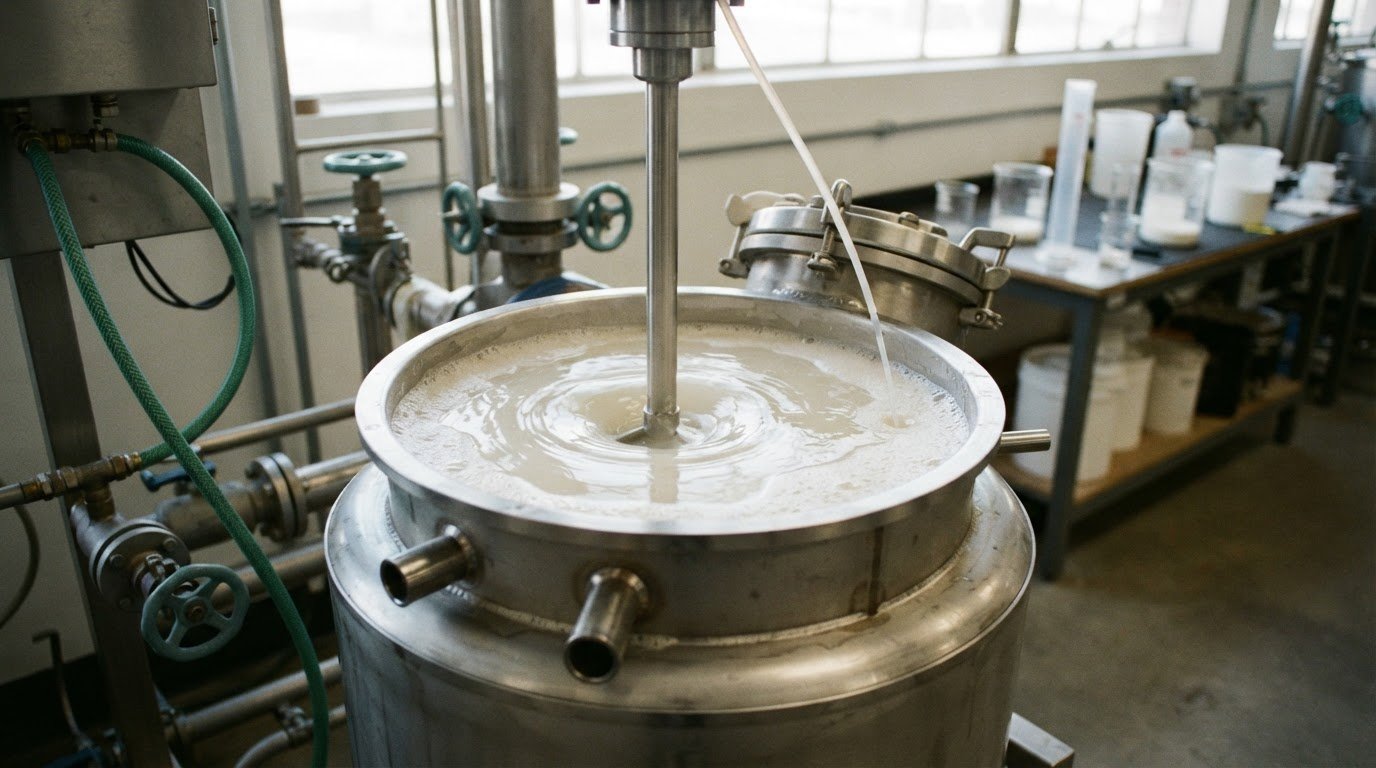
For a practical preparation sequence, begin with water and dissolve the soluble ingredients before incorporating surfactants and polymers. One basic eco-friendly liquid laundry formula contains 77% water by weight, with alkyl polyglucoside (APG) at 12.0%, sodium citrate at 5.0%, cocamidopropyl betaine at 4.0%, and xanthan gum at 0.5%. Its water is heated to approximately 40°C to support dissolution and blending. Stirring homogenizes the ingredients; the basic formula calls for a final blend of 10-15 minutes.
Addition order should protect ingredients that are sensitive to heat or formulation conditions. For example, the basic preparation instructions call for cooling below 40°C before adding enzymes, which can lose activity when denatured. The formula targets pH 7 during adjustment. A biodegradable polymer’s suitable use level depends on its function and interactions with the complete formula, rather than on biodegradability alone.
Polymer selection also distinguishes a phosphate-free design from a phosphate-builder approach. The AJ6 formulation contains 0% sodium tripolyphosphate (STPP), illustrating that a formulation can be built without that ingredient. This comparison doesn’t establish that every polymer replaces a builder; the ingredients’ functions must be assessed separately.
In the United States, polymer costs and supply depend on chemistry, required use level, sourcing, and supply continuity. Formulators weigh these factors alongside compatibility and performance because changing a polymer may require adjustments to other parts of the formula.
There’s no single typical use level or formulation range for biodegradable detergent polymers. The required amount varies with the polymer’s role, surfactants, and pH; xanthan gum at 0.5% in the example is a thickener, not a universal dosage for every polymer.
Storage assessment completes the preparation process. The basic liquid detergent has an approximate shelf life of 12 months when kept in a cool, dry place away from direct sunlight. Stability testing should track appearance, viscosity, separation, and cleaning performance over the intended storage period.
Polymer selection by surfactant type, pH, function, and compatibility
Polymer selection depends on the surfactant system’s ionic nature, the formula’s pH, the intended function, and compatibility with other ingredients. To assess a new polymer, add it in a controlled sequence, then check the complete detergent for changes in appearance, viscosity, separation, and performance.
Selecting Polymers by Surfactant Type and pH
The aim is to match a polymer’s chemical behavior to the surfactants and the formula’s pH. A polymer that works in one detergent may interact differently in another. First identify whether the surfactants are anionic, nonionic, or a mixture, then assess the polymer in that system. Test at the target pH, since pH changes can affect polymer solubility, viscosity, and interactions with other ingredients.
Polymer Functions and Surface Tension
A detergent polymer can provide a specific formulation function, such as controlling viscosity, dispersing soil, or helping prevent soil redeposition. These functions differ from the cleaning role of a surfactant, which helps reduce water’s surface tension. In one formulation, AJ6 reduced surface tension by 43.27% at a detergent concentration of 0.1%; at 0.25%, the reduction was 47.55%. Those results illustrate surface-tension performance, not a universal result for every polymer or detergent. Select and assess each ingredient according to its intended role.
Compatibility with Other Ingredients
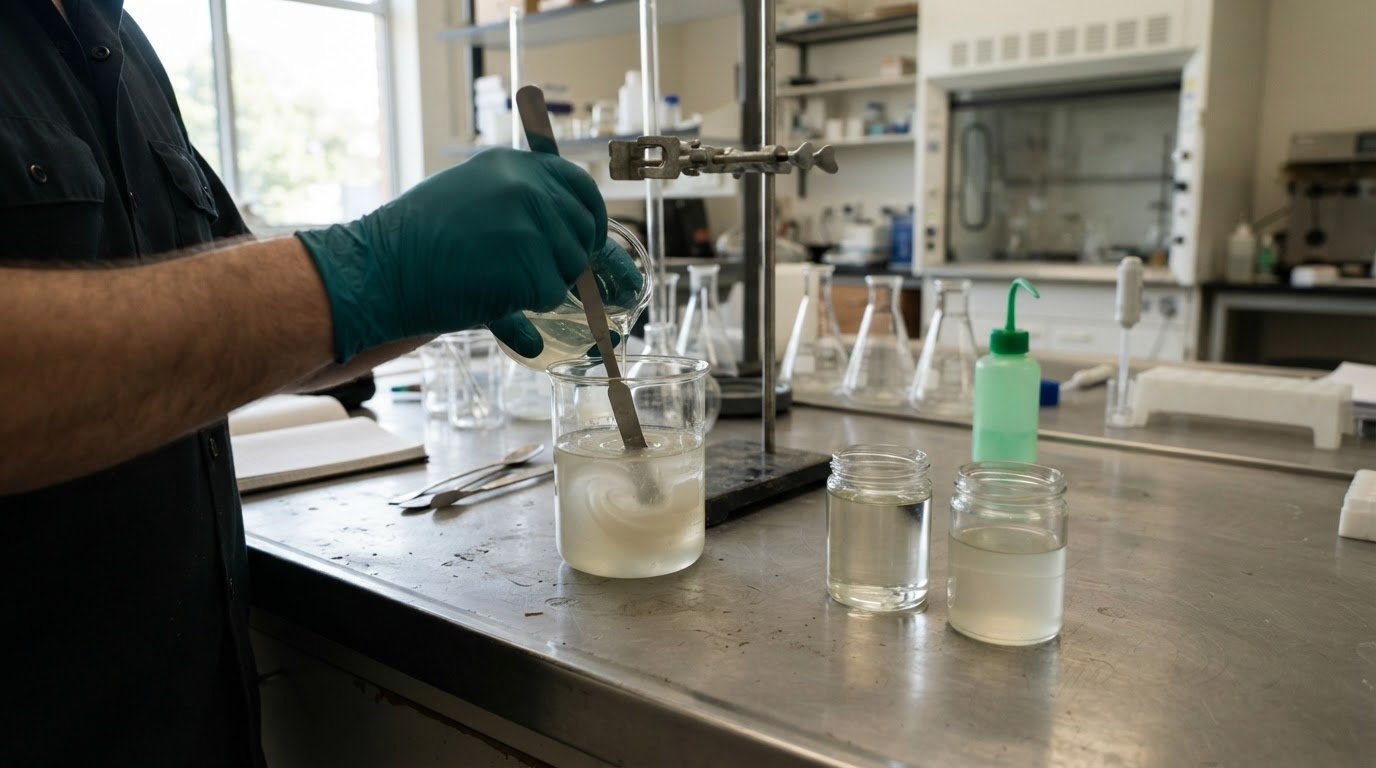
Compatibility means the polymer works alongside surfactants, builders, enzymes, fragrances, and preservatives in the finished formula. An ingredient can change the mixture’s appearance, viscosity, or stability. For a practical assessment, add the polymer to the intended formula and check for clumping, cloudiness, separation, and texture changes. Then assess performance after adding the remaining ingredients, rather than judging the polymer in water alone.
Test the formulation across its target pH and observe the results after each addition. For enzyme-containing detergents, pH deserves particular attention: enzymes typically remain stable around pH 7-8. A polymer that performs well on its own may still need a different addition sequence or formula adjustment to preserve the intended balance.
Detergent stability and shelf-life assessment
Shelf life depends on whether the detergent’s components remain uniform and functional during storage. Assess the finished liquid for changes in appearance, viscosity, separation, odor, and cleaning performance. A polymer can affect several of these properties, so evaluate it in the complete formula, not as an isolated ingredient. For the basic liquid detergent example, the approximate shelf life is 12 months in a cool, dry place away from direct sunlight.
Storage temperature and enzyme performance are also relevant. The example recommends keeping the detergent below 25°C to preserve enzyme stability and product integrity. Enzymes typically remain stable around pH 7-8, so pH is one factor to monitor when a formula contains enzyme agents. Track pH alongside visible changes and performance, rather than treating appearance alone as a complete stability assessment.
A practical assessment can track the product from mixing through storage:
- Record the initial appearance, viscosity, and pH of each finished batch.
- Inspect stored samples for separation, cloudiness, odor changes, or thickening.
- Compare cleaning performance with the initial sample at the end of storage.
- Document any changes alongside the formula and storage conditions.
Process conditions matter too. One liquid detergent preparation was cooled at 10°C for 48 hours before filtration and packing. This is a reported preparation example, not a universal requirement for every detergent. A stability plan should reflect the actual manufacturing sequence, including polymer addition, cooling, and filtration, because each step can influence the final product’s physical condition.
To maintain precise batch consistency across these handling, filtration, and packing stages at commercial scale, facilities increasingly implement advanced robotic and process control systems, such as those developed by industrial automation specialists like EdNex Automation.
Interpret results in the context of the formula. For example, a viscosity shift may involve the polymer, surfactant system, or pH; separation may mean components are no longer evenly dispersed. Compare samples over the intended storage period and keep batch records. This helps distinguish a one-off process variation from a recurring stability issue and supports a shelf-life decision based on the finished detergent.
Environmental impact of biodegradable ingredients
Biodegradable polymers can support environmental goals, but a polymer’s label alone doesn’t establish the impact of a finished detergent. Assess the ingredient’s biodegradation evidence alongside its role, concentration, and the formulation’s overall performance. Cleaning effectiveness matters too: a detergent must remove soil from fabric while meeting its environmental design objectives.
One carbohydrate polymer made from white dextrin, sorbitol, and maleic anhydride had a BOD/COD biodegradation ratio of 1.12. Its batch contained 30.76% white dextrin, 53.86% sorbitol, and 15.38% maleic anhydride by weight. These figures describe that specific polymer example. They shouldn’t be treated as results for other polymers or as a complete environmental assessment of a detergent.
Interpret biodegradation data in relation to the material tested and the intended formulation. A polymer’s composition and function affect how relevant its biodegradation results are to a product decision. Consider evidence for the polymer alongside the finished detergent’s ingredients, use, and cleaning performance. A single laboratory result does not establish the full environmental profile of a product.
For U.S. formulations, California’s Prop 65 is a regional chemical-compliance consideration, not a biodegradability standard or ecolabel. A biodegradation result alone doesn’t establish compliance with labeling or environmental marketing requirements. Those questions require a separate review of the product’s ingredients, claims, and sales context.
Environmental evaluation can also account for trade-offs. A polymer may serve a useful formulation function, but its environmental value depends on more than that function or a single test result. Review the evidence, how well it applies to the polymer as used, and whether the detergent retains its intended cleaning performance. Keep biodegradation data distinct from broader environmental claims.
For formulation decisions, connect polymer performance with relevant environmental evidence before selecting an ingredient. Explore biodegradable polymer formulation considerations alongside the detergent’s technical requirements.
JAS Global Industries
JAS Global Industries develops tailor-made specialty chemical formulations and advanced chemical technologies to support process efficiency and operational reliability. Its expertise is relevant when formulation decisions extend beyond polymer selection and call for a specialty-chemical solution shaped around process needs.
For detergent development, the challenge is to align ingredient function, compatibility, stability, and environmental evidence. JAS Global Industries’ specialty-chemical expertise can support organizations exploring tailored solutions in its areas of work. It complements, rather than replaces, evaluation of the complete detergent formula and its performance.
If you are considering a tailored specialty-chemical solution, contact JAS Global Industries to discuss your requirements.
Move from formulation goals to a practical plan
Turn your detergent priorities into a development brief: define the intended use, performance goals, ingredient constraints, and environmental criteria. For teams formulating detergents with biodegradable polymers, this brief can clarify which trade-offs matter and what evidence will guide ingredient selection.
JAS Global Industries develops tailor-made specialty chemical formulations and advanced chemical technologies. If your work on formulating detergents with biodegradable polymers calls for broader specialty-chemical expertise, describe the process needs and outcomes you want to achieve.
Contact JAS Global Industries to discuss your requirements. A clear brief is a practical starting point for moving your formulation goals forward.
Frequently Asked Questions
Which biodegradable polymers are used in detergent formulations?
Examples include xanthan gum and carbohydrate-based polymers, though their roles differ. Xanthan gum can modify viscosity, while one studied carbohydrate polymer was made from white dextrin, sorbitol, and maleic anhydride. A polymer’s identity alone does not establish its performance or environmental behavior. Assess the specific material, its intended role, and relevant biodegradation evidence before deciding whether it suits a detergent.
How do biodegradable polymers function in laundry and dishwashing detergents?
In laundry detergents, polymers may control thickness, disperse soil, or reduce soil redeposition on fabric. In dishwashing formulas, a polymer’s role must match the product’s cleaning and handling goals. For example, a viscosity modifier can affect pouring and dosing, while a dispersant affects how particles remain distributed. Suitability for laundry detergent does not automatically mean a polymer is suitable for dishwashing detergent.
In laundry detergents, polymers may control thickness, disperse soil, or reduce soil redeposition on fabric. In dishwashing formulas, a polymer’s role must match the product’s cleaning and handling goals. For example, a viscosity modifier can affect pouring and dosing, while a dispersant affects how particles remain distributed. Suitability for laundry detergent does not automatically mean a polymer is suitable for dishwashing detergent—particularly for heavy grease removal, where professional commercial products from suppliers like Pro Clean Supply are formulated specifically to tackle tough kitchen oils.
Effects depend on the polymer, surfactant system, and other ingredients. A thickening polymer can change pour behavior, while a dispersing polymer may affect how soil behaves during washing. Assess foam and cleaning performance separately: a change in viscosity does not demonstrate better cleaning or foam. Compare the finished formula with a polymer-free control, measuring each property under the same use conditions.
How do biodegradable polymers compare with conventional detergent polymers such as polyacrylates?
Biodegradable polymers and polyacrylates differ in chemical structure, but neither category has a single performance profile across detergent formulas. Compare a biodegradable candidate and a polyacrylate in the same base formula, assessing soil dispersion, viscosity, storage behavior, and cleaning results. Evaluate biodegradation evidence separately under comparable test conditions. This side-by-side test shows whether a candidate meets the formula’s requirements without assuming its category predicts performance.
What biodegradability and toxicity data are available for detergent polymers?
Biodegradation evidence may include a BOD/COD ratio for a specific polymer sample, but that measurement does not establish toxicity or the environmental profile of the whole detergent. Toxicity and biodegradation answer different questions and should be assessed separately. A polymer’s degradation result, for instance, cannot by itself show effects on aquatic organisms or explain how every ingredient behaves after use.
What are the risks, limitations, and disposal impacts of biodegradable polymers in detergents?
Key limitations include incompatibility with the formula, changes in product stability, and environmental claims that go beyond the evidence. After use, detergent ingredients enter wastewater, so disposal impacts depend on the polymer and its behavior in the relevant treatment process. A biodegradable label alone does not prove complete breakdown under every condition. Assess the finished formula’s performance and environmental evidence together before making product claims.