

Relying on water to suppress industrial dust is no longer a management strategy; it is a regulatory liability. With the global dust control market projected to reach $23.21 billion in 2026, the shift toward molecular-level protection is a necessity for modern infrastructure. You understand that maintaining compliance is getting harder as international standards become more opaque and water consumption becomes unsustainable. Staying ahead of evolving environmental regulations for dust emissions requires more than reactive measures. It demands a commitment to the stability of our global resources and the safety of every worker on your site.
This guide helps you master the shifting landscape of global compliance, from the EPA’s 2026 lead dust action levels to the EU’s mandatory Environmental Management Systems. You'll learn how engineered chemical solutions, such as specialized anti-dusting agents and mining flocculants, can transform your operations by reducing material loss and ensuring stability. We examine the specific requirements of the 2026 regulatory calendar, including China's new Ecological and Environmental Code and the EU's waste gas BAT deadlines, providing a clear path to zero-penalty compliance and long-term industrial security.
Key Takeaways
- Analyze the 2026 updates to international frameworks, including the EU's IED 2.0 and China's unified Ecological and Environmental Code.
- Identify why regulators prioritize PM2.5 and PM10 to mitigate community health liabilities and long-term operational risks.
- Evaluate the financial impact of "Stop Work" orders and the evolving global penalty structures for failing to meet environmental regulations for dust emissions.
- Compare the efficiency of chemical surfactants and anti-dusting agents against traditional water-based suppression methods in resource-scarce environments.
- Discover how to protect material integrity and reduce bulk handling losses using advanced fertilizer dust suppressants.
Navigating Global Environmental Regulations for Dust Emissions in 2026
Industrial operations face a transformative year as the definition of "fugitive dust" undergoes a global reclassification. Modern environmental frameworks no longer view dust as a mere nuisance. Instead, it's defined as a critical threat to atmospheric stability and public health. For global leaders, maintaining strict adherence to environmental regulations for dust emissions is now a core operational pillar. It's about protecting resources and securing communities. This shift is driven by a harmonized effort between regional agencies to standardize particulate matter limits, moving away from fragmented local laws toward a unified global oversight model.
The 2026 landscape is defined by transparency. Regulators now demand mandatory continuous monitoring and real-time reporting. This transition from periodic sampling to constant data streams ensures that industrial sites remain accountable for their environmental footprint every hour of the day. To understand the complexity of these requirements, one must first grasp The Science of Particulate Matter and how its behavior dictates modern legal thresholds.
Key Regulatory Frameworks by Region
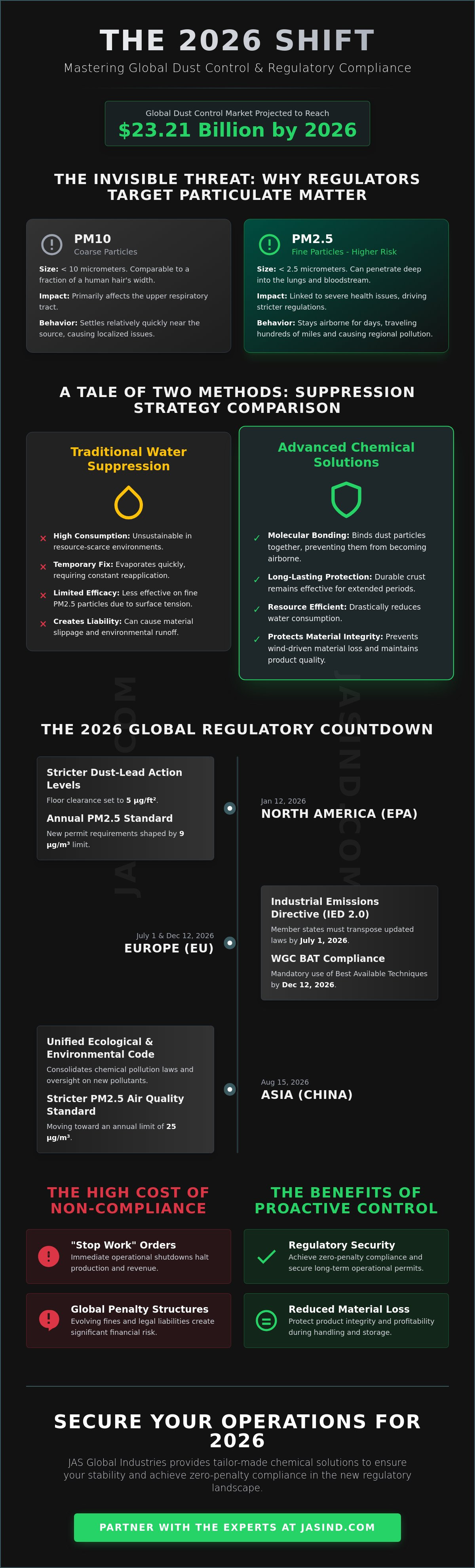
North American standards have reached a new peak of stringency. As of January 12, 2026, the EPA implemented stricter Dust-Lead Action Levels, setting floor clearance at 5 µg/ft². Simultaneously, the legal battle over the annual PM2.5 standard of 9 µg/m³ continues to shape permit requirements for new projects. In Europe, the Industrial Emissions Directive (IED 2.0) enters a critical phase. Member States must transpose these updated laws by July 1, 2026, introducing performance limits that prioritize the European Green Deal’s zero-pollution ambition.
Asian and Middle Eastern mining hubs aren't exempt from this tightening. China’s first unified Ecological and Environmental Code takes effect on August 15, 2026. This code consolidates chemical pollution laws and strengthens oversight on new pollutants. Industrial centers in these regions are now adopting stricter PM2.5 air quality standards, moving toward an annual average concentration limit of 25 micrograms per cubic meter.
The Legal Definition of Compliance
Compliance in 2026 is measured by more than just data; it’s measured by visibility. Most jurisdictions now enforce zero-tolerance thresholds for "visible emissions" at property boundaries. If dust crosses a fence line, it’s a violation. Bulk material handling and storage permits now require detailed dust management plans that include chemical suppression as a primary control method. Modern law increasingly relies on Best Available Techniques (BAT). Under the EU’s WGC BAT conclusions, industrial installations must demonstrate compliance by December 12, 2026. This isn't just a suggestion. It's a mandatory requirement for operational security. We don't just provide chemicals; we provide the stability required to meet these rigorous environmental regulations for dust emissions.
The Science of Particulate Matter: Why Regulators Target PM10 and PM2.5
Regulatory scrutiny focuses on particle size for a simple reason: size dictates risk. The smaller the particle, the more profound its impact on human health and industrial liability. In 2026, global standards are moving toward even finer monitoring as the link between microscopic dust and long-term respiratory security becomes undeniable. Understanding these aerodynamics is essential for any facility aiming for total compliance with environmental regulations for dust emissions. Coarse particles might settle quickly, but fine particulates remain suspended, creating a persistent challenge for site managers.
Smaller particles, specifically PM2.5, stay airborne for days and travel hundreds of miles from their source. This migration transforms a local operational issue into a regional environmental crisis. When these particles settle, they don't just sit on the surface. They infiltrate local ecosystems and water supplies, potentially altering soil chemistry or contaminating critical water resources. This environmental deposition is a primary driver for the US Environmental Protection Agency (EPA) regulations, which now demand tighter controls on fine particulates to protect community health and ecological stability.
PM10 vs. PM2.5: Industrial Implications
In sectors like fertilizer manufacturing, coarse dust (PM10) typically originates from mechanical grinding and crushing. Fine dust (PM2.5) often results from chemical reactions or high-heat processes during granulation. Traditional mechanical filters frequently fail at the PM2.5 level because these particles are small enough to bypass standard mesh screens. This failure creates a direct correlation between particle size and regulatory severity. As particles get smaller, the legal penalties for their release increase. Protecting your operational continuity requires moving beyond mechanical barriers. Utilizing advanced anti-dusting agents allows for the capture of these fine particles before they become airborne liabilities.
Atmospheric Chemistry and Dust Migration
Atmospheric conditions play a decisive role in regulatory boundary breaches. High wind speeds accelerate dust migration, while low humidity prevents particles from settling naturally. Industrial dust isn't chemically inert. In the atmosphere, these particles can react with water vapor or other pollutants, creating secondary compounds that are even more hazardous. Particulate matter refers to a regulated pollutant composed of microscopic solids or liquid droplets that are small enough to be inhaled. This chemical reactivity increases the complexity of monitoring. Regulators now look at the total impact of emissions, including how dust behaves once it leaves your facility. Total compliance means managing the chemistry of your product, not just the volume of your output. It requires a steady, authoritative approach to resource protection that balances production needs with environmental responsibility.
The Operational and Financial Risks of Regulatory Non-Compliance
Non-compliance is an expensive gamble. While earlier sections defined the legal thresholds of 2026, the financial reality of a breach is often more complex than a simple ticket. Failing to meet environmental regulations for dust emissions can trigger a cascade of economic failures. Direct penalties are rising globally. In many jurisdictions, daily fines now scale with a facility's total revenue, ensuring that large-scale operations can't simply budget for the fine. This shift toward revenue-based penalties reflects a global effort to prioritize resource protection over corporate convenience.
Beyond the treasury, "Stop Work" orders represent the ultimate operational risk. A single day of forced downtime at a major mining or fertilizer facility can result in millions of dollars in lost productivity. As outlined by the US EPA on Particulate Matter (PM), the regulation of these particles is foundational to public safety, and authorities are increasingly willing to halt operations until mitigation is proven. This isn't just about following rules. It's about securing your right to operate in an increasingly transparent global market. We view compliance as a pillar of stability, not a hurdle to clear.
The Hidden Cost of Dusting
Dust is often treated as a waste problem, but for leaders in bulk handling, it's a product loss problem. Every kilogram of material that becomes airborne is a kilogram that never reaches the customer. In fertilizer manufacturing, the loss of high-value fines during maritime or rail transport directly erodes profit margins. Dust is also abrasive. It invades bearings, clogs ventilation, and accelerates maintenance cycles. By utilizing advanced Anti-dusting Agents, plants can protect their equipment and their yield simultaneously. This shift in perspective from waste management to resource protection is what defines a mature industrial strategy.
ESG and Social License to Operate
Social license is the new currency of industry. Community relations hinge on the absence of "nuisance dust" complaints. A single viral video of a dust cloud over a local township can trigger years of litigation and deep reputational damage. Investors now demand transparency. They look for robust emissions reporting as a key metric of Corporate Social Responsibility (CSR). A proactive approach to dust control demonstrates that your organization is a responsible guardian of the environment, not just a consumer of its resources. High-quality Fertilizer Dust Suppressants do more than stop particles; they build trust with stakeholders and ensure long-term stability in a volatile regulatory climate.
Advanced Strategies for Dust Control: From Water to Chemical Suppression
Traditional dust control relies on a single resource: water. In arid environments or regions facing extreme water scarcity, this approach is both inefficient and irresponsible. Water evaporates rapidly. It leaves fine particulates to become airborne again within minutes. It fails to address the underlying physics of dust migration. To meet environmental regulations for dust emissions, industrial leaders must move beyond simple hydration. The global dust control market is projected to reach $23.21 billion in 2026, reflecting a massive industrial pivot toward advanced mitigation that prioritizes resource stability over temporary fixes.
Surfactants function by breaking the high surface tension of water. This allows droplets to spread and penetrate hydrophobic dust particles rather than bouncing off them. Chemical surfactants enhance dust capture efficiency by reducing the contact angle between liquid and solid surfaces. This molecular approach ensures that even the finest PM2.5 particles are captured and stabilized. It's a shift from temporary dampening to permanent protection. By utilizing these engineered solutions, facilities can maintain compliance while significantly reducing their total liquid consumption.
Crusting agents provide a vital layer of security for long-term stockpiles and material in transit. These polymers create a durable, flexible veneer that resists wind erosion and heavy rain. For maritime and rail transport, this protection is indispensable. It prevents the product loss discussed in previous sections and ensures that facilities remain within their permit limits. Integrating these tools into a comprehensive Chemicals Management Plan is the hallmark of a mature, compliant operation. It demonstrates a commitment to the stability of the surrounding environment and the integrity of the product.
Mechanical vs. Chemical Control
Mechanical systems like baghouses and cyclones are essential for point-source emissions. They capture dust at the source of generation. However, they're often insufficient for fugitive dust across large sites or during material handling. The physics of binding is different. Chemical suppressants use long-chain polymers to trap micro-particulates in a stable matrix. While water might last for minutes in high temperatures, specialized suppressants provide days or even weeks of protection. This longevity reduces the frequency of application and lowers operational costs.
Sustainability in Dust Management
Chemistry is a tool for water conservation. By increasing the efficacy of every liter used, facilities can significantly reduce their industrial water footprint. The 2026 regulatory environment also demands higher standards for the chemicals themselves. Modern Anti-dusting Agents must meet strict biodegradability requirements to ensure they don't persist in the local ecosystem. We provide the expertise to balance these environmental needs with industrial performance. Secure your compliance and optimize your resource management with our range of Fertilizer Dust Suppressants.
JAS Global Industries: Tailor-Made Solutions for Regulatory Security
JAS Global Industries operates at the intersection of technical excellence and global responsibility. We don't just supply additives. We provide the stability required to maintain modern infrastructure. Our mission centers on protecting resources through chemical innovation, ensuring that critical industrial sectors remain resilient against shifting environmental regulations for dust emissions. With a presence spanning the Middle East, Africa, Asia, and Europe, we act as a foundational partner for the world's most vital industries. This global reach allows us to understand the unique geographical and legal challenges facing your facility.
Global compliance isn't a static target. It requires a deep understanding of local ecosystems and international law. Our technical consulting teams conduct on-site audits to optimize your processes from the ground up. We identify inefficiencies, reduce material loss, and ensure your facility meets the rigorous standards of the 2026 regulatory calendar. This proactive approach transforms compliance from a corporate burden into a significant competitive advantage. We act as an indispensable pillar of your sustainability strategy, providing the reliability you need to operate at a massive scale.
Engineered for Fertilizer and Mining
Phosphate and potash operations face unique atmospheric challenges. We engineer custom formulations that address these specific mineral profiles. Our Anti-dusting Agents and Fertilizer Dust Suppressants are designed to maintain product flowability while virtually eliminating particulate release. In high-humidity maritime environments, where traditional controls often fail, our solutions have proven essential for protecting cargo integrity during long-distance transport. We focus on the fundamental needs of society by securing the supply chains that feed the world, ensuring that your product reaches its destination in peak condition.
Partnering for Global Compliance
Our Research and Innovation (R&I) centers are the engines of our regulatory security. We stay ahead of the 2026 standards by developing sustainable chemical technologies that prioritize biodegradability and worker safety. The JAS commitment to social concern means our products are as conscientious as they are powerful. We don't settle for simple logistics; we build long-term partnerships rooted in trust and results. By choosing our specialized departments, you ensure your site remains a responsible corporate citizen in an era of heightened oversight. Master the complex landscape of environmental regulations for dust emissions with a partner focused on your long-term value.
Secure your operations with JAS Global Industries
Securing Operational Stability through Global Compliance
Industrial success in 2026 requires a transition from reactive measures to proactive resource protection. You've seen how the molecular behavior of PM2.5 dictates legal thresholds and why traditional hydration methods often fall short in arid climates. Maintaining total alignment with environmental regulations for dust emissions isn't just a legal necessity. It's a core commitment to the stability of your community and the long-term longevity of your infrastructure. By prioritizing chemical innovation over temporary fixes, you secure both your yield and your social license to operate.
Since 1998, JAS Global Industries has acted as a vital guardian for major industrial sectors. Our specialized R&I centers develop tailor-made formulations that ensure your site remains a responsible corporate leader. With a steady presence across Europe, Asia, and Africa, we provide the technical expertise needed to navigate complex international standards. Don't leave your compliance to chance. Consult our experts for a custom dust suppression strategy and protect your operational future today. We're here to help you build a safer, more reliable industrial landscape that stands the test of time.
Frequently Asked Questions
What are the primary environmental regulations for dust emissions in 2026?
The primary 2026 standards include the EU's Industrial Emissions Directive 2.0 and China's unified Ecological and Environmental Code. In the United States, the EPA has enforced stricter Dust-Lead Action Levels as of January 2026. These frameworks shift the focus toward continuous monitoring and Best Available Techniques (BAT). Compliance now requires a proactive approach to resource protection rather than simple reactive watering.
How does fugitive dust differ from point-source emissions?
Fugitive dust refers to particulate matter that escapes from non-contained sources like stockpiles, haul roads, or open-air conveyor belts. Point-source emissions originate from a defined, stationary location such as a stack, vent, or chimney. While point sources are often controlled by mechanical baghouses, fugitive emissions require molecular-level chemical suppression to prevent migration across property boundaries. Both are strictly regulated under modern environmental frameworks.
Can chemical dust suppressants help meet ISO 14001 requirements?
Yes, chemical dust suppressants are essential tools for satisfying the pollution prevention mandates of ISO 14001. By reducing the reliance on excessive water consumption and preventing particulate migration, these solutions demonstrate a commitment to continuous environmental improvement. Implementing advanced suppressants helps facilities document their efforts in resource protection and waste reduction. This proactive management is a key requirement for maintaining a globally recognized Environmental Management System.
Why is water often ineffective for PM2.5 dust control?
Water is often ineffective because its high surface tension prevents it from wetting fine PM2.5 particles. Instead of capturing the dust, water droplets often bounce off or evaporate before they can provide meaningful stabilization. Microscopic particulates are simply too small to be trapped by standard water sprays. Chemical surfactants are necessary to lower surface tension and create a lasting bond that keeps these hazardous particles on the ground.
Are JAS Global dust suppressants safe for agricultural fertilizers?
Our Fertilizer Dust Suppressants are specifically engineered to be compatible with phosphate and potash operations. These formulations prevent dusting during transport without compromising the chemical integrity or flowability of the final product. We focus on protecting the resource from the plant to the field. Each solution is designed to meet strict industrial safety standards while ensuring that the fertilizer remains effective for the end user.
What is the penalty for exceeding dust emission limits?
Penalties for violating environmental regulations for dust emissions range from significant daily financial fines to mandatory "Stop Work" orders. In 2026, many jurisdictions have shifted toward revenue-based penalty structures that increase the cost of non-compliance for large-scale operations. Beyond direct fines, facilities face the risk of ESG-driven litigation and the loss of their social license to operate. These financial and reputational risks make total compliance a foundational business priority.
How do I incorporate dust suppression into a chemicals management plan?
Incorporate dust suppression by first conducting a site-wide audit to identify high-risk fugitive emission points. You should then select specific anti-dusting agents that align with your material's chemical profile and the local climate. This strategy must be documented as part of your facility's broader Environmental Management System. Regular monitoring and reporting ensure that the suppression techniques remain effective and that your operation stays within its permitted legal limits.
Do regulations for dust emissions vary by industrial sector?
Yes, regulations are often tailored to the specific risks of different industrial sectors. Mining operations face strict requirements for haul road stability and stockpile management, while fertilizer manufacturers must control fines during granulation and bulk handling. Each sector has its own set of Best Available Techniques (BAT) defined by regional authorities. Understanding these sector-specific mandates is critical for ensuring that your facility's dust control strategy is both effective and legally secure.