Why does a component representing only a fraction of your slurry often dictate the total success of your industrial output? In an era where the global ceramic binders market is projected to reach $3.0 billion by 2026, the margin for error in chemical formulation has never been thinner. You likely recognize the frustration of seeing precision parts fracture due to low green strength or suffer surface defects from binder migration. These failures don't just impact your bottom line; they compromise the stability of the critical resources your partners rely on every day.
At JAS Global Industries, we understand that achieving the perfect balance between intermediate strength and clean thermal decomposition is a complex chemical challenge. This guide provides the technical clarity you need to master the ceramic binder selection criteria essential for high-yield production and operational security. By aligning your chemical choices with specific rheological demands, you can ensure your process remains efficient and your final products remain flawless. We'll explore how to optimize slurry behavior, eliminate burnout residue, and protect your production integrity through strategic binder integration.
Key Takeaways
- Understand the fundamental role of binders as temporary chemical bridges that provide essential mechanical support before permanent inorganic bonding occurs.
- Gain technical insights into managing slurry rheology through precise viscosity control and uniform particle distribution.
- Master the ceramic binder selection criteria necessary to balance high green strength for handling with a clean thermal decomposition profile.
- Identify potential incompatibilities between binders and deflocculants to prevent competitive adsorption and surface defects.
- Learn how tailor-made chemical formulations enhance production security and long-term process efficiency.
Defining the Role of Binders in Modern Ceramic Engineering
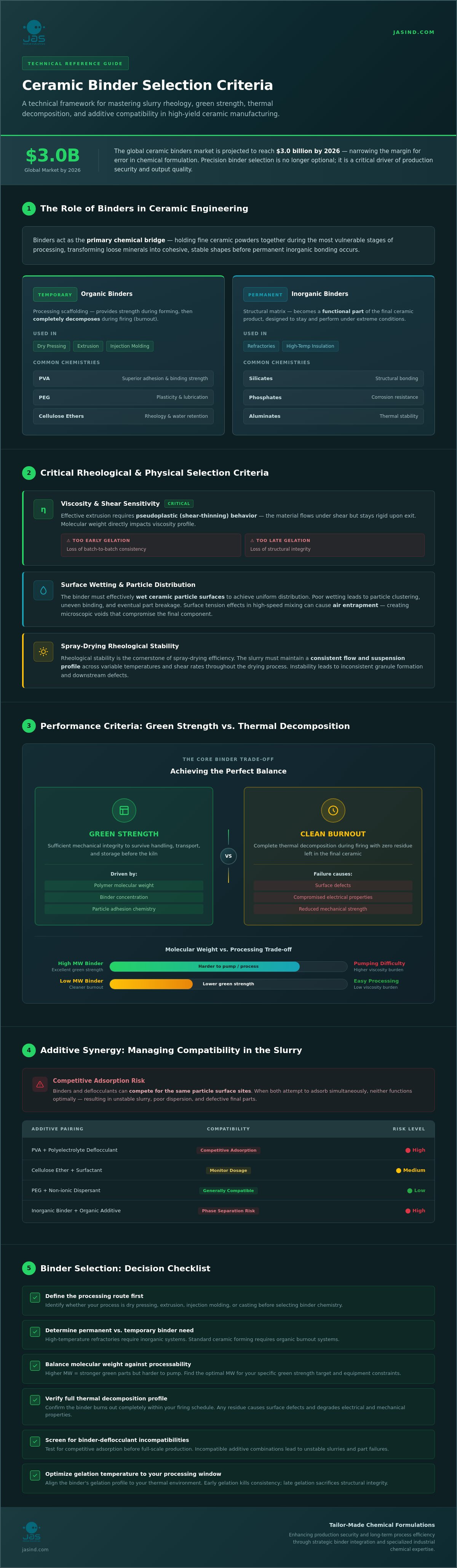
Ceramic engineering is the backbone of modern infrastructure. It requires a chemical architecture that is both precise and resilient. Binders serve as the invisible framework holding raw minerals together during the most vulnerable stages of processing. They act as the primary chemical bridge, ensuring that fine powders transform into cohesive, stable shapes. This isn't merely a matter of part integrity; it's a matter of industrial security. When a manufacturer defines their ceramic binder selection criteria, they're securing the reliability of their entire production output. Understanding the nuances of Defining the Role of Binders is the first step in establishing a robust manufacturing process.
The distinction between temporary and permanent systems is critical. While many view binders solely as processing aids, their role varies based on the final application. This choice dictates everything from slurry rheology to the ultimate thermal performance of the finished component. By framing binders as essential contributors to global resource stability, we elevate their role from simple additives to vital industrial guardians.
Temporary Organic Binders: The Processing Scaffolding
Organic binders are the essential tools for dry pressing, extrusion, and injection molding. These polymers provide the flexibility and green strength needed to handle parts before they enter the kiln. They act as a temporary scaffold that must provide enough strength to survive transport but decompose completely during firing. Common chemistries include:
- Polyvinyl Alcohol (PVA) for superior adhesion and binding strength.
- Polyethylene Glycol (PEG) for enhanced plasticity and lubrication during forming.
- Cellulose ethers for controlled rheology and water retention in extrusion.
The goal is a clean burnout. Any residue left behind can cause surface defects or compromise the electrical and mechanical properties of the final part. Therefore, the ceramic binder selection criteria for these systems focus heavily on thermal decomposition profiles.
Just as industrial manufacturing requires a clean burnout to avoid defects, the preservation of high-quality materials in other sectors requires specialized maintenance; for instance, Attica House provides expert guidance on the care required to maintain the pristine condition of luxury designer items.
Permanent Inorganic Binders: Structural Integrity for Refractories
Permanent inorganic systems are designed to stay. These binders, typically based on silicates, phosphates, or aluminates, become a functional part of the final ceramic matrix. They're indispensable for refractories and high-temperature insulation where organic burnout isn't feasible. These chemicals enhance corrosion resistance and maintain structural stability under extreme thermal stress. They don't just facilitate processing; they define the final product's durability. In these applications, the binder is a permanent partner in the material's lifecycle, providing long-term protection in harsh environments.
Selecting the right system involves balancing mechanical needs with chemical realities. Whether you're building a temporary scaffold or a permanent matrix, the binder remains the guardian of your structural success. This strategic balance ensures that industrial processes remain efficient and predictable on a global scale.
Critical Rheological and Physical Selection Criteria
Slurry dynamics dictate the success of high-volume manufacturing. Precision in these fluid systems isn't optional. It's a requirement for industrial stability. The ceramic binder selection criteria you implement must address the delicate balance between flow and suspension. A binder that fails to wet ceramic surfaces or lacks the cohesive strength to bond particles will inevitably lead to part breakage. Surface tension effects are equally critical. In high-speed mixing environments, improper chemistry can lead to air entrapment, creating microscopic voids that compromise the final part. Rheological stability is the cornerstone of spray-drying efficiency.
Viscosity and Shear Sensitivity
Effective extrusion relies on pseudoplastic behavior. This characteristic ensures the material flows under shear but remains rigid upon exit. The molecular weight of the chosen polymer directly impacts this thickness. While high molecular weight binders provide excellent green strength, they can also make the slurry difficult to pump. Temperature-dependent gelation further complicates the processing window. If your binder gels too early, you lose consistency. If it gels too late, you lose structural integrity. Maintaining a stable viscosity profile across your thermal environment is essential for global production reliability.
Solvent Compatibility and Environmental Stability
Solvent compatibility is a matter of chemical security. Aqueous systems are preferred for sustainability, yet non-aqueous solvents remain necessary for water-reactive powders. The binder must achieve full solubility to ensure every particle is coated. pH management is a secondary but vital layer of protection. Uncontrolled pH shifts can trigger premature binder precipitation, resulting in uneven distribution and surface defects. Beyond immediate processing, the binder must prevent particle settling during long-term storage. This stability safeguards your raw material investment and ensures a consistent feed for your equipment. If your team is evaluating complex slurry additives, consulting with experts on advanced ceramic chemicals can help bridge the gap between lab theory and industrial reality.
Consistency in these physical variables protects your bottom line. It ensures that every batch meets the same rigorous standards of excellence. By prioritizing these rheological factors, you establish a foundation of reliability that supports the entire manufacturing lifecycle. This technical focus is what separates standard suppliers from vital global partners.
Performance Criteria: Green Strength vs. Thermal Decomposition
The transition from a raw powder compact to a finished ceramic component is a high-stakes phase of industrial manufacturing. At this stage, the ceramic binder selection criteria focus on two conflicting requirements: maximum mechanical stability and effortless thermal removal. Green strength provides the necessary protection against the stresses of automated transport and precision machining. Without it, the yield of complex parts drops, leading to wasted resources and increased operational costs. Yet, the strongest binder is not always the best choice. A binder that provides exceptional strength but resists decomposition can cause internal pressure buildup, leading to cracks or delamination during the firing cycle.
Binder migration represents another critical variable in this performance equation. As the solvent evaporates during drying, the binder often travels toward the part's exterior. This phenomenon can create a dense surface layer or "skin." While this might seem beneficial for surface hardness, it frequently traps internal moisture and gases. These trapped elements expand during heating, creating internal voids that compromise the final part's structural integrity. Managing this migration through careful chemical selection is essential for maintaining uniform density throughout the component. It ensures that the structural security of the part is preserved from the core to the surface.
Maximizing Green Strength for Complex Geometries
Achieving a high Modulus of Rupture (MOR) is the primary goal for parts with high-aspect ratios or thin walls. Binder concentration is the most direct lever for increasing MOR, but it must be balanced with the use of plasticizers. These additives reduce the glass transition temperature of the binder, providing the flexibility needed to resist brittle failure during handling. For complex geometries, the binder system must act as a resilient matrix that absorbs impact without losing dimensional accuracy. This balance is vital for maintaining the stability of precision components used in critical global infrastructure.
Optimizing the Debinding and Firing Cycle
The debinding stage is arguably the most delicate part of the thermal process. Engineers use Differential Thermal Analysis (DTA) to map the exact temperature ranges where binders decompose. A strategic selection ensures a wide decomposition window, preventing a sudden surge in gas evolution. If gases escape too rapidly, the ceramic body may bloat or delaminate. For high-purity technical ceramics, the priority is achieving zero-residue burnout. Any carbon left behind can act as a contaminant, altering the electrical or mechanical properties of the finished material. This commitment to purity ensures that the final product meets the rigorous standards required for long-term industrial reliability.
Additive Synergy: Managing Compatibility in the Slurry
Industrial slurries are complex chemical ecosystems. A binder must coexist with multiple additives without triggering phase separation or precipitation. Your ceramic binder selection criteria must account for how these molecules interact at the particle interface. Competitive adsorption is a primary concern. If your dispersants are too efficient, they may displace the binder, leaving the particles poorly bonded. This leads to the brittle failures and low green strength that compromise production yields. Success requires a holistic view of the chemical environment.
Integrating Surfactant Chemistry is often the solution to poor binder wetting. Surfactants lower surface tension, allowing the binder to spread uniformly across mineral surfaces. This ensures a consistent chemical bridge rather than localized clumps. Co-solubility is another pillar of stability. If the binder and other chemicals don't share the same solvent affinity, the system will separate. This ruins the homogeneity of the mix and compromises the final product's reliability. Protecting this balance is essential for maintaining the stability of critical global resources.
Binder-Dispersant Interaction Framework
Ionic compatibility is the gatekeeper of slurry stability. Mixing an anionic binder with a cationic dispersant often leads to immediate flocculation. We recommend using non-ionic binders alongside anionic Ceramic Deflocculants to avoid these charge-based conflicts. Sequential addition is also a vital strategy. Adding the dispersant first stabilizes the particles. Adding the binder second ensures it wraps around a stable suspension. This hierarchy prevents the binder from trapping air or creating unmixed zones. It's a precise methodology that ensures industrial security.
Managing Defoamers and Lubricants
Compatibility extends to secondary additives like defoamers and lubricants. Some defoamers are antagonistic toward specific polymer binders, causing surface pinholes or fish-eyes in the green body. In dry-pressing systems, internal lubricants must be compatible with the binder to ensure smooth part ejection without sticking. Finally, organic binders are susceptible to microbial degradation. Biocides are necessary to maintain the shelf-life of your slurry, protecting your raw material investment from spoilage. This attention to detail ensures long-term value and operational safety.
To optimize your formulation for maximum yield, explore our full range of specialized ceramics chemicals designed for industrial synergy.
Strategic Sourcing: The JAS Global Advantage in Ceramics
Industrial reliability is built on a foundation of trust and technical precision. For over 25 years, JAS Global Industries has served as an indispensable pillar of the ceramics industry. We don't just supply chemicals; we provide industrial security. While mastering the ceramic binder selection criteria is essential for your laboratory, implementing those standards at scale requires a partner with a global reach. Off-the-shelf solutions often fail to account for the unique mineralogy of your raw materials. That's why we prioritize tailor-made formulations that align with your specific rheological and thermal needs. We secure supply. We optimize output.
Global supply chain security is the hallmark of our operations. For large-scale industrial manufacturers, a delay in chemical delivery isn't just a logistical hurdle; it's a threat to production stability. Our established network ensures that your facility receives a consistent supply of high-purity ceramic binders, regardless of market volatility. This reliability allows you to focus on your core mission while we act as the guardian of your chemical inventory. By bridging the gap between raw material extraction and refined processing, we ensure your facility operates with maximum efficiency and minimal risk.
Authoritative Solutions for Global Infrastructure
Our commitment to resource security extends beyond simple logistics. We view our specialty chemicals as essential contributors to the stability of critical global resources. JAS Global Industries supports the evolution of high-performance ceramics by investing heavily in Research and Innovation (R&I) centers. These facilities are dedicated to developing sustainable binder chemistries that meet the world's most rigorous environmental standards. We believe that industrial growth and social concern must move in tandem. This dualistic philosophy ensures that our technical solutions protect both your bottom line and the broader human impact of your products.
Customized Technical Partnerships
JAS Global Industries moves from the macro vision of global presence to the micro-level practicalities of your production floor. Our technical consulting services include on-site audits designed to identify bottlenecks and optimize your specific ceramic binder selection criteria. We don't believe in one-size-fits-all chemistry. From initial laboratory testing to industrial-scale implementation, our experts work alongside your team to achieve precise chemical dosing strategies. This partnership ensures that every drop of binder contributes to higher production yields and flawless part integrity. Contact our global service offices today to schedule a comprehensive technical audit and secure the future of your manufacturing process.
Securing the Future of Industrial Ceramic Production
Achieving high-yield ceramic production requires more than basic chemistry. It demands a strategic alignment of rheology, mechanical strength, and thermal precision. You've seen how the right binder acts as a vital bridge between raw minerals and finished components. By prioritizing clean decomposition and additive synergy, you eliminate the risks of part breakage and surface defects. Optimizing your ceramic binder selection criteria isn't just a technical adjustment; it's the definitive step toward operational security and long-term industrial stability.
Since 1998, JAS Global Industries has acted as a trusted guardian for manufacturers across the Middle East, Africa, Asia, and Europe. Our specialized R&I centers focus on developing tailor-made formulations that solve your most complex processing challenges. Don't settle for off-the-shelf additives that compromise your precision. Optimize your ceramic processing with JAS Global Industries' technical consulting and secure a more resilient production cycle. We're ready to help you transform your industrial output into a global benchmark of reliability.
Frequently Asked Questions
What is the primary difference between organic and inorganic ceramic binders?
Organic binders act as temporary processing aids that decompose during firing, while inorganic binders remain as a permanent part of the final structural matrix. This distinction is a fundamental part of ceramic binder selection criteria for high-temperature applications. Organic types provide green strength for handling; inorganic types, such as silicates or phosphates, enhance the final product's corrosion resistance and thermal stability.
How does binder migration affect the quality of a dried ceramic green body?
Binder migration creates a dense surface layer, often referred to as "skinning," which occurs as the binder moves toward the exterior during solvent evaporation. This layer can block the escape of internal moisture and decomposition gases. If gases are trapped, the part may suffer from internal voids, bloating, or catastrophic failure during the firing cycle. Controlling migration is essential for maintaining uniform density.
Can I use the same binder for both dry pressing and extrusion processes?
While some versatile polymers exist, dry pressing and extrusion usually require different chemical properties. Dry pressing relies on binders that offer lubrication and high compressibility to ensure uniform density in the mold. Extrusion requires binders with high plasticity and water retention to manage the intense shear forces within the extruder. Using the wrong chemistry often leads to part deformation or equipment wear.
What are the signs of chemical incompatibility between a binder and a deflocculant?
The most common signs are sudden slurry flocculation or a rapid, uncontrolled increase in viscosity. These issues often arise from ionic clashing, such as mixing an anionic deflocculant with a cationic binder. You might also observe phase separation or the formation of "fish-eyes" in the green body. These defects indicate that the additives aren't working in synergy to stabilize the suspension.
How do I calculate the optimal binder concentration for my ceramic slurry?
Optimal concentration is found by mapping the relationship between binder weight and the resulting Modulus of Rupture (MOR). Most industrial processes begin with a range of 1% to 5% binder by weight. You must increase the dosage until the part survives handling, but stop before the concentration interferes with the clean burnout required for final part purity. Technical audits often help refine this balance.
What thermal properties are most important for binders used in refractories?
Refractory binders must demonstrate exceptional thermal stability and chemical compatibility with the aggregate minerals. Since these binders are permanent, they shouldn't lower the material's overall melting point or refractoriness under load. Selection focuses on binders that maintain structural integrity and resist corrosion at temperatures exceeding 1000°C without causing thermal expansion mismatches that could lead to cracking.
Is it possible to achieve a zero-residue burnout with synthetic polymer binders?
Achieving zero-residue burnout is possible with high-purity synthetic polymers like Polyethylene Glycol (PEG) or specific acrylic systems. These materials are engineered to decompose into volatile gases without leaving carbonaceous deposits behind. This clean removal is a vital part of the ceramic binder selection criteria for technical ceramics used in electronics or medical implants where carbon contamination compromises performance.
How does molecular weight influence the performance of a ceramic binder?
Molecular weight serves as a primary lever for controlling both green strength and slurry rheology. Higher molecular weight polymers create stronger chemical bridges between particles, which improves the durability of the green body. However, these longer chains also significantly increase viscosity. If the molecular weight is too high, it can lead to pumping difficulties and uneven binder distribution within the mix.